

Swahili live captions and productivity tool for phone & video calls
For deaf and hard of hearing people.
Download for free


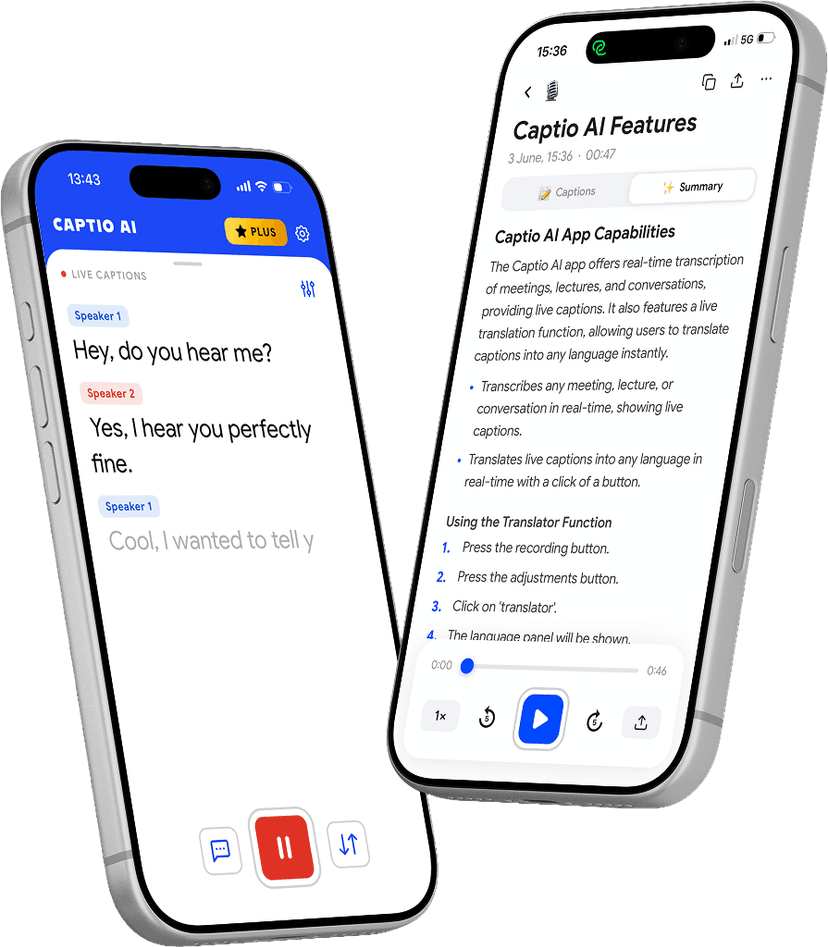
Everything you need to follow Swahili phone & video calls
Four tools built for deaf and hard of hearing Swahili speakers.
Follow the call in real time
- Captions appear word by word as the other person speaks
- Works on any call — no app integration required
- Put the call on speaker and point the microphone toward it
- Handles compressed call audio accurately
International and foreign-language calls
- They speak their language — you read in yours
- Translates in real time as they speak
- 60+ languages, no setup
- For family abroad, international business, or travel
Transcribe any call recording
- Record the call and upload for a complete written transcript
- Review instructions, information, and decisions after
- Organised by speaker
- Works on any call recording
Key information extracted from any call
- Important points pulled from any call transcript
- Useful for medical calls, customer service, and work calls
- Organised into clear sections
- Works on any saved recording
Download for free
Every situation covered
Designed for the real moments that matter — not just quiet controlled environments.
A WhatsApp call home to a relative in Mombasa or a catch-up with family in Nairobi. Fast casual Swahili, family shorthand, and prenasalized consonants that blur over a phone line. Captio AI captions everything said.
A team meeting run in Swahili from a Nairobi office or an online call with Tanzanian colleagues. Business Swahili mixes formal vocabulary with English terms. Captio AI keeps pace with both.
A callback from Kenyatta National Hospital in Nairobi or a NHIF query in Swahili. Medical calls use formal Swahili at speed. Captio AI shows the full message in text as it's spoken.
An M-Pesa customer service line, an Equity Bank IVR menu, or a Safaricom automated prompt in Swahili. Automated menus give you one chance. Captio AI shows each option before the timeout.
A call from the Swahili-speaking diaspora in Germany, the UK, or the Gulf. Diaspora Swahili carries foreign-language influence on rhythm and vocabulary. Captio AI handles it.
A WhatsApp video call with relatives in Zanzibar or a Google Meet with a Tanzanian team. All video call apps work the same way — put the call on speaker, open Captio AI, read the captions.
Most accurate and fastest models
word accuracy
independent benchmark, 2025
real-time captions
first word appears as you speak
Download for free
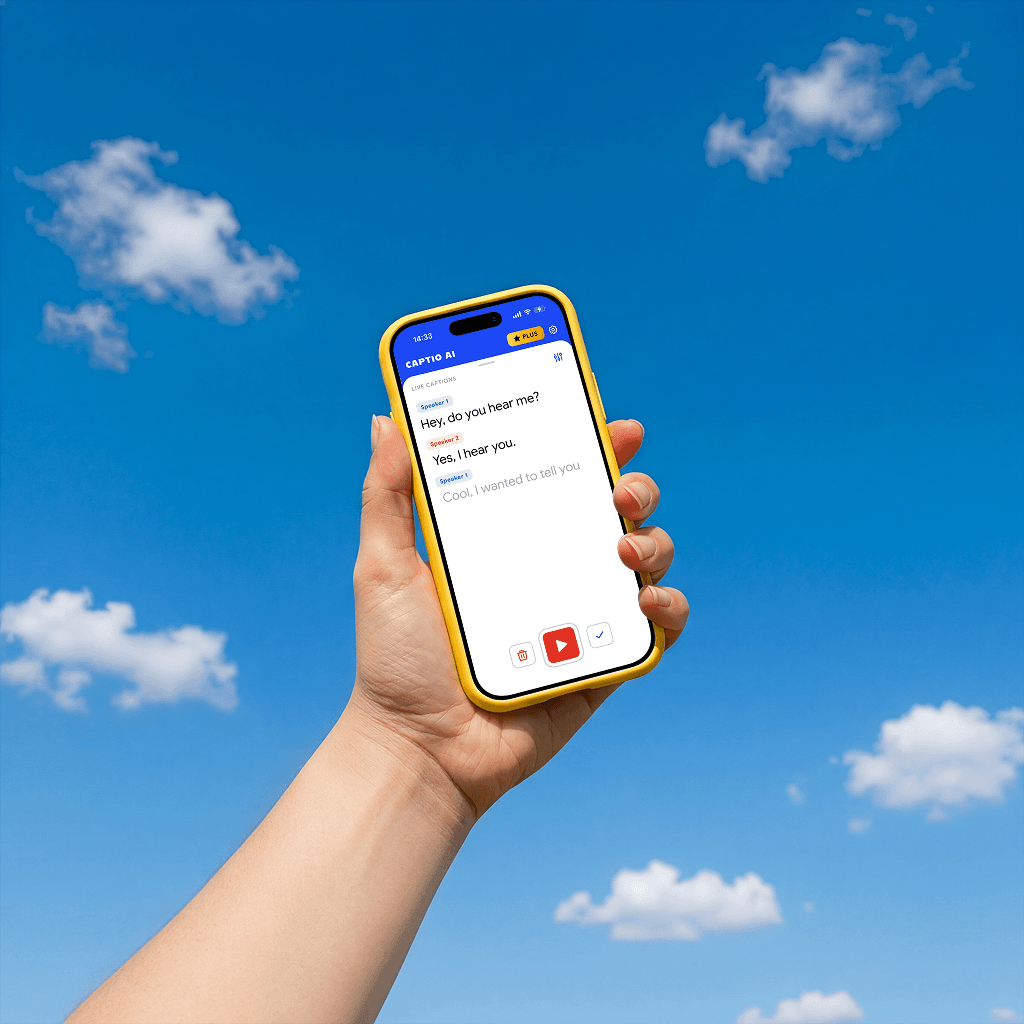
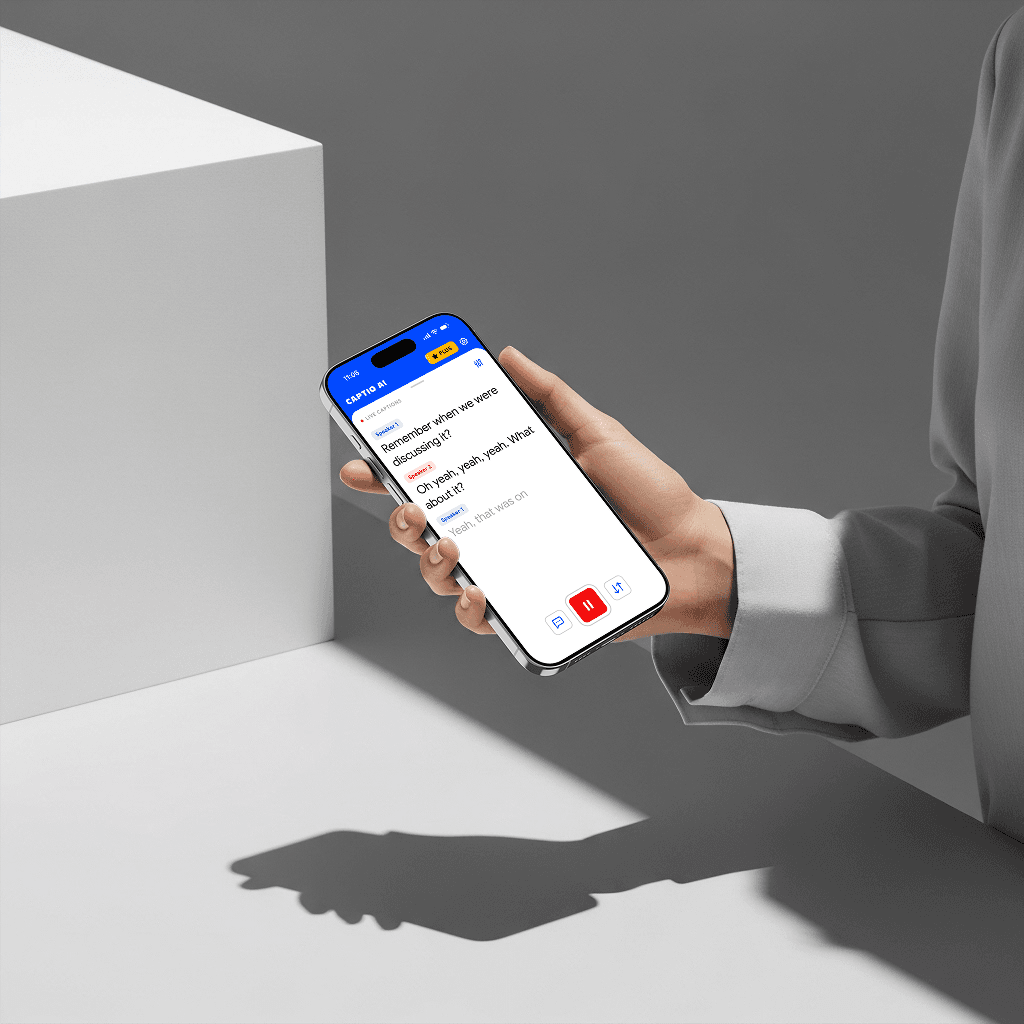
Built for the calls you have been avoiding
Captions as they speak
Words appear on screen word by word while the other person is still talking. You read what they say at the same pace everyone else hears it — no delay, no reconstruction.
Works on any call app
Captio AI does not need to integrate with any platform. Put the call on speaker, point the microphone toward the audio, and read the captions. It works the same way for any app on any device.
No more asking for repeats
Every word is on screen as it is said. If you missed something, glance at the caption rather than interrupting the call — the full sentence is there.
Handles call audio accurately
Compressed phone audio is less clean than in-person speech. Captio AI is built for real-world audio conditions, including the reduced quality of standard phone and VoIP calls.
Any language
For calls with family abroad, international colleagues, or foreign-language customer service. Live Translator captions and translates in real time with no manual setup.
Record and review after
Record any call and upload it to Audio Transcription. Get a full written record of everything said — useful for medical instructions, work decisions, and anything worth having in writing.
Why Swahili is hard to understand
Prenasalized consonants
- Swahili's most common consonants start with a hidden nasal
- Swahili prenasalized stops (mb-, nd-, nj-, ng'-) begin with a nasal closure before releasing. On a phone call, this initial nasal component is inaudible and the lip closure looks identical to /b/, /d/, /j/ — creating ambiguity across core vocabulary: mbwa (dog), ndio (yes), njia (path). These are not rare sounds — they appear in the most common Swahili words.
Coastal speech speed
- Mombasa and Zanzibar Swahili is spoken significantly faster
- Coastal Swahili — spoken in Mombasa, Zanzibar, and Lamu — is spoken at a much faster pace than the standard Swahili heard in broadcasting, with vowel elision between words. A deaf caller used to measured standard Swahili will struggle to follow a fast coastal market call or a WhatsApp voice note from a Mombasa relative.
Sheng code-switching
- Nairobi Sheng rewrites words mid-call
- Sheng — the urban argot of Nairobi that blends Swahili, English, Kikuyu, and other languages — is widely used by younger Kenyan speakers on phone calls. Words shift meaning and phonological shape rapidly, and Sheng vocabulary does not map to any single phonological system. A deaf caller tracking Swahili word shapes faces a continuously moving target.
Final vowel uniformity
- Word boundaries blur into a stream of vowels
- Swahili words nearly universally end in a vowel, removing the consonant variation that helps lip readers identify word boundaries in other languages. In connected speech, utterances can flow as a single unbroken vowel stream, and without the pitch and stress cues that hearing listeners use for segmentation, boundary identification becomes very difficult.
Swahili-English register shift
- Professional calls switch languages mid-sentence
- Business and professional Swahili calls in Nairobi and Dar es Salaam switch between Swahili and English within single sentences, especially for technical, financial, or formal vocabulary. The phonological system shifts abruptly with each language switch, requiring the deaf caller to track two separate systems simultaneously.
Download for free
Over 150,000 deaf Kenyans, and a phone system built around hearing
Kenya's 2019 national census counted 153,381 deaf people aged five and above — the majority (129,518) living in rural areas where healthcare, interpreter access, and assistive technology are least available. WHO projections indicate the hearing loss burden across sub-Saharan Africa will rise to 54 million by 2030, among the fastest-growing rates globally, driven by insufficient newborn screening, noise exposure, and limited audiological care.
Kenya's 2010 Constitution formally recognised Kenyan Sign Language (KSL) as the country's third official language — a landmark policy step. Tanzania has taken similar steps for Tanzanian Sign Language in broadcast contexts. Despite these achievements, KSL interpreters remain concentrated in Nairobi, and there is no national relay telephone service available through Safaricom, Airtel, or VoIP platforms. A deaf person in Kisumu, Mtwapa, or Nakuru who receives a bank callback or hospital appointment call has no practical real-time access option on their mobile phone.
Captio AI is built for exactly those calls: the M-Pesa customer service menu, the hospital callback from Kenyatta, the WhatsApp family call from Zanzibar. Point the phone at the speaker, open Captio AI, and read every Swahili word — including prenasalized consonants and fast coastal speech — in real time.
Download for free
What you hear stays with you.
Gone the moment it ends
Captio AI processes your audio in real time and discards it immediately. Nothing is recorded. Nothing is kept.
Not a product
Your conversations are not something Captio AI sells, shares, or monetizes — to anyone, for any reason.
Not used to train anything
What you say in a doctor's appointment or a job interview never ends up in a training dataset. Not ours. Not anyone else's.

Private by default
Captio AI supports 60+ languages
Download for free
Frequently asked questions
Follow every call in Swahili.
Captio AI is free to start
Download for free