

Russian live captions and productivity tool for phone & video calls
For deaf and hard of hearing people.
Download for free


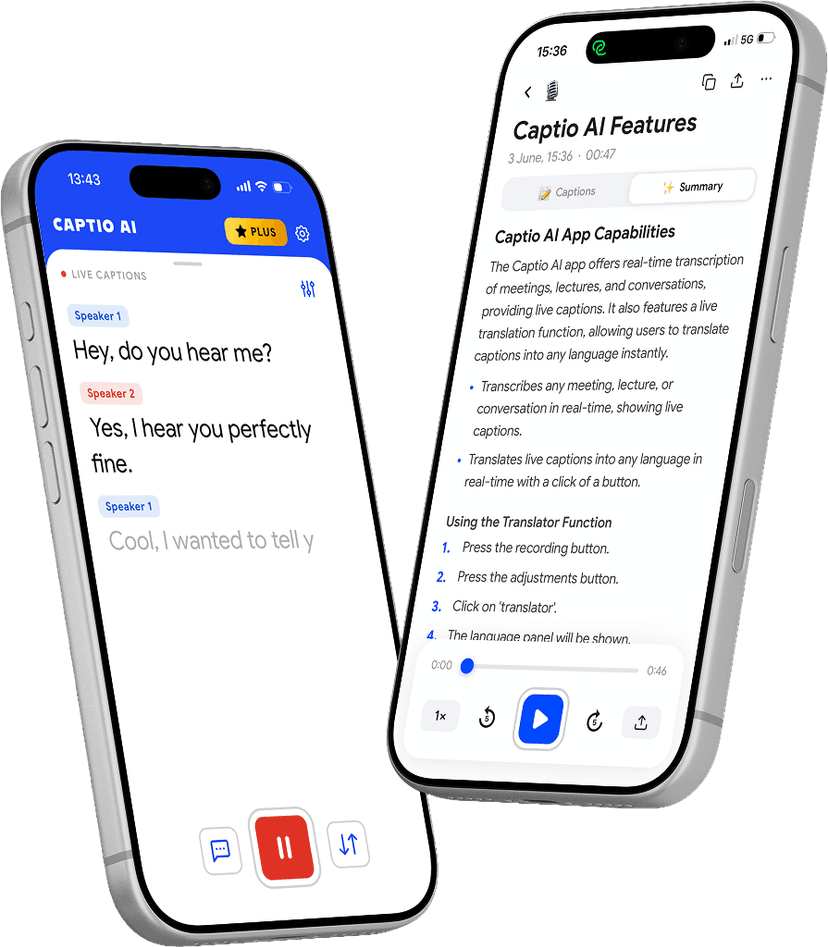
Everything you need to follow Russian phone & video calls
Four tools built for deaf and hard of hearing Russian speakers.
Follow the call in real time
- Captions appear word by word as the other person speaks
- Works on any call — no app integration required
- Put the call on speaker and point the microphone toward it
- Handles compressed call audio accurately
International and foreign-language calls
- They speak their language — you read in yours
- Translates in real time as they speak
- 60+ languages, no setup
- For family abroad, international business, or travel
Transcribe any call recording
- Record the call and upload for a complete written transcript
- Review instructions, information, and decisions after
- Organised by speaker
- Works on any call recording
Key information extracted from any call
- Important points pulled from any call transcript
- Useful for medical calls, customer service, and work calls
- Organised into clear sections
- Works on any saved recording
Download for free
Every situation covered
Designed for the real moments that matter — not just quiet controlled environments.
Papa calling from another city, babushka from her region, friends calling from Moscow. Russian family calls are long, fast, and full of informal reductions that no textbook ever covers.
Quick status updates, logistics checks, client negotiations, team check-ins. Russian office culture runs on voice calls — decisions happen fast in informal registers.
Polyclinic callbacks, test results by phone, pharmacy queries. Russian healthcare relies heavily on telephone contact between staff and patients — a missed medication instruction or appointment time has direct consequences.
Sberbank automated menus, Gazprom Mezhregiongaz helplines, MTS telecom customer service. Russian IVR systems are fast, formal, and expect quick verbal or keypad responses.
A call from family in Ukraine, Kazakhstan, or the Baltics. Russian spoken by diaspora communities carries substrate influences and accent variations on top of international call compression.
Telegram Video, WhatsApp calls, Zoom. Even with video on, following fast informal Russian with frequent reductions is cognitively exhausting. Captions remove that effort.
Most accurate and fastest models
word accuracy
independent benchmark, 2025
real-time captions
first word appears as you speak
Download for free
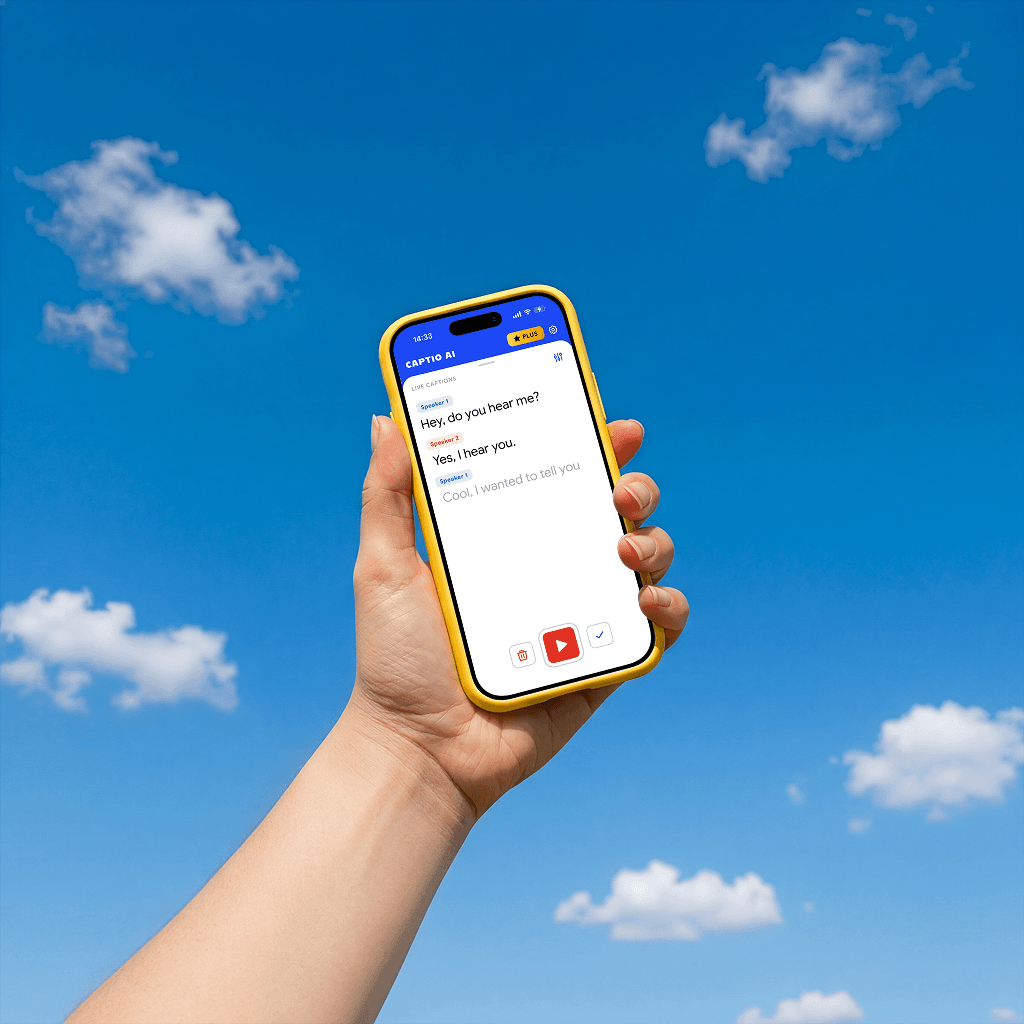
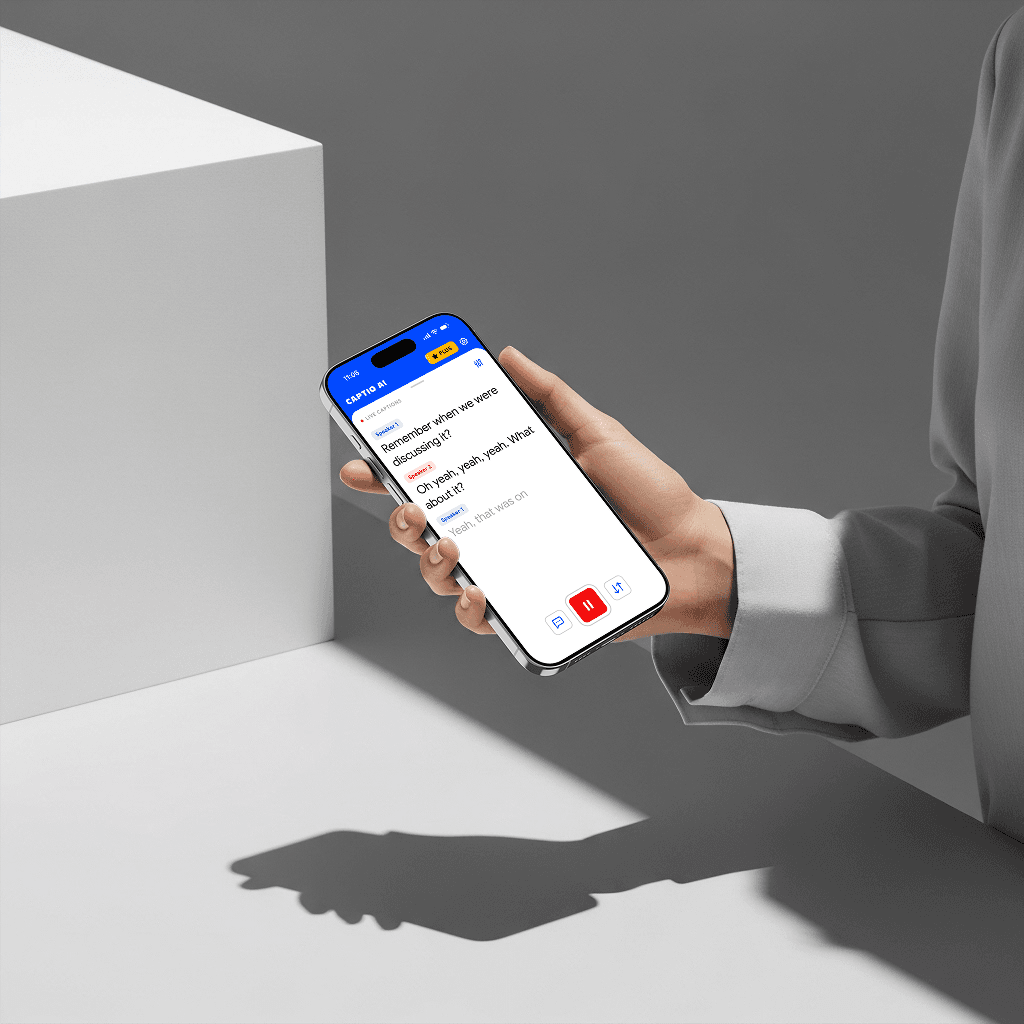
Built for the calls you have been avoiding
Captions as they speak
Words appear on screen word by word while the other person is still talking. You read what they say at the same pace everyone else hears it — no delay, no reconstruction.
Works on any call app
Captio AI does not need to integrate with any platform. Put the call on speaker, point the microphone toward the audio, and read the captions. It works the same way for any app on any device.
No more asking for repeats
Every word is on screen as it is said. If you missed something, glance at the caption rather than interrupting the call — the full sentence is there.
Handles call audio accurately
Compressed phone audio is less clean than in-person speech. Captio AI is built for real-world audio conditions, including the reduced quality of standard phone and VoIP calls.
Any language
For calls with family abroad, international colleagues, or foreign-language customer service. Live Translator captions and translates in real time with no manual setup.
Record and review after
Record any call and upload it to Audio Transcription. Get a full written record of everything said — useful for medical instructions, work decisions, and anything worth having in writing.
Why Russian is hard to understand
Palatalization pairs
- Russian has 36 consonants — half with an invisible soft/hard distinction
- Russian has a hard/soft (palatalized) distinction for most consonants: /t/ vs /tʲ/, /n/ vs /nʲ/, /s/ vs /sʲ/. Palatalization is entirely acoustic — invisible on the lips. On a phone call, these minimal pairs are the primary source of word-level ambiguity, and the palatalization cue is the first feature to degrade in compressed audio.
Akan'e vowel reduction
- Unstressed Russian vowels collapse into different sounds
- In Russian speech, unstressed vowels reduce: the /o/ in unstressed position sounds like /a/ (akan'e), and unstressed /e/ and /a/ converge on /ɪ/. 'Молоко' (milk) sounds closer to 'malako'. For a deaf caller expecting full vowels from formal contexts, reduced vowels on a casual phone call make familiar words unrecognisable.
Consonant clusters
- Russian words begin and end with dense consonant groups
- 'Встреча' (meeting) starts with three consonants; 'взгляд' (glance) starts with four. Phone compression blurs the transitions within clusters, making word boundaries and individual phonemes harder to detect. Cluster-initial words are particularly difficult to anchor as a call begins.
Regional dialect shift
- Moscow, St Petersburg, and Siberian Russian sound different
- St. Petersburg Russian differs from Moscow Russian in vowel quality and vocabulary. Siberian and Southern Russian speech have different akan'e patterns and consonant realisations. On a phone call, a deaf person calibrated by residual hearing to Moscow speech faces a shifted phonological system from a caller in Novosibirsk.
Fast informal reductions
- Casual spoken Russian shortens familiar words radically
- 'Сейчас' (now) becomes 'щас', 'человек' (person) is often clipped, numbers and greetings are reduced. Work calls between colleagues move fast and informally. The formal vocabulary of official speech is rarely heard on a phone call between people who know each other.
Download for free
Nine million Russians with disabling hearing loss — most unaided
The Global Burden of Disease Study 2019 estimates approximately 9 million Russians aged 15 and older live with disabling hearing loss. This contrasts sharply with Russia's official healthcare statistics, which recorded only 642,959 adults formally diagnosed with permanent hearing loss in 2021 — a gap that reflects underreporting, lack of population-level hearing screening, and a national census that does not collect information on hearing health. A 2023 study published in PMC found that 22.2% of Russian adults self-reported hearing trouble, but only 2.2% used hearing aids — meaning the overwhelming majority navigate daily phone calls unaided.
Russia has no national telephone relay service for deaf callers. There is no government-operated TTY equivalent, no captioned telephone service, and no legal requirement for phone-based services to offer text alternatives. Russian Sign Language lacks formal legal recognition in federal law. This means a deaf Russian navigating a polyclinic callback, a Sberbank security verification, or a utility helpline faces a phone-only system with no accommodation provision.
Captio AI is built for those calls. Put a polyclinic callback, a Sberbank automated menu, or a Telegram call from family in Siberia on speaker, and read every word in real time.
Download for free
What you hear stays with you.
Gone the moment it ends
Captio AI processes your audio in real time and discards it immediately. Nothing is recorded. Nothing is kept.
Not a product
Your conversations are not something Captio AI sells, shares, or monetizes — to anyone, for any reason.
Not used to train anything
What you say in a doctor's appointment or a job interview never ends up in a training dataset. Not ours. Not anyone else's.

Private by default
Captio AI supports 60+ languages
Download for free
Frequently asked questions
Follow every call in Russian.
Captio AI is free to start
Download for free