

Chinese live captions and productivity tool for phone & video calls
For deaf and hard of hearing people.
Download for free


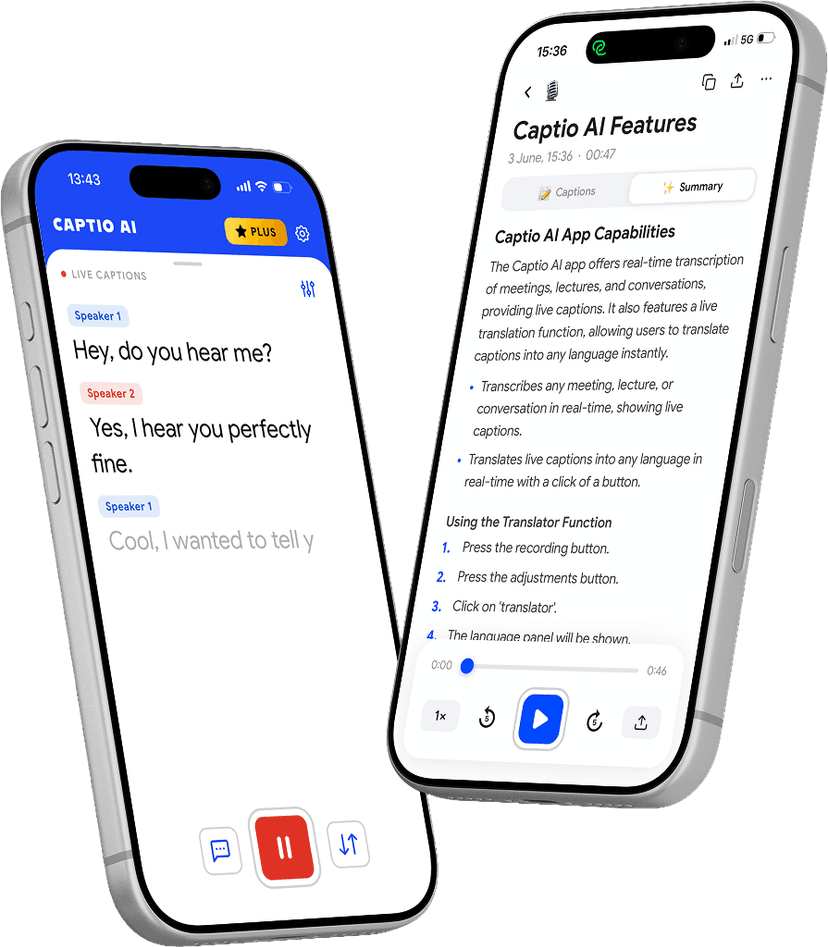
Everything you need to follow Chinese phone & video calls
Four tools built for deaf and hard of hearing Chinese speakers.
Follow the call in real time
- Captions appear word by word as the other person speaks
- Works on any call — no app integration required
- Put the call on speaker and point the microphone toward it
- Handles compressed call audio accurately
International and foreign-language calls
- They speak their language — you read in yours
- Translates in real time as they speak
- 60+ languages, no setup
- For family abroad, international business, or travel
Transcribe any call recording
- Record the call and upload for a complete written transcript
- Review instructions, information, and decisions after
- Organised by speaker
- Works on any call recording
Key information extracted from any call
- Important points pulled from any call transcript
- Useful for medical calls, customer service, and work calls
- Organised into clear sections
- Works on any saved recording
Download for free
Every situation covered
Designed for the real moments that matter — not just quiet controlled environments.
A call from a grandmother in Shandong, a parent from Beijing, a cousin from Chengdu. Chinese family calls cross dialects and generations, each person at their natural pace in their regional variety.
Business calls on WeChat or DingTalk, supplier negotiations, team stand-ups. Chinese professional culture runs heavily on voice calls — dense Mandarin at full professional speed.
Hospital appointment lines, pharmacy queries, GP callbacks. Chinese healthcare relies on telephone for booking and results, especially in tier 2 and 3 cities where digital alternatives are limited.
Bank security verification, State Grid electricity helplines, automated telecom menus. Chinese IVR systems speak fast formal Mandarin and wait seconds for a keyed or spoken response.
A WeChat call from a colleague in Singapore, a business call with a Taiwanese counterpart, family in Malaysia. Mandarin spoken across the Chinese-speaking world carries different accent and vocabulary patterns.
WeChat Video, Tencent Meeting, Zoom with family abroad. Video calls are the default for Chinese families across continents. Even with video, following fast informal Mandarin on a compressed stream is exhausting without captions.
Most accurate and fastest models
character accuracy
independent benchmark, 2025
real-time captions
first word appears as you speak
Download for free


Built for the calls you have been avoiding
Captions as they speak
Words appear on screen word by word while the other person is still talking. You read what they say at the same pace everyone else hears it — no delay, no reconstruction.
Works on any call app
Captio AI does not need to integrate with any platform. Put the call on speaker, point the microphone toward the audio, and read the captions. It works the same way for any app on any device.
No more asking for repeats
Every word is on screen as it is said. If you missed something, glance at the caption rather than interrupting the call — the full sentence is there.
Handles call audio accurately
Compressed phone audio is less clean than in-person speech. Captio AI is built for real-world audio conditions, including the reduced quality of standard phone and VoIP calls.
Any language
For calls with family abroad, international colleagues, or foreign-language customer service. Live Translator captions and translates in real time with no manual setup.
Record and review after
Record any call and upload it to Audio Transcription. Get a full written record of everything said — useful for medical instructions, work decisions, and anything worth having in writing.
Why Chinese is hard to understand
Tonal invisibility
- Mandarin's four tones are entirely acoustic
- Lexical tone in Mandarin is carried purely in pitch (F0). There is no lip movement that signals which tone is being produced. A deaf or hard of hearing caller receives zero visual tonal information. On a phone call, compressed audio degrades the pitch signal further — tone perception relies entirely on context and any residual hearing.
Dialect interference
- Regional accents shift tones in unexpected ways
- A Shanghainese speaker using Mandarin, a Cantonese colleague, or a Sichuanese family member produces tonal interference — tones shifted or realised differently from standard Putonghua. Compressed phone audio makes dialect-shifted tonal patterns harder to distinguish even for experienced listeners.
Erhua and neutral tones
- Beijing Mandarin adds r-colouring and unstressed syllables
- Northern Mandarin features erhua (r-colouring of syllable finals) and frequent neutral/unstressed tones. These create phonetically irregular forms — familiar words sound different from their dictionary form. A Beijing family call produces unexpected acoustic patterns with no visual parallel.
Retroflex confusion
- Zh/ch/sh versus z/c/s — same lips, different sounds
- The retroflex/alveolar contrast (zh vs z, ch vs c, sh vs s) is a key source of minimal pairs in Mandarin. These sounds produce similar lip configurations and are partially masked by phone compression, making pairs like 'zhī' vs 'zī' near-indistinguishable on a compressed call.
Fast casual speed
- Family calls move faster than broadcast Mandarin
- A family call from Chengdu or Wuhan runs at a speed and informality that sounds nothing like slow, clear broadcast Mandarin. Tones compress, syllables reduce, and the pace leaves no time to reconstruct missed words from context.
Download for free
115 million people in China with significant hearing loss
A 2024 provincial-level analysis in the Chinese Medical Journal estimated 115 million people had moderate-to-complete hearing loss in China in 2015, and projects that number will reach 242 million by 2060 — a 110% increase driven by ageing and noise exposure. China's 2006 national disability survey formally registered 27.8 million citizens with hearing disability; by 2021, 38 million disability certificates had been issued across all categories.
Policy has moved slowly. China's first Law on Construction of Barrier-Free Environments was passed in June 2023 — a significant step — but it focuses primarily on physical access and digital accessibility for elderly users. There is no national telephone relay service for deaf callers, no TTY equivalent, and no anti-discrimination provision requiring phone-based services to offer text alternatives. The Congressional-Executive Commission on China noted in December 2023 that China's disability system still lacks effective reasonable accommodation requirements.
Captio AI is built for those calls. Point the phone toward a WeChat call from a grandparent in Shandong or a work call on DingTalk, put it on speaker, and read the captions in real time — tones, dialects, and regional varieties included.
Download for free
What you hear stays with you.
Gone the moment it ends
Captio AI processes your audio in real time and discards it immediately. Nothing is recorded. Nothing is kept.
Not a product
Your conversations are not something Captio AI sells, shares, or monetizes — to anyone, for any reason.
Not used to train anything
What you say in a doctor's appointment or a job interview never ends up in a training dataset. Not ours. Not anyone else's.

Private by default
Captio AI supports 60+ languages
Download for free
Frequently asked questions
Follow every call in Chinese.
Captio AI is free to start
Download for free