

Persian live captions and productivity tool for phone & video calls
For deaf and hard of hearing people.
Download for free


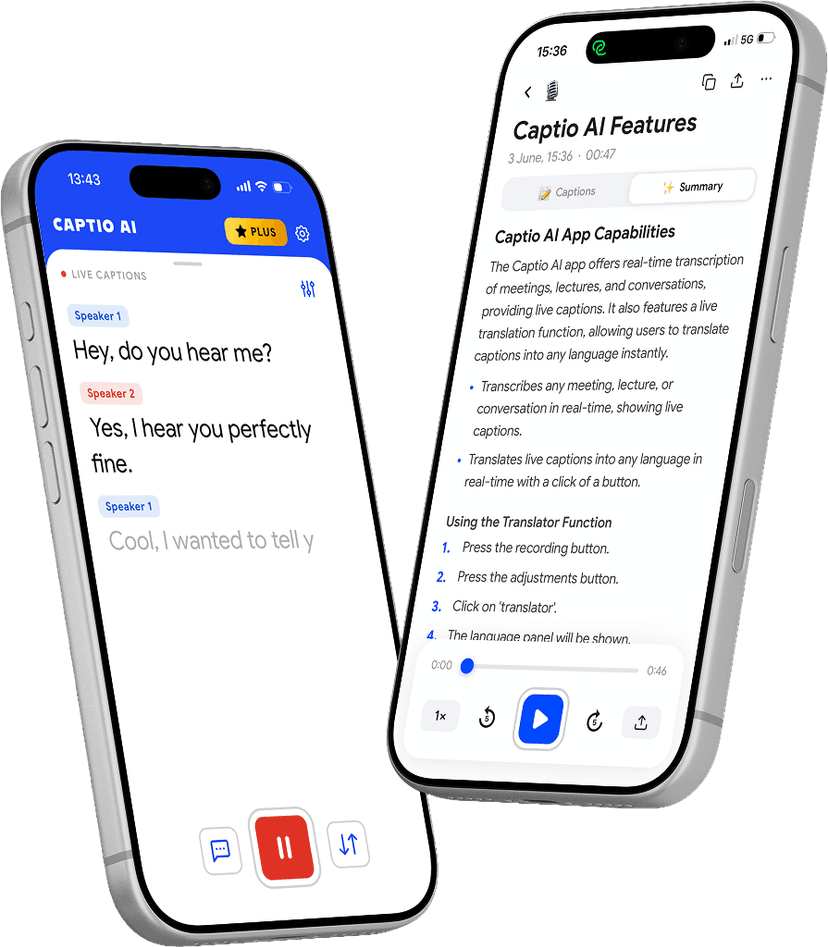
Everything you need to follow Persian phone & video calls
Four tools built for deaf and hard of hearing Persian speakers.
Follow the call in real time
- Captions appear word by word as the other person speaks
- Works on any call — no app integration required
- Put the call on speaker and point the microphone toward it
- Handles compressed call audio accurately
International and foreign-language calls
- They speak their language — you read in yours
- Translates in real time as they speak
- 60+ languages, no setup
- For family abroad, international business, or travel
Transcribe any call recording
- Record the call and upload for a complete written transcript
- Review instructions, information, and decisions after
- Organised by speaker
- Works on any call recording
Key information extracted from any call
- Important points pulled from any call transcript
- Useful for medical calls, customer service, and work calls
- Organised into clear sections
- Works on any saved recording
Download for free
Every situation covered
Designed for the real moments that matter — not just quiet controlled environments.
A call with family in Tehran where multiple relatives speak at once, mixing formal Persian with the fast colloquial dialect of the capital.
A conference call with colleagues in Iran where business terminology flows quickly and participants speak with accents from Isfahan, Shiraz, or Mashhad.
A callback from a clinic in Tehran where the doctor delivers follow-up instructions in formal Persian and moves quickly through the details.
An automated IVR line from Bank Melli or a utility company where the menu is in Standard Persian but the agent switches to a regional variety.
A call from family in the Iranian diaspora who mix Persian with English or the language of their host country in every other sentence.
A WhatsApp or Skype video call with relatives in Iran where connection quality varies and speakers are often partially off-camera.
Most accurate and fastest models
word accuracy
independent benchmark, 2025
real-time captions
first word appears as you speak
Download for free
Built for the calls you have been avoiding
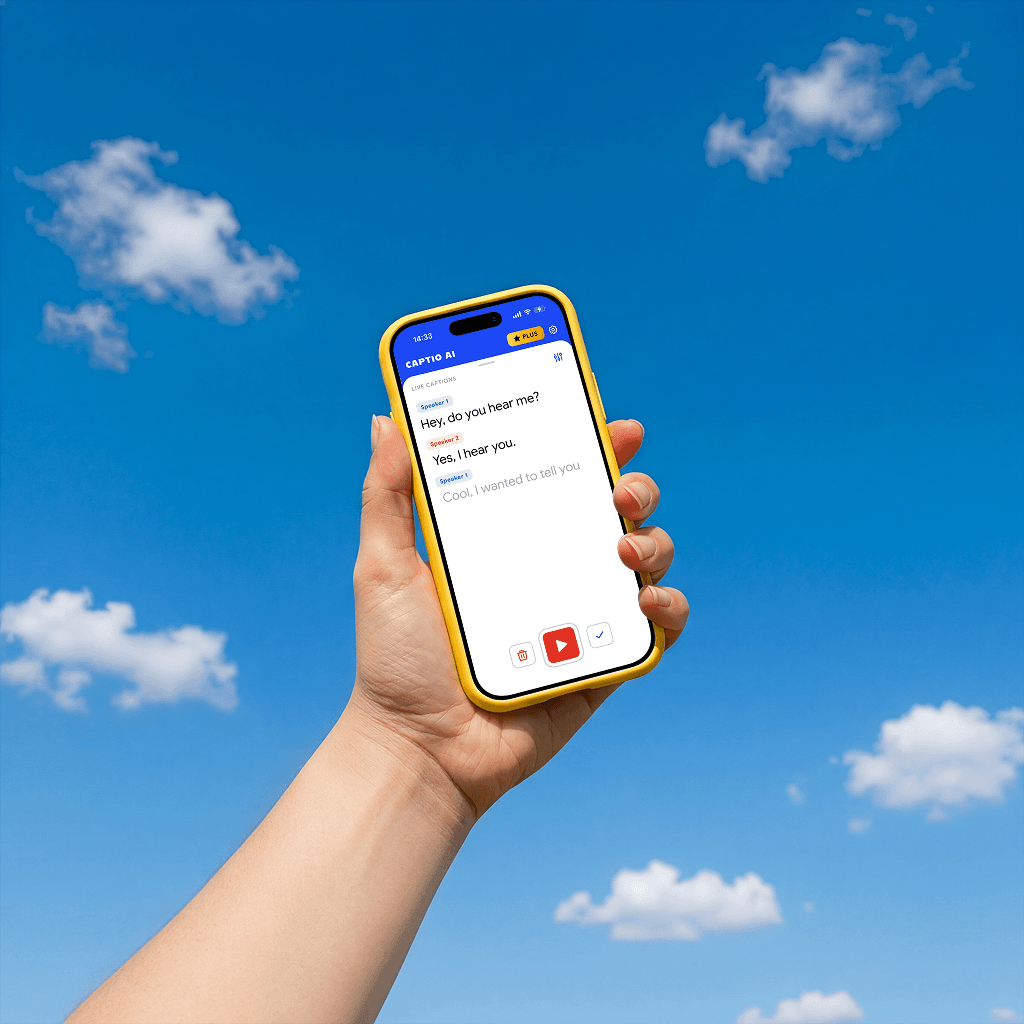
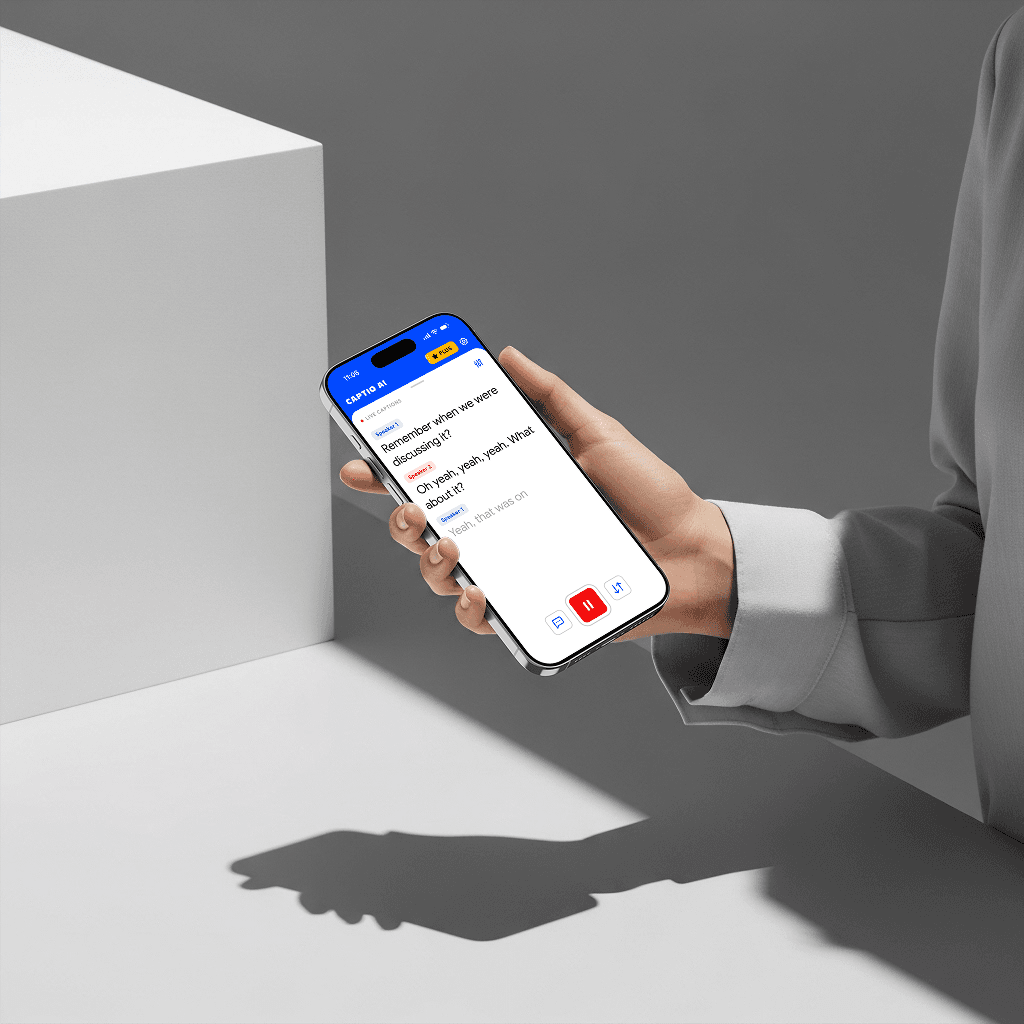
Captions as they speak
Words appear on screen word by word while the other person is still talking. You read what they say at the same pace everyone else hears it — no delay, no reconstruction.
Works on any call app
Captio AI does not need to integrate with any platform. Put the call on speaker, point the microphone toward the audio, and read the captions. It works the same way for any app on any device.
No more asking for repeats
Every word is on screen as it is said. If you missed something, glance at the caption rather than interrupting the call — the full sentence is there.
Handles call audio accurately
Compressed phone audio is less clean than in-person speech. Captio AI is built for real-world audio conditions, including the reduced quality of standard phone and VoIP calls.
Any language
For calls with family abroad, international colleagues, or foreign-language customer service. Live Translator captions and translates in real time with no manual setup.
Record and review after
Record any call and upload it to Audio Transcription. Get a full written record of everything said — useful for medical instructions, work decisions, and anything worth having in writing.
Why Persian is hard to understand
Back-vowel compression
- Three back vowels collapse in fast speech
- Persian distinguishes a, o, and u at the back of the mouth — distinctions that narrow sharply in informal Tehran speech. On a phone or video call, words that a hearing caller separates by vowel quality look identical from the front. A deaf caller watching lips sees the same rear mouth position for sounds that carry different meaning.
Regional vowel systems
- Iranian Persian, Dari, and Tajik diverge in vowel inventory
- A family call connecting Tehran with Kabul or Dushanbe involves two different vowel systems. Iranian Persian, Afghan Dari, and Tajik Persian have diverged in their vowel inventories over centuries. For a deaf caller accustomed to one variety, the other arrives with unfamiliar mouth shapes for the same written words.
Word-final elision
- Final consonants drop in casual Tehran Persian
- In informal Tehran speech, word-final consonants — particularly -n, -d, and -nd endings — are frequently softened or elided. These endings carry grammatical information about tense, number, and case. On a video call in casual register, a deaf caller loses the grammatical layer that those endings provide.
Bilabial similarity
- Persian /p/, /b/, /f/, and /v/ are visually near-identical
- Persian has a cluster of bilabial and labiodental consonants — /p/, /b/, /f/, /v/ — that produce nearly identical lip configurations in fast speech. Whole families of words become visually indistinguishable. A video call running at natural conversational pace collapses these distinctions without audio.
Southern dialect speed
- Shirazi and Kermani Persian run faster than northern standard
- Southern and southeastern Persian dialects — Shirazi, Kermani, Yazdi — are characteristically faster in conversational register than Standard Persian. A video call from Shiraz sounds phonologically different from one from Isfahan or Tehran: faster pace, different vowel realizations, and local vocabulary a deaf caller may have no schema for.
Download for free
Hearing loss is Iran's most prevalent registered disability — affecting millions of Persian speakers
Hearing loss is Iran's most prevalent registered disability. A population-based study in southwest Iran found sensorineural hearing loss linked strongly to socioeconomic status, with lower-income households experiencing significantly higher rates. National surveillance data place the rate of congenital deafness and hearing impairment at 2.6 per 1,000 live births — ranging from 0.9 to 5.8 per 1,000 depending on province, with higher rates in regions where consanguineous marriage is common. A Tehran-based prevalence study across 6,521 individuals found an overall hearing impairment rate of 14.27%, with 0.48% identifying as deaf.
Iran has a national programme for ear and hearing care under the Ministry of Health and Medical Education, with a stated goal of universal neonatal hearing screening. Despite this framework, access to audiological services and hearing assistive technology remains uneven across provinces. Deaf and hard-of-hearing university students in Iran have described the persistent burden of navigating Persian as a spoken majority language — lip-reading a language with complex back vowels and dialectally varied phonology — in academic and professional settings where interpreting support is absent or inconsistent.
Captio AI captions every Persian call in real time — so whether a relative is calling from Mashhad, Shiraz, or Isfahan, their words appear on screen the moment they say them, without the caller needing to slow down or repeat themselves.
Download for free
What you hear stays with you.
Gone the moment it ends
Captio AI processes your audio in real time and discards it immediately. Nothing is recorded. Nothing is kept.
Not a product
Your conversations are not something Captio AI sells, shares, or monetizes — to anyone, for any reason.
Not used to train anything
What you say in a doctor's appointment or a job interview never ends up in a training dataset. Not ours. Not anyone else's.

Private by default
Captio AI supports 60+ languages
Download for free
Frequently asked questions
Follow every call in Persian.
Captio AI is free to start
Download for free