

Arabic live captions and productivity tool for phone & video calls
For deaf and hard of hearing people.
Download for free


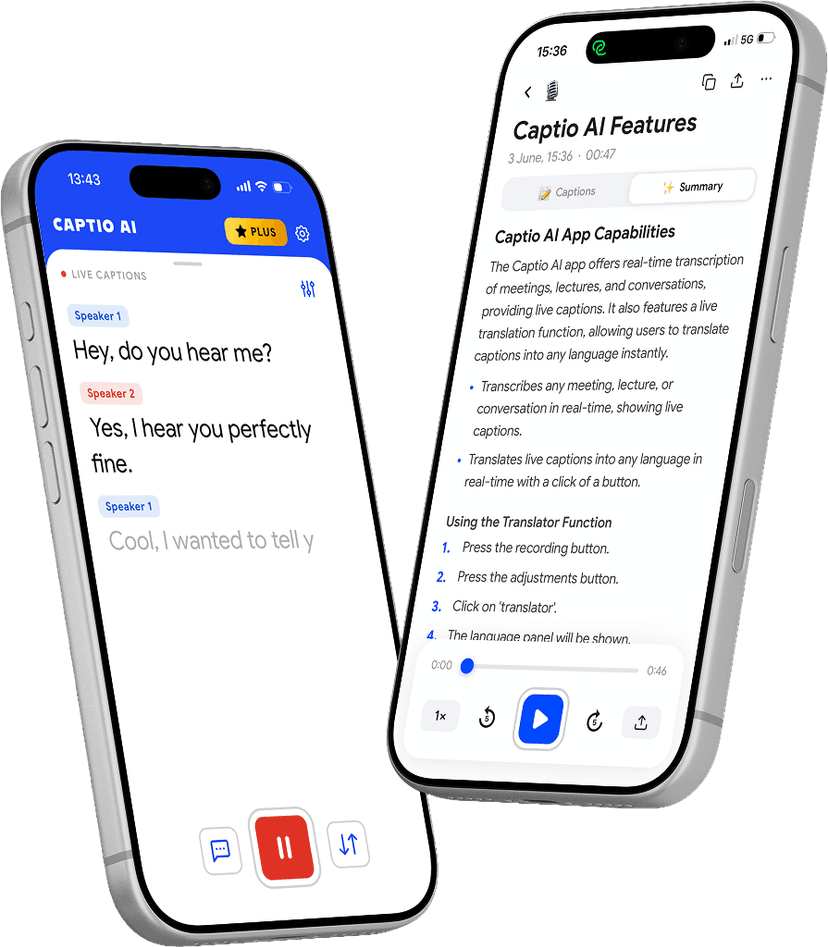
Everything you need to follow Arabic phone & video calls
Four tools built for deaf and hard of hearing Arabic speakers.
Follow the call in real time
- Captions appear word by word as the other person speaks
- Works on any call — no app integration required
- Put the call on speaker and point the microphone toward it
- Handles compressed call audio accurately
International and foreign-language calls
- They speak their language — you read in yours
- Translates in real time as they speak
- 60+ languages, no setup
- For family abroad, international business, or travel
Transcribe any call recording
- Record the call and upload for a complete written transcript
- Review instructions, information, and decisions after
- Organised by speaker
- Works on any call recording
Key information extracted from any call
- Important points pulled from any call transcript
- Useful for medical calls, customer service, and work calls
- Organised into clear sections
- Works on any saved recording
Download for free
Every situation covered
Designed for the real moments that matter — not just quiet controlled environments.
A call from Amo in Cairo, a parent from Riyadh, cousins from Beirut. Every caller speaks their own dialect at full speed — no concessions to the listener on the other end.
Business calls in Gulf Arabic, client negotiations in Levantine, team check-ins in Egyptian. Arabic-medium professional culture runs heavily on phone in the UAE, Saudi Arabia, and Qatar.
Hospital appointment lines, pharmacy queries, clinic callbacks, SEHA or MOH health line calls. In many Arab countries, medical access begins with a phone call in fast formal or regional Arabic.
Saudi Telecom IVR menus, Emirates NBD automated banking, Egyptian utility helplines. Arabic automated systems speak at standard rate and expect prompt responses.
A call from family in Morocco to relatives in the Gulf, a business call with a Levantine counterpart from an Egyptian office. The dialect gap on top of phone compression is the sharpest version of the Arabic call challenge.
WhatsApp calls are the dominant Arabic communication channel. Even with video on, following fast colloquial Arabic on a compressed video stream is exhausting. Captions let you read while you watch.
Most accurate and fastest models
word accuracy
independent benchmark, 2025
real-time captions
first word appears as you speak
Download for free
Built for the calls you have been avoiding
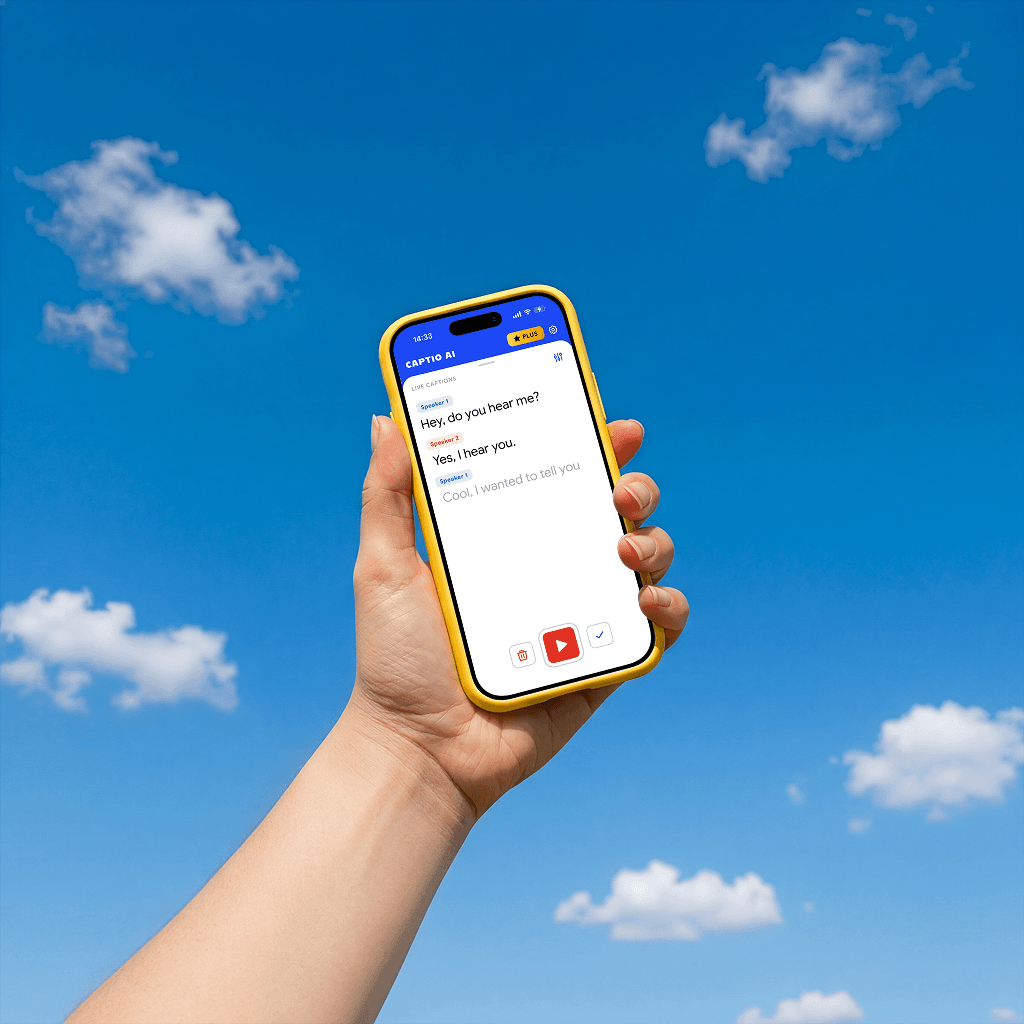
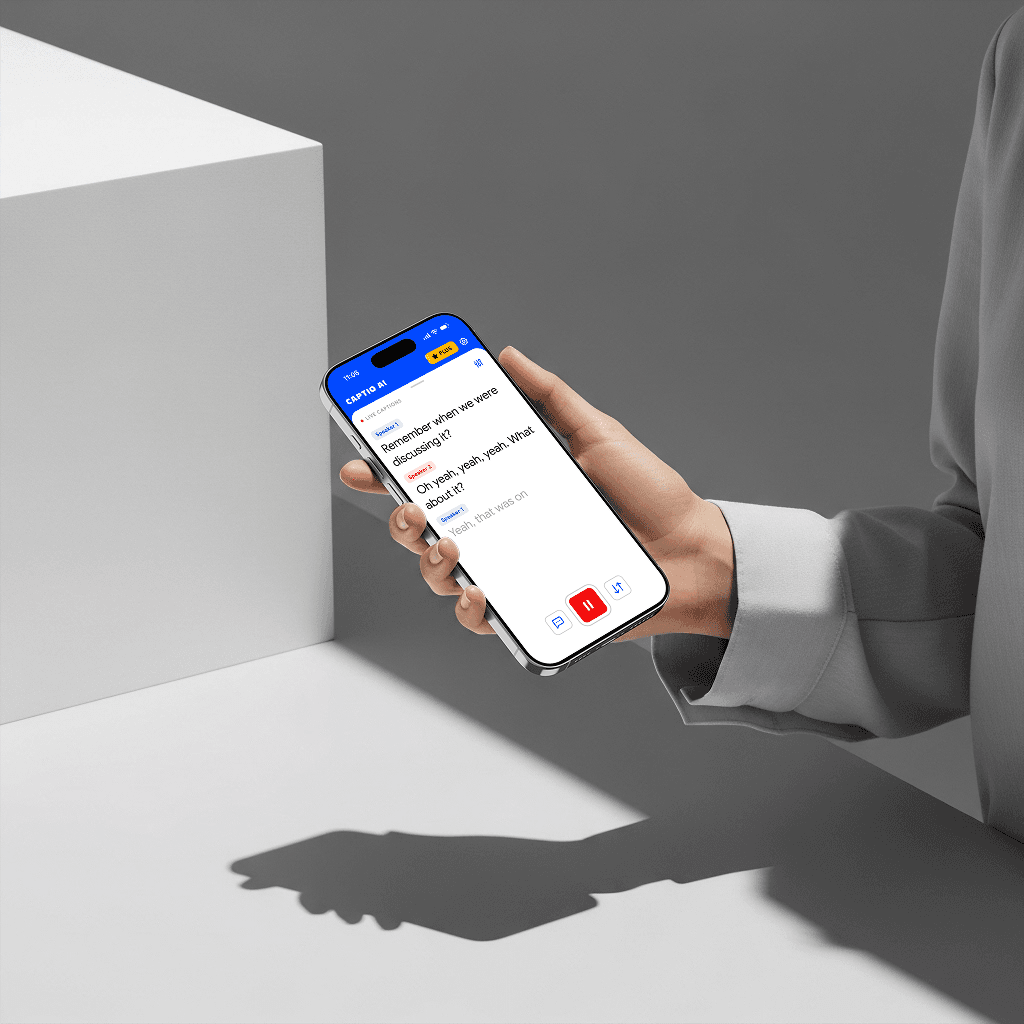
Captions as they speak
Words appear on screen word by word while the other person is still talking. You read what they say at the same pace everyone else hears it — no delay, no reconstruction.
Works on any call app
Captio AI does not need to integrate with any platform. Put the call on speaker, point the microphone toward the audio, and read the captions. It works the same way for any app on any device.
No more asking for repeats
Every word is on screen as it is said. If you missed something, glance at the caption rather than interrupting the call — the full sentence is there.
Handles call audio accurately
Compressed phone audio is less clean than in-person speech. Captio AI is built for real-world audio conditions, including the reduced quality of standard phone and VoIP calls.
Any language
For calls with family abroad, international colleagues, or foreign-language customer service. Live Translator captions and translates in real time with no manual setup.
Record and review after
Record any call and upload it to Audio Transcription. Get a full written record of everything said — useful for medical instructions, work decisions, and anything worth having in writing.
Why Arabic is hard to understand
Pharyngeal and uvular sounds
- Arabic has consonants produced entirely in the throat
- Arabic pharyngeals (/ħ/ and /ʕ/) and the uvular /q/ are articulated deep in the throat — no lip movement is involved. On a phone call, these sounds produce no visual signal and their acoustic character is affected by narrowband compression. A deaf caller who might partly track lip movements in person has zero cue on a call.
MSA versus dialect gap
- The language on family calls is not the language of formal study
- Modern Standard Arabic is taught in schools and used in media. Family calls happen in Egyptian, Levantine, Gulf, or Moroccan Darija — varieties with different phoneme inventories, vocabularies, and speaking rates. The variety a deaf caller has practised may be nothing like the dialect on the other end of the phone.
Emphatic consonants
- Pharyngealized consonants change vowel quality, not lip shape
- Arabic emphatic consonants (/sˤ/, /dˤ/, /tˤ/, /ðˤ/) contrast with plain consonants in minimal pairs. The acoustic difference is in vowel colouring — not in visible articulation. Phone compression can reduce this vowel quality difference, making emphatic/plain minimal pairs hard to distinguish even with some residual hearing.
Dialect-specific mergers
- Each dialect collapses different phoneme distinctions
- Gulf Arabic realises /q/ as /g/; Moroccan Darija merges Standard Arabic vowels and adds Berber substrate phonology; Levantine Arabic drops final case vowels. A deaf caller calibrated by residual hearing to one dialect faces a different phonological system on a call from a different region.
Fast colloquial speed
- Casual Arabic moves faster than broadcast speech
- Colloquial Arabic on a family call runs considerably faster than formal news speech. Vowels reduce, unstressed syllables drop, and words contract into forms that look and sound nothing like their formal counterparts. On a compressed phone call, this rate and reduction is compounded.
Download for free
Hearing loss across the Arab region — undercounted and underserved
Hearing loss rates across Arab countries are elevated by high rates of consanguineous marriage, which increases genetic risk for congenital deafness. A study examining 22 Arab majority countries published in Otology and Neurotology found hearing loss to be a significant genetic burden across Qatar, Saudi Arabia, Egypt, and the Levant. In Saudi Arabia, a 2024 study found 1.4% of nationals reported a hearing impairment — approximately 290,000 people — while functional hearing difficulty affected 7.1%. In Egypt, an estimated 7% of the population has disabling hearing loss, placing the total above 7 million.
Phone accessibility infrastructure across the Arab world is largely absent. There is no pan-Arab telephone relay service. Most countries in the region have no text telephone equivalent, no captioned telephone service, and no government mandate requiring phone-based services to offer text alternatives. A deaf Egyptian who needs to book a clinic appointment, a hard of hearing Saudi responding to a bank security call, or a Jordanian with hearing loss navigating a government helpline all face the same barrier: a phone-only system with no fallback.
Captio AI is built for those calls. Put a hospital appointment line in Riyadh, a work call in Dubai, or a WhatsApp call from family in Cairo on speaker, and read every word in real time — whatever the dialect, whatever the speed.
Download for free
What you hear stays with you.
Gone the moment it ends
Captio AI processes your audio in real time and discards it immediately. Nothing is recorded. Nothing is kept.
Not a product
Your conversations are not something Captio AI sells, shares, or monetizes — to anyone, for any reason.
Not used to train anything
What you say in a doctor's appointment or a job interview never ends up in a training dataset. Not ours. Not anyone else's.

Private by default
Captio AI supports 60+ languages
Download for free
Frequently asked questions
Follow every call in Arabic.
Captio AI is free to start
Download for free