

Thai live captions and productivity tool for phone & video calls
For deaf and hard of hearing people.
Download for free


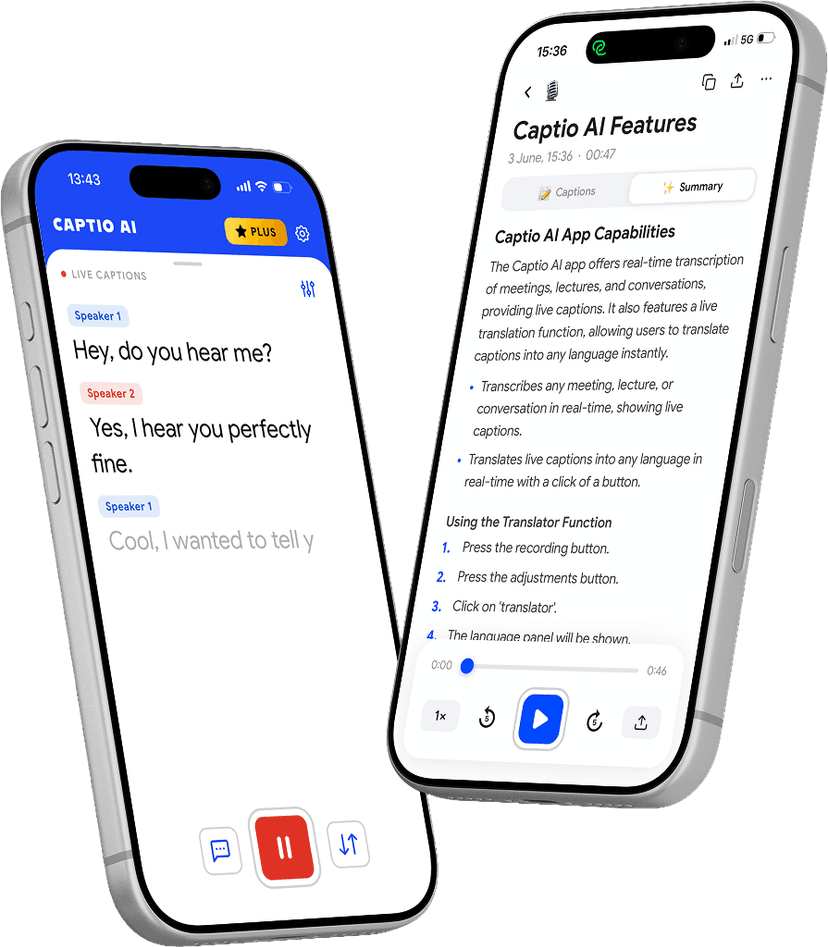
Everything you need to follow Thai phone & video calls
Four tools built for deaf and hard of hearing Thai speakers.
Follow the call in real time
- Captions appear word by word as the other person speaks
- Works on any call — no app integration required
- Put the call on speaker and point the microphone toward it
- Handles compressed call audio accurately
International and foreign-language calls
- They speak their language — you read in yours
- Translates in real time as they speak
- 60+ languages, no setup
- For family abroad, international business, or travel
Transcribe any call recording
- Record the call and upload for a complete written transcript
- Review instructions, information, and decisions after
- Organised by speaker
- Works on any call recording
Key information extracted from any call
- Important points pulled from any call transcript
- Useful for medical calls, customer service, and work calls
- Organised into clear sections
- Works on any saved recording
Download for free
Every situation covered
Designed for the real moments that matter — not just quiet controlled environments.
A call with family in Bangkok or Chiang Mai where conversation moves quickly between informal and formal Thai.
A work call or video meeting where colleagues switch between Thai and English and business vocabulary is dense.
A callback from a hospital in Bangkok where a nurse delivers appointment details and prescription instructions in rapid Thai.
A call to a bank or government office where the automated menu is in Standard Thai and the agent speaks with a regional accent.
A call from a Thai family member working abroad who mixes Thai with the local language of their host country.
A LINE video call with family across Thailand — in Chiang Mai, Khon Kaen, or Hat Yai — where tones and accents shift between regions.
Most accurate and fastest models
character accuracy
independent benchmark, 2025
real-time captions
first word appears as you speak
Download for free


Built for the calls you have been avoiding
Captions as they speak
Words appear on screen word by word while the other person is still talking. You read what they say at the same pace everyone else hears it — no delay, no reconstruction.
Works on any call app
Captio AI does not need to integrate with any platform. Put the call on speaker, point the microphone toward the audio, and read the captions. It works the same way for any app on any device.
No more asking for repeats
Every word is on screen as it is said. If you missed something, glance at the caption rather than interrupting the call — the full sentence is there.
Handles call audio accurately
Compressed phone audio is less clean than in-person speech. Captio AI is built for real-world audio conditions, including the reduced quality of standard phone and VoIP calls.
Any language
For calls with family abroad, international colleagues, or foreign-language customer service. Live Translator captions and translates in real time with no manual setup.
Record and review after
Record any call and upload it to Audio Transcription. Get a full written record of everything said — useful for medical instructions, work decisions, and anything worth having in writing.
Why Thai is hard to understand
Five-tone invisibility
- All tonal distinctions are pitch-only — invisible on video
- Thai distinguishes five phonemic tones — mid, low, falling, high, and rising — that encode meaning entirely through pitch. On a phone or video call, two words that differ only in tone produce identical lip movements. A deaf caller sees nothing that differentiates them. The entire tonal system is auditory-only.
Unreleased final stops
- Word-final stops close without a visible burst
- Thai word-final plosives — /k/, /t/, /p/ — are typically unreleased in standard pronunciation: the closure is made but the air burst is absent. For a hearing caller this is audible; for a deaf caller on a video call, an unreleased final stop is visually indistinguishable from an open syllable. A whole class of word endings effectively disappears.
Consonant cluster compression
- Initial clusters compress at natural conversational pace
- Thai has consonant clusters at syllable onset that compress significantly in natural fast speech. At conversational pace in a phone call, these clusters deliver fewer visually distinct onset positions than a careful pronunciation would suggest. A deaf caller tracking lip position misses the cluster distinction.
Bangkok-regional accent gap
- Isan, Northern, and Southern Thai sound perceptibly different
- Central Thai (Bangkok standard) sounds perceptibly different from Northern Thai (Kham Mueang), Northeastern Thai (Isan), and Southern Thai — in vowel quality, tone shapes, and consonant inventory. A deaf caller accustomed to Central Thai encounters a different phonological landscape when a family member calls from Chiang Mai or Khon Kaen.
Register layering
- Colloquial, formal, and royal Thai use different vocabulary
- Thai has multiple registers — colloquial, formal, royal, and religious — each with distinct vocabulary and phonological patterns. A video call with a doctor or government official uses words with different shapes than the informal register. A deaf caller who has calibrated to everyday speech encounters unfamiliar mouth positions in formal contexts.
Download for free
Hearing loss affects millions of Thai people while sign language interpreter provision remains critically limited
A hearing survey of Bangkok's population found a general hearing loss prevalence of 53.02% across all degrees of impairment, with 2.8% experiencing moderate or greater hearing loss. A broader national cohort study across 87,134 Thai adults found that 8.5% reported trouble hearing and 0.13% identified as deaf. The burden increases steeply with age: adults aged 65 and over had 8.56 times greater rates of hearing loss than younger participants. Thailand's rapid population ageing means this burden is growing — and the infrastructure of support for deaf and hard-of-hearing citizens has not kept pace.
Thailand ratified the UN Convention on the Rights of Persons with Disabilities in 2008, and the Persons with Disabilities Empowerment Act entitles people with disabilities to free or affordable healthcare, sign-language interpretation, and reasonable accommodation in public services. Thai Sign Language was recognised as the national language of deaf people as early as 1999. In practice, however, enforcement has been weak: healthcare staff are often unaware of the entitlements deaf patients carry, the number of registered sign-language interpreters is small relative to the deaf population, and medical sign language standardisation remains an ongoing challenge documented in peer-reviewed research.
Captio AI captions every Thai call in real time — so a deaf person can follow a family video call from Chiang Mai, a doctor's callback from Bangkok, or a customer service line anywhere in Thailand without missing a word.
Download for free
What you hear stays with you.
Gone the moment it ends
Captio AI processes your audio in real time and discards it immediately. Nothing is recorded. Nothing is kept.
Not a product
Your conversations are not something Captio AI sells, shares, or monetizes — to anyone, for any reason.
Not used to train anything
What you say in a doctor's appointment or a job interview never ends up in a training dataset. Not ours. Not anyone else's.

Private by default
Captio AI supports 60+ languages
Download for free
Frequently asked questions
Follow every call in Thai.
Captio AI is free to start
Download for free