

Korean live captions and productivity tool for phone & video calls
For deaf and hard of hearing people.
Download for free


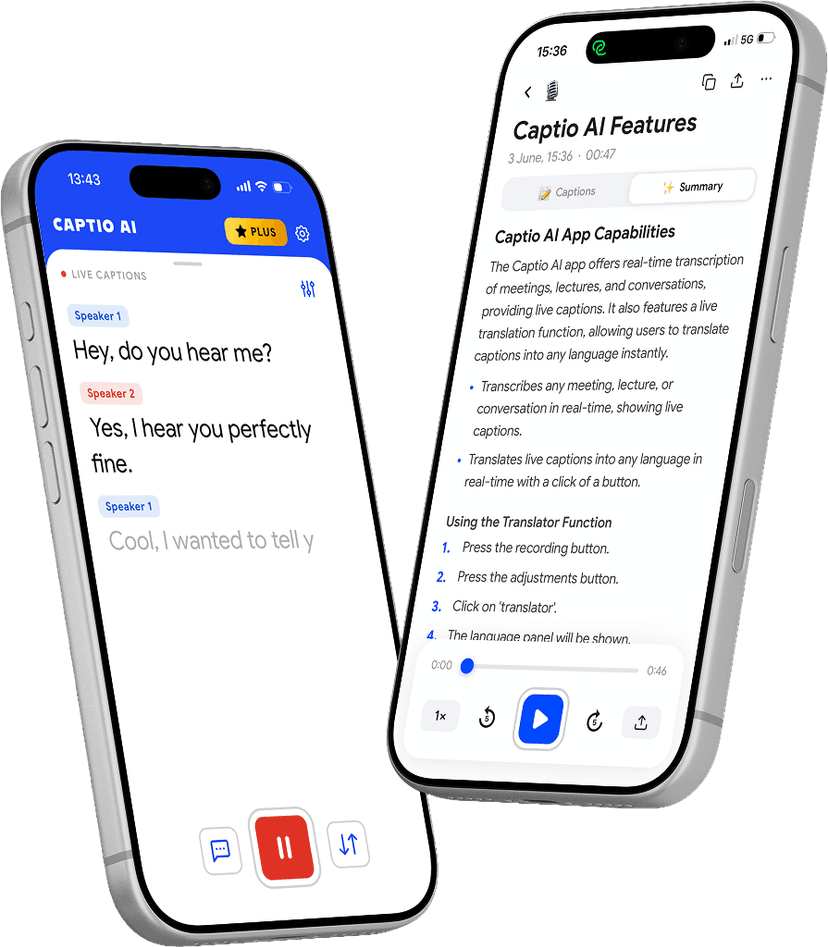
Everything you need to follow Korean phone & video calls
Four tools built for deaf and hard of hearing Korean speakers.
Follow the call in real time
- Captions appear word by word as the other person speaks
- Works on any call — no app integration required
- Put the call on speaker and point the microphone toward it
- Handles compressed call audio accurately
International and foreign-language calls
- They speak their language — you read in yours
- Translates in real time as they speak
- 60+ languages, no setup
- For family abroad, international business, or travel
Transcribe any call recording
- Record the call and upload for a complete written transcript
- Review instructions, information, and decisions after
- Organised by speaker
- Works on any call recording
Key information extracted from any call
- Important points pulled from any call transcript
- Useful for medical calls, customer service, and work calls
- Organised into clear sections
- Works on any saved recording
Download for free
Every situation covered
Designed for the real moments that matter — not just quiet controlled environments.
A call with parents or grandparents in Seoul or a relative in Busan. Family conversations carry regional satoori, fast casual Korean, and the shorthand of close relationships. Captio AI captions everything said.
A team call in Korean from a Seoul office or a video meeting with Korean colleagues. Business Korean with honorifics and English technical vocabulary. Captio AI keeps pace with both.
A callback from Severance Hospital or a prescription query from a neighborhood pharmacy in Korean. Medical Korean uses formal vocabulary at speed. Captio AI shows the full message in text.
A Kakao Bank notification call or a KB Bank IVR menu in Korean. Automated menus give you one chance. Captio AI captions each option before the timeout.
A call from the Korean diaspora in the US, Australia, or Southeast Asia. Diaspora Korean carries foreign-language influence on vocabulary and rhythm. Captio AI handles it accurately.
A KakaoTalk video call with family in Incheon or a Zoom meeting with a Korean team. All video call apps work the same way — put the call on speaker, open Captio AI, read the captions.
Most accurate and fastest models
character accuracy
independent benchmark, 2025
real-time captions
first word appears as you speak
Download for free
Built for the calls you have been avoiding
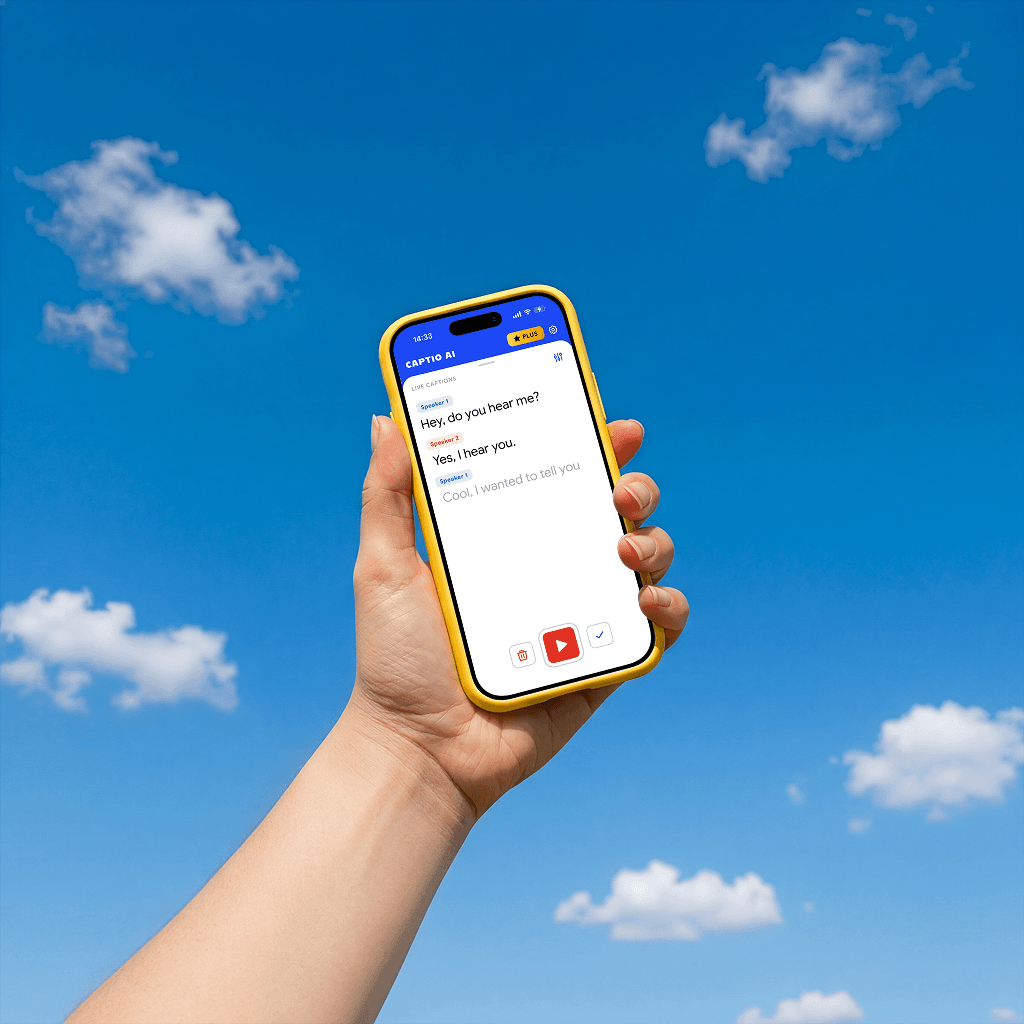
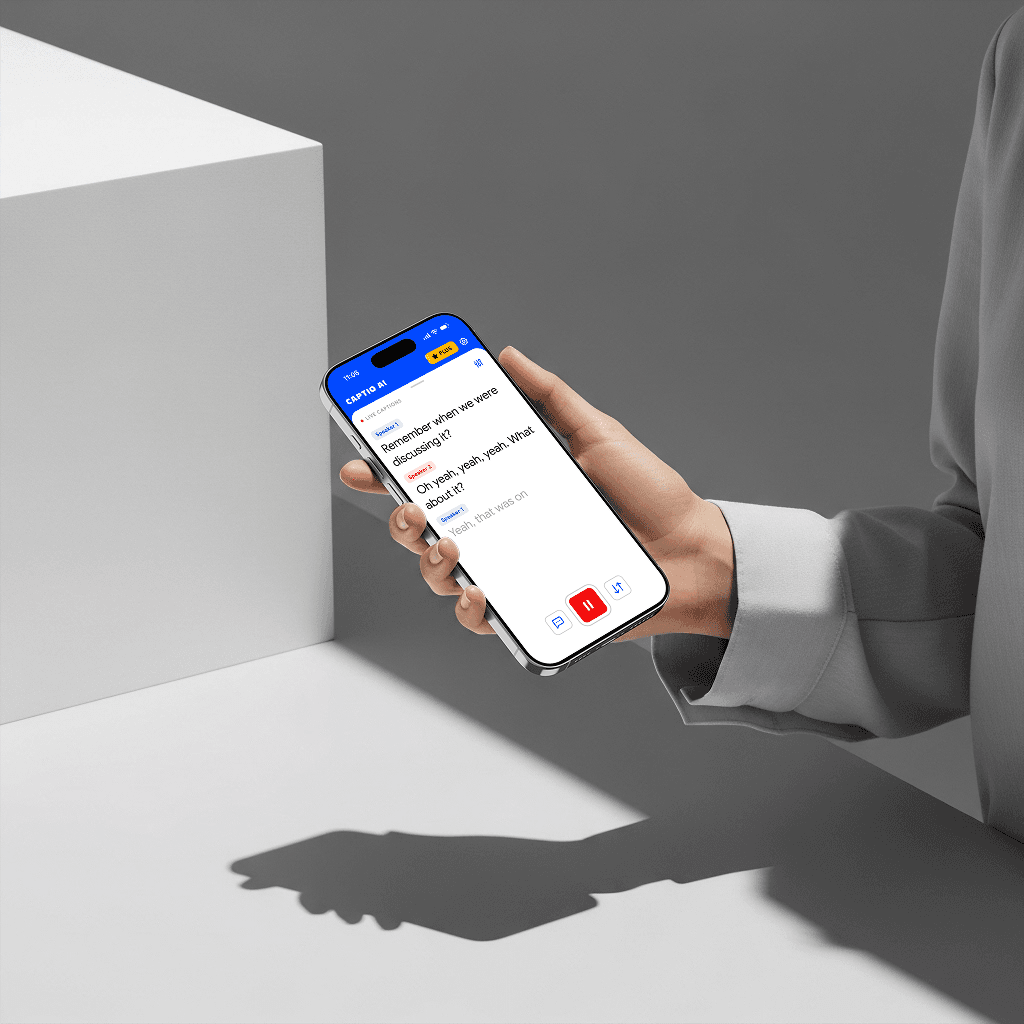
Captions as they speak
Words appear on screen word by word while the other person is still talking. You read what they say at the same pace everyone else hears it — no delay, no reconstruction.
Works on any call app
Captio AI does not need to integrate with any platform. Put the call on speaker, point the microphone toward the audio, and read the captions. It works the same way for any app on any device.
No more asking for repeats
Every word is on screen as it is said. If you missed something, glance at the caption rather than interrupting the call — the full sentence is there.
Handles call audio accurately
Compressed phone audio is less clean than in-person speech. Captio AI is built for real-world audio conditions, including the reduced quality of standard phone and VoIP calls.
Any language
For calls with family abroad, international colleagues, or foreign-language customer service. Live Translator captions and translates in real time with no manual setup.
Record and review after
Record any call and upload it to Audio Transcription. Get a full written record of everything said — useful for medical instructions, work decisions, and anything worth having in writing.
Why Korean is hard to understand
Three-way consonant contrast
- Lax, aspirated, and tensed consonants look identical
- Korean distinguishes three stop series: lax (ㅂ), aspirated (ㅍ), and tensed/fortis (ㅃ). Tensed consonants are produced with glottal constriction and no additional lip force — the distinction is entirely in the throat. On a phone call without hearing, all three series collapse visually. This affects dozens of high-frequency minimal pairs in Korean.
Identical vowel lip shapes
- Several Korean vowel pairs look the same on lips
- Korean vowel pairs like 아/어 (a/eo), 오/우 (o/u), and 이/으 (i/eu) look nearly identical on lips. The back-front distinction in 으/이 is entirely in tongue position with no lip spreading difference. These contrasts appear throughout common particles and verb endings — the most frequent elements in Korean speech.
Consonant lenition
- The same consonant sounds different depending on position
- In Korean, consonants at the syllable onset following a vowel become lax (lenited). This means the same consonant sounds different depending on its position: 밥 (bap) starts with the same letter as the second syllable of 밥을 (babŭl), but the second occurrence sounds softer. For a deaf caller tracking consonant identity, position-dependent shifts add a continuous disambiguation burden.
Seoul vowel mergers
- Younger Seoul speakers collapse 애 and 에 into one vowel
- Younger Seoul speakers have merged 애 (ae) and 에 (e) into a single vowel — a shift now dominant in urban Korean under 40. This merger is not reflected in writing, so pairs of words that were historically distinct now sound identical in the speech of most Korean callers under 40. A deaf caller cannot predict which words have merged.
Satoori regional variety
- Busan, Gyeongsang, and Jeolla dialects use different intonation
- Regional Korean varieties — Busan satoori, Gyeongsang, Jeolla — use different intonation patterns, prosodic stress, vowel realizations, and vocabulary from Seoul Korean. A deaf caller familiar with Seoul speech may not recognize fast Busan satoori even though both are Korean, particularly on a compressed phone call.
Download for free
Hearing impairment is the most common newly registered disability in South Korea — and phone access hasn't caught up
Around 5.3% of South Koreans report having hearing loss according to the 2024 KoreaTrak survey, with 5.9% among adults aged 18 and older. Hearing impairment accounts for 16.8% of all registered disabilities in South Korea, and at 31.7% of newly registered disability cases, it is the single most common new disability type registered annually. The total number of Koreans registered with hearing disabilities exceeded 400,000 by 2024.
South Korea's National Health Insurance has provided hearing aid subsidies for registered individuals with hearing disabilities since 1989, with the subsidy raised to approximately US$1,000 in 2015. Despite this policy support, only 19% of non-users believed they were eligible for financial assistance — indicating that awareness of state support remains critically low. Video relay services and caption phone access exist within registered DSP systems but are not available inside KakaoTalk, Zoom, or standard VoIP calls.
Captio AI lets a deaf person in Busan follow a KakaoTalk video call with family in Seoul, navigate a Kakao Bank automated menu, or read a Severance Hospital callback — without a caption phone subscription, without a relay number, on any smartphone.
Download for free
What you hear stays with you.
Gone the moment it ends
Captio AI processes your audio in real time and discards it immediately. Nothing is recorded. Nothing is kept.
Not a product
Your conversations are not something Captio AI sells, shares, or monetizes — to anyone, for any reason.
Not used to train anything
What you say in a doctor's appointment or a job interview never ends up in a training dataset. Not ours. Not anyone else's.

Private by default
Captio AI supports 60+ languages
Download for free
Frequently asked questions
Follow every call in Korean.
Captio AI is free to start
Download for free