

Welsh live captions and productivity tool for lectures
For deaf and hard of hearing people.
Download for free
Everything you need to follow Welsh lectures
Four tools built for deaf and hard of hearing Welsh speakers.
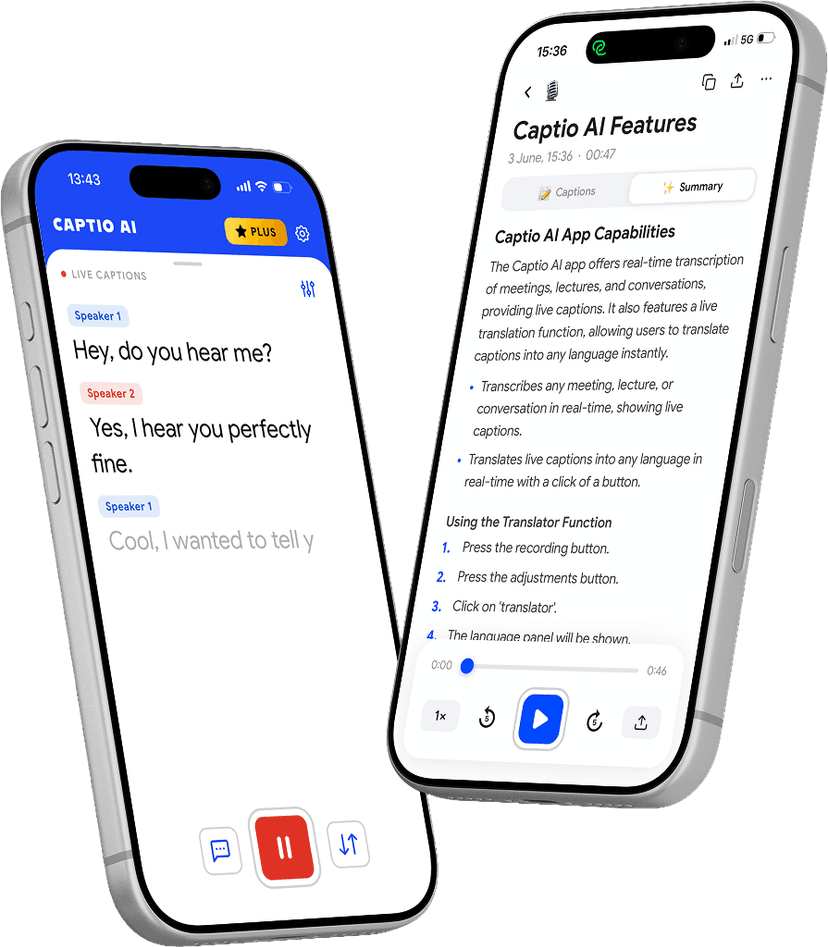
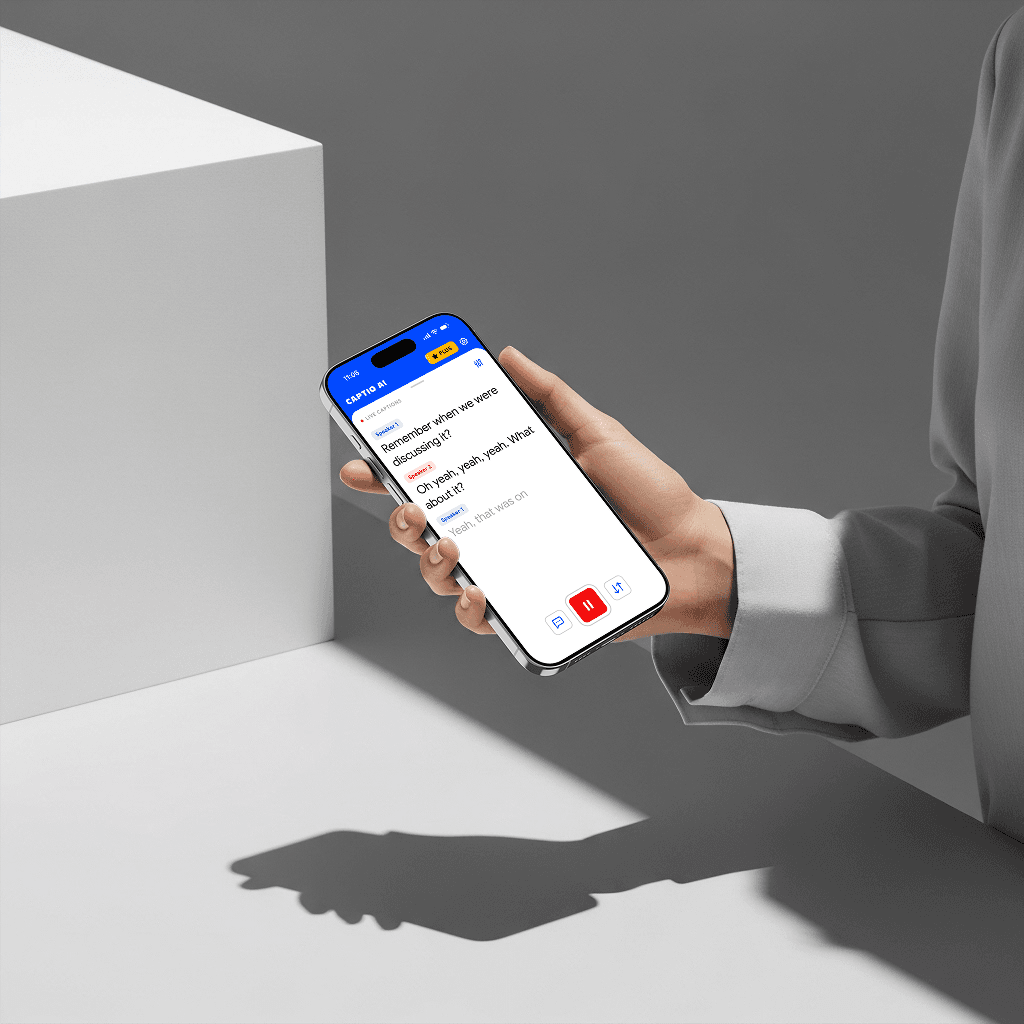
Follow the lecture as it happens
- Captions appear word by word while the lecturer is still speaking
- Works in lecture halls, seminars, and tutorials
- No setup — place the phone on your desk and start
- Any accent, any pace
For courses in another language
- Captions and translates in real time
- For international students or foreign-language courses
- 60+ languages, no switching
- Follow the lecture in the language you read best
Full transcript to study from
- Record the lecture and upload it for a complete written transcript
- Searchable, copyable, shareable
- Review at your own pace after class
- Works on any lecture recording
Key points extracted automatically
- Important concepts and takeaways pulled from any transcript
- Organised into sections — not one continuous block
- Useful for revision and exam preparation
- Works on any saved lecture transcript
Download for free
Every situation covered
Designed for the real moments that matter — not just quiet controlled environments.
Large lecture halls at Bangor University and Aberystwyth University — where Welsh-medium degree programmes cover sciences, humanities, and professional subjects in Welsh, with lecturers from across Wales bringing north and south varieties.
Seminars and tutorials in Welsh — small group discussions where students and faculty debate in Welsh, code-switching into English freely for technical terms and back into Welsh for discussion.
Online and recorded Welsh-medium lectures on institutional platforms — digital content where the mutation system and lateral fricative are the only acoustic channel and lip-reading is unavailable.
Study groups in Welsh student communities in Bangor, Aberystwyth, and Cardiff — peer discussion in Welsh, with students from different dialect regions mixing northern and southern varieties.
Welsh for Adults and learner-level courses at Welsh institutions — courses for heritage speakers or second-language learners of Welsh, where pronunciation varies widely and the mutation system is applied inconsistently.
Guest speakers at Eisteddfod academic sessions and national institutions — public lectures by Welsh academics, writers, and politicians delivering in Welsh, often on S4C broadcasts without real-time captioning.
Most accurate and fastest models
word accuracy
independent benchmark, 2025
real-time captions
first word appears as you speak
Download for free
Built for the pace and pressure of a real lecture
Follow without splitting your attention
Lip-reading and note-taking at the same time is an impossible cognitive load. Captio AI handles the following so you can direct all your attention to understanding what is being said.
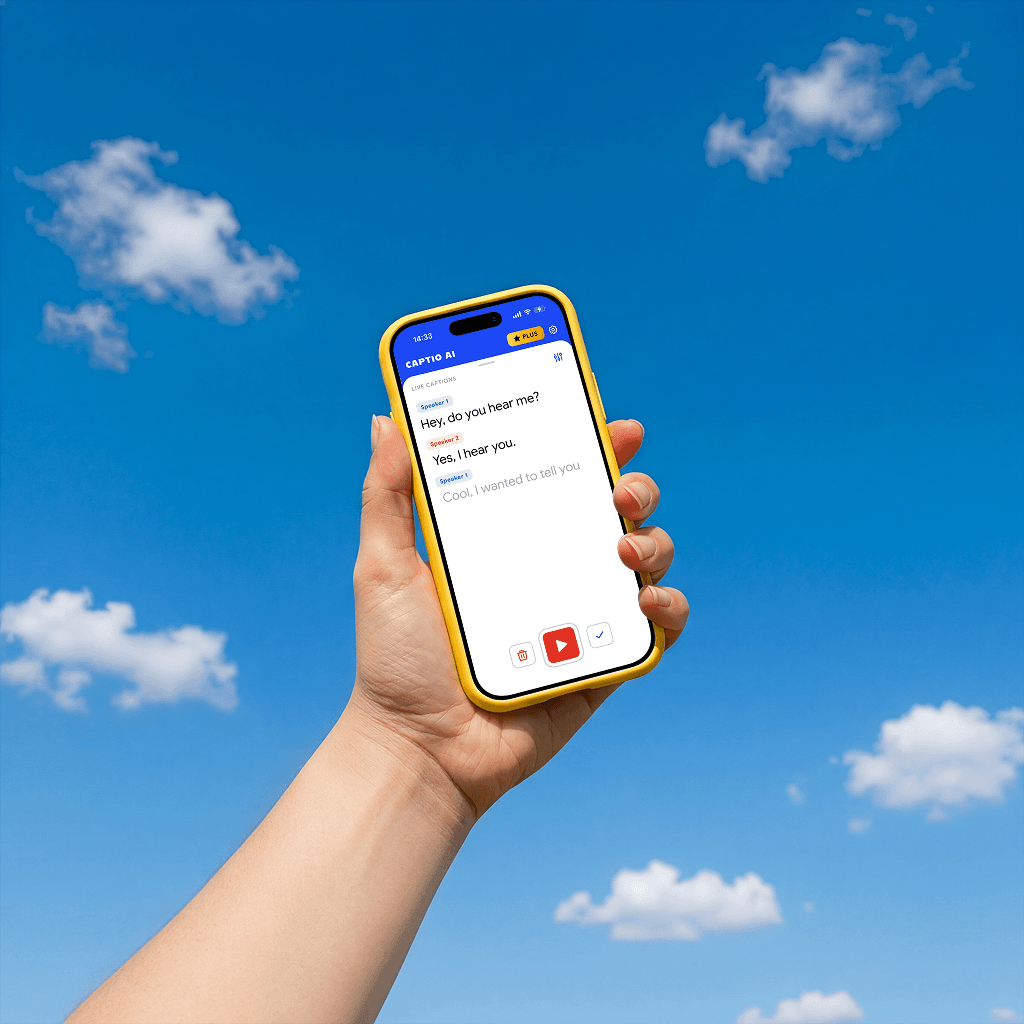
Captions while the lecturer is still speaking
Words appear on your screen as they are said — not after the sentence ends. You stay in sync with the lecture rather than always being a beat behind.
Works in any lecture setting
Lecture halls, seminar rooms, online classes, study groups. Place the phone on your desk, point it toward the audio source, and Captio AI handles the rest.
A full transcript to study from
Record the lecture and upload it to Audio Transcription after class. Get a complete written record you can search, annotate, and revise from — at your own pace.
60+ languages
For international students, students studying abroad, or courses taught in a second language. Captio AI captions or translates in real time with no manual setup.
No advance notice needed
Official university captioning requires booking in advance and is not available for every session. Captio AI works for any lecture, any time, with no prior arrangement.
Why Welsh is hard to understand
Consonant mutation system
- Nine categories of consonant mutation change word-initial sounds based on grammar — making visual parsing unpredictable
- Welsh has a system of initial consonant mutation where the first sound of a word changes based on grammatical context. Soft mutation, nasal mutation, aspirate mutation, and h-prothesis cause the initial consonant to change — cath (cat) becomes y gath (the cat) after the definite article, and fy nghath (my cat) after a nasal trigger. A lip-reader who has learned the visual pattern of 'cath' must recognize it as [ŋɡath] in a different syntactic context. The mutation system makes Welsh the most visually unpredictable language in Western Europe for lip-readers.
Voiceless lateral fricative
- The ll sound — a lateral airflow fricative — has no parallel in any neighboring language and is invisible on the lips
- Welsh 'll' is a voiceless alveolar lateral fricative /ɬ/ — produced by placing the tongue against the alveolar ridge and releasing air laterally from the sides, with no central airflow. The lip position is nearly identical to plain /l/ — no distinctive lip shape signals to a lip-reader that this sound is different. In a Welsh lecture at Bangor or Aberystwyth, words like llan, llawr, and llawn contain a sound completely invisible on the lips.
Voiceless nasal trill
- The rh sound — a voiceless nasal trill — has almost no visible lip correlate
- Welsh 'rh' is a voiceless alveolar nasal trill /r̥/ — produced with the tongue tip trilling against the alveolar ridge while air passes through the nasal cavity, with no voicing. The lip shape for 'rh' is almost identical to voiced /r/ and produces no distinctive visible articulation. Words like rhan, rhad, and rhyw begin with a sound lip-reading cannot distinguish from their voiced counterparts.
North–South dialect split
- North Welsh and South Welsh differ substantially in pronunciation — a Gwynedd lecturer sounds different from one from Swansea
- Welsh dialects divide broadly into North Wales (Gwynedd, Anglesey, Llŷn Peninsula) and South Wales (Cardiff, Swansea, the Valleys) varieties. These differ in vowel quality, stress patterns, and consonant pronunciation. A deaf student at Cardiff University has calibrated to southern Welsh; a visiting lecturer from Bangor uses a systematically different phonological system.
Welsh–English code-switching
- Welsh-medium lectures regularly shift into English for technical terminology and back into Welsh
- Welsh-medium higher education routinely incorporates English terminology — especially in STEM where Welsh-language technical vocabulary is limited or where the primary literature is in English. A deaf student lip-reading a Welsh lecture must track mid-sentence switches into English phonology and back, with no visual signal when the language changes — Welsh and English share many consonant shapes but differ substantially in vowel quality.
Download for free
575,500 deaf and hard of hearing people in Wales — and a Welsh deaf community still waiting for a BSL Wales Act
There are approximately 575,500 deaf and hard of hearing people in Wales, according to RNID — which has reported serious and widespread healthcare failings affecting this community. An estimated 4,000 to 7,300 people in Wales use British Sign Language (BSL) as their primary means of communication. Deaf people in Wales are twice as likely to experience mental health problems as the general population, a disparity attributed in part to the communication barriers that accumulate in healthcare, education, and employment settings.
The Welsh Government formally recognised BSL as a language in its own right in January 2004. However, as of 2025, Wales still does not have a BSL Act equivalent to the British Sign Language (Scotland) Act 2015 or the UK-wide BSL Act 2022 — a legislative gap that deaf advocates have described as leaving the Welsh deaf community without the structural protections that Scottish and UK law provide. A BSL (Wales) Bill was being campaigned for by organisations including the Institute of Welsh Affairs in 2025 but had not yet been enacted. Welsh-medium academic interpretation is even scarcer than English-medium BSL provision.
Welsh-medium higher education is a national policy priority in Wales — with the Welsh Government's strategy targeting growth in the number of students studying through the medium of Welsh — but accessibility for deaf and hard of hearing students in Welsh-medium programmes has not kept pace with that expansion. For a deaf student at Bangor University following a Welsh-medium lecture in which consonant mutations make word-initial sounds unpredictable, Captio AI provides real-time captions in Welsh that no interpreter pool in Wales can currently match at scale.
Download for free
What you hear stays with you.
Gone the moment it ends
Captio AI processes your audio in real time and discards it immediately. Nothing is recorded. Nothing is kept.
Not a product
Your conversations are not something Captio AI sells, shares, or monetizes — to anyone, for any reason.
Not used to train anything
What you say in a doctor's appointment or a job interview never ends up in a training dataset. Not ours. Not anyone else's.

Private by default
Captio AI supports 60+ languages
Download for free
Frequently asked questions
Follow every lecture in Welsh.
Captio AI is free to start
Download for free