

Italian live captions and productivity tool for lectures
For deaf and hard of hearing people.
Download for free


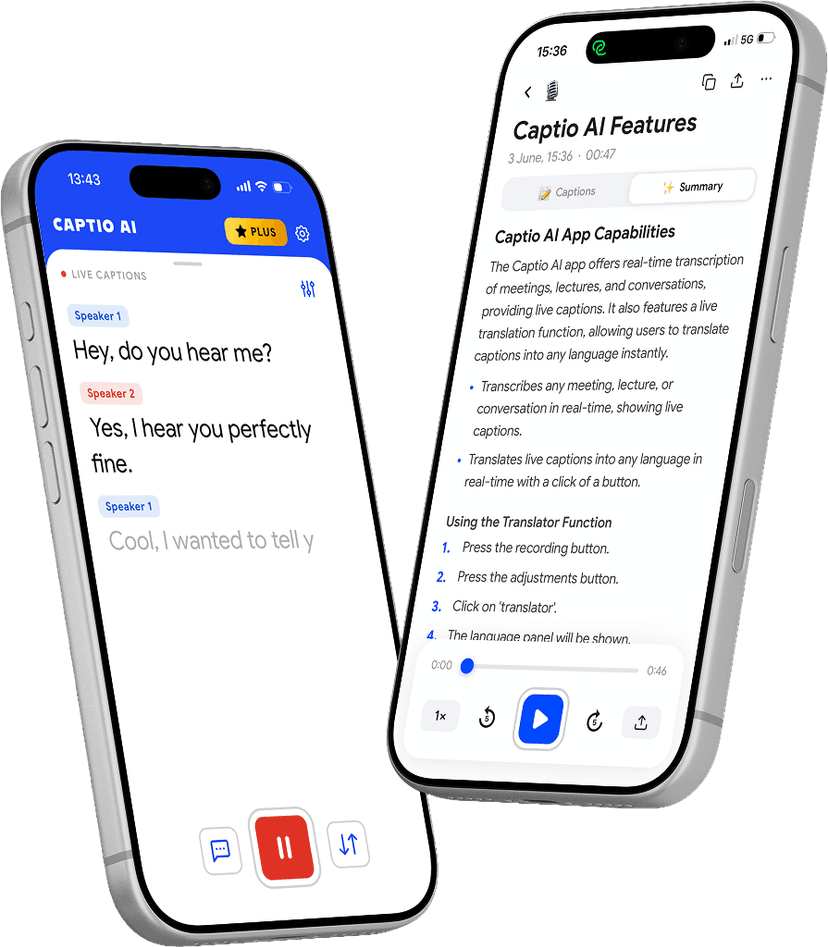
Everything you need to follow Italian lectures
Four tools built for deaf and hard of hearing Italian speakers.
Follow the lecture as it happens
- Captions appear word by word while the lecturer is still speaking
- Works in lecture halls, seminars, and tutorials
- No setup — place the phone on your desk and start
- Any accent, any pace
For courses in another language
- Captions and translates in real time
- For international students or foreign-language courses
- 60+ languages, no switching
- Follow the lecture in the language you read best
Full transcript to study from
- Record the lecture and upload it for a complete written transcript
- Searchable, copyable, shareable
- Review at your own pace after class
- Works on any lecture recording
Key points extracted automatically
- Important concepts and takeaways pulled from any transcript
- Organised into sections — not one continuous block
- Useful for revision and exam preparation
- Works on any saved lecture transcript
Download for free
Every situation covered
Designed for the real moments that matter — not just quiet controlled environments.
Università degli Studi di Roma La Sapienza, Bologna, Milan, Naples Federico II lecture halls. Italian-medium lectures at academic pace. Place the phone on the desk facing the speaker. Captio AI captions from any row.
Italian university seminars mixing Italian and English in discussion. Students from different regions contributing with different dialectal backgrounds. Captio AI captions whoever is speaking so you follow every argument.
Recorded lectures on university portals, YouTube academic channels, or Zoom recordings. Put the recording on speaker and point Captio AI at the audio for accurate captions in real time.
Study groups in Rome, Milan, or Bologna — fast conversational Italian mixed with English. Captio AI follows whoever is explaining and handles regional variety without switching.
Erasmus and international students at Italian universities following Italian-medium lectures. Live Translator captions in real time so language is not the access barrier.
Visiting academics and guest speakers from across Italy's regions. Captio AI handles Northern, Roman, Neapolitan, and Sicilian varieties of Italian — any speaker at any venue.
Most accurate and fastest models
word accuracy
independent benchmark, 2025
real-time captions
first word appears as you speak
Download for free

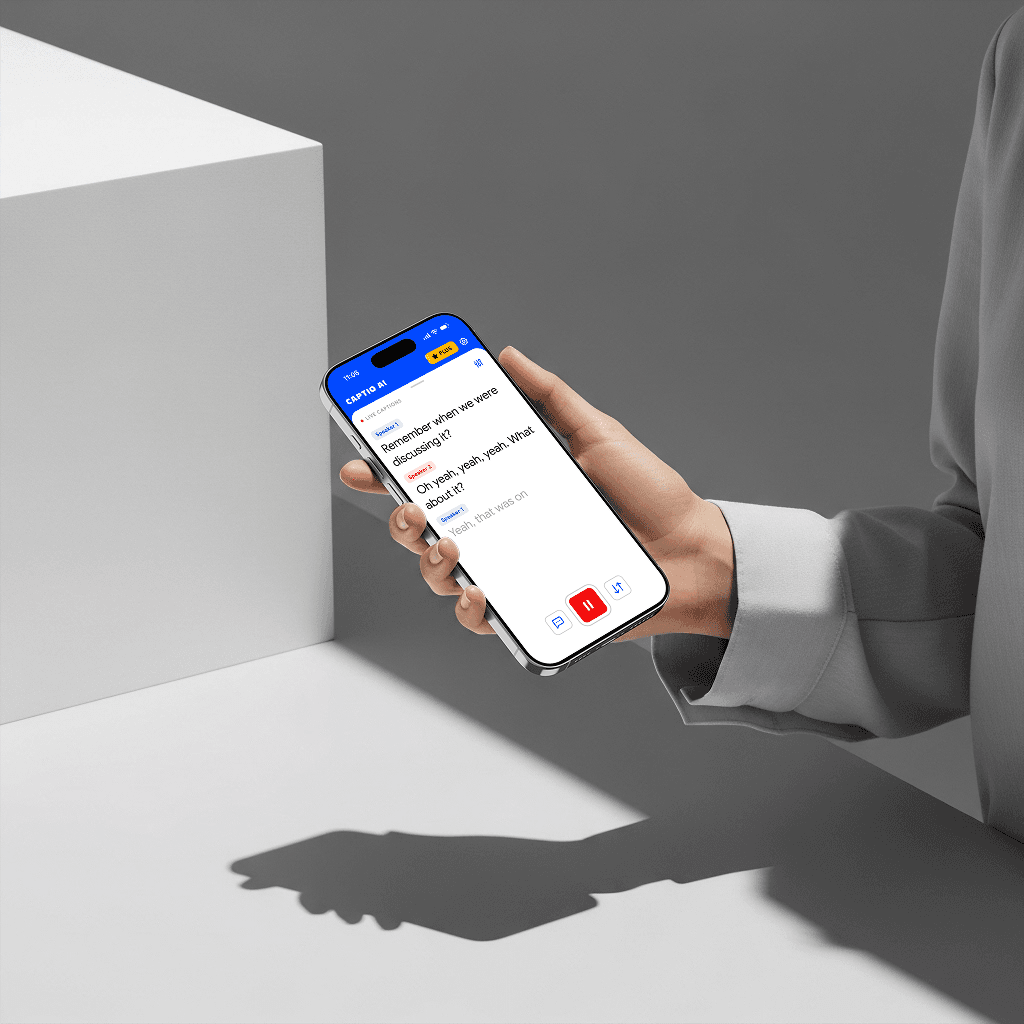
Built for the pace and pressure of a real lecture
Follow without splitting your attention
Lip-reading and note-taking at the same time is an impossible cognitive load. Captio AI handles the following so you can direct all your attention to understanding what is being said.
Captions while the lecturer is still speaking
Words appear on your screen as they are said — not after the sentence ends. You stay in sync with the lecture rather than always being a beat behind.
Works in any lecture setting
Lecture halls, seminar rooms, online classes, study groups. Place the phone on your desk, point it toward the audio source, and Captio AI handles the rest.
A full transcript to study from
Record the lecture and upload it to Audio Transcription after class. Get a complete written record you can search, annotate, and revise from — at your own pace.
60+ languages
For international students, students studying abroad, or courses taught in a second language. Captio AI captions or translates in real time with no manual setup.
No advance notice needed
Official university captioning requires booking in advance and is not available for every session. Captio AI works for any lecture, any time, with no prior arrangement.
Why Italian is hard to understand
Gemination invisibility
- Italian gemination distinguishes hundreds of word pairs — but the lip shape is identical for single and doubled consonants
- Italian uses consonant gemination (lengthening) as a phonemic distinction: pala (shovel) vs. palla (ball), nono (ninth) vs. nonno (grandfather), capello (hair) vs. cappello (hat). Gemination is a temporal feature — the consonant hold is lengthened — with no change in lip shape. A deaf student lip-reading Italian in a lecture cannot distinguish single from double consonants from lip movement alone, collapsing dozens of word pairs into visual homophones.
Regional accent divergence
- Italian from Milan, Naples, Rome, Sicily, and Venice produces different vowel quality and consonant realizations — all heard in Italian academia
- Italian has no single spoken standard — what is written as Standard Italian is realized very differently across regions. Northern Italian (Milan, Turin) tends toward more closed final vowels and a different /r/ realization. Neapolitan and Southern Italian has more open vowel quality and marked consonant lengthening. Sicilian carries substrate influence on sibilants. Roman Italian has distinct intonation. Italian universities draw faculty from across these regions, and each variety produces different lip profiles for the same written words.
Unstressed final vowels
- Italian word stress is unpredictable — and stress position changes meaning with no visible cue
- Italian word stress can fall on any syllable and is largely unpredictable from spelling. Stress position changes meaning: pèsco (I fish) vs. pésco (peach), àncora (anchor) vs. ancóra (still/yet), prìncipi (princes) vs. princìpi (principles). In a lecture, a deaf student who has identified the lip shape of a word still cannot determine its meaning without recovering the stress pattern — which requires the acoustic signal.
Dialectal asides
- Italian lecturers switch to regional dialect for informal asides, jokes, and examples — changing the phonological system mid-lecture
- In Italian universities, it is common for professors to slip into their regional dialect when speaking informally — for an aside, a joke, or a colloquial example. Neapolitan, Venetian, Sicilian, and Roman dialects are distinct linguistic systems, not just accented Italian. The code-switch happens without warning and changes the phonological system, vocabulary, and prosody the deaf student is tracking. The informal portions of a lecture — often the pedagogically important examples — are the most likely to be delivered in dialect.
Academic Latinisms
- Italian academic lectures use formal Latin-derived vocabulary that differs phonologically from everyday Italian
- Academic Italian in humanities, law, and medicine uses formal Latin-derived terminology: epistemologico, paradigmatico, sussidiario, teleologico. These Latinate words have consonant clusters and stress patterns unusual in everyday Italian. A deaf student who lip-reads colloquial Italian encounters unfamiliar mouth shapes when the professor shifts to academic register — particularly in disciplines that lean heavily on Latin and Greek roots.
Download for free
3.5 million Italians with hearing loss — and LIS only officially recognized in 2021
Italy has approximately 3.5 million people with some form of hearing loss, of whom roughly 70,000 are severely deaf. Italian Sign Language (Lingua Italiana dei Segni, LIS) was granted official recognition only in 2021 — a late milestone compared to other Western European countries. A study published in PMC (PMC12730023) on trends in cochlear implant utilization in Italy found that implant procedures grew from 537 in 2001 to 1,595 in 2023, reflecting both growing surgical capacity and increasing diagnosis rates. Yet cochlear implants — even when effective — do not eliminate the access barriers in a fast Italian university lecture environment.
Italy ratified the UN Convention on the Rights of Persons with Disabilities, and the legal framework for educational inclusion exists. In practice, however, systematic real-time captioning in Italian university lecture halls is absent. An epidemiological study published in the European Review (europeanreview.org/article/7416) documented Italy's deaf population and noted that in a country where LIS recognition came only in 2021, interpreter provision and captioning infrastructure are correspondingly nascent. Most Italian universities do not employ captioners for standard lectures; deaf and hard of hearing students must request accommodation individually and outcomes vary by institution and faculty.
Research on deaf and hard of hearing readers in Italian found specific challenges with non-canonical sentence structures — object relative clauses and object questions — that are common in Italian academic speech. Deaf students in Italian universities face a language that is phonologically demanding for lip-reading (gemination, unpredictable stress, regional variation) and grammatically complex (extensive pro-drop, non-canonical word orders in formal writing), compounded by a support infrastructure that is only beginning to develop following LIS recognition.
Download for free
What you hear stays with you.
Gone the moment it ends
Captio AI processes your audio in real time and discards it immediately. Nothing is recorded. Nothing is kept.
Not a product
Your conversations are not something Captio AI sells, shares, or monetizes — to anyone, for any reason.
Not used to train anything
What you say in a doctor's appointment or a job interview never ends up in a training dataset. Not ours. Not anyone else's.

Private by default
Captio AI supports 60+ languages
Download for free
Frequently asked questions
Follow every lecture in Italian.
Captio AI is free to start
Download for free