

Bengali live captions and productivity tool for lectures
For deaf and hard of hearing people.
Download for free


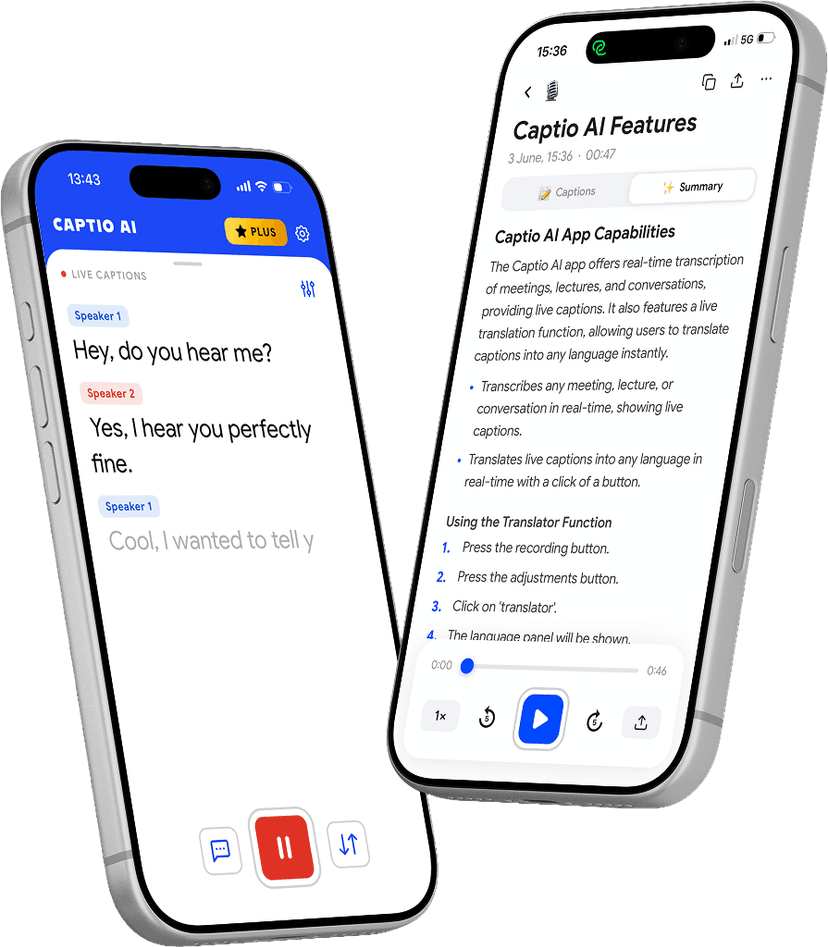
Everything you need to follow Bengali lectures
Four tools built for deaf and hard of hearing Bengali speakers.
Follow the lecture as it happens
- Captions appear word by word while the lecturer is still speaking
- Works in lecture halls, seminars, and tutorials
- No setup — place the phone on your desk and start
- Any accent, any pace
For courses in another language
- Captions and translates in real time
- For international students or foreign-language courses
- 60+ languages, no switching
- Follow the lecture in the language you read best
Full transcript to study from
- Record the lecture and upload it for a complete written transcript
- Searchable, copyable, shareable
- Review at your own pace after class
- Works on any lecture recording
Key points extracted automatically
- Important concepts and takeaways pulled from any transcript
- Organised into sections — not one continuous block
- Useful for revision and exam preparation
- Works on any saved lecture transcript
Download for free
Every situation covered
Designed for the real moments that matter — not just quiet controlled environments.
University lecture halls in Dhaka, Kolkata, Chittagong, and Rajshahi vary widely in acoustics and PA quality. Place your phone on the desk facing the PA speaker. Captio AI captions fast Bengali academic delivery from any seat.
Bengali university seminars switch between formal and colloquial registers. Students from different regions — Dhaka, Kolkata, Sylhet — contribute with phonetic variation. Captio AI follows whoever is speaking so you track every argument.
Bangladesh Open University, BUET, and Indian platform recordings host Bengali lectures. Auto-captions frequently fail on aspirated consonants and rapid speech. Put the lecture on speaker and point Captio AI at the audio for accurate captions.
Dormitory rooms, campus tea stalls, library tables in Dhaka or Kolkata. Fast conversational Bengali in revision sessions. Captio AI captions whoever is speaking so you follow every explanation without losing the thread.
Bengali students in English-medium courses, or international students at universities in Bangladesh and West Bengal. Live Translator captions in real time so language is not the barrier.
Visiting academics from Bangladesh, West Bengal, and the global Bengali diaspora. Bengali academic speakers draw from both Dhaka and Kolkata phonetic varieties. Captio AI covers any speaker at any campus without prior arrangement.
Most accurate and fastest models
word accuracy
independent benchmark, 2025
real-time captions
first word appears as you speak
Download for free

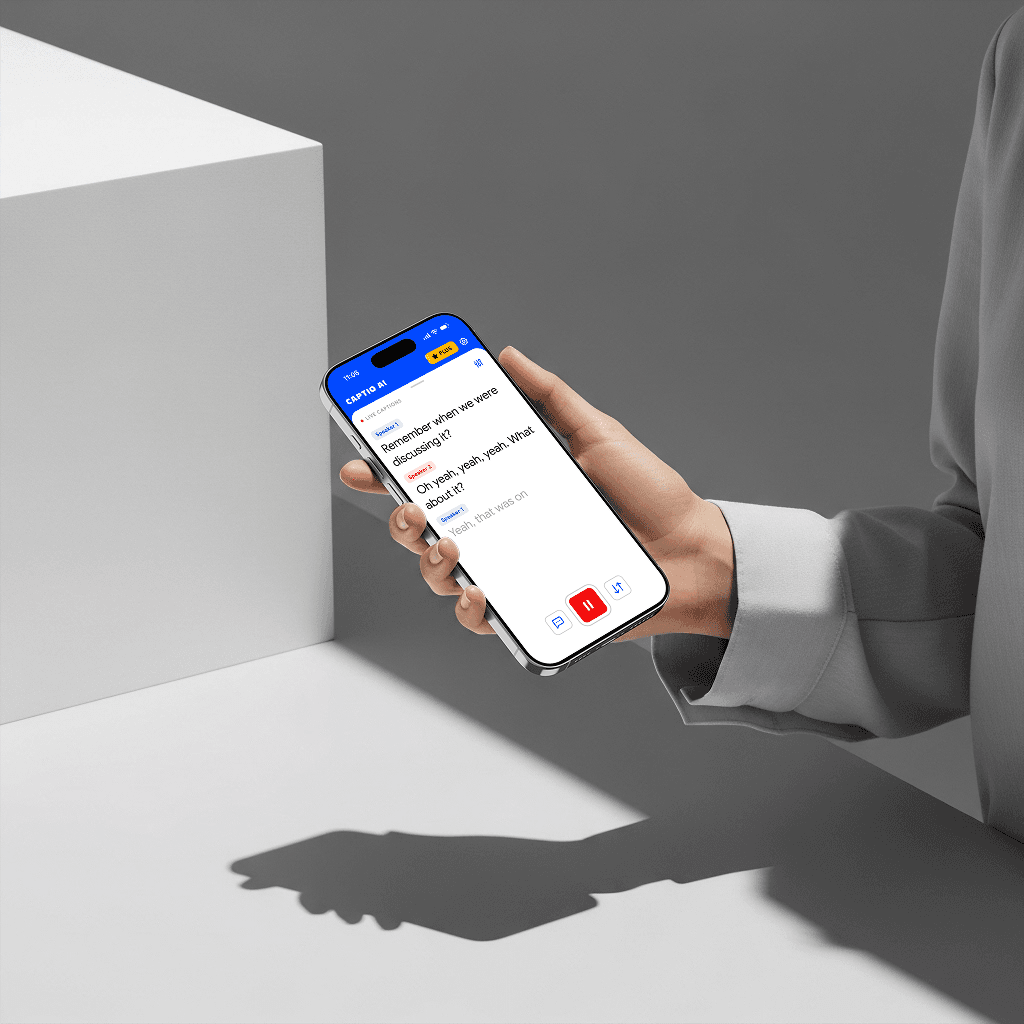
Built for the pace and pressure of a real lecture
Follow without splitting your attention
Lip-reading and note-taking at the same time is an impossible cognitive load. Captio AI handles the following so you can direct all your attention to understanding what is being said.
Captions while the lecturer is still speaking
Words appear on your screen as they are said — not after the sentence ends. You stay in sync with the lecture rather than always being a beat behind.
Works in any lecture setting
Lecture halls, seminar rooms, online classes, study groups. Place the phone on your desk, point it toward the audio source, and Captio AI handles the rest.
A full transcript to study from
Record the lecture and upload it to Audio Transcription after class. Get a complete written record you can search, annotate, and revise from — at your own pace.
60+ languages
For international students, students studying abroad, or courses taught in a second language. Captio AI captions or translates in real time with no manual setup.
No advance notice needed
Official university captioning requires booking in advance and is not available for every session. Captio AI works for any lecture, any time, with no prior arrangement.
Why Bengali is hard to understand
Aspirated stop grid
- Bengali has four stop variants that all look identical on the lips
- Bengali has a four-way contrast among stop consonants: voiceless unaspirated /p/, voiceless aspirated /pʰ/, voiced unaspirated /b/, and voiced breathy/aspirated /bʱ/. Aspiration is acoustic — a burst of air following the release. Voice quality (modal vs breathy) is acoustic. On the lips, all four variants look identical. In a Bengali lecture, a deaf student loses three of the four phonemic distinctions for every stop consonant in the sentence.
Retroflex vs dental
- Bengali retroflex consonants change meaning but produce no visible lip change
- Bengali distinguishes dental and retroflex consonant pairs: /t̪/ vs /ʈ/, /d̪/ vs /ɖ/, /n/ vs /ɳ/. The retroflex articulation involves the tongue curling back to touch the palate — far behind the lips, with no visible face movement. Academic and technical Bengali vocabulary uses retroflex consonants extensively. A deaf student lip-reading a Bengali lecturer cannot distinguish them from their dental equivalents.
Dhaka vs Kolkata dialect gap
- Eastern and Western Bengali produce different sounds from the same words
- Dhaka Bengali (Eastern variety) and Kolkata Bengali (Standard Western variety) differ substantially in vowel quality, word-final consonant realization, and phoneme inventories. A deaf student who has calibrated lip-reading to Kolkata Bengali will find a Dhaka-variety lecturer produces different visual patterns for the same words — and vice versa. At universities in Bangladesh and West Bengal, the lecturer's regional variety is not announced in advance.
Etymological layers
- Bengali academic vocabulary draws from Sanskrit, Persian, Arabic, and English — each with different mouth profiles
- Bengali academic lectures layer Sanskrit-derived (tatsama) vocabulary, Perso-Arabic borrowings, and English technical terms. Each etymological layer brings different phonological patterns and articulation profiles. A deaf student tracking a Bengali humanities lecture encounters Sanskrit compounds, Islamic terminology from Arabic and Persian, and English STEM terms — three distinct visual-speech systems in the same sentence.
Fast aspirated delivery
- At lecture speed, Bengali's aspirated inventory makes every stop consonant ambiguous
- Bengali academic speech at lecture pace runs fast with minimal pausing. Aspiration spreads to adjacent sounds and nasalization increases in fast speech. The already-invisible aspirated consonant inventory becomes harder to track when every stop potentially carries aspiration that only acoustics can confirm. A deaf student processing Bengali at lecture speed is working with degraded phonemic signal at the exact pace it is hardest to decode.
Download for free
Tens of millions of deaf and hard of hearing people across Bangladesh and West Bengal — with almost no lecture access
A landmark study of hearing loss in Bangladesh found that 9.6% of the population — approximately 13.7 million people based on the 2011 census — had a hearing loss of 40 dB or greater. More than 34% had any degree of hearing loss, representing approximately 49 million people across the country (PMC6349144). In West Bengal and across India's Bengali-speaking population, a 2011 census figure of 13.4 million individuals aged 15–59 with a hearing disability was reported — of whom 73.9% were classified as marginal workers, reflecting the depth of economic exclusion. The combined Bengali-speaking deaf and hard of hearing population across Bangladesh and India is among the largest linguistically cohesive deaf populations on earth.
The education gap begins early. In Bangladesh, hearing impairment carries moderate financial strain for 39% of families and causes moderate challenges in social participation for 47.5% of affected children (WHO EMRO, 2023). Both Bangladesh and the Indian state of West Bengal have severe shortages of sign language interpreters and specialist teachers for deaf education. Bangla Sign Language in Bangladesh and Indian Sign Language in West Bengal operate under different organisations, with no unified interpreter training pipeline that reaches higher education institutions.
A 2024 preprint studying online education and hearing status among students in Bangladesh found that even the expansion of digital learning platforms — intended to broaden access — introduced new barriers for students with hearing difficulties, as online lecture content rarely carries accurate captions in Bangla (medrxiv, 2024). In both countries, the deaf student who reaches university does so having navigated an education system with minimal specialist support — and encounters the lecture hall as another unsupported environment.
Download for free
What you hear stays with you.
Gone the moment it ends
Captio AI processes your audio in real time and discards it immediately. Nothing is recorded. Nothing is kept.
Not a product
Your conversations are not something Captio AI sells, shares, or monetizes — to anyone, for any reason.
Not used to train anything
What you say in a doctor's appointment or a job interview never ends up in a training dataset. Not ours. Not anyone else's.

Private by default
Captio AI supports 60+ languages
Download for free
Frequently asked questions
Follow every lecture in Bengali.
Captio AI is free to start
Download for free