

Afrikaans live captions and productivity tool for lectures
For deaf and hard of hearing people.
Download for free


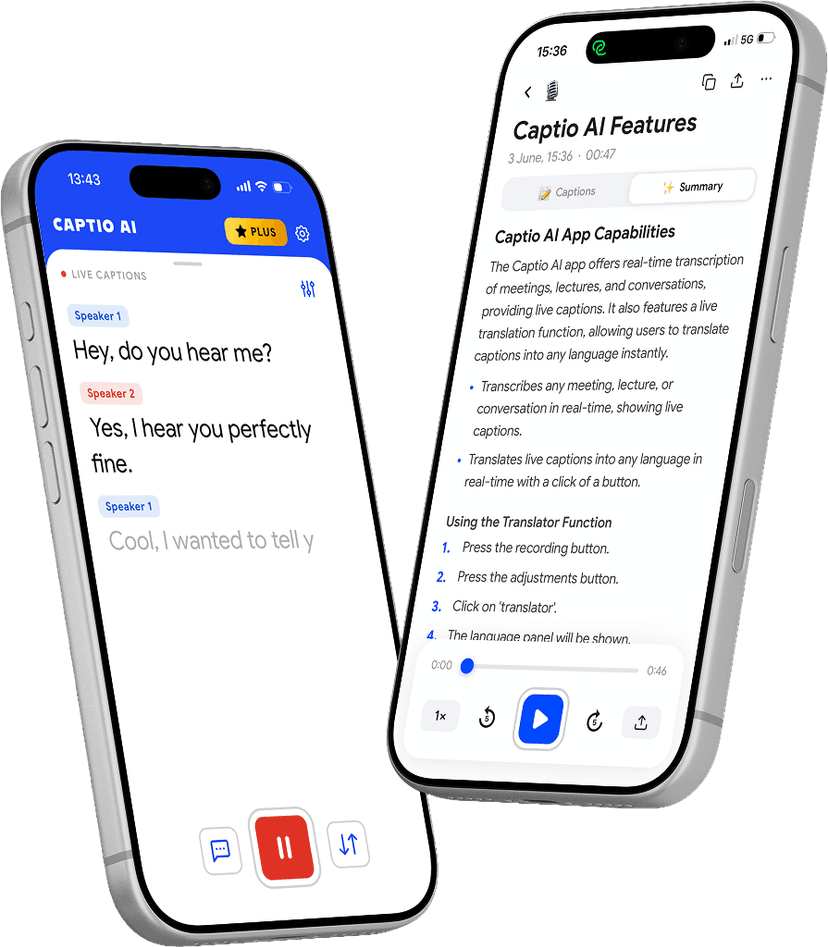
Everything you need to follow Afrikaans lectures
Four tools built for deaf and hard of hearing Afrikaans speakers.
Follow the lecture as it happens
- Captions appear word by word while the lecturer is still speaking
- Works in lecture halls, seminars, and tutorials
- No setup — place the phone on your desk and start
- Any accent, any pace
For courses in another language
- Captions and translates in real time
- For international students or foreign-language courses
- 60+ languages, no switching
- Follow the lecture in the language you read best
Full transcript to study from
- Record the lecture and upload it for a complete written transcript
- Searchable, copyable, shareable
- Review at your own pace after class
- Works on any lecture recording
Key points extracted automatically
- Important concepts and takeaways pulled from any transcript
- Organised into sections — not one continuous block
- Useful for revision and exam preparation
- Works on any saved lecture transcript
Download for free
Every situation covered
Designed for the real moments that matter — not just quiet controlled environments.
Large lecture halls at Stellenbosch University, University of the Free State, and North-West University — Afrikaans-medium instruction at full academic pace. Captio AI captions the professor in real time.
Seminars and werksgeleenthede (tutorial sessions) where discussion is in Afrikaans, often with English academic vocabulary. Captio AI handles both without manual switching.
Recorded lectures on university portals (SUNLearn, Blackboard) or shared as video files — play on speaker and Captio AI captions whatever is playing in real time.
Study groups reviewing Afrikaans lecture material in student accommodation. Captio AI captions whoever is speaking.
Lectures from Cape Afrikaans-speaking faculty whose Afrikaans carries Western Cape phonological features. Captio AI handles standard and Cape Afrikaans varieties.
Online courses and webinars delivered by Afrikaans-medium South African universities. Captio AI captions any audio source in real time.
Most accurate and fastest models
word accuracy
independent benchmark, 2025
real-time captions
first word appears as you speak
Download for free
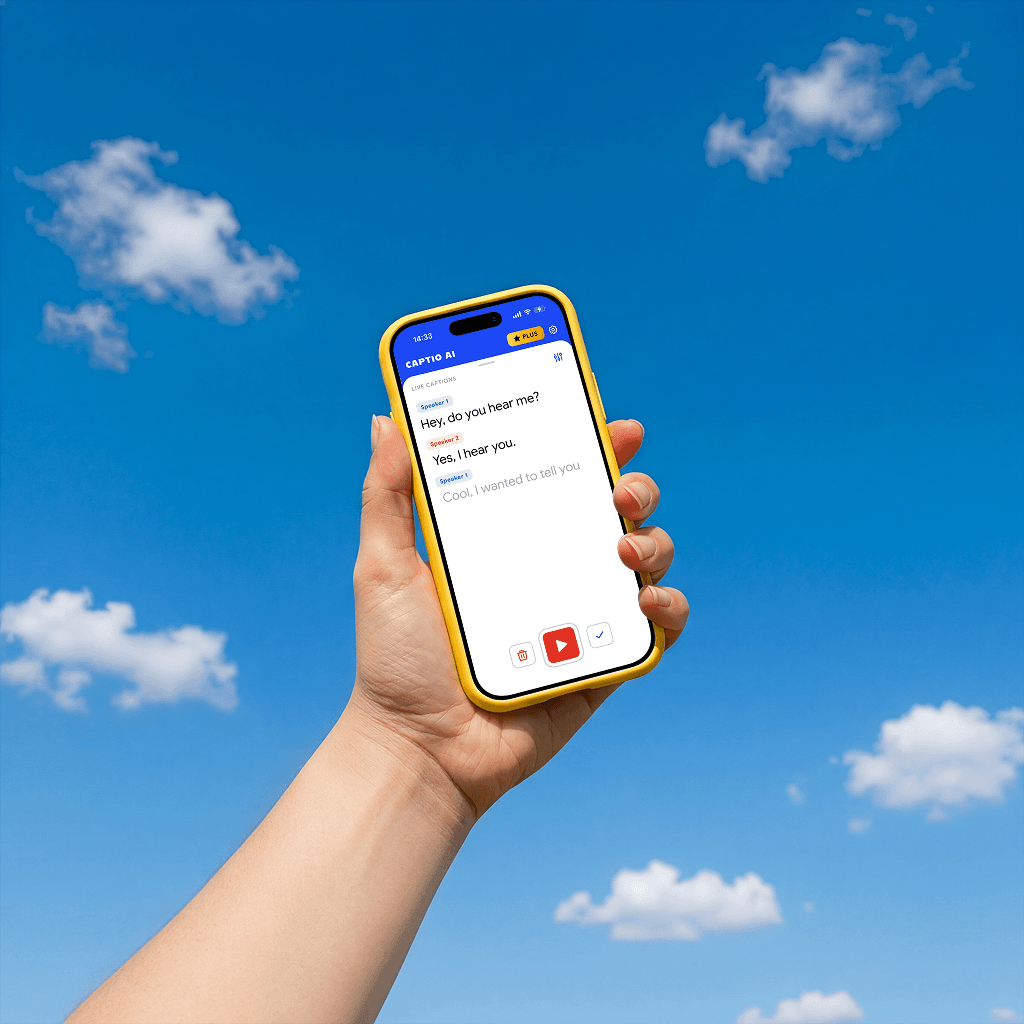
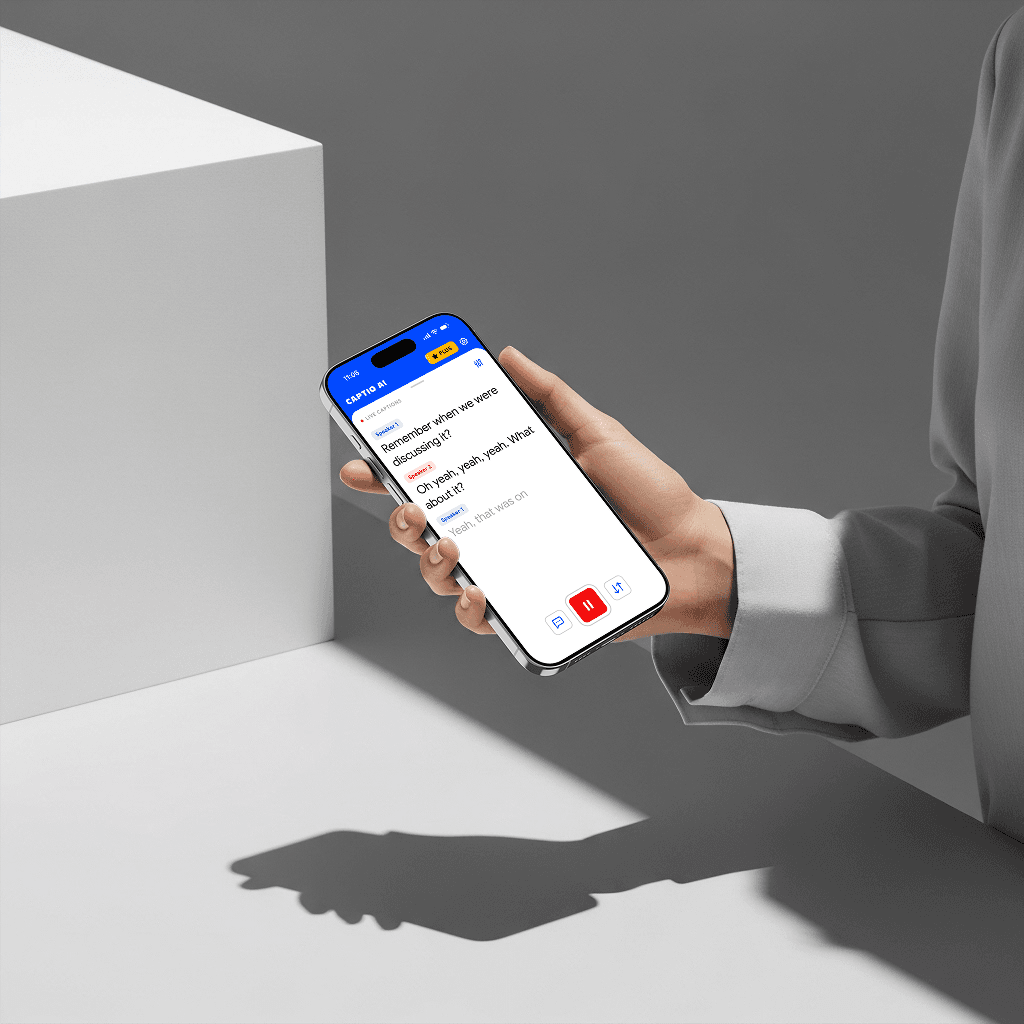
Built for the pace and pressure of a real lecture
Follow without splitting your attention
Lip-reading and note-taking at the same time is an impossible cognitive load. Captio AI handles the following so you can direct all your attention to understanding what is being said.
Captions while the lecturer is still speaking
Words appear on your screen as they are said — not after the sentence ends. You stay in sync with the lecture rather than always being a beat behind.
Works in any lecture setting
Lecture halls, seminar rooms, online classes, study groups. Place the phone on your desk, point it toward the audio source, and Captio AI handles the rest.
A full transcript to study from
Record the lecture and upload it to Audio Transcription after class. Get a complete written record you can search, annotate, and revise from — at your own pace.
60+ languages
For international students, students studying abroad, or courses taught in a second language. Captio AI captions or translates in real time with no manual setup.
No advance notice needed
Official university captioning requires booking in advance and is not available for every session. Captio AI works for any lecture, any time, with no prior arrangement.
Why Afrikaans is hard to understand
Diphthong inventory
- Afrikaans has seven diphthongs — at lecture speed these glides compress into one lip shape
- Afrikaans has one of the largest diphthong inventories in the Germanic languages — seven diphthongs out of a 17-vowel phoneme system. Each diphthong is a gliding movement between two vowel positions. At full lecture speed, the glide trajectory compresses: a deaf student tracking the starting and ending position has a fraction of a second to register both before the next word arrives.
Cape Afrikaans divergence
- Cape Afrikaans vowel quality differs from standard Afrikaans — two different lip patterns for the same words
- Cape Malay-influenced Afrikaans, spoken in the Western Cape and Cape Flats, differs from standard Afrikaans in vowel quality and some phonological processes. At Stellenbosch University in the Winelands and the University of the Western Cape in Bellville, the same written Afrikaans word can arrive with different vowel lip shapes depending on which variety the lecturer speaks.
Afrikaans-English code-switching
- South African academic discourse mixes Afrikaans and English within the same sentence
- South African universities — even those with Afrikaans as a medium of instruction — operate in a pervasively bilingual Afrikaans-English environment. Lectures in Afrikaans shift to English for technical vocabulary, quotations, and often whole explanations. For a deaf student, this switching happens with no visual warning — two phonological systems in rapid alternation.
Uvular /r/ in some varieties
- Some Afrikaans speakers use a uvular /r/ — throat-produced and invisible on the lips
- A subset of Afrikaans speakers, particularly in some Western Cape communities, use a uvular /R/ rather than the alveolar /r/ of standard Afrikaans. This uvular realisation is produced at the back of the throat with no lip movement. For a deaf student, the word-initial and word-medial /r/ sounds arrive as either a visible alveolar tap or an invisible throat resonance depending on the lecturer.
Nasal vowel assimilation
- Some Afrikaans dialects nasalize vowels before nasal consonants — invisible on the lips
- As in Dutch (from which Afrikaans derives), some Afrikaans dialects nasalize the vowel before a nasal consonant, sometimes deleting the nasal entirely. 'Man' may arrive with a nasalized vowel rather than a final nasal consonant. Nasalization is an acoustic property with no visual correlate — a deaf student sees the same lip shape for the oral and nasal version of the vowel.
Download for free
12 million South Africans with hearing loss — and SASL recognised only in 2023
An estimated 12 million South Africans are affected by some degree of hearing loss, including approximately 4 million with hearing disabilities — one of the largest hearing-impaired populations in Sub-Saharan Africa. A 2018 study published in African Health Sciences (PMC6306974) found hearing loss prevalence of 17.5% at primary health care clinics in South Africa, with the majority of losses bilateral and sensorineural. Rural Limpopo Province had a prevalence of 19.88%, highlighting how geography compounds access to audiological care.
South African Sign Language (SASL) was recognised as the 12th official language of South Africa only in 2023 — a constitutional amendment decades after deaf communities had campaigned for recognition. Despite 4 million people with hearing disabilities, fewer than 600,000 use SASL, reflecting both the diversity of communication modes among South African deaf and hard of hearing people, and the limited sign language education historically provided. South African universities are required to accommodate students with disabilities, but systematic live captioning for deaf students in Afrikaans-medium lectures is not standard practice.
The Afrikaans-speaking deaf community is additionally navigating a system in which language politics shape institutional practice: Stellenbosch and the University of the Free State are the primary Afrikaans-medium institutions, and their deaf students attend lectures in a language that is among the harder West Germanic languages to lip-read at speed. Captio AI captions Afrikaans lecture speech in real time — in a Stellenbosch seminar room or a UFS lecture theatre — handling standard and Cape Afrikaans varieties in the same session.
[1]Prevalence of hearing loss at primary health care clinics in South Africa — PMC6306974, 2018
[2]Prevalence and impact of hearing loss in South Africa — NCPD
[3]South Africa's SASL recognition as 12th official language — background
[4]GBD 2019 — Hearing loss prevalence and years lived with disability (PMC7960691)
Download for free
What you hear stays with you.
Gone the moment it ends
Captio AI processes your audio in real time and discards it immediately. Nothing is recorded. Nothing is kept.
Not a product
Your conversations are not something Captio AI sells, shares, or monetizes — to anyone, for any reason.
Not used to train anything
What you say in a doctor's appointment or a job interview never ends up in a training dataset. Not ours. Not anyone else's.

Private by default
Captio AI supports 60+ languages
Download for free
Frequently asked questions
Follow every lecture in Afrikaans.
Captio AI is free to start
Download for free