

Turkish live captions and productivity tool for lectures
For deaf and hard of hearing people.
Download for free


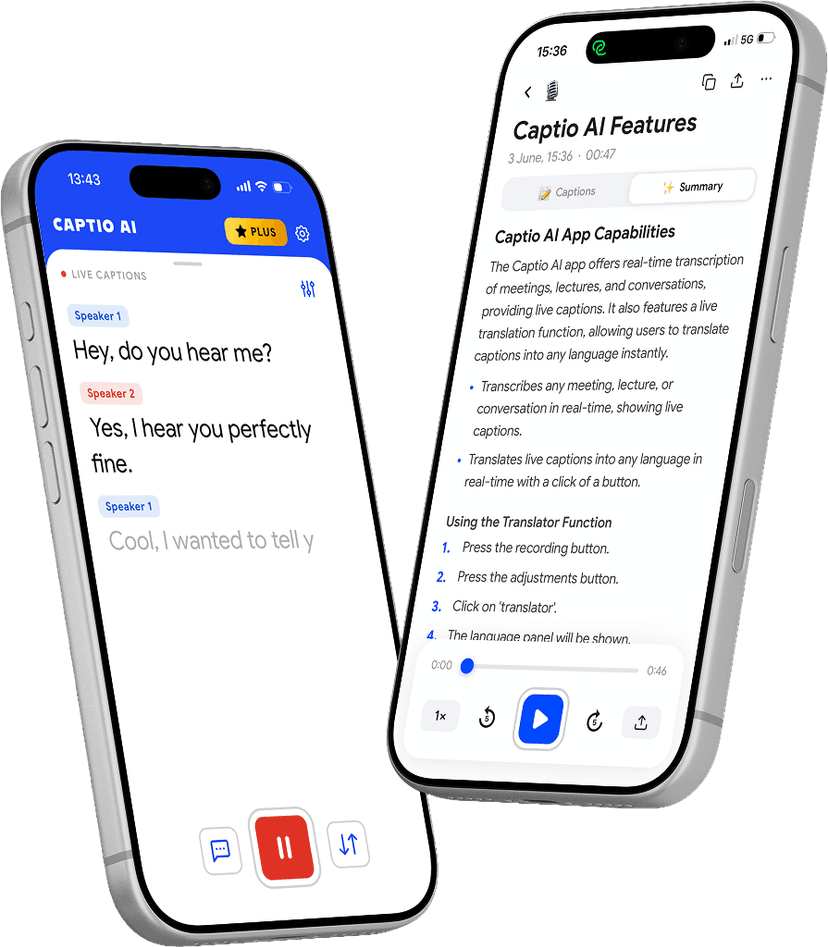
Everything you need to follow Turkish lectures
Four tools built for deaf and hard of hearing Turkish speakers.
Follow the lecture as it happens
- Captions appear word by word while the lecturer is still speaking
- Works in lecture halls, seminars, and tutorials
- No setup — place the phone on your desk and start
- Any accent, any pace
For courses in another language
- Captions and translates in real time
- For international students or foreign-language courses
- 60+ languages, no switching
- Follow the lecture in the language you read best
Full transcript to study from
- Record the lecture and upload it for a complete written transcript
- Searchable, copyable, shareable
- Review at your own pace after class
- Works on any lecture recording
Key points extracted automatically
- Important concepts and takeaways pulled from any transcript
- Organised into sections — not one continuous block
- Useful for revision and exam preparation
- Works on any saved lecture transcript
Download for free
Every situation covered
Designed for the real moments that matter — not just quiet controlled environments.
Boğaziçi University, ODTÜ, Istanbul University, and Hacettepe lecture halls. Turkish-medium lectures in fast academic Turkish with Istanbul standard and regional variety. Place the phone on the desk facing the speaker. Captio AI captions from any row.
Turkish university seminars mixing academic Turkish and English in discussion. Students from different Turkish regions contributing with varying regional phonetics. Captio AI captions whoever is speaking.
Recorded lectures on university portals, Zoom recordings, or YouTube academic channels. Put the recording on speaker and point Captio AI at the audio for accurate captions in real time.
Study groups in Istanbul, Ankara, or Izmir — fast conversational Turkish mixed with English. Captio AI follows whoever is explaining and handles code-switching without any adjustment.
Turkish students in English-medium programmes, or international students at Turkish universities. Live Translator captions in real time so language is not the access barrier.
Visiting academics and guest speakers. Turkish university talks draw speakers from across Turkey's 81 provinces. Captio AI handles Istanbul, Anatolian, Black Sea, and eastern Turkish — any speaker at any venue.
Most accurate and fastest models
word accuracy
independent benchmark, 2025
real-time captions
first word appears as you speak
Download for free
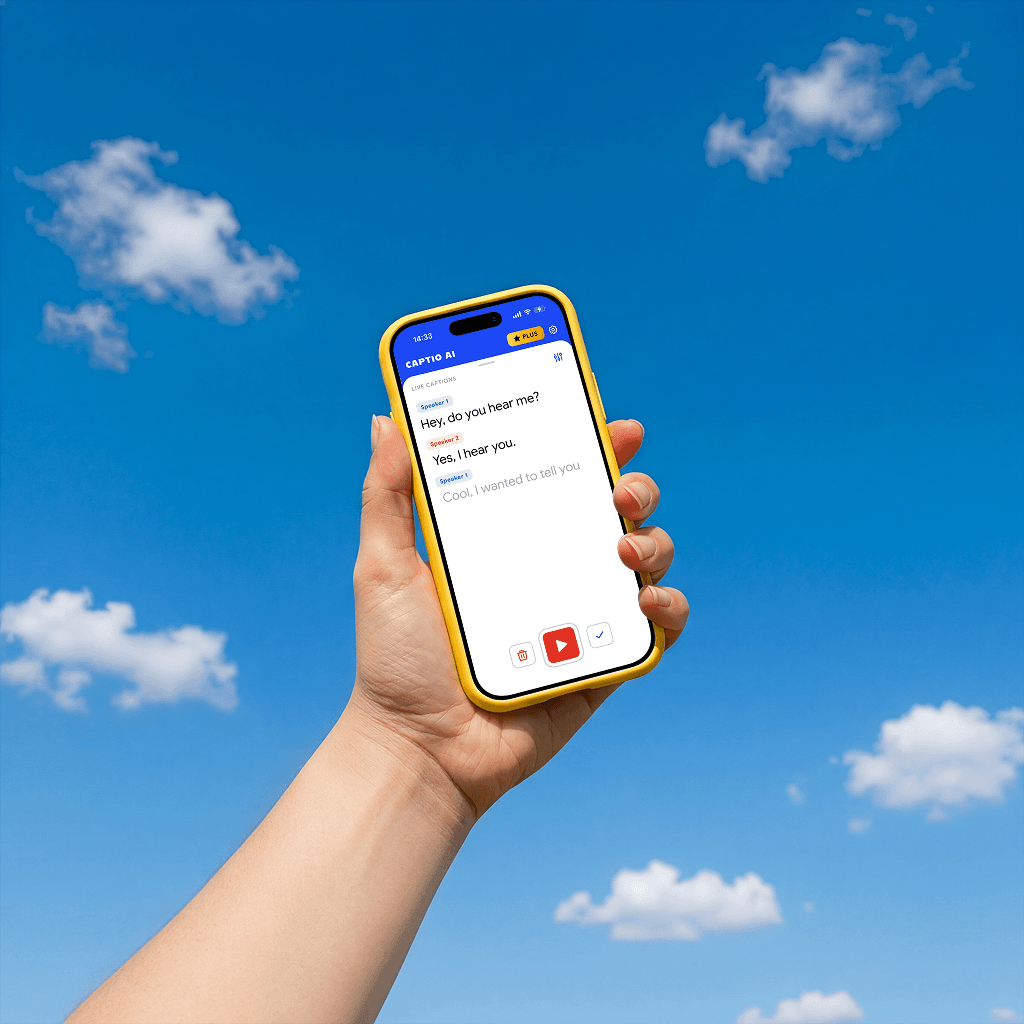
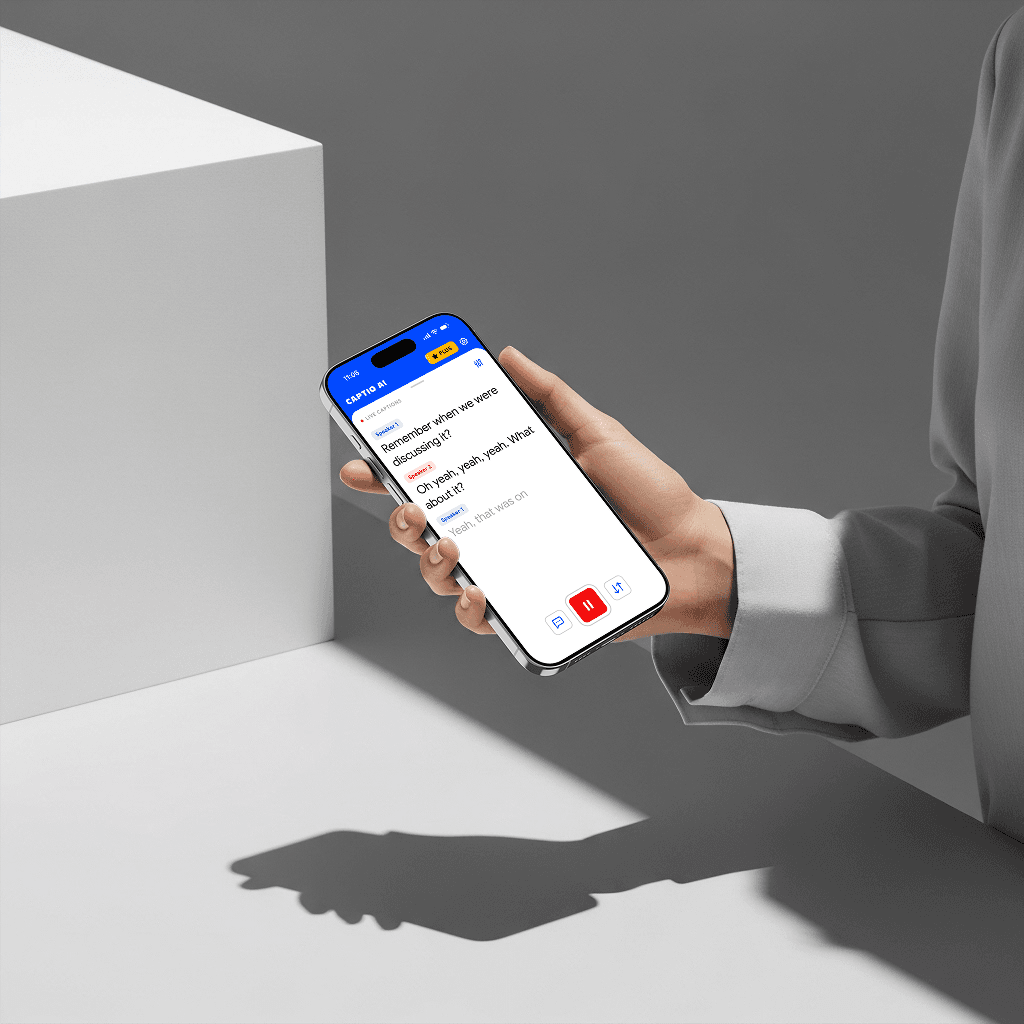
Built for the pace and pressure of a real lecture
Follow without splitting your attention
Lip-reading and note-taking at the same time is an impossible cognitive load. Captio AI handles the following so you can direct all your attention to understanding what is being said.
Captions while the lecturer is still speaking
Words appear on your screen as they are said — not after the sentence ends. You stay in sync with the lecture rather than always being a beat behind.
Works in any lecture setting
Lecture halls, seminar rooms, online classes, study groups. Place the phone on your desk, point it toward the audio source, and Captio AI handles the rest.
A full transcript to study from
Record the lecture and upload it to Audio Transcription after class. Get a complete written record you can search, annotate, and revise from — at your own pace.
60+ languages
For international students, students studying abroad, or courses taught in a second language. Captio AI captions or translates in real time with no manual setup.
No advance notice needed
Official university captioning requires booking in advance and is not available for every session. Captio AI works for any lecture, any time, with no prior arrangement.
Why Turkish is hard to understand
Agglutinative suffix loss
- Turkish agglutination builds long words from many suffixes — missing any one suffix changes the meaning entirely
- Turkish is agglutinative: meaning is encoded in chains of suffixes attached to a root word. Gelememişsiniz (you were apparently unable to come) — six morphemes in one word, each suffix carrying grammatical information. On the lips, the root may be recoverable, but the suffix chain is a continuous stream of short vowels and consonants with little visual differentiation. In a lecture, the suffixes carry the tense, negation, evidentiality, and person information — all of it systematically difficult to lip-read.
Vowel harmony invisibility
- Turkish vowel harmony changes every suffix systematically — but front/back vowel distinction produces very similar lip shapes
- Turkish vowel harmony requires all vowels in a word to agree in frontness and rounding: in a word with a front vowel root (ev, house), all suffixes take front vowels (evde, at home; evler, houses). On the lips, the front/back distinction looks nearly identical — both /e/ and /a/ require similar lip opening and spread. A deaf student cannot recover the harmony class from lip shape alone, making suffix prediction from lip movement fundamentally ambiguous.
Silent ğ
- The Turkish soft-g (ğ) is effectively silent — an invisible phoneme that lengthens the preceding vowel
- Turkish ğ (yumuşak g, soft-g) is not pronounced as a consonant in standard Istanbul Turkish — it functions as a vowel lengthener between vowels. Dağ (mountain) sounds like /daː/; değil (not) sounds like /deːl/. On the lips, ğ is invisible. A deaf student lip-reading a Turkish lecturer cannot distinguish words where ğ appears from words where it does not — yet the difference carries lexical meaning.
Regional accent divergence
- Istanbul Turkish, Anatolian varieties, Black Sea, and Kurdish-influenced eastern Turkish all have different lip profiles
- Standard Turkish is based on Istanbul, but Turkish universities draw professors from across 81 provinces. Anatolian regional accents retain consonant realizations absent from Istanbul standard. Black Sea Turkish (Laz-substrate) has distinct sibilants. Eastern Turkish carries Kurdish prosodic influence. A deaf student calibrated to Istanbul standard encounters different lip patterns in every lecture from a professor with a different regional background.
Academic Ottoman-Turkish vocabulary
- Formal academic Turkish uses Ottoman-derived terminology that differs phonologically from colloquial spoken Turkish
- Academic lectures in Turkish humanities, law, and medicine use formal Ottoman-derived vocabulary (müdahale, intervention; müzakere, deliberation; hüküm, judgment) that sounds phonologically different from everyday Turkish — including unfamiliar consonant clusters and vowel sequences. Turkish Sign Language was banned until 2005, meaning the academic deaf community spent decades in an oral-only educational tradition using formal vocabulary that was never made visually accessible.
Download for free
Turkey's million deaf and hard of hearing — navigating universities built around hearing
Turkey's Statistical Institute (TÜİK) surveys have documented that hearing loss accounts for 5.9% of all disability registrations in Turkey. Separately, approximately 1,300–2,600 infants are born with congenital hearing loss in Turkey each year out of approximately 1.3 million annual births. These figures, combined with age-related and acquired hearing loss, indicate a substantial deaf and hard of hearing population navigating daily life — including university education — without systemic support. A study published in PMC (PMC6794910) on the age of intervention for Turkish children with hearing and speech disorders found significant delays in identification, meaning many students reach university with late-diagnosed or undermanaged hearing loss.
Turkish Sign Language (Türk İşaret Dili, TİD) was banned for much of the twentieth century under oralism policies that presumed sign language hindered lip-reading learning. The ban was lifted in 2005 with the Law on Disabled Individuals (Law 5378), which also recognized TİD formally. Turkey ratified the UN Convention on the Rights of Persons with Disabilities in 2009. However, access to TİD interpretation at universities remains geographically limited, and systematic real-time captioning in Turkish university lecture halls does not exist as a standard provision. Most deaf and hard of hearing students negotiate accommodation individually with their faculties.
The GBD 2019 study estimated that hearing loss globally affected 1.57 billion people, with Turkey's Middle East and North Africa region carrying a significant burden. For Turkish universities, the practical consequence is that deaf and hard of hearing students sit in lecture halls where the content is delivered in academic Turkish — a phonologically demanding, agglutinative language with heavy suffix load, Ottoman-derived vocabulary, and regional accent variation — with no real-time text access and a sign language interpreter provision that is sparse outside Istanbul and Ankara.
Download for free
What you hear stays with you.
Gone the moment it ends
Captio AI processes your audio in real time and discards it immediately. Nothing is recorded. Nothing is kept.
Not a product
Your conversations are not something Captio AI sells, shares, or monetizes — to anyone, for any reason.
Not used to train anything
What you say in a doctor's appointment or a job interview never ends up in a training dataset. Not ours. Not anyone else's.

Private by default
Captio AI supports 60+ languages
Download for free
Frequently asked questions
Follow every lecture in Turkish.
Captio AI is free to start
Download for free