

Catalan live captions and productivity tool for lectures
For deaf and hard of hearing people.
Download for free


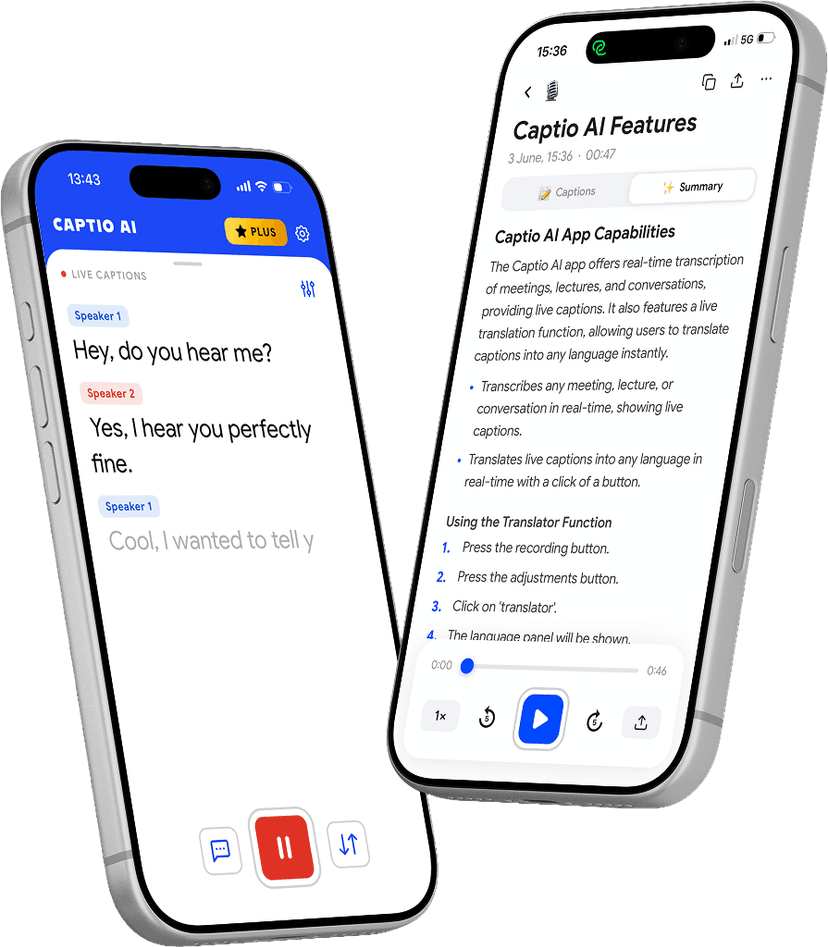
Everything you need to follow Catalan lectures
Four tools built for deaf and hard of hearing Catalan speakers.
Follow the lecture as it happens
- Captions appear word by word while the lecturer is still speaking
- Works in lecture halls, seminars, and tutorials
- No setup — place the phone on your desk and start
- Any accent, any pace
For courses in another language
- Captions and translates in real time
- For international students or foreign-language courses
- 60+ languages, no switching
- Follow the lecture in the language you read best
Full transcript to study from
- Record the lecture and upload it for a complete written transcript
- Searchable, copyable, shareable
- Review at your own pace after class
- Works on any lecture recording
Key points extracted automatically
- Important concepts and takeaways pulled from any transcript
- Organised into sections — not one continuous block
- Useful for revision and exam preparation
- Works on any saved lecture transcript
Download for free
Every situation covered
Designed for the real moments that matter — not just quiet controlled environments.
Large lecture theatres at UB, UAB, UPC, and UPF — where courses are delivered in Catalan at academic pace by lecturers from across the Catalan lands, including Valencian or Balearic visiting professors whose vowel systems differ from standard Central Catalan.
Seminars and tutorials in Catalan departments — small discussion sessions where students present in Catalan and debate code-switches freely between Catalan and Spanish, with lip shapes changing mid-sentence.
Online and recorded lectures on Moodle or institutional portals — Catalan university content delivered asynchronously, where acoustic cues are the only signal and vowel-reduced Catalan is impossible to follow without captions.
Study groups in Catalan — where peer discussion moves between Catalan and Spanish freely, and the informal contractions of spoken Catalan compress further in casual peer speech.
International and Erasmus courses taught in Catalan — where non-native Catalan-speaking students deliver presentations with non-standard pronunciation and reduced control of vowel reduction rules.
Guest speakers at Catalan institutions — public talks by politicians, researchers, or cultural figures whose regional Catalan variety (Mallorcan, Valencian, northern) differs from what the student has calibrated to.
Most accurate and fastest models
word accuracy
independent benchmark, 2025
real-time captions
first word appears as you speak
Download for free
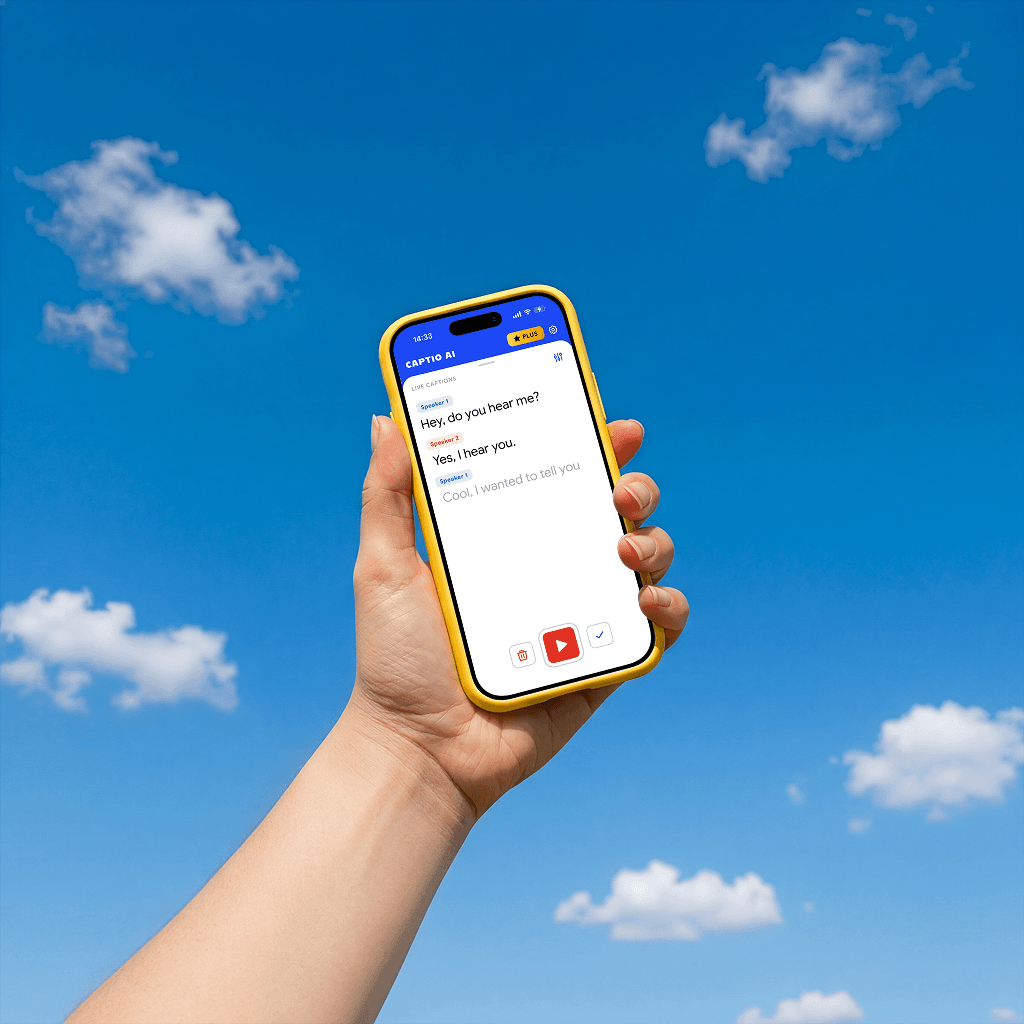
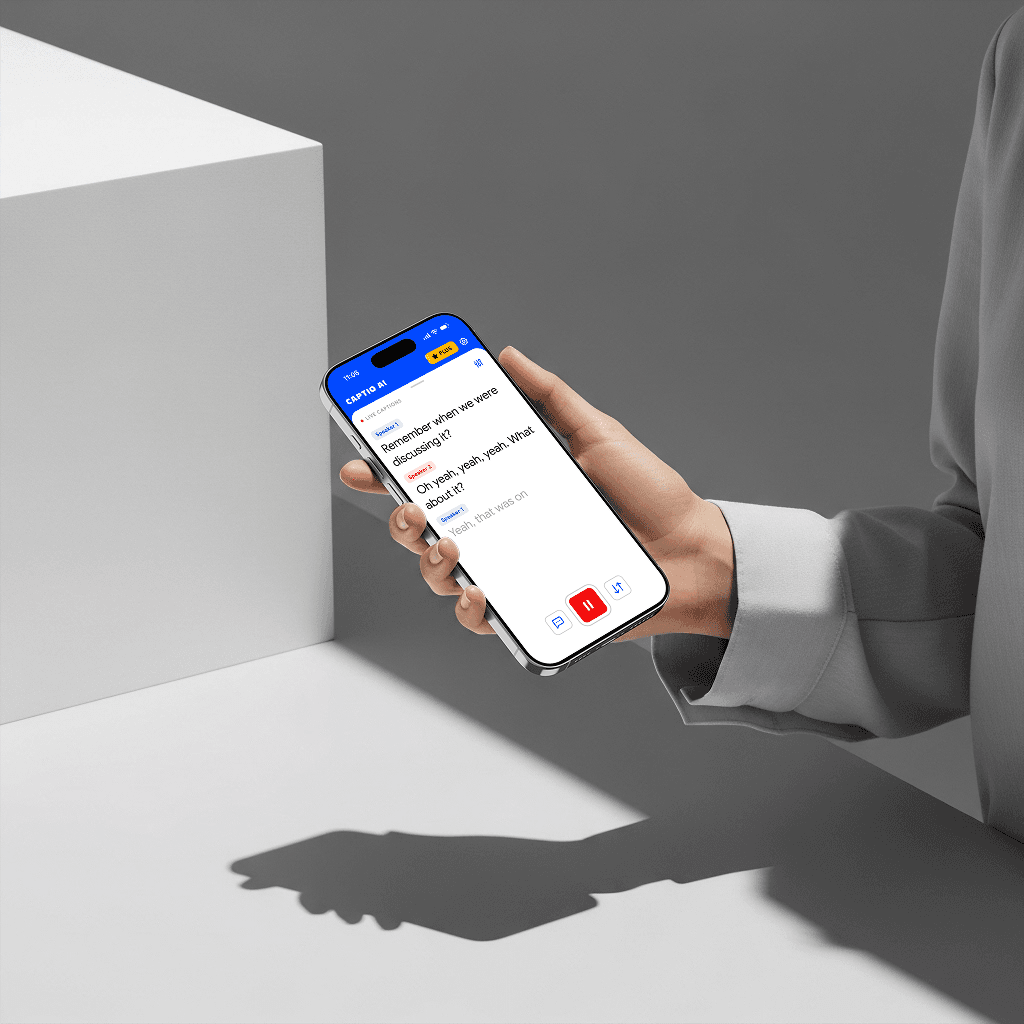
Built for the pace and pressure of a real lecture
Follow without splitting your attention
Lip-reading and note-taking at the same time is an impossible cognitive load. Captio AI handles the following so you can direct all your attention to understanding what is being said.
Captions while the lecturer is still speaking
Words appear on your screen as they are said — not after the sentence ends. You stay in sync with the lecture rather than always being a beat behind.
Works in any lecture setting
Lecture halls, seminar rooms, online classes, study groups. Place the phone on your desk, point it toward the audio source, and Captio AI handles the rest.
A full transcript to study from
Record the lecture and upload it to Audio Transcription after class. Get a complete written record you can search, annotate, and revise from — at your own pace.
60+ languages
For international students, students studying abroad, or courses taught in a second language. Captio AI captions or translates in real time with no manual setup.
No advance notice needed
Official university captioning requires booking in advance and is not available for every session. Captio AI works for any lecture, any time, with no prior arrangement.
Why Catalan is hard to understand
Vowel reduction
- Central Catalan collapses three unstressed vowels into a single schwa
- In standard Central Catalan, the sounds /a/, /ɛ/, and /e/ all merge into the same schwa [ə] when unstressed. A lecturer at UB or UPC speaking at pace leaves a deaf student with a drastically reduced set of lip positions — three distinct vowel sounds become one, and words that looked distinguishable in slow speech blur into near-identical mouth shapes at the speed of a university lecture.
Eastern–Western split
- Valencian and Balearic Catalan vowel systems differ entirely from Central Catalan
- Eastern Catalan (Barcelona) and Western varieties (Lleida, Valencia, Mallorca) have different vowel inventories and stress patterns. A Valencian lecturer invited to a Catalan seminar speaks a variety where those collapsed schwas reappear as full vowels — and where the rhythm of syllables is different enough that lip-reading cues built up in one variety don't transfer to the other.
Palatal cluster invisibility
- The digraphs ll, ny, l·l produce sounds with no visible lip movement
- Catalan uses palatal consonants like /ʎ/ (ll), /ɲ/ (ny), and the lateral /l·l/ — all produced at the hard palate with little or no lip movement. In a seminar at the Universitat Autònoma de Barcelona, words like llum, anys, or intel·ligent carry essential meaning in sounds a lip-reader cannot see.
Clitic contraction
- Spoken Catalan contracts articles and clitics into chains with no visible word boundary
- Catalan spoken at academic pace contracts definite articles (l'home, l'any), clitics, and vowel-initial words into continuous chains. A run like 'l'he vist i l'han dit' becomes overlapping lip shapes with no visible pause or boundary, and a deaf student has no visual signal of where one word ends and the next begins.
Catalan–Spanish code-switching
- Lectures shift mid-sentence between Catalan and Spanish
- In Catalan universities, many lecturers mix Catalan and Spanish within the same sentence — especially when citing sources, addressing administrative topics, or quoting external researchers. A deaf student must process both phonological systems simultaneously with no reliable visual signal that the language has changed.
Download for free
12,000 deaf LSC signers in Catalonia — and a sign language recognized since 1994 that still lacks systematic university provision
Catalan Sign Language (Llengua de Signes Catalana, LSC) is used by approximately 12,000 deaf people in the Catalan lands, with around 25,000 total users including hearing signers and interpreters, according to estimates from the Catalan Federation for the Deaf (FESOCA). Catalonia was the first autonomous community in Spain to pass a sign language law — in 1994, a full 13 years before Spain's national sign language law — and LSC was further reinforced by the Catalan Sign Language Act of 2010, which gave the Institut d'Estudis Catalans regulatory authority over the language.
Despite this early recognition, systematic provision for deaf and hard of hearing students in Catalan universities remains underdeveloped. The 2010 LSC Act established rights but did not mandate live captioning or LSC interpreting in lecture settings. Deaf students in Catalan universities navigate a support system that is institution-dependent and largely reactive — they must request accommodation individually, and provision varies sharply between faculties and between universities.
Spain as a whole has approximately 1,064,000 people who are deaf or have some hearing disability — 2.3% of the national population according to the National Statistics Institute (EDAD 2008). For a deaf student at UB, UAB, or UPC struggling to follow a lecture delivered with the schwa-heavy phonology of Central Catalan at speed, Captio AI provides real-time captions in Catalan, keeping up with the vowel reductions and palatal clusters that make lip-reading insufficient.
[1]Catalan Sign Language — Wikipedia (25,000 users, 12,000 deaf signers in Catalonia)
[2]The Deaf Community in Spain — CNSE (1,064,000 deaf or hearing disabled in Spain)
[3]Spain — European Union of the Deaf (EUD member, sign language recognition)
[4]GBD 2019 — Hearing loss prevalence and years lived with disability (PMC7960691)
Download for free
What you hear stays with you.
Gone the moment it ends
Captio AI processes your audio in real time and discards it immediately. Nothing is recorded. Nothing is kept.
Not a product
Your conversations are not something Captio AI sells, shares, or monetizes — to anyone, for any reason.
Not used to train anything
What you say in a doctor's appointment or a job interview never ends up in a training dataset. Not ours. Not anyone else's.

Private by default
Captio AI supports 60+ languages
Download for free
Frequently asked questions
Follow every lecture in Catalan.
Captio AI is free to start
Download for free