

Vietnamese live captions and productivity tool for lectures
For deaf and hard of hearing people.
Download for free


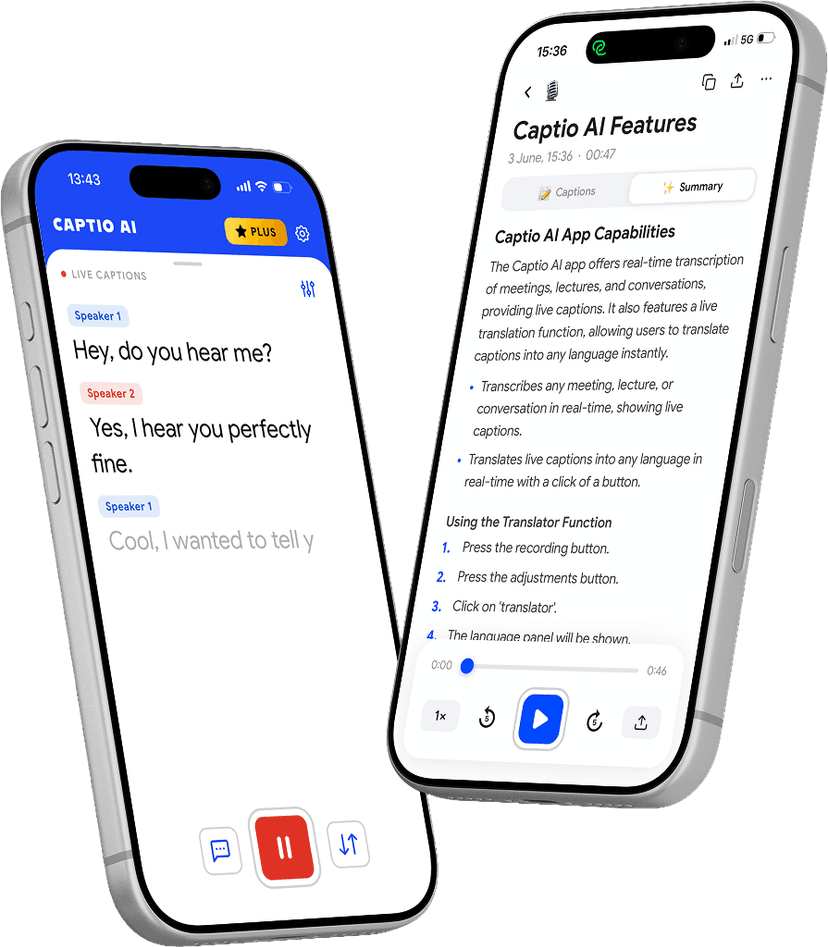
Everything you need to follow Vietnamese lectures
Four tools built for deaf and hard of hearing Vietnamese speakers.
Follow the lecture as it happens
- Captions appear word by word while the lecturer is still speaking
- Works in lecture halls, seminars, and tutorials
- No setup — place the phone on your desk and start
- Any accent, any pace
For courses in another language
- Captions and translates in real time
- For international students or foreign-language courses
- 60+ languages, no switching
- Follow the lecture in the language you read best
Full transcript to study from
- Record the lecture and upload it for a complete written transcript
- Searchable, copyable, shareable
- Review at your own pace after class
- Works on any lecture recording
Key points extracted automatically
- Important concepts and takeaways pulled from any transcript
- Organised into sections — not one continuous block
- Useful for revision and exam preparation
- Works on any saved lecture transcript
Download for free
Every situation covered
Designed for the real moments that matter — not just quiet controlled environments.
Vietnam National University Hanoi, HCMC National University, and polytechnics. Vietnamese-medium lectures at academic pace. Place the phone on the desk facing the speaker. Captio AI captions from any row in Northern or Southern Vietnamese.
University seminar discussions blending Vietnamese and English in technical content. Students from Hanoi, Ho Chi Minh City, and the provinces contributing with different tonal varieties. Captio AI captions whoever is speaking.
Recorded lectures on university portals, Coursera Vietnam, or Ruangguru-style platforms. Put the recording on speaker and point Captio AI at the audio for accurate captions in real time.
Study groups in Hanoi or Ho Chi Minh City — fast conversational Vietnamese mixed with English. Captio AI follows whoever is explaining, whether Northern or Southern tonal variety.
Vietnamese students in English-medium programmes, or international students at Vietnamese universities. Live Translator captions in real time so language is not the access barrier.
Guest speakers from industry and visiting academics. Captio AI handles Hanoi Vietnamese, Ho Chi Minh City Vietnamese, and Central Vietnamese varieties — any speaker at any venue.
Most accurate and fastest models
word accuracy
independent benchmark, 2025
real-time captions
first word appears as you speak
Download for free


Built for the pace and pressure of a real lecture
Follow without splitting your attention
Lip-reading and note-taking at the same time is an impossible cognitive load. Captio AI handles the following so you can direct all your attention to understanding what is being said.
Captions while the lecturer is still speaking
Words appear on your screen as they are said — not after the sentence ends. You stay in sync with the lecture rather than always being a beat behind.
Works in any lecture setting
Lecture halls, seminar rooms, online classes, study groups. Place the phone on your desk, point it toward the audio source, and Captio AI handles the rest.
A full transcript to study from
Record the lecture and upload it to Audio Transcription after class. Get a complete written record you can search, annotate, and revise from — at your own pace.
60+ languages
For international students, students studying abroad, or courses taught in a second language. Captio AI captions or translates in real time with no manual setup.
No advance notice needed
Official university captioning requires booking in advance and is not available for every session. Captio AI works for any lecture, any time, with no prior arrangement.
Why Vietnamese is hard to understand
Six invisible tones
- Vietnamese has six tones in the Northern dialect — every single one is invisible on the lips
- Northern Vietnamese distinguishes six tones: flat (ngang), falling (huyền), rising-glottalized (sắc), falling-glottalized (nặng), dipping (hỏi), and creaky-rising (ngã). These tones differ by pitch height, pitch direction, phonation type (modal vs. creaky vs. breathy), and length — none of which is visible on the speaker's lips. The word 'ma' means six entirely different things depending on tone. In a lecture, every syllable is a potential ambiguity.
North-South tonal split
- Southern Vietnamese collapses six tones to five — and the words that merge are different from what Northern speakers merge
- Southern Vietnamese merges the ngã (creaky-rising) and hỏi (dipping) tones into a single realization, leaving five tones. This creates genuine ambiguity between Northern and Southern speech: words that are distinct in Hanoi are homophones in Saigon, and vice versa. A deaf student calibrated to Hanoi Vietnamese encounters a different tonal landscape in a lecture delivered by a Ho Chi Minh City-trained professor. Both systems are invisible on the lips — but they are invisible in different ways.
Consonant inventory divergence
- Northern and Southern Vietnamese have different initial consonant inventories — and lip-read patterns differ between them
- Northern Vietnamese distinguishes /v/ from /j/ (the letter 'gi'), /z/ from /ʒ/ (the letters 'r'), and /ʔ/ (initial glottal stop). Southern Vietnamese merges many of these — /v/ and /j/ both become /j/, /z/ and /ʒ/ both become /j/ or /v/ depending on context. A deaf student who has practised reading Northern Vietnamese lips encounters different movements for the same written words when a Southern-trained lecturer speaks.
Monosyllabic density
- Vietnamese is monosyllabic — every syllable is a potential word, making segmentation by visual cues alone impossible
- Vietnamese words are almost entirely monosyllabic. A sentence flows as a rapid sequence of syllables, each potentially carrying independent meaning. There are no multi-syllable word shapes to anchor lip-reading: no visual difference between a word boundary and a syllable within a word. In a lecture, this produces a visual stream with no segmentation cues — a deaf student who misses one syllable loses the entire semantic unit.
Sino-Vietnamese academic register
- Academic Vietnamese uses Sino-Vietnamese vocabulary with different phonological shapes from everyday speech
- Formal academic Vietnamese draws heavily on Sino-Vietnamese vocabulary (words of Chinese origin used in formal registers): học thuật (academic), khoa học (science), triết học (philosophy). These multi-syllable Sino-Vietnamese compounds have different rhythmic and phonological patterns from native Vietnamese vocabulary. A deaf student who lip-reads everyday Vietnamese encounters different mouth shapes throughout an academic lecture.
Download for free
One million deaf Vietnamese — with ten sign language interpreters for the entire country
Vietnam is estimated to have approximately one million deaf people and 116,000 deaf children — figures documented by the World Bank's Intergenerational Deaf Education Project. Vietnam's National Statistics Office published a 2023 survey of people with disabilities confirming that 6.11% of the Vietnamese population aged two and older has a disability, with hearing-related disability representing a substantial portion. For deaf students specifically, the educational pipeline narrows sharply at secondary level: only 68% of disabled children reach primary school, and only 31% continue to upper secondary level — meaning the majority of deaf students in Vietnam never reach university.
For those who do reach university, the infrastructure gap is acute. DVV International documented in 2017 that Vietnam had only ten sign language interpreters for the entire country — a ratio incompatible with any meaningful university-level accommodation. The World Bank's IDEO project, which wound down in September 2022, introduced standardized Vietnamese Sign Language (VSL) materials into preschool curricula, with the Ministry of Education and Training authorizing their nationwide use. But secondary and higher education interpreter provision remained absent from the programme's scope — leaving university students without any real-time access solution.
Vietnam's disability survey (NSO 2023) found that people with disabilities are significantly more likely to be out of work, less likely to have completed schooling, and more likely to live in poverty than the non-disabled population. For deaf and hard of hearing students at Vietnamese universities, this structural exclusion begins in the lecture hall: Vietnamese — a tonal language with six pitch contrasts, monosyllabic structure, and Northern-Southern variation — is among the most demanding languages in the world for lip-reading, and no institutional captioning provision exists at scale.
Download for free
What you hear stays with you.
Gone the moment it ends
Captio AI processes your audio in real time and discards it immediately. Nothing is recorded. Nothing is kept.
Not a product
Your conversations are not something Captio AI sells, shares, or monetizes — to anyone, for any reason.
Not used to train anything
What you say in a doctor's appointment or a job interview never ends up in a training dataset. Not ours. Not anyone else's.

Private by default
Captio AI supports 60+ languages
Download for free
Frequently asked questions
Follow every lecture in Vietnamese.
Captio AI is free to start
Download for free