

Urdu live captions and productivity tool for lectures
For deaf and hard of hearing people.
Download for free


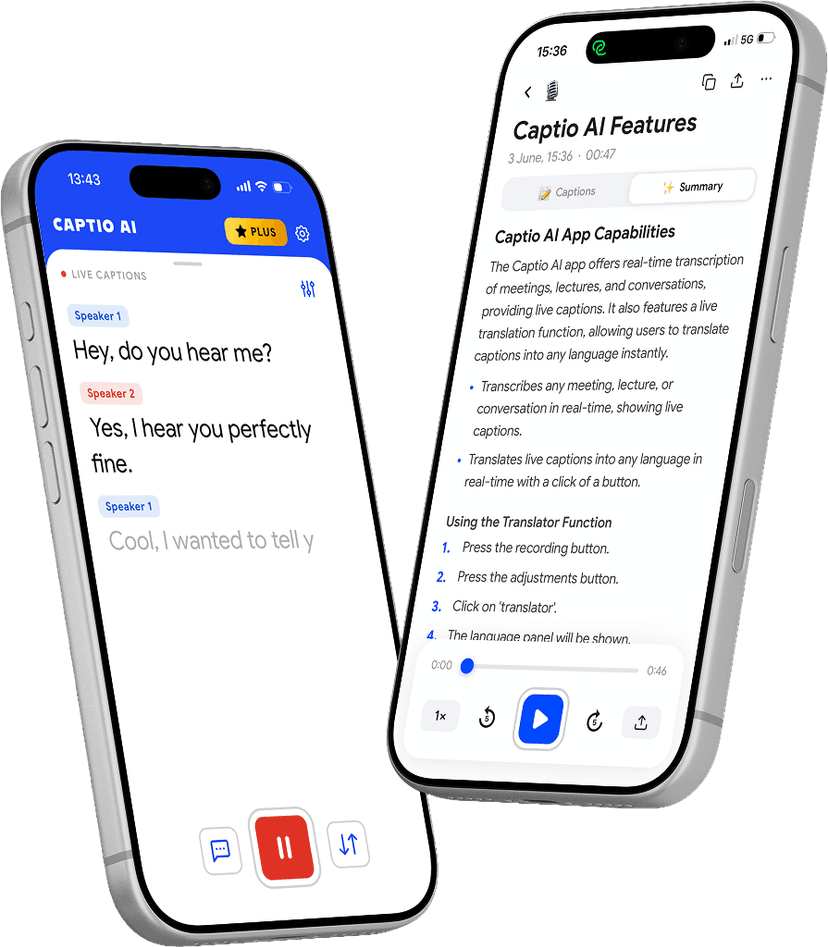
Everything you need to follow Urdu lectures
Four tools built for deaf and hard of hearing Urdu speakers.
Follow the lecture as it happens
- Captions appear word by word while the lecturer is still speaking
- Works in lecture halls, seminars, and tutorials
- No setup — place the phone on your desk and start
- Any accent, any pace
For courses in another language
- Captions and translates in real time
- For international students or foreign-language courses
- 60+ languages, no switching
- Follow the lecture in the language you read best
Full transcript to study from
- Record the lecture and upload it for a complete written transcript
- Searchable, copyable, shareable
- Review at your own pace after class
- Works on any lecture recording
Key points extracted automatically
- Important concepts and takeaways pulled from any transcript
- Organised into sections — not one continuous block
- Useful for revision and exam preparation
- Works on any saved lecture transcript
Download for free
Every situation covered
Designed for the real moments that matter — not just quiet controlled environments.
Pakistani university lecture halls at institutions like Punjab University, QAU, and LUMS can hold hundreds of students. Professors deliver in Urdish at pace. Place your phone on the desk facing the PA speaker. Captio AI captions the mixed-language delivery accurately from any row.
Pakistani university seminars involve fast Urdish discussion. Students and professors switch between Urdu and English mid-sentence. Captio AI follows whoever is speaking so you track every argument and contribution.
Virtual learning platforms at Pakistani universities host lecture recordings. Auto-captions frequently fail on Urdu aspirated consonants and Urdish switching. Put the lecture on speaker and point Captio AI at the audio for accurate captions.
Hostel common rooms, campus canteens, university lawns. Fast conversational Urdu in revision sessions. Captio AI captions whoever is speaking so you follow every explanation.
Pakistani students in English-medium programmes at partner institutions, or international students at Pakistani universities. Live Translator captions in real time so language is not the access barrier.
Visiting academics, government officials, industry leaders at Pakistani university talks. Speakers from Punjab, Sindh, KPK, and Balochistan each carry distinct phonetic variation. Captio AI covers any speaker without prior arrangement.
Most accurate and fastest models
word accuracy
independent benchmark, 2025
real-time captions
first word appears as you speak
Download for free
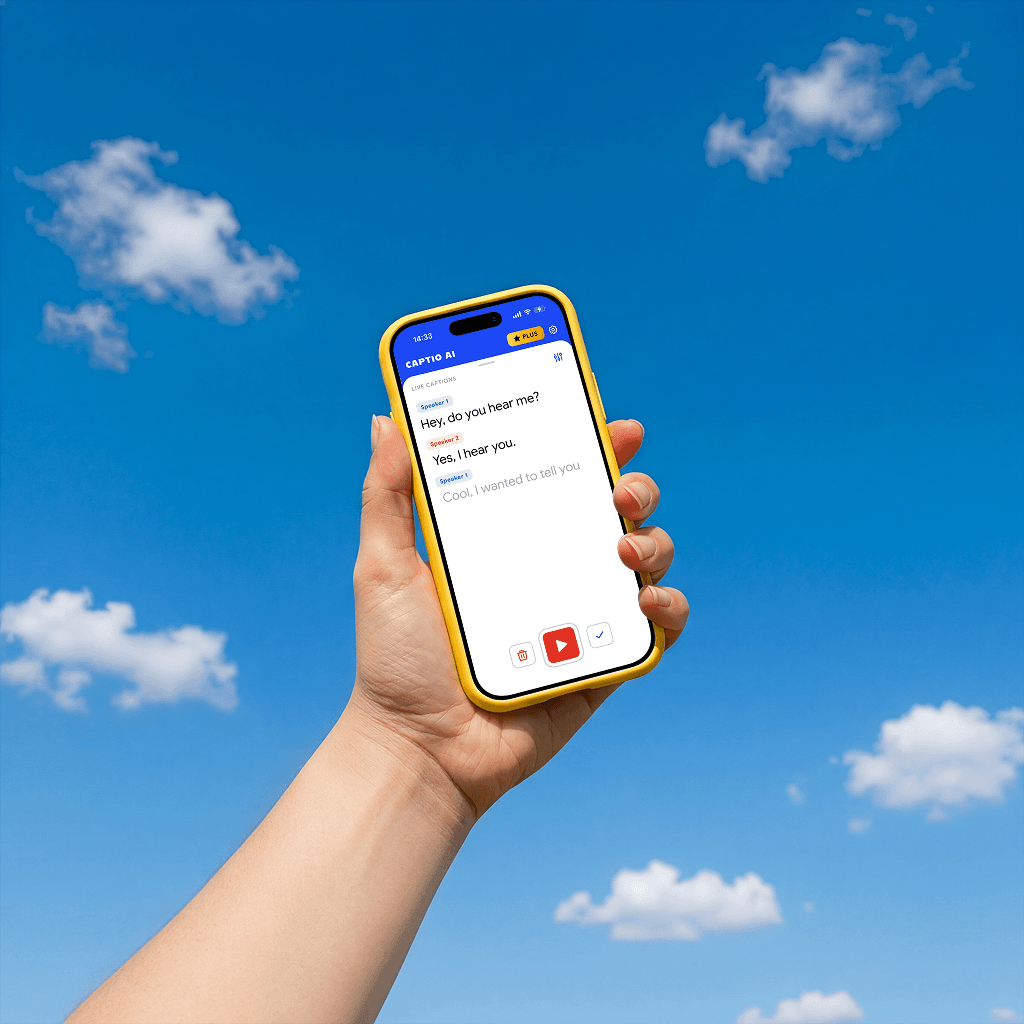
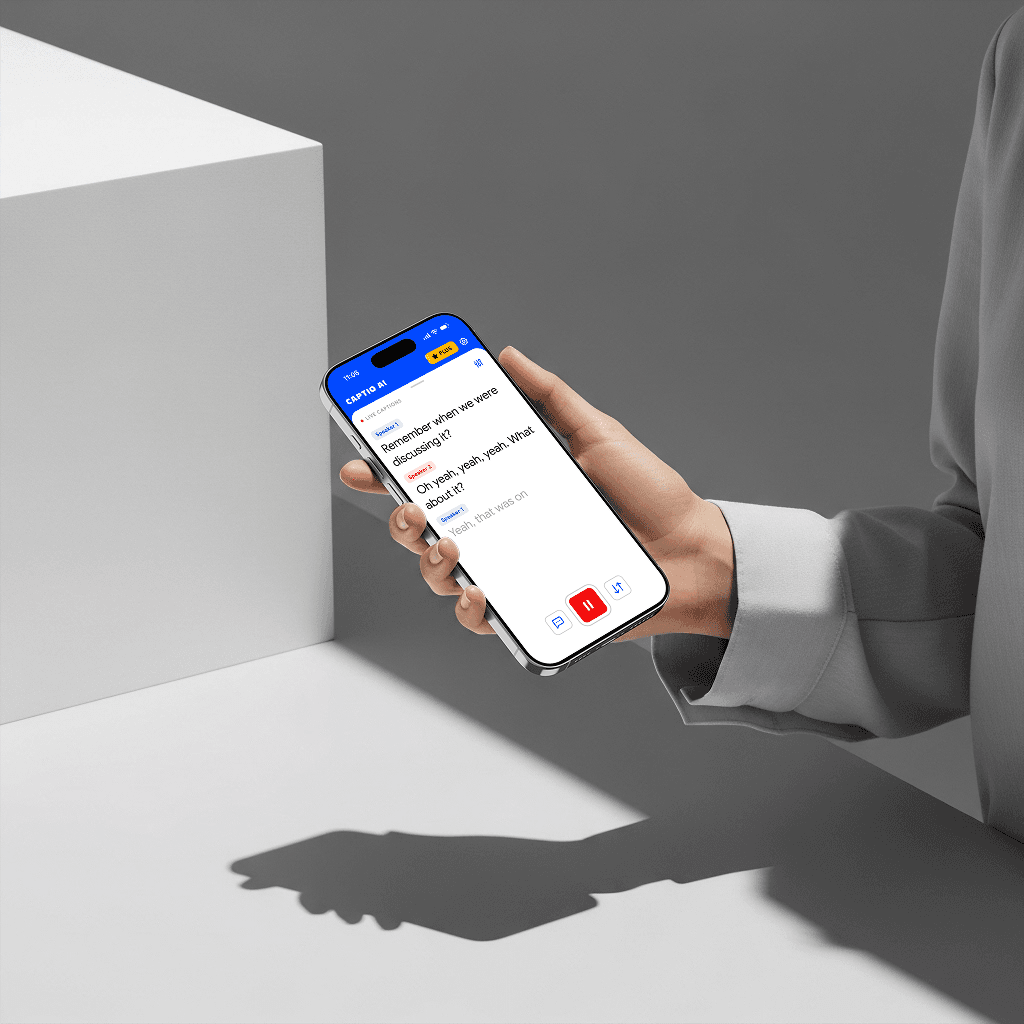
Built for the pace and pressure of a real lecture
Follow without splitting your attention
Lip-reading and note-taking at the same time is an impossible cognitive load. Captio AI handles the following so you can direct all your attention to understanding what is being said.
Captions while the lecturer is still speaking
Words appear on your screen as they are said — not after the sentence ends. You stay in sync with the lecture rather than always being a beat behind.
Works in any lecture setting
Lecture halls, seminar rooms, online classes, study groups. Place the phone on your desk, point it toward the audio source, and Captio AI handles the rest.
A full transcript to study from
Record the lecture and upload it to Audio Transcription after class. Get a complete written record you can search, annotate, and revise from — at your own pace.
60+ languages
For international students, students studying abroad, or courses taught in a second language. Captio AI captions or translates in real time with no manual setup.
No advance notice needed
Official university captioning requires booking in advance and is not available for every session. Captio AI works for any lecture, any time, with no prior arrangement.
Why Urdu is hard to understand
11 aspirated consonants
- Urdu has more aspirated consonants than almost any other language — and they are all invisible
- Urdu distinguishes 11 aspirated consonants from their unaspirated pairs: /pʰ/, /bʱ/, /tʰ/, /dʱ/, /ʈʰ/, /ɖʱ/, /kʰ/, /gʱ/, /tʃʰ/, /dʒʱ/, /fʱ/. Each aspirated consonant is produced with a burst of air following the release — a purely acoustic distinction with no visible face movement. A deaf student lip-reading Urdu cannot distinguish any of the 11 aspirated consonants from their unaspirated counterparts. In a lecture where every stop and affricate potentially carries this phonemic distinction, systematic misreading is inevitable.
Retroflex system
- Urdu retroflexes change meaning but produce no visible lip change
- Like Hindi, Urdu has phonemic retroflex consonants (/ʈ/, /ɖ/, /ɳ/, /ɽ/) contrasting with their dental equivalents. The retroflex articulation involves the tongue tip curling back — an articulation point far behind the lips with no surface expression. Retroflex consonants appear extensively in technical Urdu vocabulary and in loanwords from Sanskrit and regional languages. A deaf student cannot recover these distinctions from visual information alone.
Perso-Arabic pharyngeals
- Urdu's Arabic and Persian loanwords carry sounds that are completely invisible
- Urdu academic vocabulary in humanities, social sciences, and Islamic studies is dense with Arabic and Persian loanwords carrying pharyngeal and uvular consonants: /q/, /x/, /ɣ/, /ħ/, /ʕ/. These are produced at the uvula or pharynx — far behind the lips, with no visible articulation. For a deaf student lip-reading a social sciences or Islamic studies lecture, 20–30% of the technical vocabulary may contain sounds that are acoustically distinctive but visually absent.
Urdish code-switching
- Pakistani university lectures switch between Urdu and English mid-sentence
- University lectures in Pakistan routinely alternate between Urdu explanation and English technical vocabulary — a register sometimes called Urdish. The phonological system, stress patterns, and lip profile shift simultaneously with no visual signal. A deaf student tracking Urdu must instantly recalibrate to English phonology when the lecturer switches — which in fast academic delivery can happen multiple times per minute.
Regional Urdu variation
- Punjabi, Sindhi, and Pashto L1 speakers each deliver Urdu with different phonetic profiles
- Urdu is a second language for most Pakistanis. Punjabi-L1, Sindhi-L1, and Pashto-L1 speakers each carry substrate phonology into their Urdu. Lahore Urdu has Punjabi vowel influence; Karachi Urdu has been shaped by Sindhi and Muhajir varieties; KPK Urdu carries Pashto prosodic patterns. A deaf student calibrated to one regional variety encounters a different visual profile when their lecturer comes from another province.
Download for free
Millions of deaf and hard of hearing people in Pakistan — and a university system without them
A survey by Pakistan's Ministry of National Health Sciences found that 4.8% of the total population has a hearing disability — representing approximately 11 million people at current population levels. A broader estimate, accounting for genetic aetiology and underreporting, places the figure at approximately 14.5 million Pakistanis living with hearing loss, of whom roughly half have a genetic cause (PMC10967143, 2024). Late identification of hearing impairment is endemic in Pakistan due to the absence of a standardised national neonatal hearing screening programme — meaning many children reach primary school without established communication supports, and the education gap compounds from there.
A 2023 WHO EMRO study on hearing impairment's impact on children and families in Pakistan found that 47.5% of children with hearing impairment faced moderate challenges in joining social activities and 26% faced severe challenges. Hearing impairment caused moderate financial strain on 39% of families and mild strain on 26.8% — indicating that the economic burden of managing hearing loss in Pakistan further limits access to the specialist support that higher education would require (WHO EMRO, 2023). Pakistani universities have no standardised provision for real-time captioning in lectures; the Pakistan Ear Foundation has engaged in policy advocacy but interpreter training and institutional provision remain minimal.
The access gap at Pakistani universities is compounded by the language of instruction. Urdu is a second language for most Pakistani students, and lectures — already delivered in a non-native tongue for most students — are delivered without captions in a phonological system that contains 11 aspirated consonants and a dense inventory of pharyngeal sounds, all invisible to a deaf student. A deaf student in a Urdu lecture hall is navigating a double gap: the gap between their native language and the instruction language, and the gap between the sounds of that instruction language and what is visible on the lips.
Download for free
What you hear stays with you.
Gone the moment it ends
Captio AI processes your audio in real time and discards it immediately. Nothing is recorded. Nothing is kept.
Not a product
Your conversations are not something Captio AI sells, shares, or monetizes — to anyone, for any reason.
Not used to train anything
What you say in a doctor's appointment or a job interview never ends up in a training dataset. Not ours. Not anyone else's.

Private by default
Captio AI supports 60+ languages
Download for free
Frequently asked questions
Follow every lecture in Urdu.
Captio AI is free to start
Download for free