

Chinese live captions and productivity tool for lectures
For deaf and hard of hearing people.
Download for free


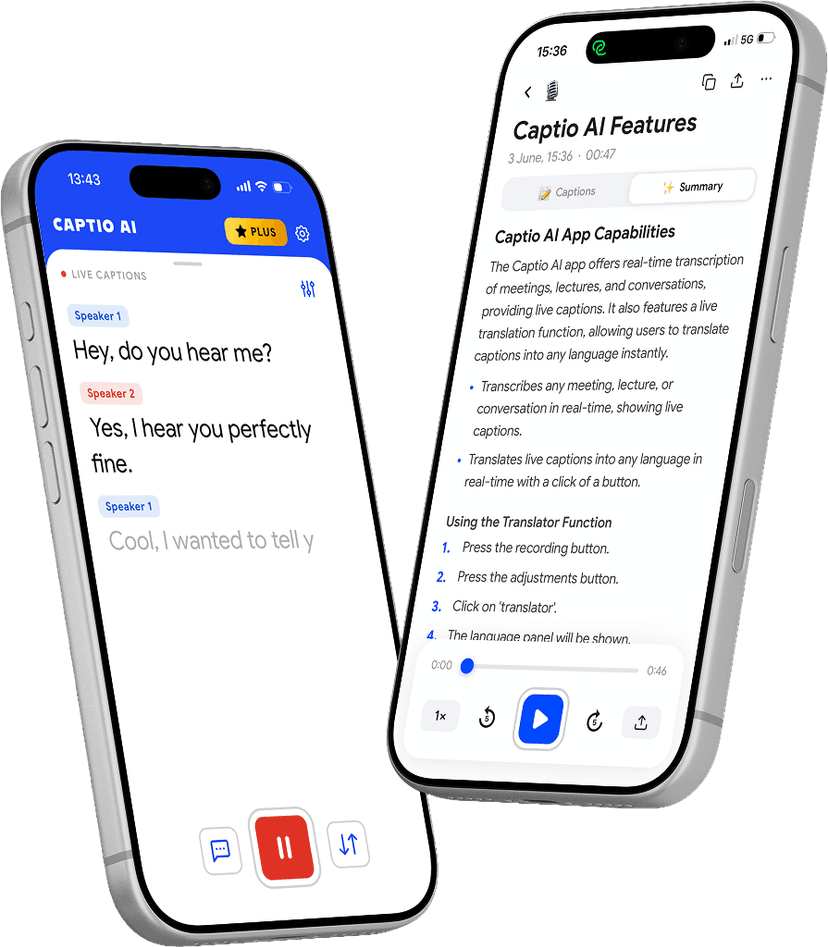
Everything you need to follow Chinese lectures
Four tools built for deaf and hard of hearing Chinese speakers.
Follow the lecture as it happens
- Captions appear word by word while the lecturer is still speaking
- Works in lecture halls, seminars, and tutorials
- No setup — place the phone on your desk and start
- Any accent, any pace
For courses in another language
- Captions and translates in real time
- For international students or foreign-language courses
- 60+ languages, no switching
- Follow the lecture in the language you read best
Full transcript to study from
- Record the lecture and upload it for a complete written transcript
- Searchable, copyable, shareable
- Review at your own pace after class
- Works on any lecture recording
Key points extracted automatically
- Important concepts and takeaways pulled from any transcript
- Organised into sections — not one continuous block
- Useful for revision and exam preparation
- Works on any saved lecture transcript
Download for free
Every situation covered
Designed for the real moments that matter — not just quiet controlled environments.
Chinese university lecture theatres can hold 200–500 students. Professors speak from the front, often turning to write characters on the board. Place your phone on the desk facing the PA speaker. Captio AI captions every word from the back rows, even when the lecturer's face is not visible.
Chinese university seminars involve fast Mandarin discussion with students and professors contributing at pace. Captio AI follows whoever is speaking so you track every argument and every contribution without asking anyone to repeat.
Lecture recordings on Chinese platforms like Chaoxing and Xuetang often carry auto-captions that fail on regional-accented Mandarin and technical vocabulary. Put the recording on speaker and point Captio AI toward the audio for accurate captions on any platform.
Library study rooms, canteen tables, dormitory group sessions. Chinese student study groups discuss fast and often switch between Mandarin and English for technical terms. Captio AI handles both so you follow every explanation.
International students at Chinese universities follow lectures in Mandarin with English technical vocabulary. Live Translator captions in real time so the language barrier does not stack on top of the access barrier.
Visiting academics, industry leaders, alumni talks at Chinese universities. Academic speakers from Shanghai, Guangdong, or Sichuan each bring a distinct Mandarin variety. Captio AI covers any speaker at any venue without prior arrangement.
Most accurate and fastest models
character accuracy
independent benchmark, 2025
real-time captions
first word appears as you speak
Download for free

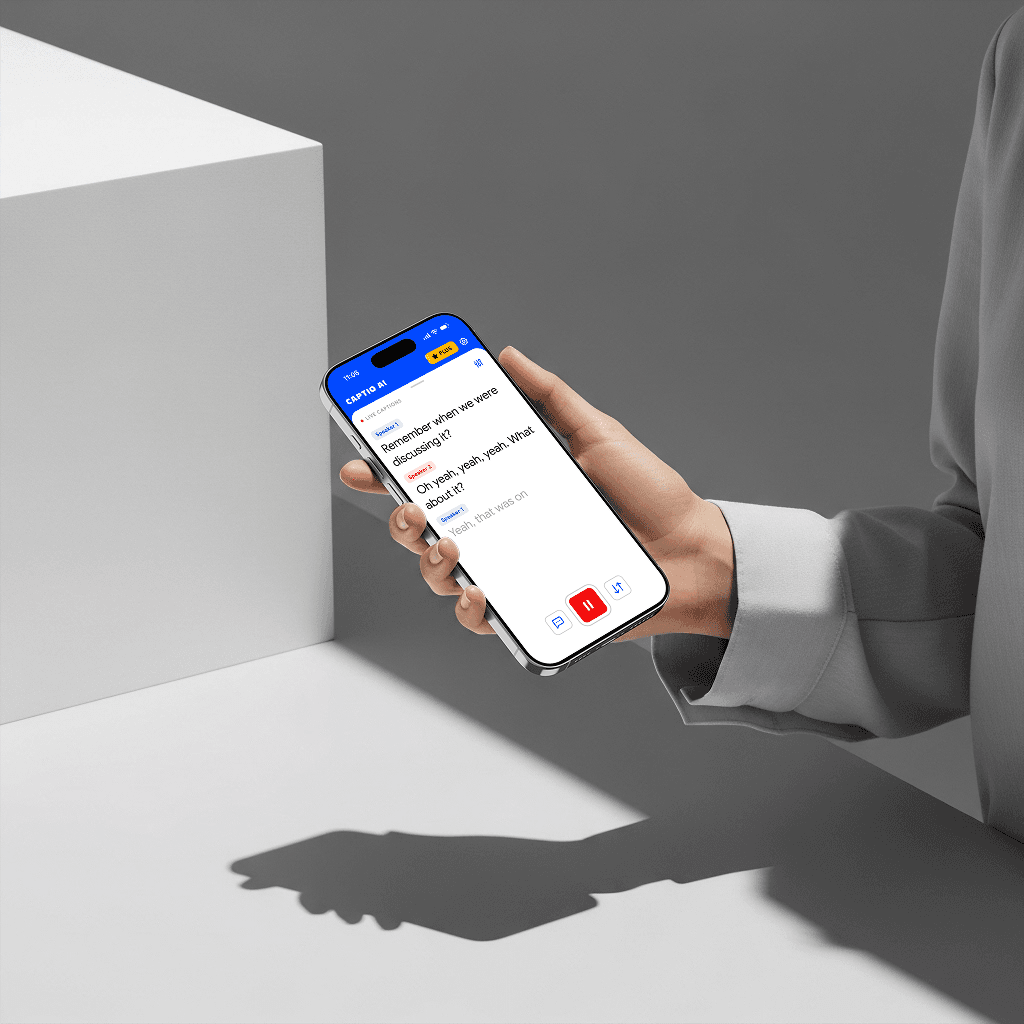
Built for the pace and pressure of a real lecture
Follow without splitting your attention
Lip-reading and note-taking at the same time is an impossible cognitive load. Captio AI handles the following so you can direct all your attention to understanding what is being said.
Captions while the lecturer is still speaking
Words appear on your screen as they are said — not after the sentence ends. You stay in sync with the lecture rather than always being a beat behind.
Works in any lecture setting
Lecture halls, seminar rooms, online classes, study groups. Place the phone on your desk, point it toward the audio source, and Captio AI handles the rest.
A full transcript to study from
Record the lecture and upload it to Audio Transcription after class. Get a complete written record you can search, annotate, and revise from — at your own pace.
60+ languages
For international students, students studying abroad, or courses taught in a second language. Captio AI captions or translates in real time with no manual setup.
No advance notice needed
Official university captioning requires booking in advance and is not available for every session. Captio AI works for any lecture, any time, with no prior arrangement.
Why Chinese is hard to understand
Tonal collapse
- Tones are the only thing distinguishing thousands of homophones — and they are invisible
- Mandarin uses four tones plus a neutral tone to distinguish meaning. In a fast lecture, tones blur and neutralize. On the lips, tonal information is completely absent. Research estimates that only about 5% of deaf individuals can lip-read Chinese, compared to 25% for English. In a lecture hall, a deaf student misses the entire disambiguation layer — and the academic vocabulary is dense with homophones that only tone separates.
No word boundaries
- Chinese speech arrives as an unbroken syllable stream
- Mandarin has no acoustic word boundaries and no pauses between words. In a lecture, technical vocabulary — compound terms built from two-syllable units — arrives as a continuous chain of syllables with no visual stopping points. Without tone to help, a deaf student cannot tell if they are hearing 时间 (time), 实践 (practice), or 实验 (experiment) — all of which look identical on the lips.
Regional Mandarin variation
- The Mandarin of a Sichuan professor sounds nothing like Beijing Standard Chinese
- Chinese universities draw lecturers from across provinces. Sichuan-accented Mandarin merges retroflex and non-retroflex initial consonants. Shanghainese-accented Mandarin drops some initial consonants entirely. Cantonese-accented Mandarin reshapes the tonal system. A deaf student who has calibrated their lip-reading to Standard Mandarin will find a strongly regional-accented lecturer nearly unreadable.
Academic compound vocabulary
- Chinese academic terms share identical lip profiles with everyday words
- Chinese academic vocabulary is built from classical compound terms — two-syllable units assembled from literary Chinese. These share lip profiles with hundreds of common everyday words. In a STEM lecture, the word for 'photosynthesis' (光合作用) and multiple unrelated terms produce nearly identical mouth movements at speed. Losing one syllable in a compound collapses the whole term.
Lecture-script conflict
- Professors write on the board while speaking — breaking the lip-reading window
- In Chinese lecture halls, professors frequently face the board while writing characters and continue speaking. For a deaf student, the moment the lecturer turns away is the moment the only access route closes. This is structurally embedded in the format of a Chinese lecture and cannot be solved by positioning the phone differently.
Download for free
27.8 million deaf and hard of hearing people in China. A university system built around hearing.
China has the largest deaf and hard of hearing population in the world — 27.8 million people, according to the Second National Sample Survey on Disability. The Chinese university system was not built for this population. Until 2014, deaf students were required to complete the listening component of the national English examination (Gaokao) to qualify for university admission — an exam requiring hearing students to demonstrate spoken-English comprehension. The modification that followed — exempting deaf students from the aural section — addressed one moment in a system that remains structurally inaccessible at every other.
Only a handful of mainstream universities in China admit deaf applicants. Most are directed toward special education-focused institutions that limit the academic disciplines available to them. Deaf students often begin university a year later than hearing peers because of curriculum staging in the special education pipeline. Research documenting the experience of deaf students navigating Chinese higher education describes a consistent pattern: formal inclusion policies that dissolve on arrival at the institution, and an absence of in-lecture support that leaves deaf students to manage with whatever residual hearing they have — or without (Pulitzer Center, 2021).
A 2025 PMC study on university adjustment among deaf and hard of hearing students found that communication barriers in lecture-based learning environments remain the primary driver of academic underperformance — independent of students' intellectual ability (PMC12505907, 2025). China has no formal national recognition of Chinese Sign Language as an official language. Certified interpreter provision in higher education is concentrated in cities and institutions with specialist programmes — not in the mainstream university lecture halls where most deaf students study.
Download for free
What you hear stays with you.
Gone the moment it ends
Captio AI processes your audio in real time and discards it immediately. Nothing is recorded. Nothing is kept.
Not a product
Your conversations are not something Captio AI sells, shares, or monetizes — to anyone, for any reason.
Not used to train anything
What you say in a doctor's appointment or a job interview never ends up in a training dataset. Not ours. Not anyone else's.

Private by default
Captio AI supports 60+ languages
Download for free
Frequently asked questions
Follow every lecture in Chinese.
Captio AI is free to start
Download for free