

Korean live captions and productivity tool for lectures
For deaf and hard of hearing people.
Download for free


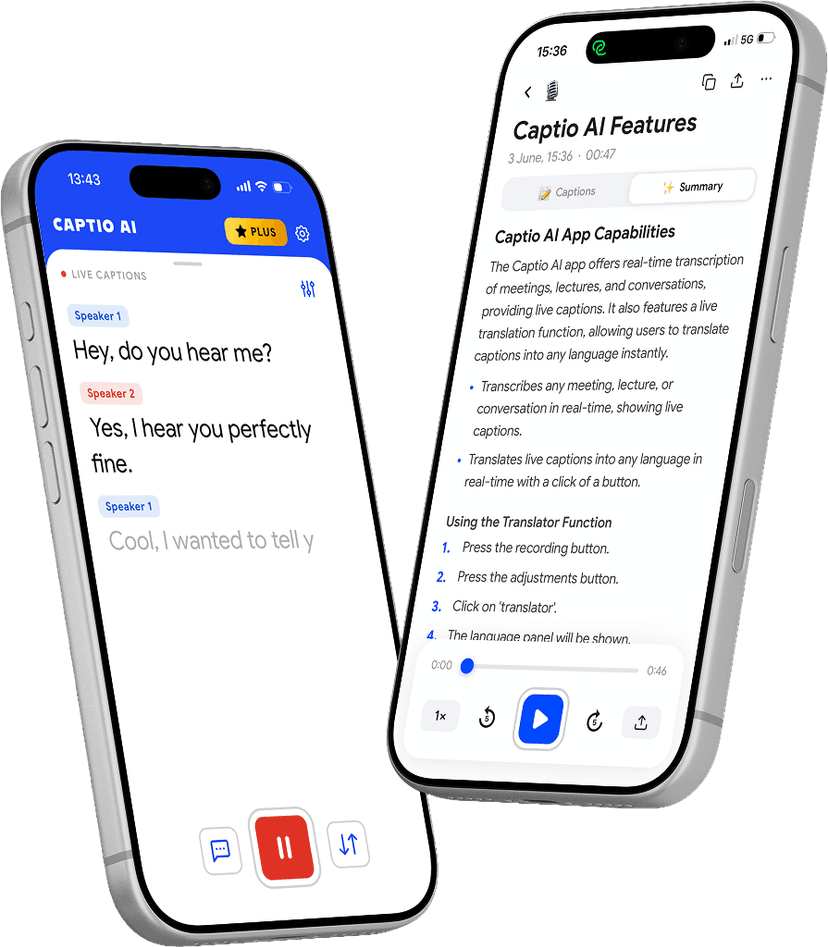
Everything you need to follow Korean lectures
Four tools built for deaf and hard of hearing Korean speakers.
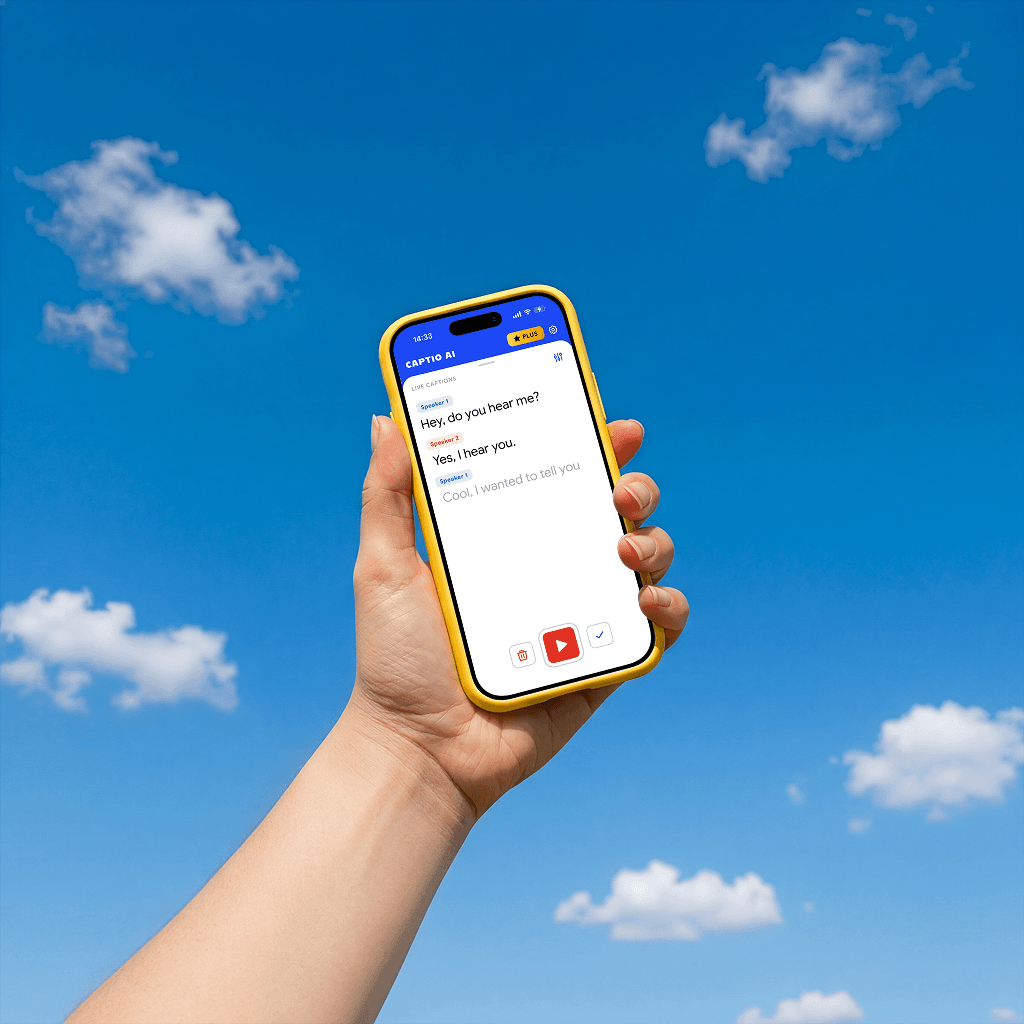
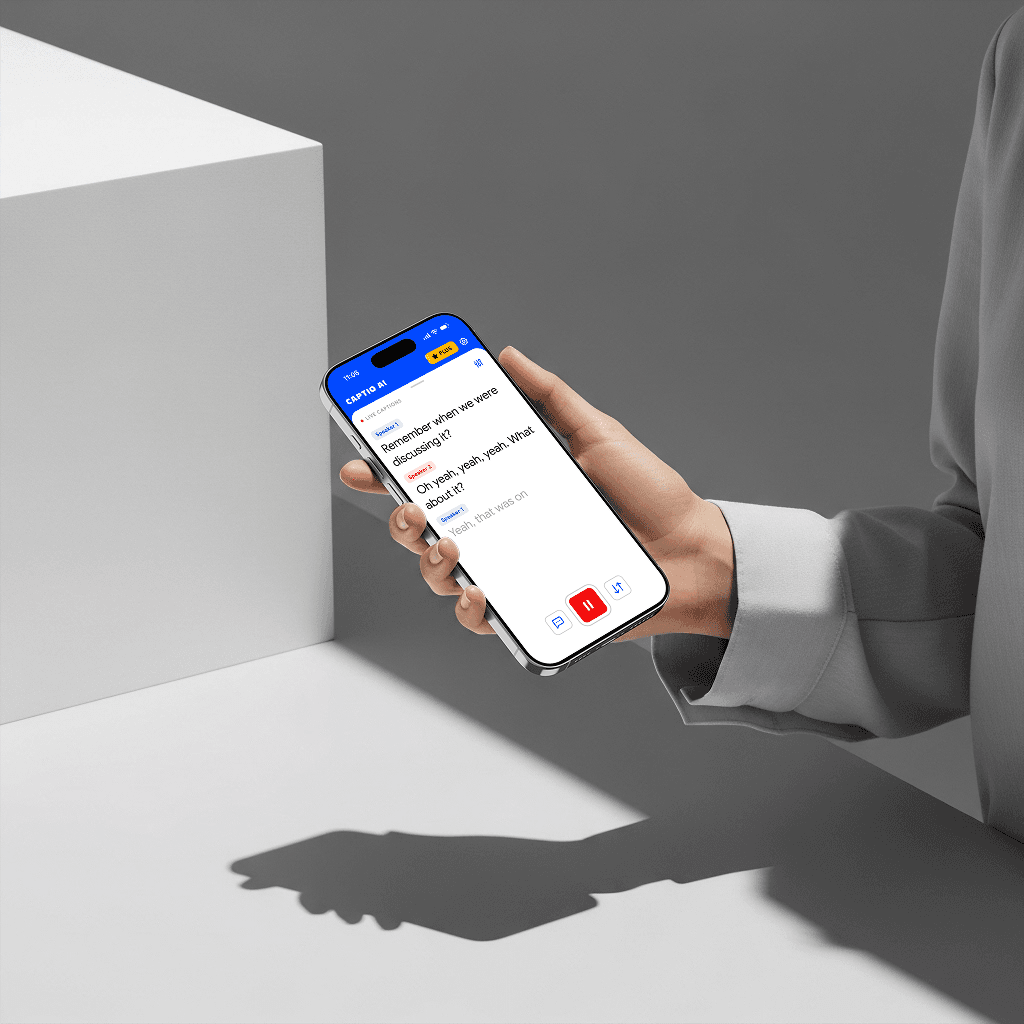
Follow the lecture as it happens
- Captions appear word by word while the lecturer is still speaking
- Works in lecture halls, seminars, and tutorials
- No setup — place the phone on your desk and start
- Any accent, any pace
For courses in another language
- Captions and translates in real time
- For international students or foreign-language courses
- 60+ languages, no switching
- Follow the lecture in the language you read best
Full transcript to study from
- Record the lecture and upload it for a complete written transcript
- Searchable, copyable, shareable
- Review at your own pace after class
- Works on any lecture recording
Key points extracted automatically
- Important concepts and takeaways pulled from any transcript
- Organised into sections — not one continuous block
- Useful for revision and exam preparation
- Works on any saved lecture transcript
Download for free
Every situation covered
Designed for the real moments that matter — not just quiet controlled environments.
Seoul National University, Yonsei, KAIST, POSTECH, and Korea University lecture halls. Korean-medium lectures at academic pace. Place the phone on the desk facing the PA system. Captio AI captions from any row.
Korean university seminars (세미나) with students presenting and debating in fast academic Korean. Captio AI captions whoever is speaking so you follow every argument without asking for repeats.
Recorded lectures on K-MOOC, university LMS portals, or Zoom recordings. Put the recording on speaker and point Captio AI at the audio for accurate captions.
Study groups in Seoul, Daejeon, or Busan — fast conversational Korean mixed with English academic terms. Captio AI follows whoever is explaining without any switching.
Korean students in English-medium programmes, or international students following Korean-medium lectures. Live Translator captions in real time so language is not the access barrier.
Guest speakers from industry and visiting academics. Captio AI handles Seoul, Gyeongsang, and Jeolla Korean — any speaker at any Korean university.
Most accurate and fastest models
character accuracy
independent benchmark, 2025
real-time captions
first word appears as you speak
Download for free
Built for the pace and pressure of a real lecture
Follow without splitting your attention
Lip-reading and note-taking at the same time is an impossible cognitive load. Captio AI handles the following so you can direct all your attention to understanding what is being said.
Captions while the lecturer is still speaking
Words appear on your screen as they are said — not after the sentence ends. You stay in sync with the lecture rather than always being a beat behind.
Works in any lecture setting
Lecture halls, seminar rooms, online classes, study groups. Place the phone on your desk, point it toward the audio source, and Captio AI handles the rest.
A full transcript to study from
Record the lecture and upload it to Audio Transcription after class. Get a complete written record you can search, annotate, and revise from — at your own pace.
60+ languages
For international students, students studying abroad, or courses taught in a second language. Captio AI captions or translates in real time with no manual setup.
No advance notice needed
Official university captioning requires booking in advance and is not available for every session. Captio AI works for any lecture, any time, with no prior arrangement.
Why Korean is hard to understand
3-way stop invisibility
- Korean's three-way consonant contrast — plain, tense, aspirated — produces identical lip shapes
- Korean distinguishes three categories for stops and affricates: plain (ㅂ, ㄷ, ㄱ, ㅈ), tense or fortis (ㅃ, ㄸ, ㄲ, ㅉ), and aspirated (ㅍ, ㅌ, ㅋ, ㅊ). All three produce the same lip closure or approach — the distinctions are entirely in subglottal pressure, laryngeal tension, and aspiration. Research on Korean lip-reading found that many consonants and vowels share identical lip movements, and that a one-to-one relation between Korean phonemes and lip shapes does not exist. In a lecture, this means every stop and affricate is visually ambiguous.
Coda invisibility
- Korean syllable-final consonants are produced inside the mouth — the lip shape gives no information about the coda
- Korean syllable structure allows complex codas (받침, batchim). The coda consonant is produced with the tongue, not the lips — a final /k/, /p/, or /t/ (unreleased in coda position) produces no visible movement. A deaf student lip-reading Korean hears the nucleus from the lip shape but cannot determine the coda. In a lecture, the coda carries grammatical information: 학생 (haksaeng, student) vs. 학 (hak, crane) differ only in whether a final syllable is present.
Seoul-Gyeongsang prosody gap
- Seoul Korean and Gyeongsang Korean have different lexical pitch accents — producing different prosodic rhythms on the lips
- Standard Seoul Korean lacks lexical pitch accent, but Gyeongsang Korean (spoken across Busan, Daegu, and much of South Korea's southeast) has a two-pattern pitch accent system. Gyeongsang-dialect Korean produces different rhythmic groupings and stress patterns from Seoul standard. Korean universities draw faculty from across the peninsula. A deaf student calibrated to Seoul Korean encounters genuinely different prosodic patterns when the lecturer grew up speaking Gyeongsang or Jeolla variety.
ㅐ/ㅔ vowel merger
- Seoul Korean speakers have merged the ㅐ and ㅔ vowels — creating homophones that only orthography distinguishes
- In contemporary Seoul Korean, most speakers under 60 have merged the traditional vowels ㅐ (ae, /ɛ/) and ㅔ (e, /e/) into a single vowel. Words that were previously distinct are now homophones in speech. For a deaf student, this merger compounds the difficulty: two different words share the same lip shape, and only written context distinguishes them.
Sino-Korean academic vocabulary
- Korean university lectures use Sino-Korean (한자어) academic vocabulary with different phonological patterns from native Korean words
- Korean academic vocabulary draws heavily on Sino-Korean (hanja-based) words: 강의 (gangeui, lecture), 연구 (yeongu, research), 철학 (cheolhak, philosophy). These Sino-Korean words have different phonological structures — consonant clusters, syllable weight — from native Korean vocabulary. A deaf student who lip-reads everyday Korean encounters different mouth shapes when the professor delivers academic content in Sino-Korean register.
Download for free
Nearly 400,000 registered deaf and hard of hearing in Korea — with only 5% of special education teachers knowing sign language
The number of registered deaf and hard of hearing people in South Korea grew from 82,906 in 2000 to 384,672 in 2020, according to nationwide surveys of people with disabilities. A 2023 situational analysis of ear and hearing care in South Korea published in Frontiers in Public Health (fpubh.2023.1215556) examined the infrastructure gap, finding that despite Korea's advanced healthcare system, hearing aid adoption and intervention rates lag behind prevalence data. As of 2024, the Republic of Korea's Health Ministry reported up to 2.65 million people with some form of disability — and hearing-related disability remains among the most prevalent categories.
For deaf and hard of hearing students at Korean universities, the structural situation is constrained. A 2012 survey found that only 5% of special education teachers in Seoul knew Korean Sign Language (KSL). Korea has 2,968 registered KSL interpreters for approximately 384,672 registered deaf and hard of hearing people — a ratio of 5.7 interpreters per 100,000 population, significantly below what is required for consistent university-level provision. Oralism-focused educational approaches, where deaf students were historically taught to lip-read and speak rather than use sign language, remain influential in Korean educational policy.
The E-ASR journal study (2023) tracking deaf and hard of hearing status in Korea from 2000 to 2020 documented that while the registered population has grown, systemic support in mainstream higher education has not kept pace. Most Korean universities do not provide real-time captioning in standard lectures. Deaf and hard of hearing students must either attend Korea Polytechnic University (which has specialist DHH provision) or negotiate individual accommodation at mainstream universities — a process that varies significantly by institution and faculty.
Download for free
What you hear stays with you.
Gone the moment it ends
Captio AI processes your audio in real time and discards it immediately. Nothing is recorded. Nothing is kept.
Not a product
Your conversations are not something Captio AI sells, shares, or monetizes — to anyone, for any reason.
Not used to train anything
What you say in a doctor's appointment or a job interview never ends up in a training dataset. Not ours. Not anyone else's.

Private by default
Captio AI supports 60+ languages
Download for free
Frequently asked questions
Follow every lecture in Korean.
Captio AI is free to start
Download for free