

Polish live captions and productivity tool for lectures
For deaf and hard of hearing people.
Download for free


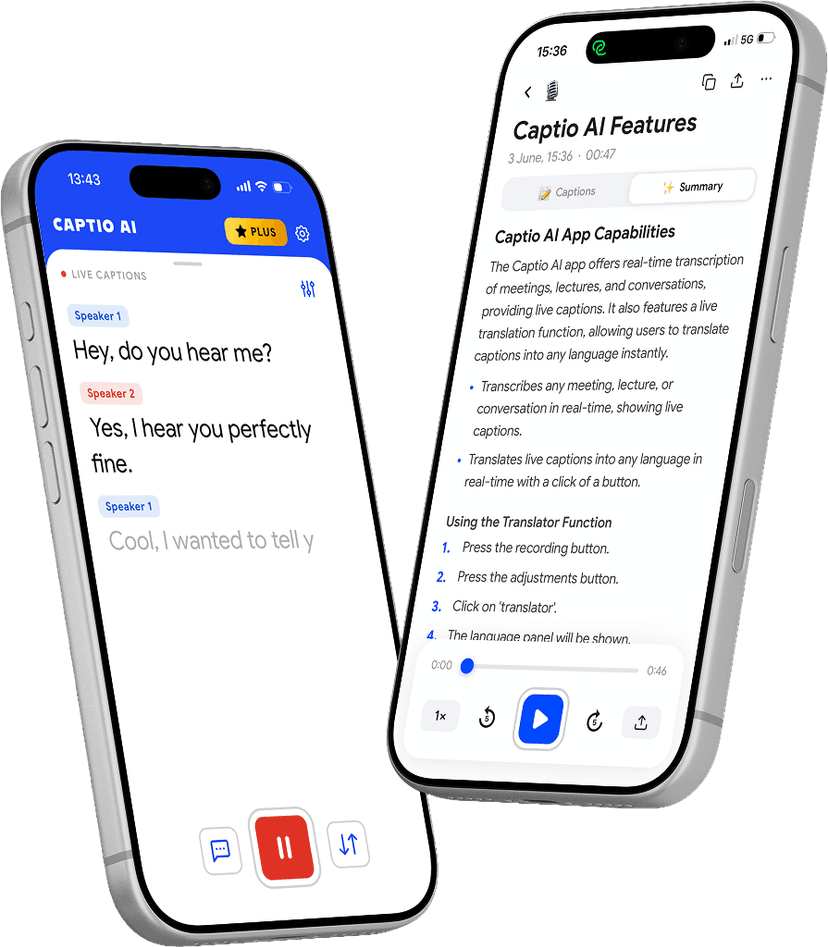
Everything you need to follow Polish lectures
Four tools built for deaf and hard of hearing Polish speakers.
Follow the lecture as it happens
- Captions appear word by word while the lecturer is still speaking
- Works in lecture halls, seminars, and tutorials
- No setup — place the phone on your desk and start
- Any accent, any pace
For courses in another language
- Captions and translates in real time
- For international students or foreign-language courses
- 60+ languages, no switching
- Follow the lecture in the language you read best
Full transcript to study from
- Record the lecture and upload it for a complete written transcript
- Searchable, copyable, shareable
- Review at your own pace after class
- Works on any lecture recording
Key points extracted automatically
- Important concepts and takeaways pulled from any transcript
- Organised into sections — not one continuous block
- Useful for revision and exam preparation
- Works on any saved lecture transcript
Download for free
Every situation covered
Designed for the real moments that matter — not just quiet controlled environments.
University of Warsaw, Jagiellonian University, Warsaw University of Technology, and Wrocław University lecture halls. Polish-medium lectures at academic pace. Place the phone on the desk facing the speaker. Captio AI captions from any row.
Polish university seminars where students present and debate in academic Polish. Fast Polish with sibilant-heavy vocabulary. Captio AI captions whoever is speaking so you follow every argument.
Recorded lectures on university portals, Zoom recordings, or Polish MOOC platforms. Put the recording on speaker and point Captio AI at the audio for accurate captions.
Study groups in Warsaw, Kraków, or Wrocław — fast conversational Polish mixed with English for technical topics. Captio AI follows whoever is explaining without any switching.
International students at Polish universities following Polish-medium lectures. Live Translator captions in real time so language is not the access barrier.
Visiting academics and guest speakers from across Poland's regions — Warsaw, Kraków, Gdańsk, Silesia. Captio AI handles standard Polish and Mazovian, Silesian-influenced, and Lesser Polish regional varieties.
Most accurate and fastest models
word accuracy
independent benchmark, 2025
real-time captions
first word appears as you speak
Download for free
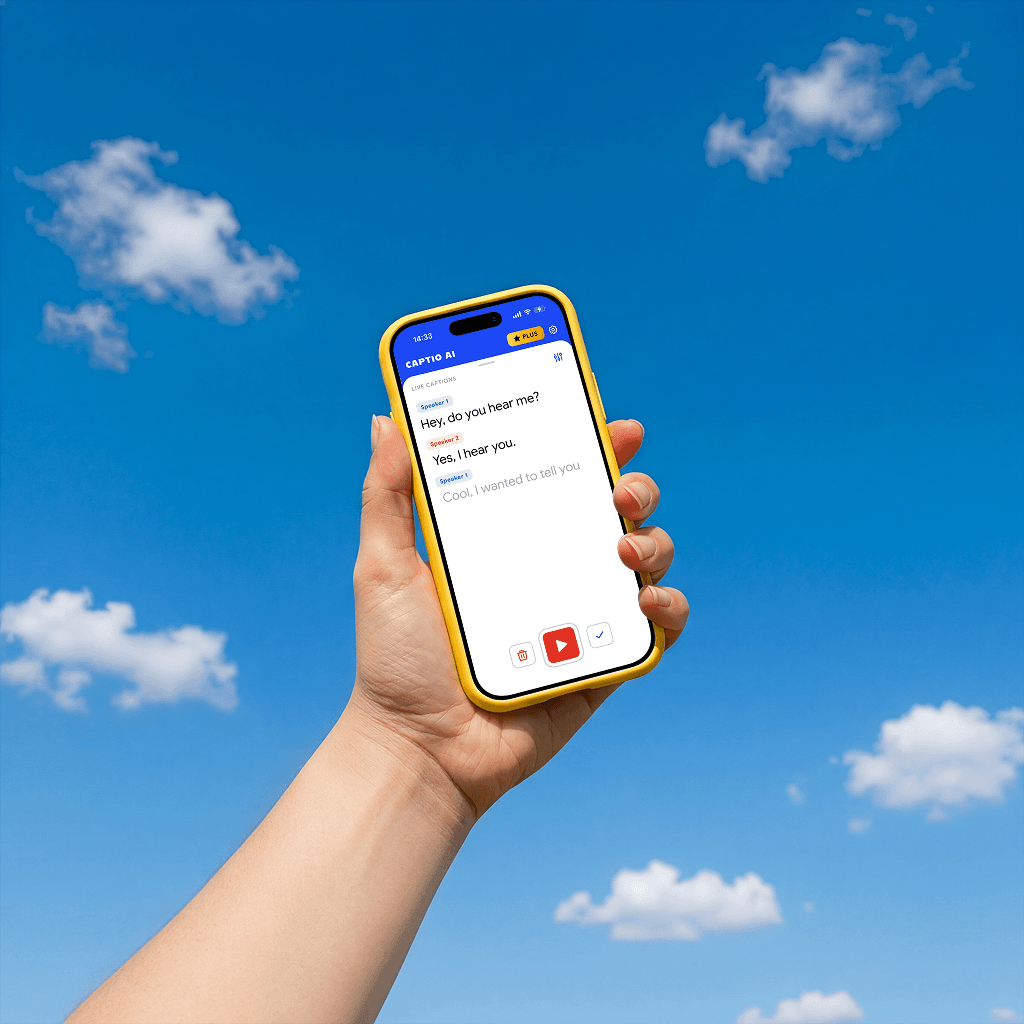
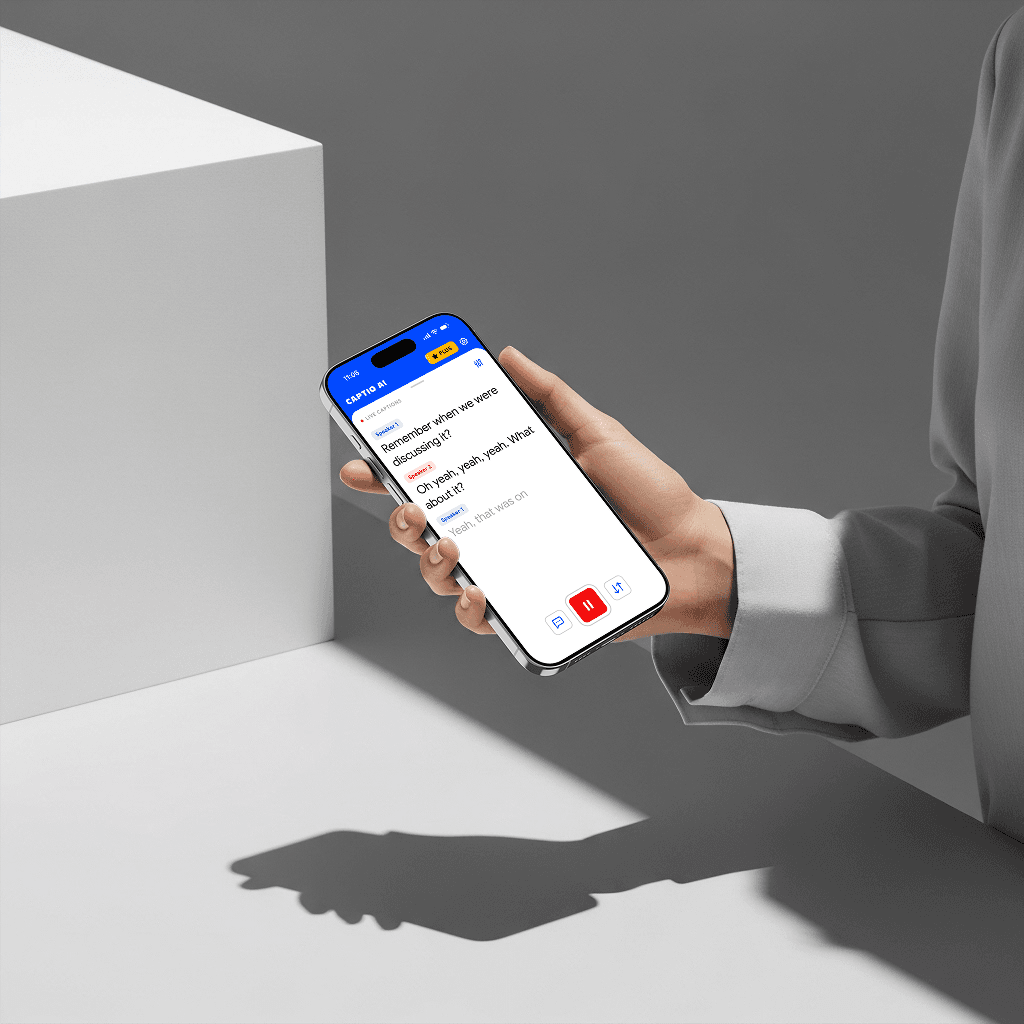
Built for the pace and pressure of a real lecture
Follow without splitting your attention
Lip-reading and note-taking at the same time is an impossible cognitive load. Captio AI handles the following so you can direct all your attention to understanding what is being said.
Captions while the lecturer is still speaking
Words appear on your screen as they are said — not after the sentence ends. You stay in sync with the lecture rather than always being a beat behind.
Works in any lecture setting
Lecture halls, seminar rooms, online classes, study groups. Place the phone on your desk, point it toward the audio source, and Captio AI handles the rest.
A full transcript to study from
Record the lecture and upload it to Audio Transcription after class. Get a complete written record you can search, annotate, and revise from — at your own pace.
60+ languages
For international students, students studying abroad, or courses taught in a second language. Captio AI captions or translates in real time with no manual setup.
No advance notice needed
Official university captioning requires booking in advance and is not available for every session. Captio AI works for any lecture, any time, with no prior arrangement.
Why Polish is hard to understand
Six sibilant sounds, one lip shape
- Polish has six sibilant and affricate sounds that all look nearly identical on the lips
- Polish distinguishes six acoustically different sibilant-region sounds: /ʂ/ (sz), /t͡ʂ/ (cz), /ʐ/ (ż/rz), /d͡ʐ/ (dż), /ɕ/ (ś), and /t͡ɕ/ (ć). All six are produced with similar lip and dental placement — the distinctions are primarily in tongue body position (retroflexed vs. palatal) and manner. In a Polish lecture, these sounds appear throughout technical vocabulary and colloquial speech alike. To a lip-reader, all six look essentially identical — yet they distinguish different words entirely.
Complex consonant clusters
- Polish has word-initial clusters of up to four consonants — all produced inside the mouth with no visible lip movement
- Polish permits consonant clusters of exceptional complexity: strz- (four consonants: s+t+r+ʂ), wstrz- (five: f+s+t+r+ʂ), źdźbło, drzwi. These clusters are fully pronounced — Polish does not simplify them in casual speech. The articulation occurs between the teeth and the palate, with lip shape giving almost no information. In an academic lecture, technical Polish vocabulary frequently contains these clusters, and a deaf student sees static lip position while five consonants are articulated.
Nasal vowel invisibility
- Polish nasal vowels /ɔ̃/ (ą) and /ɛ̃/ (ę) carry lexical meaning — and nasality is entirely invisible on the lips
- Polish has two nasal vowels — ą (/ɔ̃/ or /ɔm/~/ɔn/ before stops) and ę (/ɛ̃/ or /ɛm/~/ɛn/ before stops). These distinguish word forms that carry different grammatical meanings. Nasality is produced in the nasal cavity — the lips take the same position as for the oral counterpart. In a lecture, Polish nasal vowels mark grammatical case distinctions that carry meaning, and all are invisible.
Mazovian dialect sibilant merger
- Mazovian Polish merges four sibilant classes into two — creating a regionally different phonological system from standard
- The Mazovian dialect (spoken in Warsaw and the surrounding region, home to Poland's largest universities) undergoes mazurzenie — a systematic merger of the retroflex series (sz, cz, ż, dż) with the palatal series (ś, ć, ź, dź). Warsaw-educated speakers often produce merged sibilants — a system that differs from standard literary Polish. A deaf student calibrated to standard Polish encounters a different sibilant landscape when the lecturer grew up in Mazovia.
Fast academic delivery
- Polish academic speech at lecture pace compresses vowels and reduces word boundaries — degrading what little visual information is available
- Polish academic delivery is characteristically fast, with consistent penultimate stress but significant vowel reduction in unstressed syllables. The vowel reductions and connected speech effects that fast academic Polish produces collapse distinctions that would otherwise be recoverable in careful speech. A deaf student who has practised with slower, more careful Polish encounters a different visual profile in the lecture hall.
Download for free
Poland's deaf community navigating a university system built around hearing — sign language recognized but provision uneven
Poland has a substantial deaf and hard of hearing population navigating higher education without systematic captioning support. A study published in PMC (PMC10488362) on hearing aid qualification in Poland over 25 years documented the changing profile of people seeking hearing support — with more people presenting earlier and at less severe levels of loss, suggesting growing awareness. Age-related hearing loss is documented in the Polish cohort of the PURE study (PMC11985806), confirming the growing burden. Within the European Region, WHO estimates approximately 190 million people have some hearing loss — Poland's share is proportionate to its 38 million population.
Polish Sign Language (Polski Język Migowy, PJM) has been legally recognized in Poland since 2011 under the Act on Sign Language and Other Means of Communication. The Polish Deaf Association (Polski Związek Głuchych, PZG) has been active in advocacy, and there is growing provision of PJM interpretation in public services. However, systematic real-time captioning in Polish university lecture halls — for deaf and hard of hearing students who do not use sign language — remains largely absent. Most Polish universities handle accessibility through individual accommodation requests, without standard captioning provision in ordinary lectures.
Polish phonology presents a concentrated set of visual lip-reading challenges that compound the institutional gap. The six sibilant contrasts that all look alike on the lips, the word-initial consonant clusters of up to four consonants produced inside the mouth, and the nasal vowels that carry grammatical meaning — all make Polish one of the more demanding European languages for lip-reading in an academic context. Technical vocabulary in Polish engineering, medicine, and law is particularly dense with these features.
Download for free
What you hear stays with you.
Gone the moment it ends
Captio AI processes your audio in real time and discards it immediately. Nothing is recorded. Nothing is kept.
Not a product
Your conversations are not something Captio AI sells, shares, or monetizes — to anyone, for any reason.
Not used to train anything
What you say in a doctor's appointment or a job interview never ends up in a training dataset. Not ours. Not anyone else's.

Private by default
Captio AI supports 60+ languages
Download for free
Frequently asked questions
Follow every lecture in Polish.
Captio AI is free to start
Download for free