

Ukrainian live captions and productivity tool for lectures
For deaf and hard of hearing people.
Download for free


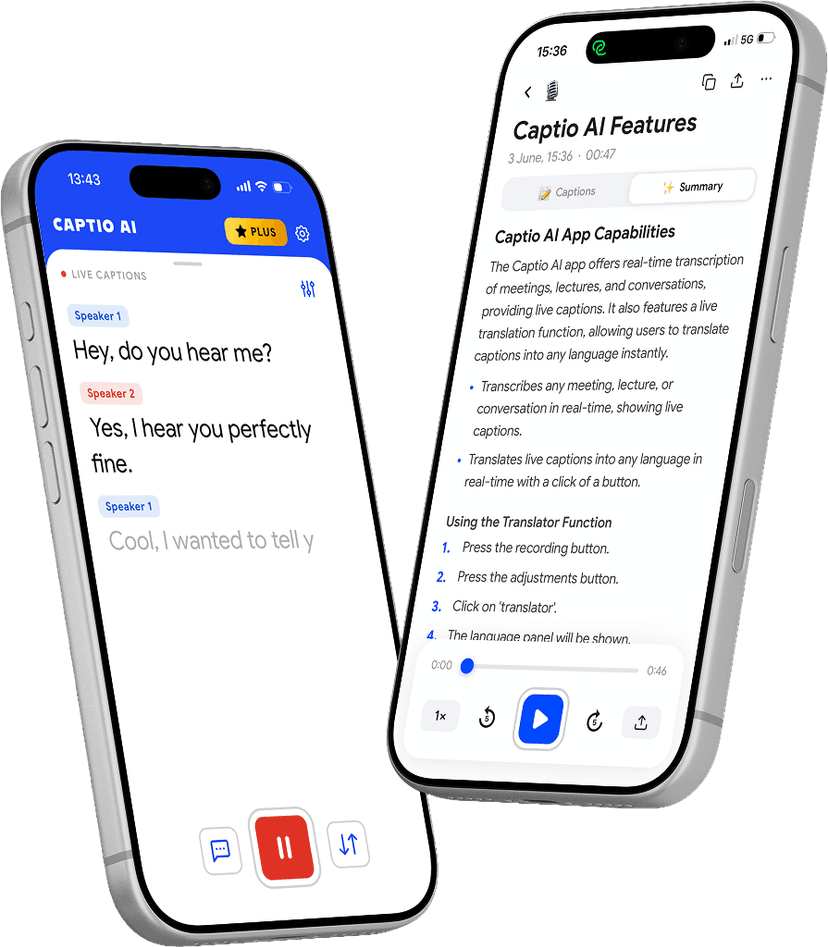
Everything you need to follow Ukrainian lectures
Four tools built for deaf and hard of hearing Ukrainian speakers.
Follow the lecture as it happens
- Captions appear word by word while the lecturer is still speaking
- Works in lecture halls, seminars, and tutorials
- No setup — place the phone on your desk and start
- Any accent, any pace
For courses in another language
- Captions and translates in real time
- For international students or foreign-language courses
- 60+ languages, no switching
- Follow the lecture in the language you read best
Full transcript to study from
- Record the lecture and upload it for a complete written transcript
- Searchable, copyable, shareable
- Review at your own pace after class
- Works on any lecture recording
Key points extracted automatically
- Important concepts and takeaways pulled from any transcript
- Organised into sections — not one continuous block
- Useful for revision and exam preparation
- Works on any saved lecture transcript
Download for free
Every situation covered
Designed for the real moments that matter — not just quiet controlled environments.
Taras Shevchenko National University of Kyiv, Lviv Polytechnic, Kharkiv National University lecture halls — in Ukraine and wherever Ukrainian universities continue operating remotely. Place the phone on the desk facing the speaker. Captio AI captions from any location.
Ukrainian university seminars where students present and debate in academic Ukrainian, often online. Captio AI captions whoever is speaking so you follow every argument without asking for repeats.
Recorded Ukrainian lectures on university portals, Zoom sessions, or YouTube academic channels. Put the recording on speaker and point Captio AI at the audio for accurate captions in real time.
Study groups across Ukraine and in refugee communities in Poland, Germany, and the UK — fast conversational Ukrainian mixed with English. Captio AI follows whoever is speaking.
Ukrainian students in English-medium programmes abroad, or international students following Ukrainian-medium courses. Live Translator captions in real time so language is not the access barrier.
Visiting academics and diaspora Ukrainian speakers from North America, Europe, and Australia. Captio AI handles standard Ukrainian, western varieties, and eastern surzhyk-influenced delivery.
Most accurate and fastest models
word accuracy
independent benchmark, 2025
real-time captions
first word appears as you speak
Download for free
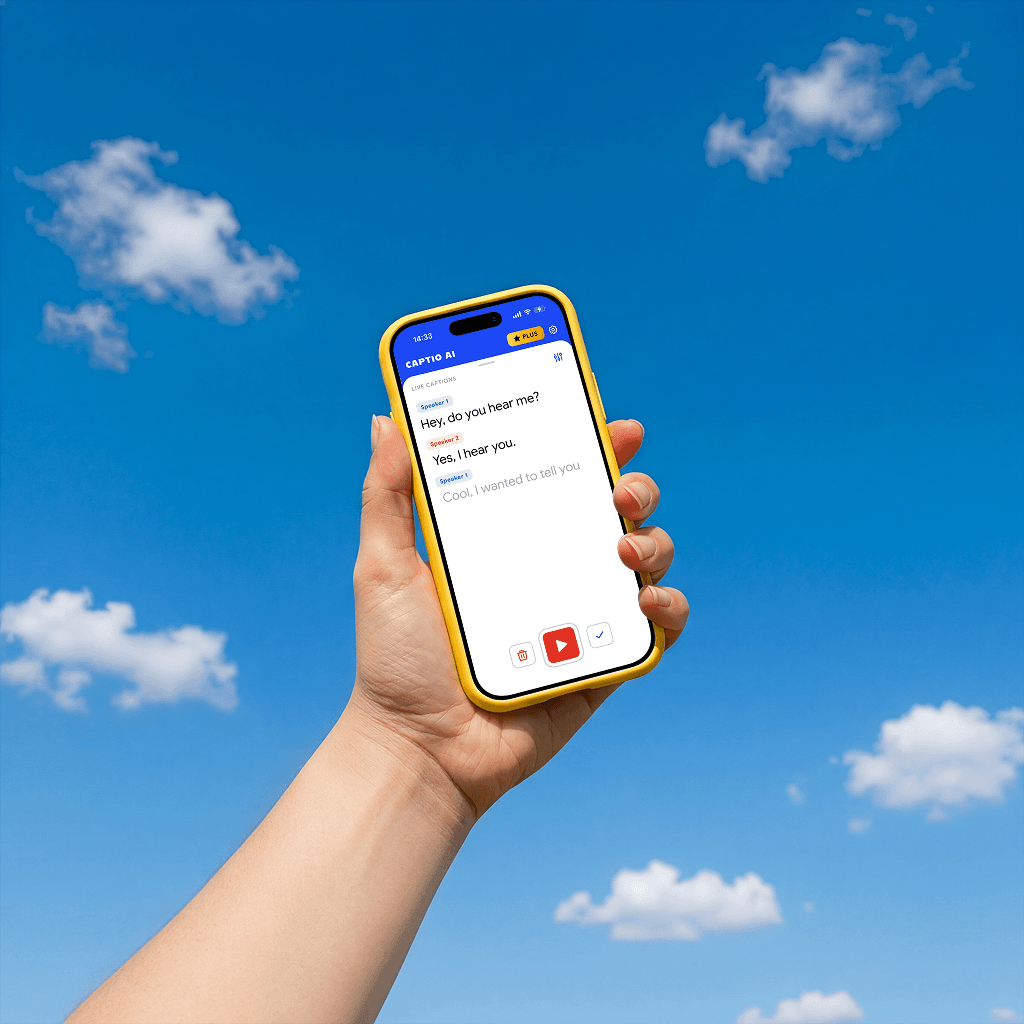
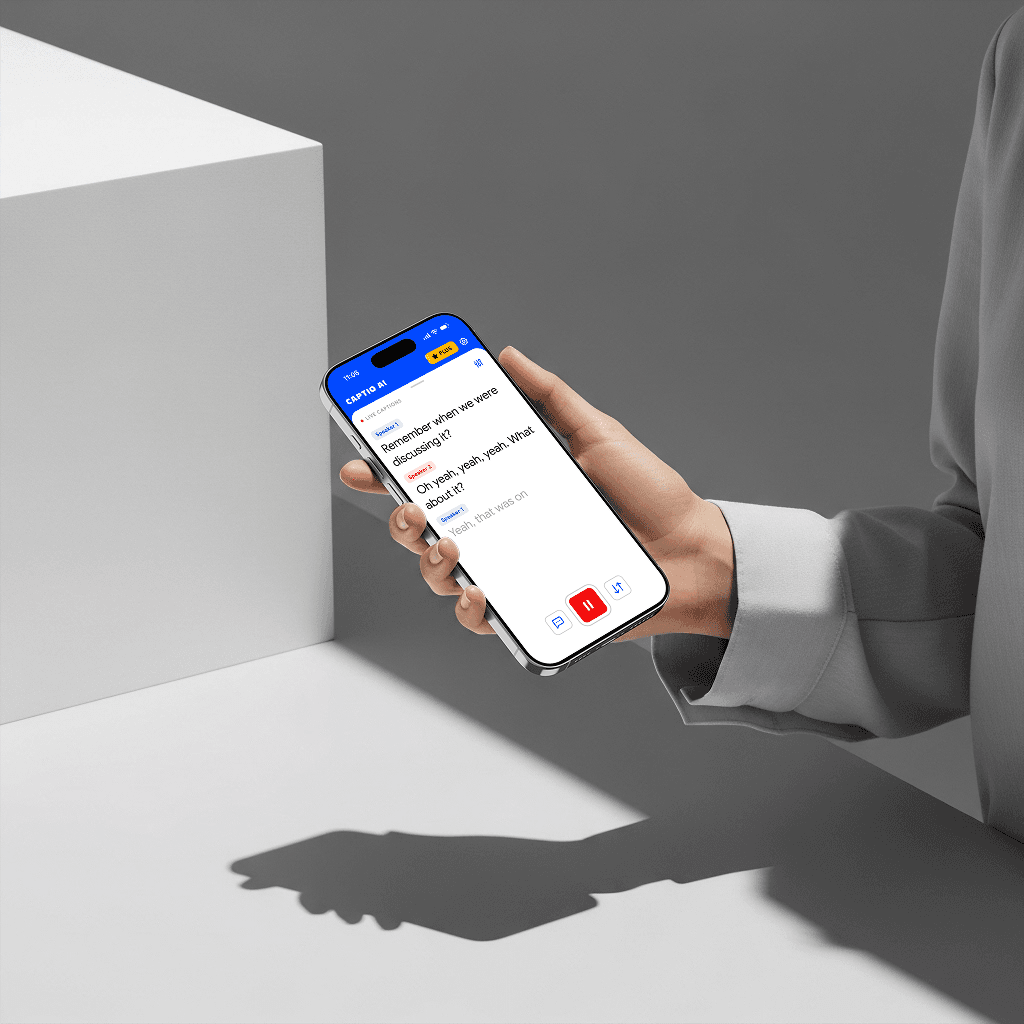
Built for the pace and pressure of a real lecture
Follow without splitting your attention
Lip-reading and note-taking at the same time is an impossible cognitive load. Captio AI handles the following so you can direct all your attention to understanding what is being said.
Captions while the lecturer is still speaking
Words appear on your screen as they are said — not after the sentence ends. You stay in sync with the lecture rather than always being a beat behind.
Works in any lecture setting
Lecture halls, seminar rooms, online classes, study groups. Place the phone on your desk, point it toward the audio source, and Captio AI handles the rest.
A full transcript to study from
Record the lecture and upload it to Audio Transcription after class. Get a complete written record you can search, annotate, and revise from — at your own pace.
60+ languages
For international students, students studying abroad, or courses taught in a second language. Captio AI captions or translates in real time with no manual setup.
No advance notice needed
Official university captioning requires booking in advance and is not available for every session. Captio AI works for any lecture, any time, with no prior arrangement.
Why Ukrainian is hard to understand
Hard-soft consonant contrast
- Ukrainian distinguishes hard and soft (palatalized) versions of most consonants — all visually identical on the lips
- Ukrainian has 33 phonemic consonants, including hard-soft (palatalized) pairs throughout the system. The soft consonant is produced with the body of the tongue raised toward the hard palate — a movement entirely inside the mouth. On the lips, hard /t/ and soft /tʲ/ look identical. In a Ukrainian lecture, hard-soft contrasts carry grammatical meaning (case endings, verb conjugations, noun classes) throughout every sentence, and all of them are invisible.
Ukrainian apostrophe
- The Ukrainian hard sign (ʼ) before soft vowels marks a non-palatalization that produces no visible lip difference
- Ukrainian uses an apostrophe (ʼ) before certain soft vowels (я, є, ї, ю) to indicate that the preceding consonant does not palatalize: пʼять (five) vs пять (palatalized cluster). This distinction changes both phonology and meaning, but produces no visible difference in lip movement. In a lecture, these apostrophe-marked words appear throughout and are entirely invisible to a lip-reader.
Surzhyk code-mixing
- Eastern Ukrainian surzhyk — a Russian-Ukrainian mixed variety — changes the phonological system mid-sentence
- Surzhyk is a pervasive Russian-Ukrainian mixed speech used across eastern Ukraine (Kharkiv, Dnipro, Zaporizhzhia) and in many families displaced by the war. Russian and Ukrainian differ in significant phonological ways — Ukrainian has /ɦ/ (voiced glottal fricative) where Russian has /g/ (voiced velar stop), Ukrainian has /i/ where Russian has /ɨ/, and vowel qualities differ throughout. In a university lecture from a speaker with surzhyk background, the phonological system shifts within sentences, making lip-reading calibration impossible.
Ukrainian /ɦ/ vs Russian /g/
- Ukrainian's distinctive /ɦ/ (voiced glottal fricative) contrasts with Russian /g/ — and war displacement has mixed both populations in universities
- Ukrainian has /ɦ/ (the letter г, a voiced glottal fricative, as in 'he' in English but voiced) where Russian has /g/ (a velar stop). This is one of the most salient phonological differences between the two languages. In post-war Ukrainian universities, students and lecturers from eastern regions who grew up with Russian or surzhyk produce /g/ in positions where western speakers produce /ɦ/ — creating phonological variation across a single lecture hall.
Academic Slavonic register
- Ukrainian academic lectures use a formal register dense with Church Slavonic and Latinate terminology — phonologically remote from everyday speech
- Ukrainian academic language draws on Church Slavonic vocabulary and Latin-origin terminology in a way that diverges significantly from colloquial speech. A deaf student who lip-reads everyday conversational Ukrainian encounters different phonological profiles when the professor shifts to formal academic register — with longer, multisyllabic words and consonant clusters from Slavonic or Latin roots.
Download for free
Ukraine's deaf community displaced by war — navigating university without captioning infrastructure on two continents
The WHO European Region estimates approximately 190 million people across Europe have some hearing loss — 20% of the population. Ukraine, with a pre-war population of approximately 44 million, carried a proportionate share. Ukraine's national disability registration system documented hundreds of thousands of people with hearing-related disability before the 2022 full-scale invasion. The conflict has dramatically disrupted the deaf community's access to education, rehabilitation, and social services: universities have relocated, students have been displaced across Europe, and the infrastructure that existed for deaf and hard of hearing students — already limited — has been disrupted.
Ukrainian Sign Language (Українська жестова мова, UZhM) exists as a community language but has limited formal institutional support. Before the war, Ukrainian universities did not systematically provide real-time captioning in ordinary lectures. For deaf and hard of hearing Ukrainian students now studying remotely from Poland, Germany, the Czech Republic, or the UK, the challenge is compounded: they follow lectures conducted in Ukrainian — a phonologically demanding language with hard-soft consonant pairs, surzhyk variation, and formal academic register — in an environment with no captioning infrastructure and no in-person institutional support.
War displacement has also created a new mixed linguistic context in Ukrainian universities. Students who grew up in eastern Ukraine with surzhyk or Russian-dominant backgrounds are now enrolled alongside western Ukrainian students in institutions where standard western Ukrainian is the medium of instruction. For deaf students trying to lip-read in this environment, the phonological variation is substantial — and all of it occurs without any captioning.
Download for free
What you hear stays with you.
Gone the moment it ends
Captio AI processes your audio in real time and discards it immediately. Nothing is recorded. Nothing is kept.
Not a product
Your conversations are not something Captio AI sells, shares, or monetizes — to anyone, for any reason.
Not used to train anything
What you say in a doctor's appointment or a job interview never ends up in a training dataset. Not ours. Not anyone else's.

Private by default
Captio AI supports 60+ languages
Download for free
Frequently asked questions
Follow every lecture in Ukrainian.
Captio AI is free to start
Download for free