

Belarusian live captions and productivity tool for lectures
For deaf and hard of hearing people.
Download for free


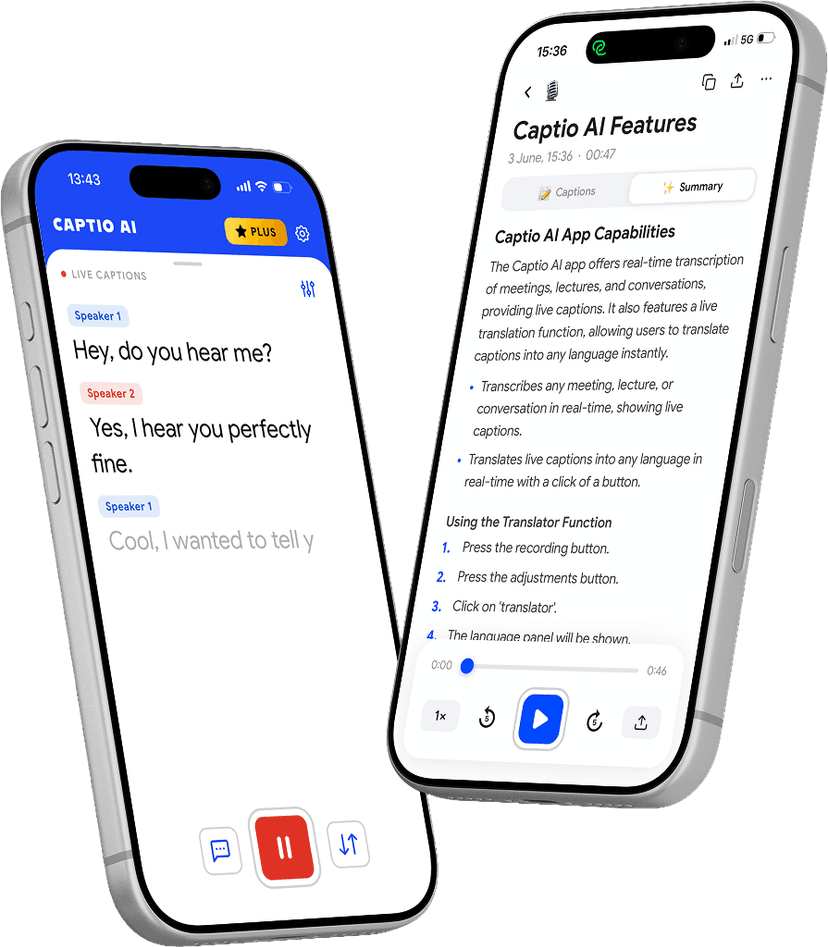
Everything you need to follow Belarusian lectures
Four tools built for deaf and hard of hearing Belarusian speakers.
Follow the lecture as it happens
- Captions appear word by word while the lecturer is still speaking
- Works in lecture halls, seminars, and tutorials
- No setup — place the phone on your desk and start
- Any accent, any pace
For courses in another language
- Captions and translates in real time
- For international students or foreign-language courses
- 60+ languages, no switching
- Follow the lecture in the language you read best
Full transcript to study from
- Record the lecture and upload it for a complete written transcript
- Searchable, copyable, shareable
- Review at your own pace after class
- Works on any lecture recording
Key points extracted automatically
- Important concepts and takeaways pulled from any transcript
- Organised into sections — not one continuous block
- Useful for revision and exam preparation
- Works on any saved lecture transcript
Download for free
Every situation covered
Designed for the real moments that matter — not just quiet controlled environments.
Large lecture halls at Belarusian State University, BNTU, and Minsk universities — Belarusian or Russian instruction at full academic pace. Captio AI captions the professor in real time.
Seminars and tutorial sessions where discussion moves between Belarusian and Russian. Captio AI captions both languages without manual switching.
Recorded lectures on university portals or shared as video files — play on speaker and Captio AI captions whatever is playing in real time.
Study groups in Minsk student accommodation reviewing lecture content in Belarusian and Russian. Captio AI captions whoever is speaking.
Lectures from eastern or southern Belarusian faculty whose Belarusian carries regional phonological features. Captio AI handles northeastern and southwestern Belarusian varieties.
Online courses and webinars delivered by Belarusian universities. Captio AI captions any audio source in real time.
Most accurate and fastest models
word accuracy
independent benchmark, 2025
real-time captions
first word appears as you speak
Download for free
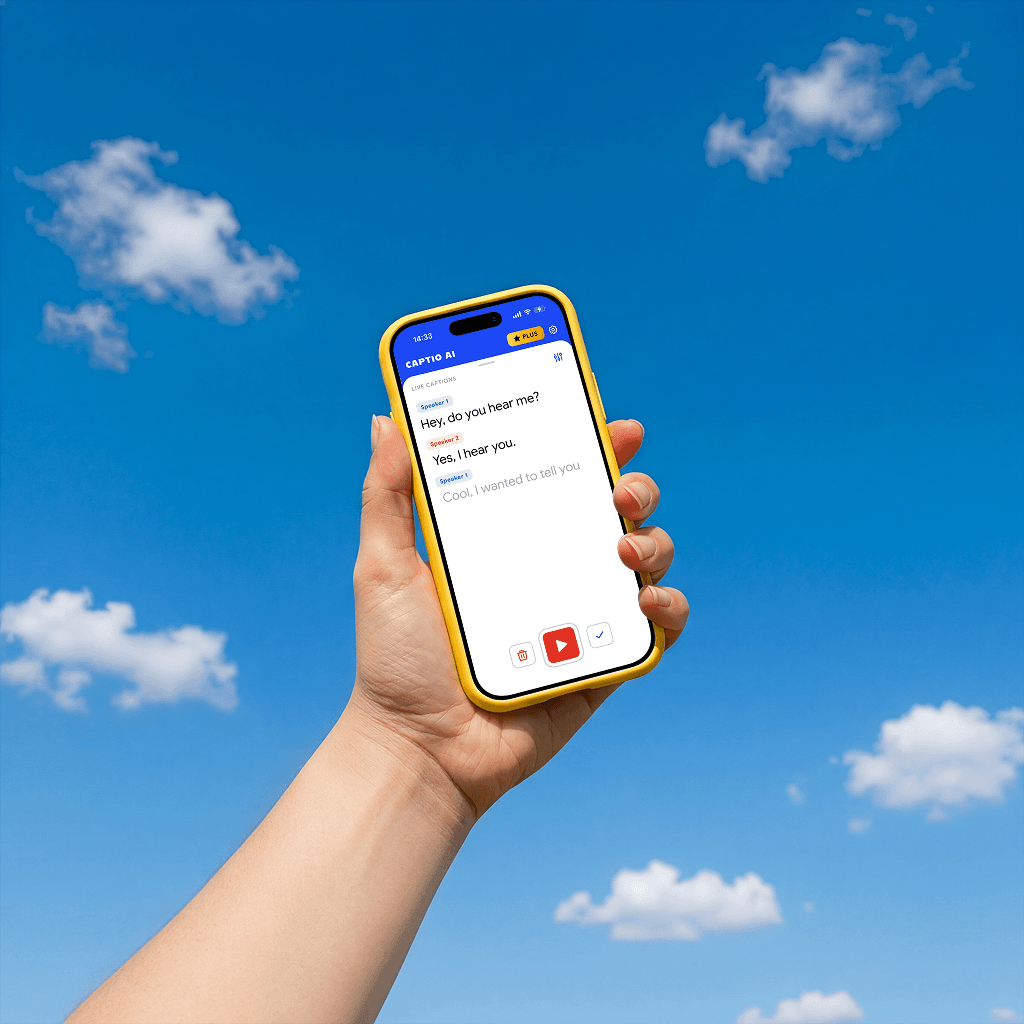
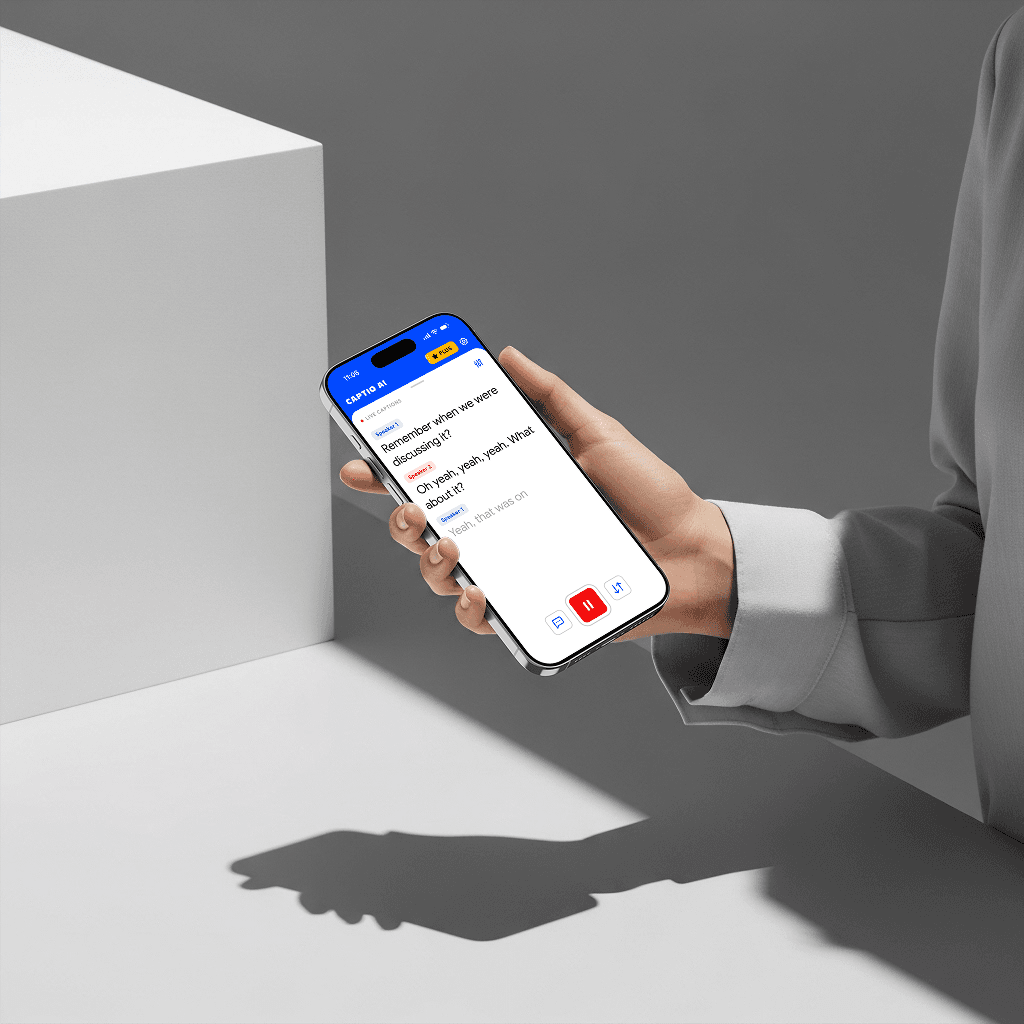
Built for the pace and pressure of a real lecture
Follow without splitting your attention
Lip-reading and note-taking at the same time is an impossible cognitive load. Captio AI handles the following so you can direct all your attention to understanding what is being said.
Captions while the lecturer is still speaking
Words appear on your screen as they are said — not after the sentence ends. You stay in sync with the lecture rather than always being a beat behind.
Works in any lecture setting
Lecture halls, seminar rooms, online classes, study groups. Place the phone on your desk, point it toward the audio source, and Captio AI handles the rest.
A full transcript to study from
Record the lecture and upload it to Audio Transcription after class. Get a complete written record you can search, annotate, and revise from — at your own pace.
60+ languages
For international students, students studying abroad, or courses taught in a second language. Captio AI captions or translates in real time with no manual setup.
No advance notice needed
Official university captioning requires booking in advance and is not available for every session. Captio AI works for any lecture, any time, with no prior arrangement.
Why Belarusian is hard to understand
Akan'e — mandatory vowel reduction
- Belarusian reduces all unstressed /o/ and /a/ to the same sound — the reduction is obligatory
- Belarusian akan'e is more thoroughgoing than Russian akan'e: both /o/ and /a/ in unstressed positions reduce to /a/, and this reduction applies in all registers including formal academic speech. A deaf student tracking vowel positions in unstressed syllables gets less visual information from Belarusian than from Russian — the contrast that exists in careful speech collapses into a single mid-low vowel in every unstressed position.
Voiced velar fricative
- Belarusian uses /ɣ/ where Russian uses /g/ — a throat-produced sound invisible on the lips
- Belarusian uses a voiced velar fricative /ɣ/ in positions where Russian has a voiced stop /g/. This fricative is produced at the very back of the mouth with minimal lip movement. In a Minsk university lecture, the Belarusian /ɣ/ that begins dozens of common academic words — 'hrupa' (group), 'hramatyka' (grammar) — arrives from the throat with no visible front articulation.
Belarusian-Russian code-switching
- Minsk university lectures shift between Belarusian and Russian mid-sentence
- Belarus is functionally bilingual. Lectures at Belarusian State University and other Minsk institutions regularly switch between Belarusian and Russian — sometimes mid-sentence. For a deaf student, both languages share similar consonant-heavy phonology, but their vowel systems and some consonants differ enough to create ambiguity. The switching happens without visual warning.
Palatalization system
- Belarusian has 39+ consonant phonemes with palatalized pairs — invisible from the front
- Belarusian has one of the most complex consonant inventories in Slavic, with palatalized (soft) consonants paired with non-palatalized (hard) ones across most consonant positions. The distinction is made by tongue body raising — the lips barely change position. In a fast Belarusian lecture, a deaf student cannot visually distinguish soft from hard consonants throughout the session.
Iotation
- Belarusian iotation produces palatalized sequences that look like plain consonants on the lips
- Belarusian uses the letter 'і' (і) in specific positions to iotate (palatalize) the preceding consonant, creating sequences where what is written as a vowel functions as a palatalizing element. These iotated consonant sequences look similar to non-iotated ones from the front — a deaf student following Belarusian lecture text sees the same lip shape for both.
Download for free
The highest GJB2 mutation carrier rate in Europe — genetic deafness at population scale in Belarus
A genetic study of Belarusian patients with non-syndromic sensorineural hearing loss found a carrier frequency of the 35delG GJB2 mutation of 5.7% — the highest recorded in any European population. This mutation was detected in 53% of Belarusian patients with SNHL, making it the dominant genetic cause of deafness in the country. The second most common mutation, 312del14, adds further genetic burden. Belarus's high carrier frequency has a direct demographic consequence: a substantial proportion of Belarusian deafness is hereditary and present from birth, creating a population of deaf people who have never had auditory access to Belarusian language.
Belarusian civil society — including deaf advocacy organisations — has operated under significant restrictions since 2020, with many independent NGOs suspended or forced to re-register under restrictive conditions. The institutional infrastructure for deaf rights and academic access has been further weakened in this context. Belarusian universities do not provide systematic live captioning for deaf students, and the combination of state control over NGOs and a lack of legal mandate for academic interpreter provision means deaf students at BSU or BNTU attend spoken lectures with no alternative access mechanism.
The bilingual reality of Belarusian higher education — where lectures may be in Belarusian, Russian, or an unsignalled mix of both — compounds the access gap. A deaf student who is fluent in Belarusian lip-reading patterns still encounters Russian-medium sections of lectures, and vice versa. Captio AI captions Belarusian and Russian speech in real time, covering both languages of Belarusian academic life in a single session.
Download for free
What you hear stays with you.
Gone the moment it ends
Captio AI processes your audio in real time and discards it immediately. Nothing is recorded. Nothing is kept.
Not a product
Your conversations are not something Captio AI sells, shares, or monetizes — to anyone, for any reason.
Not used to train anything
What you say in a doctor's appointment or a job interview never ends up in a training dataset. Not ours. Not anyone else's.

Private by default
Captio AI supports 60+ languages
Download for free
Frequently asked questions
Follow every lecture in Belarusian.
Captio AI is free to start
Download for free