

Norwegian live captions and productivity tool for lectures
For deaf and hard of hearing people.
Download for free


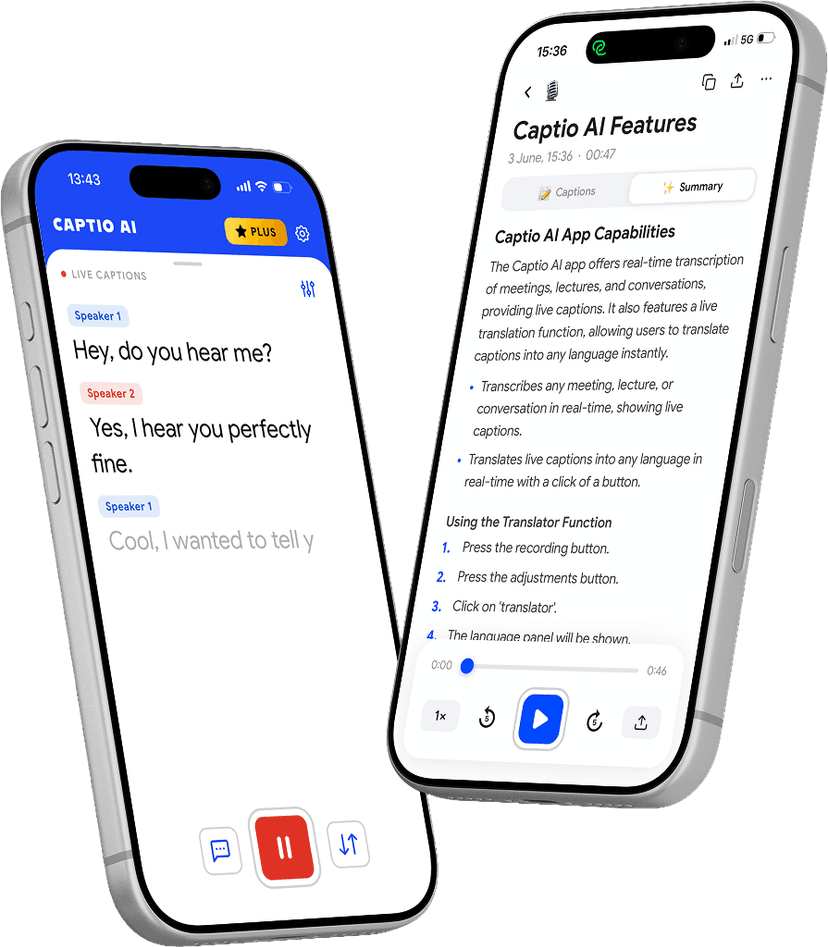
Everything you need to follow Norwegian lectures
Four tools built for deaf and hard of hearing Norwegian speakers.
Follow the lecture as it happens
- Captions appear word by word while the lecturer is still speaking
- Works in lecture halls, seminars, and tutorials
- No setup — place the phone on your desk and start
- Any accent, any pace
For courses in another language
- Captions and translates in real time
- For international students or foreign-language courses
- 60+ languages, no switching
- Follow the lecture in the language you read best
Full transcript to study from
- Record the lecture and upload it for a complete written transcript
- Searchable, copyable, shareable
- Review at your own pace after class
- Works on any lecture recording
Key points extracted automatically
- Important concepts and takeaways pulled from any transcript
- Organised into sections — not one continuous block
- Useful for revision and exam preparation
- Works on any saved lecture transcript
Download for free
Every situation covered
Designed for the real moments that matter — not just quiet controlled environments.
Large lecture halls at the University of Oslo, NTNU Trondheim, the University of Bergen, and UiT Tromsø — Norwegian instruction in regional dialect at full academic pace. Captio AI captions the professor in real time.
Seminars and gruppearbeid (group work sessions) where discussion is in Norwegian, often with English research terminology. Captio AI handles both without manual switching.
Recorded lectures on university portals (Canvas, Mitt UiO) or shared as video files — play on speaker and Captio AI captions whatever is playing in real time.
Study groups reviewing Norwegian lecture material in student accommodation. Captio AI captions whoever is speaking.
Lectures from Bergen or Tromsø faculty whose Norwegian carries western or northern regional features. Captio AI handles Oslo, Bergen, Tromsø, and Trondheim Norwegian varieties.
Online courses and webinars delivered by Norwegian universities in Norwegian or English. Captio AI captions any audio source in real time.
Most accurate and fastest models
word accuracy
independent benchmark, 2025
real-time captions
first word appears as you speak
Download for free
Built for the pace and pressure of a real lecture
Follow without splitting your attention
Lip-reading and note-taking at the same time is an impossible cognitive load. Captio AI handles the following so you can direct all your attention to understanding what is being said.
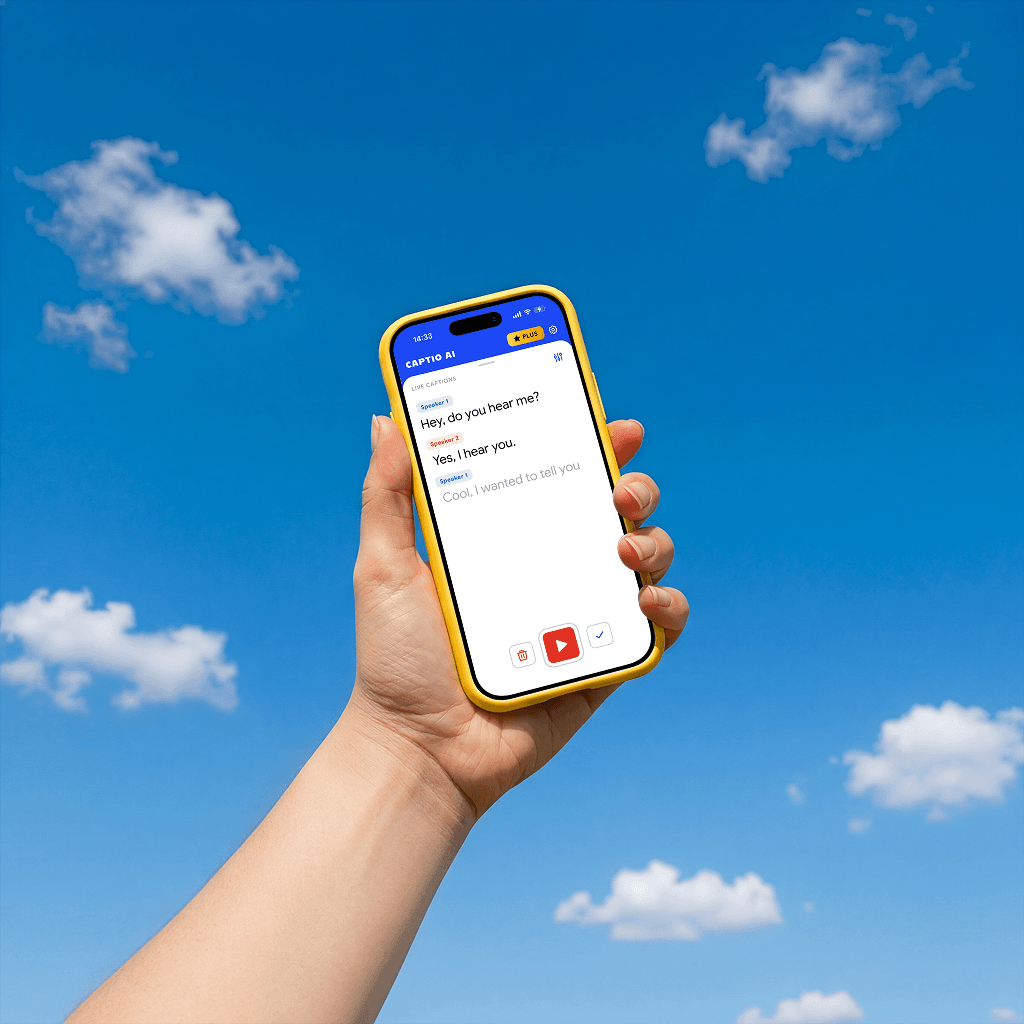
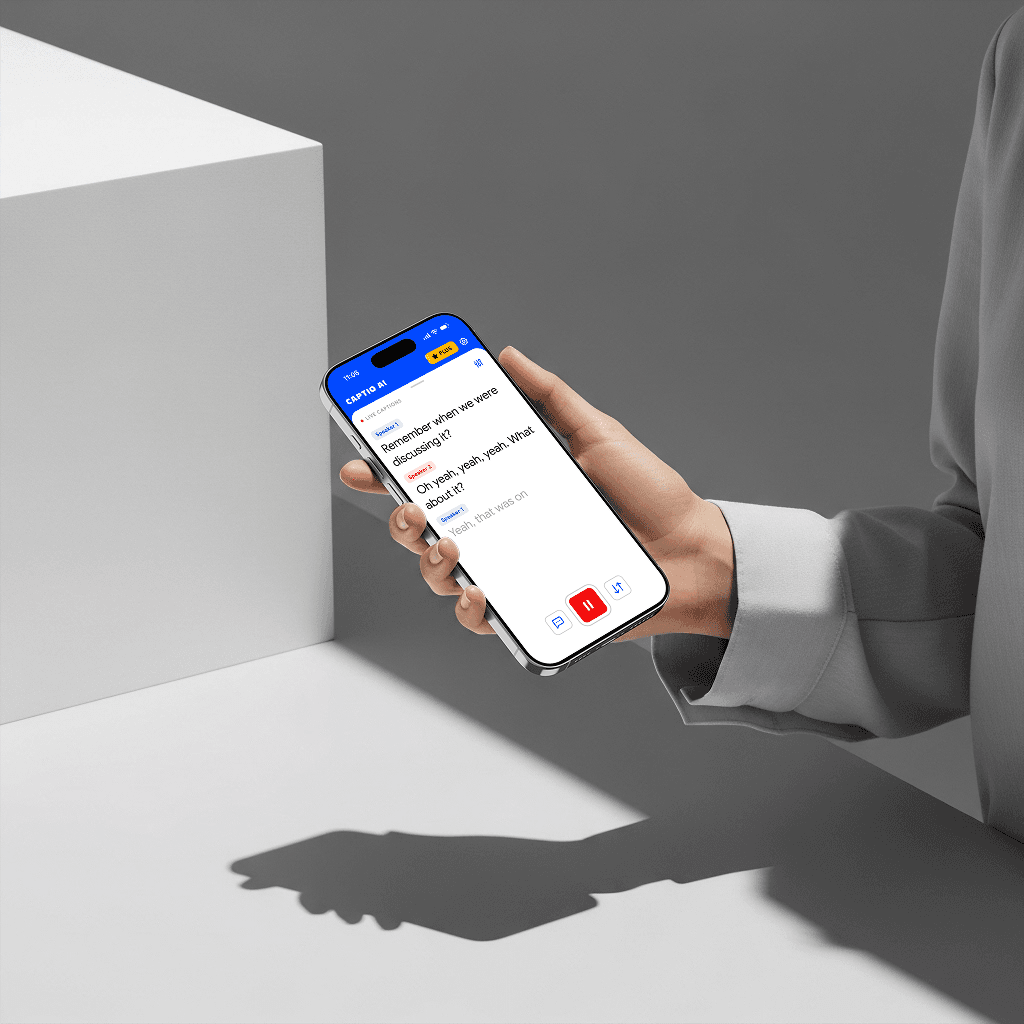
Captions while the lecturer is still speaking
Words appear on your screen as they are said — not after the sentence ends. You stay in sync with the lecture rather than always being a beat behind.
Works in any lecture setting
Lecture halls, seminar rooms, online classes, study groups. Place the phone on your desk, point it toward the audio source, and Captio AI handles the rest.
A full transcript to study from
Record the lecture and upload it to Audio Transcription after class. Get a complete written record you can search, annotate, and revise from — at your own pace.
60+ languages
For international students, students studying abroad, or courses taught in a second language. Captio AI captions or translates in real time with no manual setup.
No advance notice needed
Official university captioning requires booking in advance and is not available for every session. Captio AI works for any lecture, any time, with no prior arrangement.
Why Norwegian is hard to understand
No spoken standard
- Norwegian has no enforced spoken standard — every lecturer uses their own dialect
- Norway has two official written standards (Bokmål and Nynorsk) but no prescribed spoken standard. University lecturers at Oslo, Bergen, Tromsø, or Trondheim speak their native regional dialect in formal academic settings. A deaf student must recalibrate for every new lecturer — there is no single Norwegian phonological target to master.
Pitch accent
- Norwegian distinguishes minimal word pairs by tonal melody — invisible on the lips
- Like Swedish, Norwegian uses a lexical pitch accent (Tone 1 and Tone 2) to distinguish word pairs: 'bønder' (farmers, Tone 1) versus 'bønner' (beans, Tone 2). The tonal distinction is entirely acoustic. In a lecture hall, the pitch melody that distinguishes these word pairs carries no visual information a deaf student can track.
Retroflex consonants
- Eastern Norwegian /r/ causes following consonants to become retroflex — invisible from the front
- In eastern Norwegian dialects (Oslo, Trøndersk), the /r/ influences following alveolar consonants, making them retroflex: /r/ + /t/ → /ʈ/, /r/ + /n/ → /ɳ/. These retroflex sounds are produced with the tongue tip curled back — a distinction invisible from the front. 'Stor dame' produces retroflex consonants that look identical to plain alveolars on the lips.
Bergen uvular /R/
- Bergen Norwegian uses a uvular /R/ — throat-produced and invisible on the lips
- Bergen Norwegian uses a uvular /R/ instead of the alveolar /r/ of eastern Norwegian. The uvular sound is produced at the back of the throat with no visible lip movement. At the University of Bergen, faculty who are Bergen natives deliver word-initial and word-medial /r/ sounds from the throat — a deaf student expecting an alveolar articulation sees nothing.
Nynorsk vs Bokmål pronunciation
- Nynorsk-influenced faculty produce different vowel qualities from Bokmål-standard speech
- Norwegian faculty from western regions — Bergen, Sogn og Fjordane, Møre og Romsdal — often lecture with Nynorsk-influenced pronunciation: different vowel qualities, different syllable rhythm. A deaf student calibrated to Oslo Bokmål-standard Norwegian finds Nynorsk-influenced western Norwegian speech presenting different vowel lip positions for the same academic content.
Download for free
11,000 deaf and hard of hearing Norwegians — and a HUNT study showing hearing loss raises disability pension risk by 50%
Norway's deaf and hard of hearing community numbers approximately 11,000 individuals. A large population follow-up study — the HUNT Hearing Study — tracked 21,754 Norwegian adults from 1996 to 2011 and found that hearing loss at baseline was associated with a 50% higher risk of receiving a disability pension (hazard ratio 1.5, 95% CI 1.3–1.8). The association was strongest among younger workers and those with lower educational attainment. The pathway from hearing loss to disability pension runs directly through educational barriers — those who cannot access lectures cannot qualify for the professions that keep them off disability pension.
Norwegian Sign Language (NTS) was formally recognised as a full language under Norwegian law on 1 January 2022. Under the Norwegian Constitution, all individuals have the right to education including those with disabilities, and DHH individuals have formal rights to deaf education in primary and lower secondary years. Norwegian newborn hearing screening achieves 95% coverage. Despite this strong early-intervention infrastructure, Norwegian universities do not provide systematic live captioning — individual students must arrange interpreter support through their institution, and specialised academic interpreters for STEM and professional fields are in short supply.
A 2026 study in Frontiers in Education found that perceived hearing difficulties in Norway are associated with poorer school satisfaction and increased peer victimisation — confirming that the barriers begin before university. For a deaf student at UiO, NTNU, or UiB — facing any of Norway's regional dialects with no spoken standard — Captio AI provides real-time captions in every Norwegian variety, covering Oslo, Bergen, Tromsø, and Trondheim speech in a single session.
[1]Hearing loss, sick leave, and disability pension — HUNT follow-up study (PMC9281024)
[2]Perceived hearing difficulties and school satisfaction in Norway — Frontiers in Education, 2026
[3]Deafness in Norway — Wikipedia overview of NSL recognition and community
[4]GBD 2019 — Hearing loss prevalence and years lived with disability (PMC7960691)
Download for free
What you hear stays with you.
Gone the moment it ends
Captio AI processes your audio in real time and discards it immediately. Nothing is recorded. Nothing is kept.
Not a product
Your conversations are not something Captio AI sells, shares, or monetizes — to anyone, for any reason.
Not used to train anything
What you say in a doctor's appointment or a job interview never ends up in a training dataset. Not ours. Not anyone else's.

Private by default
Captio AI supports 60+ languages
Download for free
Frequently asked questions
Follow every lecture in Norwegian.
Captio AI is free to start
Download for free