

Tagalog live captions and productivity tool for lectures
For deaf and hard of hearing people.
Download for free


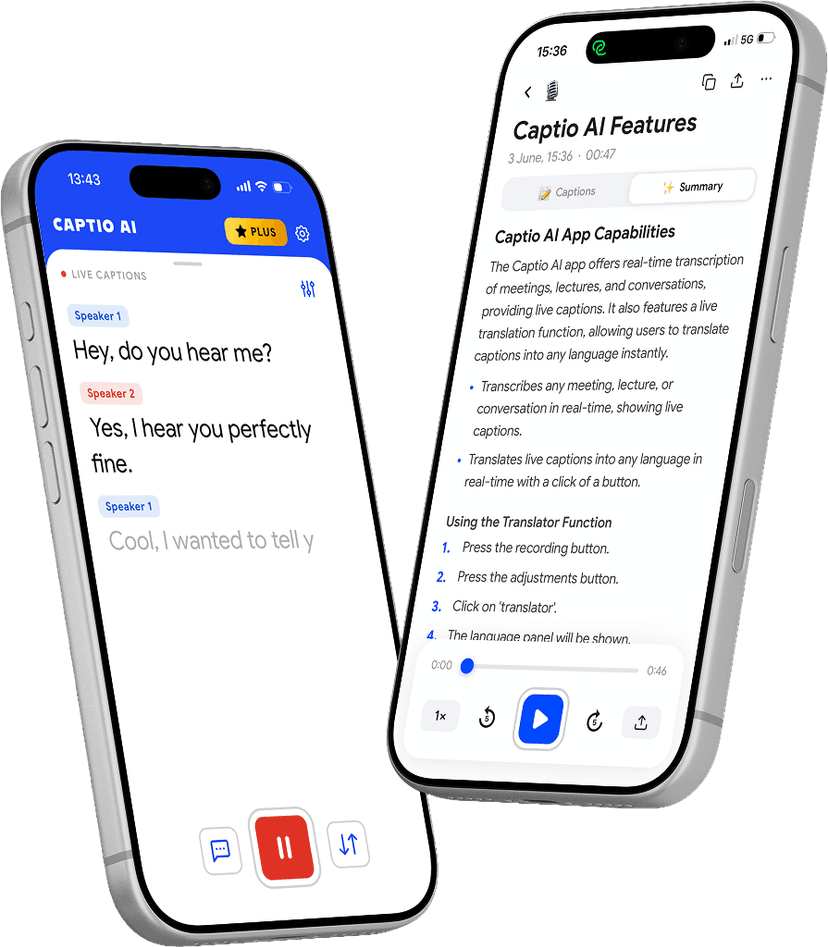
Everything you need to follow Tagalog lectures
Four tools built for deaf and hard of hearing Tagalog speakers.
Follow the lecture as it happens
- Captions appear word by word while the lecturer is still speaking
- Works in lecture halls, seminars, and tutorials
- No setup — place the phone on your desk and start
- Any accent, any pace
For courses in another language
- Captions and translates in real time
- For international students or foreign-language courses
- 60+ languages, no switching
- Follow the lecture in the language you read best
Full transcript to study from
- Record the lecture and upload it for a complete written transcript
- Searchable, copyable, shareable
- Review at your own pace after class
- Works on any lecture recording
Key points extracted automatically
- Important concepts and takeaways pulled from any transcript
- Organised into sections — not one continuous block
- Useful for revision and exam preparation
- Works on any saved lecture transcript
Download for free
Every situation covered
Designed for the real moments that matter — not just quiet controlled environments.
Large lecture theatres at UP Diliman, Ateneo de Manila, and De La Salle — Filipino and Taglish instruction delivered at full academic pace. Captio AI captions the professor in real time from any seat.
Smaller university seminars where faculty switch freely between Filipino, English, and technical terminology. Captio AI handles the code-switching without manual language adjustment.
Recorded lectures posted to the school's LMS, YouTube, or Google Drive — play on speaker and Captio AI captions whatever is playing.
Study group sessions reviewing lecture content in Filipino and English. Captio AI captions whoever is speaking so you follow each person's contribution.
Guest lecturers and visiting academics from different Philippine regions — Cebuano, Ilocano, or Visayan-accented Filipino. Captio AI handles regional accented Filipino speech.
Pan-Philippine webinars and online courses from CHED-accredited institutions. Captio AI captions any audio source in real time.
Most accurate and fastest models
word accuracy
independent benchmark, 2025
real-time captions
first word appears as you speak
Download for free
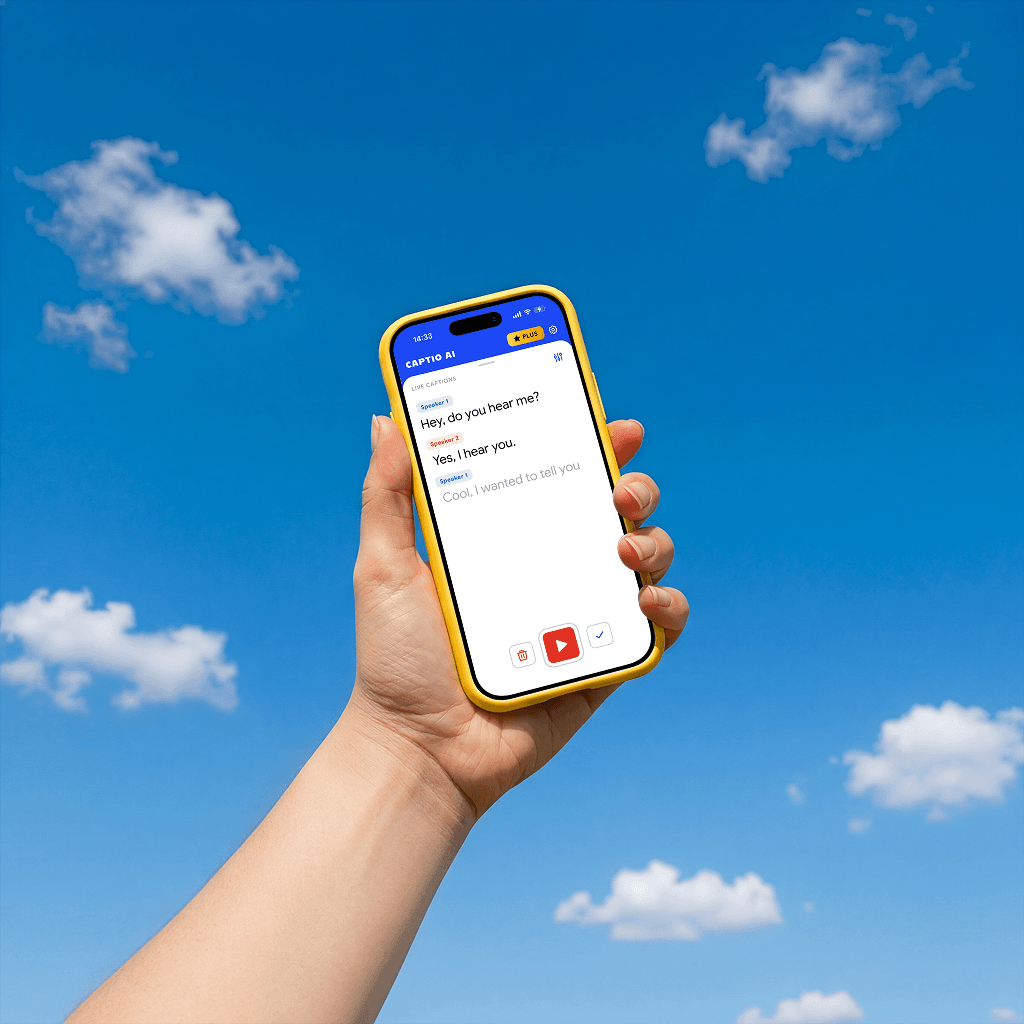
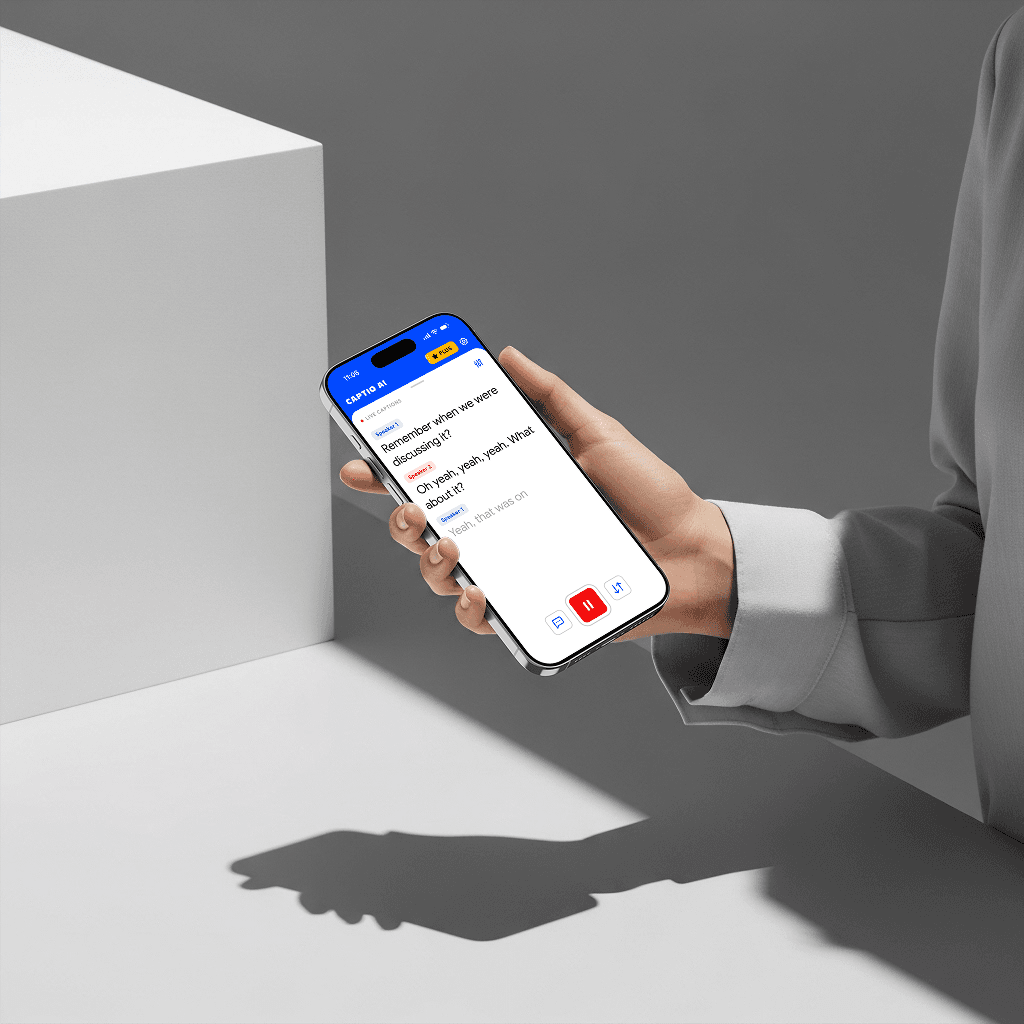
Built for the pace and pressure of a real lecture
Follow without splitting your attention
Lip-reading and note-taking at the same time is an impossible cognitive load. Captio AI handles the following so you can direct all your attention to understanding what is being said.
Captions while the lecturer is still speaking
Words appear on your screen as they are said — not after the sentence ends. You stay in sync with the lecture rather than always being a beat behind.
Works in any lecture setting
Lecture halls, seminar rooms, online classes, study groups. Place the phone on your desk, point it toward the audio source, and Captio AI handles the rest.
A full transcript to study from
Record the lecture and upload it to Audio Transcription after class. Get a complete written record you can search, annotate, and revise from — at your own pace.
60+ languages
For international students, students studying abroad, or courses taught in a second language. Captio AI captions or translates in real time with no manual setup.
No advance notice needed
Official university captioning requires booking in advance and is not available for every session. Captio AI works for any lecture, any time, with no prior arrangement.
Why Tagalog is hard to understand
Glottal stop pairs
- Tagalog distinguishes word meaning by a final glottal stop that is completely invisible
- Tagalog word pairs like 'bata' (child) and 'batà' (robe) differ only by a final glottal stop — a brief throat closure with no lip movement. In a Philippine university lecture hall, these meaning-bearing glottal stops vanish. A deaf student watching the professor's lips reads the same shape for both words.
Schwa reduction
- Unstressed syllables collapse in fast academic Filipino
- At lecture speed, unstressed syllables in Filipino reduce toward schwa or disappear. The syllable structure a deaf student expects from careful speech — tracking lip positions — gives way to compressed mouth movements where mid-word vowels are gone.
Taglish switching
- Philippine lectures shift between Filipino and English mid-sentence
- Filipino academic instruction habitually mixes Filipino grammar with English technical vocabulary — sometimes within the same clause. The lecture frame stays Filipino but the terminology is English. For a deaf student, the lip pattern shifts register mid-phrase with no visual warning, requiring constant mental adjustment between two very different phonological systems.
Regional accents
- Cebuano, Ilocano, and Visayan-influenced Filipino carry different mouth movement patterns
- The Philippines has over 180 languages, and Filipino spoken by faculty from the Visayas, Ilocos, or Mindanao regions carries phonological influence from local languages. Cebuano-influenced Filipino, in particular, has different vowel qualities and rhythm. A deaf student calibrated to Metro Manila Filipino will miss significant portions from a regional-accented lecturer.
Stress homophones
- Tagalog stress position changes meaning, but stress is invisible on the lips
- Tagalog uses stress position to distinguish word pairs — 'bágo' (new) versus 'bagó' (before) — where only the vowel quality of the stressed syllable shifts. At lecture speed, this distinction collapses into one lip shape for both words.
Download for free
9 million Filipinos with hearing loss — and almost no specialist support
A 2020 national survey published in the Asia-Pacific Journal of Public Health found that 14.7% of Filipino adults aged 18–65 have moderate or worse hearing loss — rising to 49.1% among adults over 65. The prevalence of severe to profound hearing loss in the Philippines is comparatively high against high-income countries, driven in part by high rates of outer and middle ear disease, with 14.2% of survey participants having active ear conditions. An estimated 9 million Filipinos have hearing loss requiring medical attention or rehabilitation.
The Philippines has one of the smallest ear and hearing specialist populations in Southeast Asia — 862 ENT physicians and only 84 audiologists serving a population of over 110 million. Filipino Sign Language (FSL) was formally recognised under Republic Act 11106 in 2018, giving FSL users legal rights to interpretation in education and government services. In practice, interpreter access at Philippine universities remains scarce, and most deaf students at higher education institutions manage without live captioning or systematic interpreter provision.
The economic consequences are stark. The estimated daily income of deaf Filipinos stands at around ₱35–60 compared to ₱290 for hearing Filipinos, reflecting how systematically excluded deaf Filipinos are from the labour market — a gap that begins in the lecture halls where spoken instruction is the only mode of delivery. Captio AI captions Filipino and Taglish lecture speech in real time, so deaf and hard of hearing students at UP Diliman, Ateneo, or any provincial university can follow any class without requiring advance institutional accommodation.
Download for free
What you hear stays with you.
Gone the moment it ends
Captio AI processes your audio in real time and discards it immediately. Nothing is recorded. Nothing is kept.
Not a product
Your conversations are not something Captio AI sells, shares, or monetizes — to anyone, for any reason.
Not used to train anything
What you say in a doctor's appointment or a job interview never ends up in a training dataset. Not ours. Not anyone else's.

Private by default
Captio AI supports 60+ languages
Download for free
Frequently asked questions
Follow every lecture in Tagalog.
Captio AI is free to start
Download for free