

English live captions and productivity tool for lectures
For deaf and hard of hearing people.
Download for free
Everything you need to follow English lectures
Four tools built for deaf and hard of hearing English speakers.
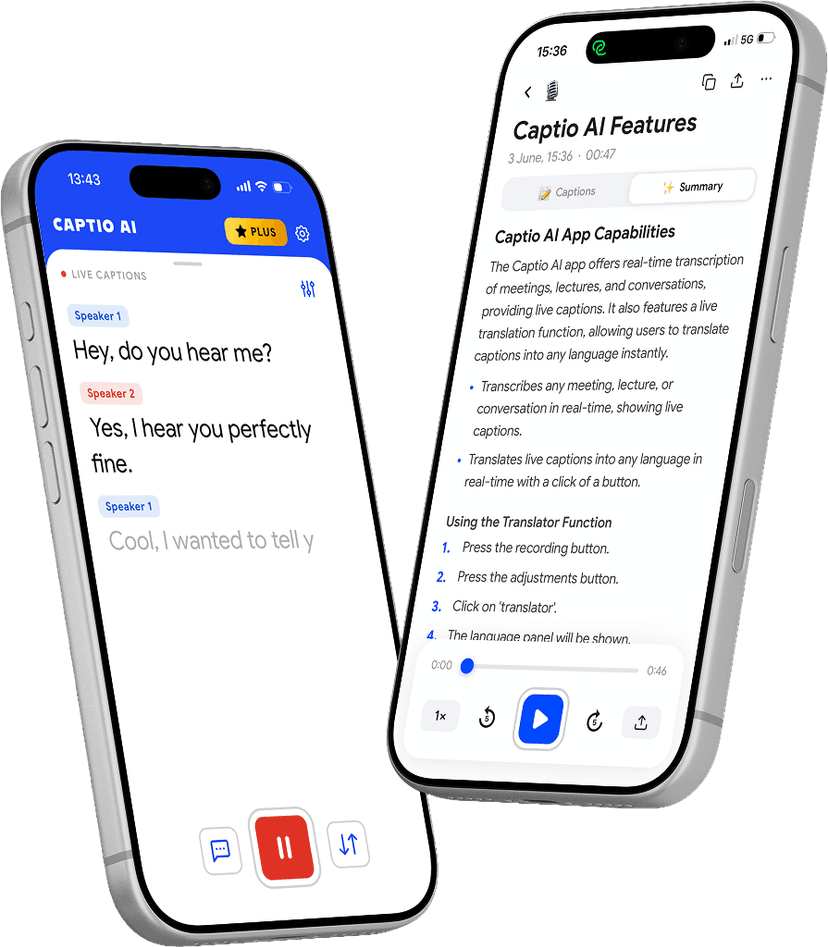
Follow the lecture as it happens
- Captions appear word by word while the lecturer is still speaking
- Works in lecture halls, seminars, and tutorials
- No setup — place the phone on your desk and start
- Any accent, any pace
For courses in another language
- Captions and translates in real time
- For international students or foreign-language courses
- 60+ languages, no switching
- Follow the lecture in the language you read best
Full transcript to study from
- Record the lecture and upload it for a complete written transcript
- Searchable, copyable, shareable
- Review at your own pace after class
- Works on any lecture recording
Key points extracted automatically
- Important concepts and takeaways pulled from any transcript
- Organised into sections — not one continuous block
- Useful for revision and exam preparation
- Works on any saved lecture transcript
Download for free
Every situation covered
Designed for the real moments that matter — not just quiet controlled environments.
UK lecture theatres hold 200–400 students. The lecturer speaks at the front, the PA bounces sound off the walls, and from row twelve there is no reliable lip-read angle. Place your phone on the desk facing the nearest speaker output. Captio AI captions every word from any row, without requiring you to be close enough to see the lecturer's face.
British university seminars move fast — eight to fifteen students around a table, contributions switching without warning, regional accents mixing in a small room with no microphone. Captio AI follows whoever is speaking so you track every argument and every contribution without asking anyone to slow down or repeat.
UK universities run lecture capture through Panopto and Echo360. Auto-generated captions are often inaccurate for technical terms and accented speech. Put the lecture on speaker and point Captio AI toward the audio — accurate captions in real time, for any platform, live or recorded.
Library group rooms, campus cafes, student halls. The informal revision session is where a lot of actual learning happens — problems worked through, gaps filled, questions answered. Captio AI captions whoever is speaking at the table so you follow every explanation without losing the thread.
UK universities attract lecturers from across Europe, South Asia, and East Asia. A Portuguese-accented English delivery, a French-language course, a visiting German researcher. Live Translator captions in real time so the lecturer's first language is never the reason you fall behind.
Visiting academics, industry speakers, alumni talks. These sessions are announced last minute, added to the schedule without notice, and cannot be booked for official captioning in advance. Captio AI covers any speaker at any campus venue without prior arrangement.
Most accurate and fastest models
word accuracy
independent benchmark, 2025
real-time captions
first word appears as you speak
Download for free
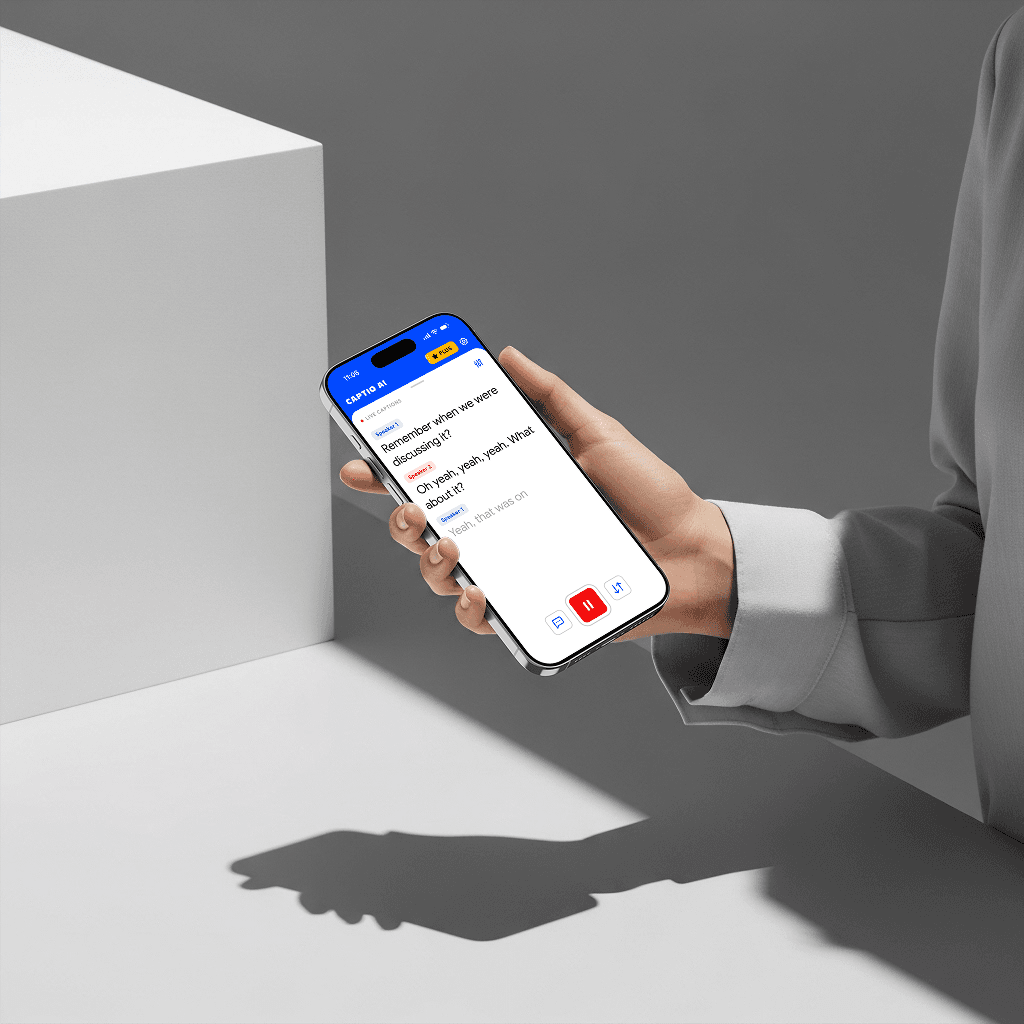
Built for the pace and pressure of a real lecture
Follow without splitting your attention
Lip-reading and note-taking at the same time is an impossible cognitive load. Captio AI handles the following so you can direct all your attention to understanding what is being said.
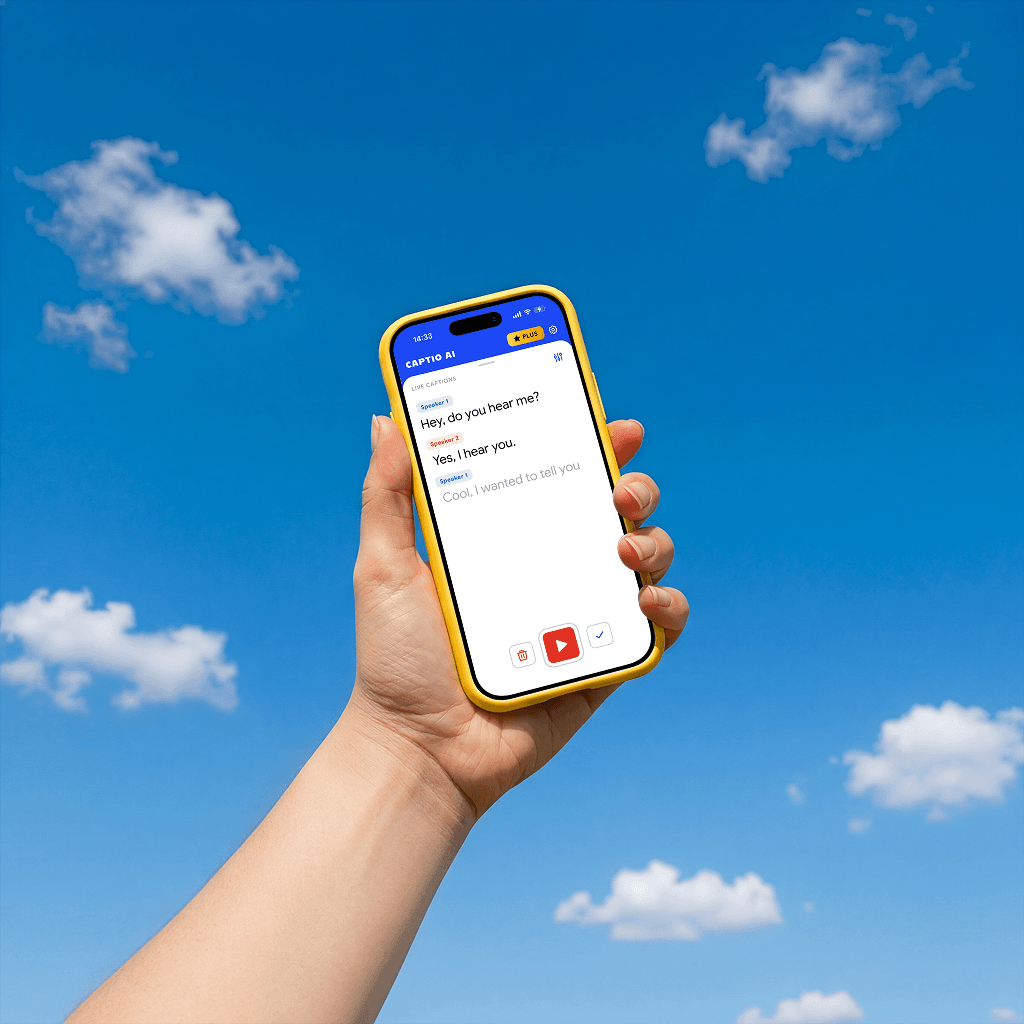
Captions while the lecturer is still speaking
Words appear on your screen as they are said — not after the sentence ends. You stay in sync with the lecture rather than always being a beat behind.
Works in any lecture setting
Lecture halls, seminar rooms, online classes, study groups. Place the phone on your desk, point it toward the audio source, and Captio AI handles the rest.
A full transcript to study from
Record the lecture and upload it to Audio Transcription after class. Get a complete written record you can search, annotate, and revise from — at your own pace.
60+ languages
For international students, students studying abroad, or courses taught in a second language. Captio AI captions or translates in real time with no manual setup.
No advance notice needed
Official university captioning requires booking in advance and is not available for every session. Captio AI works for any lecture, any time, with no prior arrangement.
Why English is hard to understand
Connected speech
- Lecture pace collapses spoken English completely
- Academics speak at 150–180 words per minute. At that pace, English vowels reduce to schwa, syllables drop, and words run together — 'going to' becomes 'gonna', 'want to' becomes 'wanna', 'probably' becomes 'prob'ly'. These reductions are not errors; they are normal fast English. On the lips, they vanish. A deaf student lip-reading a lecturer is decoding a compressed signal, not the words written on the slides.
Viseme ambiguity
- Half of English phonemes look identical on the lips
- P, B, and M share the same lip closure. F and V are visually indistinguishable. T, D, and N produce nearly identical mouth shapes. Researchers estimate that even skilled lip-readers decode only 30–45% of English speech from visual information alone. In a lecture, where precise vocabulary matters, every ambiguous phoneme is a potential comprehension gap at the exact moment the content was most important.
Regional accent diversity
- A UK lecture hall contains multiple accent systems
- British English spans accent groups that are phonologically remote from one another. A Glaswegian lecturer has a different vowel inventory from a Scouse one; Geordie vowels are unlike Estuary English; a Yorkshire lecturer drops different phonemes than a Welsh English speaker. Each is a different lip-reading task. Deaf students at UK universities encounter lecturers from every region — often without warning, with no time to adjust.
Academic jargon
- Technical vocabulary has no lip-reading anchor
- Lectures are dense with Latin-derived terminology, acronyms, field-specific vocabulary, and proper nouns that cannot be predicted from context. 'Photosynthesis', 'jurisprudence', 'epistemology', 'haematology' — none of these can be lip-read reliably. Missing a technical term leaves a gap at the exact moment of the lecture that matters most, with no way to recover it without stopping the room.
Dual-task impossibility
- Taking notes while lip-reading is not physically possible
- A hearing student takes notes while their auditory system processes the lecture passively. For a deaf student, every moment spent writing is a moment not watching the lecturer's face — which breaks the only access route to the content. The choice is to follow without notes or write without following. Neither is what university was supposed to require.
Download for free
Deaf and hard of hearing students are falling behind — and the lecture is why
Over 18 million adults in the UK are deaf, have hearing loss, or have tinnitus — a figure updated from the 2021 census that includes people with milder loss previously uncounted (RNID, 2024). Of those, 2.4 million have a level of hearing loss that means they would struggle to hear most conversational speech. 62% of people with hearing loss in the UK report isolation or reduced confidence as a direct consequence (RNID, 2023 Health and Wellbeing Survey). The university lecture — the primary format of UK higher education — is a setting specifically designed around hearing.
The attainment gap begins before students reach university. Just 34% of deaf students in England gained two A-levels or equivalent qualifications, compared to 55% of hearing students — a gap reflecting years of accumulated access failures in mainstream classrooms (NDCS and Education Policy Institute, 2023). By the time deaf students reach university they are already carrying a deficit built from years of lectures, seminars, and discussions where access was partial at best. A 2025 study found that 23.2% of deaf and hard of hearing learners left further education without any recognised qualifications at all (Williams, NADP, 2025).
Inside UK universities, the accommodation infrastructure has not kept pace. Real-time captioning must be booked in advance, requires disclosure of a disability, and is unavailable for many session types — guest speakers, ad-hoc tutorials, and online-only formats often fall outside what can be arranged. Qualified BSL interpreters with specialist subject knowledge are in critically short supply. There has been a 26% decline in qualified Teachers of the Deaf across the UK since 2011 (NDCS), and the pipeline into specialist higher education support roles has followed. A Disabled Students' Allowance of up to £20,725 per year is available — but only after disclosure, assessment, and approval, none of which helps a deaf student in a lecture starting at nine tomorrow.
Download for free
What you hear stays with you.
Gone the moment it ends
Captio AI processes your audio in real time and discards it immediately. Nothing is recorded. Nothing is kept.
Not a product
Your conversations are not something Captio AI sells, shares, or monetizes — to anyone, for any reason.
Not used to train anything
What you say in a doctor's appointment or a job interview never ends up in a training dataset. Not ours. Not anyone else's.

Private by default
Captio AI supports 60+ languages
Download for free
Frequently asked questions
Follow every lecture in English.
Captio AI is free to start
Download for free