

Arabic live captions and productivity tool for lectures
For deaf and hard of hearing people.
Download for free


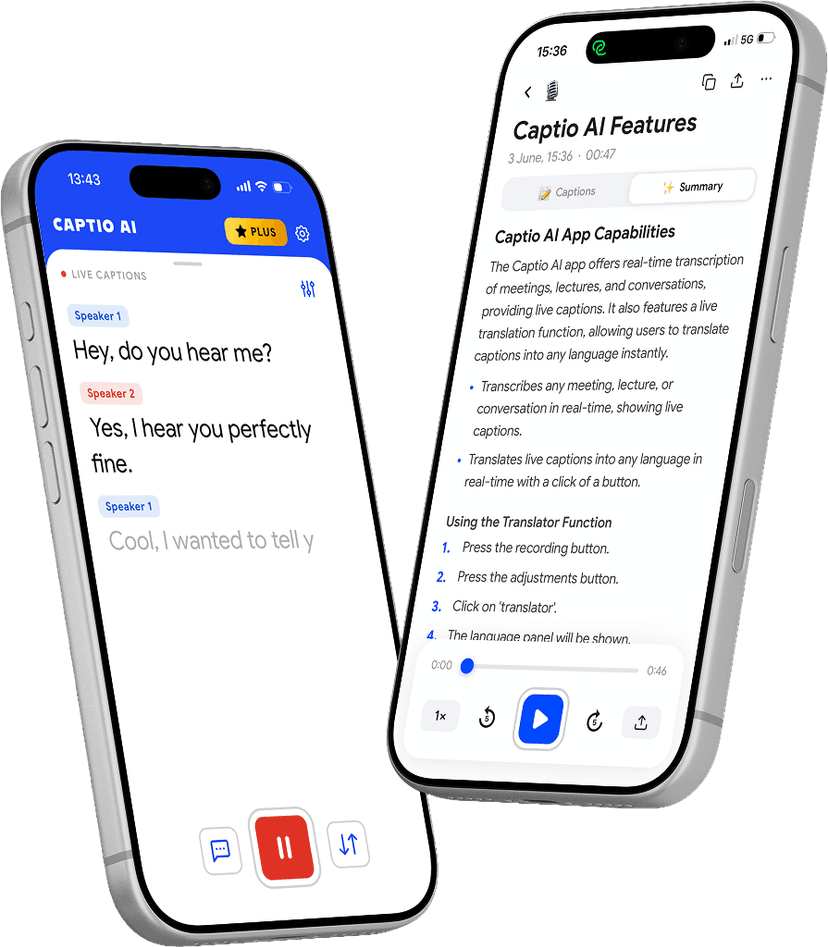
Everything you need to follow Arabic lectures
Four tools built for deaf and hard of hearing Arabic speakers.
Follow the lecture as it happens
- Captions appear word by word while the lecturer is still speaking
- Works in lecture halls, seminars, and tutorials
- No setup — place the phone on your desk and start
- Any accent, any pace
For courses in another language
- Captions and translates in real time
- For international students or foreign-language courses
- 60+ languages, no switching
- Follow the lecture in the language you read best
Full transcript to study from
- Record the lecture and upload it for a complete written transcript
- Searchable, copyable, shareable
- Review at your own pace after class
- Works on any lecture recording
Key points extracted automatically
- Important concepts and takeaways pulled from any transcript
- Organised into sections — not one continuous block
- Useful for revision and exam preparation
- Works on any saved lecture transcript
Download for free
Every situation covered
Designed for the real moments that matter — not just quiet controlled environments.
Arab university lecture halls and قاعات الدرس are formal settings where professors deliver MSA at pace. Place your phone on the desk facing the PA speaker. Captio AI captions the formal MSA register as spoken — regardless of the lecturer's regional phonetic background.
Arabic university seminars involve formal MSA discussion mixed with students' regional dialect influences. Fast switching between registers and contributors. Captio AI follows whoever is speaking so you track every argument and contribution.
E-learning platforms across the Arab world carry recorded lectures in MSA. Auto-captions often fail on pharyngeal consonants and emphatic sounds. Put the lecture on speaker and point Captio AI at the audio for accurate real-time captions.
Campus study sessions where students shift freely between MSA and their regional dialect. Fast collaborative study in Arabic. Captio AI captions the spoken Arabic regardless of which variety is being used at any moment.
Arab students in English or French-medium courses at bilingual universities like AUB, AUC, or KAUST. Live Translator captions in real time so language is not the access barrier on top of everything else.
Visiting scholars from across the Arab world, distinguished academics, international researchers — each bringing their own regional phonetic profile. Captio AI covers any speaker at any lecture venue without prior arrangement.
Most accurate and fastest models
word accuracy
independent benchmark, 2025
real-time captions
first word appears as you speak
Download for free
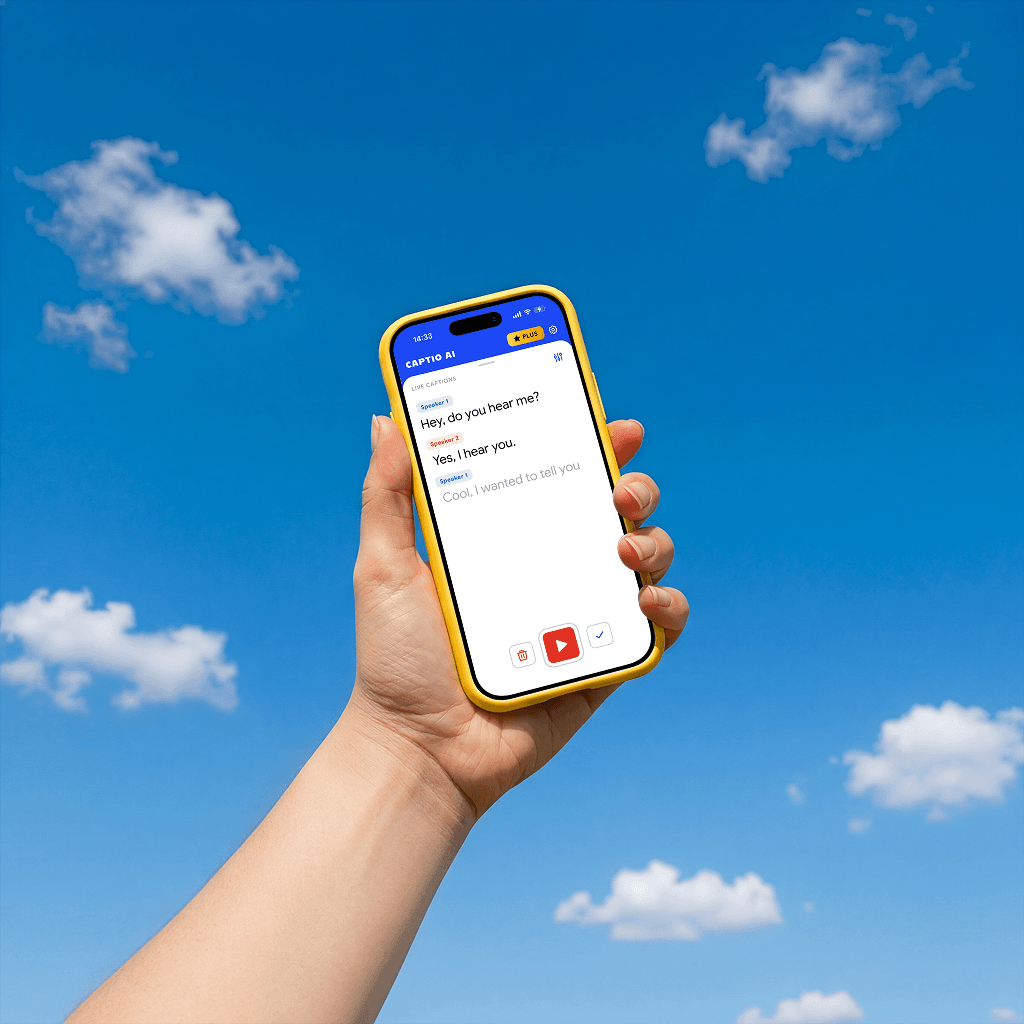
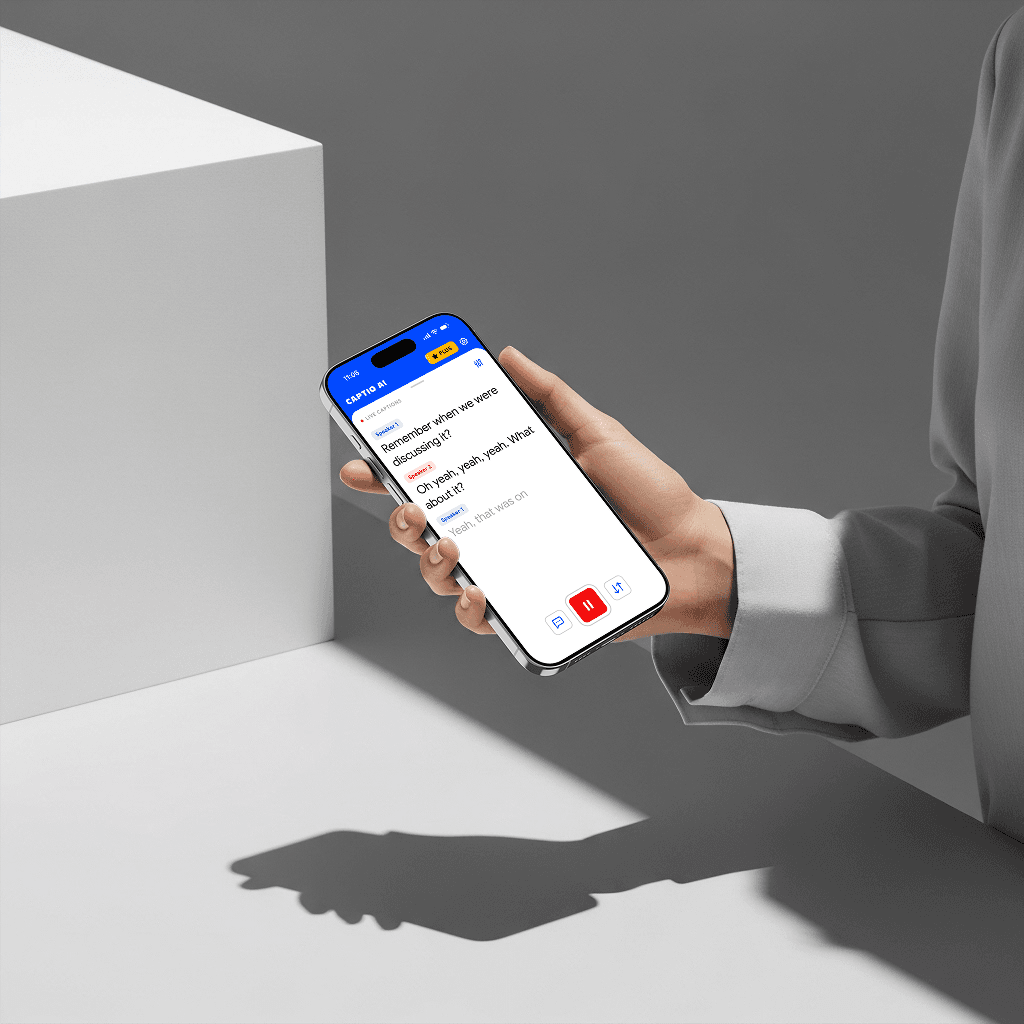
Built for the pace and pressure of a real lecture
Follow without splitting your attention
Lip-reading and note-taking at the same time is an impossible cognitive load. Captio AI handles the following so you can direct all your attention to understanding what is being said.
Captions while the lecturer is still speaking
Words appear on your screen as they are said — not after the sentence ends. You stay in sync with the lecture rather than always being a beat behind.
Works in any lecture setting
Lecture halls, seminar rooms, online classes, study groups. Place the phone on your desk, point it toward the audio source, and Captio AI handles the rest.
A full transcript to study from
Record the lecture and upload it to Audio Transcription after class. Get a complete written record you can search, annotate, and revise from — at your own pace.
60+ languages
For international students, students studying abroad, or courses taught in a second language. Captio AI captions or translates in real time with no manual setup.
No advance notice needed
Official university captioning requires booking in advance and is not available for every session. Captio AI works for any lecture, any time, with no prior arrangement.
Why Arabic is hard to understand
Diglossia barrier
- No Arab student grows up speaking the language their lecturer uses
- University lectures in Arabic are delivered in Modern Standard Arabic (MSA/Fusha) — a register no child acquires as a first language. Every Arab student is already processing a formal variety that differs substantially from their spoken dialect. For a deaf student, this means the visual speech pattern of the lecturer does not match the everyday Arabic they have practised lip-reading at home. The diglossic gap is a barrier before any phonological difficulty even begins.
Pharyngeal sounds
- Arabic's pharyngeal and uvular consonants leave no visible trace on the lips
- Arabic has sounds produced deep in the throat: /ħ/ (voiceless pharyngeal fricative), /ʕ/ (voiced pharyngeal fricative), /q/ (uvular stop), /x/ and /ɣ/ (uvular fricatives). These are articulated at the back of the vocal tract, far behind the lips. On the face, they look like a neutral open mouth. A deaf student cannot distinguish these sounds from each other or from other consonants — and in Arabic, these phonemes appear in core vocabulary including many academic terms.
Emphatic consonants
- Arabic has four emphatic consonants that change meaning but are completely invisible
- Arabic has four pharyngealized 'emphatic' consonants (/sˤ/, /dˤ/, /tˤ/, /ðˤ/) that contrast with their plain equivalents (/s/, /d/, /t/, /ð/). The pharyngealization is entirely internal — no visible lip change. But emphatic consonants shift the meaning of words and alter surrounding vowel quality throughout the syllable. A deaf student lip-reading Arabic loses these contrasts entirely, causing systematic misreading across academic vocabulary.
Regional dialect interference
- Lecturers from Egypt, the Gulf, North Africa, and the Levant speak MSA with different phonetic realizations
- Even when delivering MSA, a lecturer's phonetic output is shaped by their regional dialect. Egyptian Arabic speakers produce MSA with different vowel quality and consonant timing than Gulf or Moroccan Arabic speakers. A deaf student calibrated to one regional phonetic baseline encounters the same lecture content through a different visual profile depending on where the lecturer comes from — and this varies lecture by lecture across a semester.
Note-taking in right-to-left script
- Writing Arabic while lip-reading is a harder dual-task than in any left-to-right language
- Arabic script runs right to left in Nastaliq-adjacent connected form, with vowel diacritics commonly omitted. Every moment a deaf student spends writing is a moment not watching the lecturer's face. In lectures that mix Arabic and English technical terms — common in STEM — the student must also track a script-direction change simultaneously. The dual-task impossibility that affects all deaf students in lectures is compounded here by the script's own demands.
Download for free
Deaf and hard of hearing students across the Arab world — and universities not built to reach them
A 2023 PMC study evaluating higher education accessibility for deaf and hard of hearing students across Arab countries found that while hard-of-hearing students are admitted to most Arab universities in various disciplines, deaf students are only admitted to a handful of institutions and are limited to specific academic majors under strict conditions (PMC10025149, 2023). The study assessed 88 universities across 22 Arab countries and found only 'moderate' institutional requirements for accommodating deaf and hard of hearing students — meaning most universities have acknowledged the category without putting provision in place.
The specialist support gap is acute. In the UAE, fewer than 15 certified sign language specialists were identified in the country as of 2023, and until 2023 there was no accredited Emirati body to license sign language professionals (Tandfonline, 2023). In Saudi Arabia, the National Newborn Hearing Screening programme now covers approximately 96% of live births — but only 53% of referred infants complete diagnostic follow-up (PMC12385270, 2025). Without early identification, children enter the education system without established communication supports, and the gap compounds through each stage of schooling into higher education.
The WHO places the Southeast Asia and Eastern Mediterranean regions among those with the highest unmet burden of hearing loss globally. For deaf and hard of hearing students at Arab universities navigating Modern Standard Arabic lectures, the challenge is not only the phonological complexity of the language — it is the institutional assumption that hearing is a prerequisite for participation. There is no default accommodation, no captioning in most lecture halls, and no expectation that a deaf student's access to the lecture should match a hearing student's.
Download for free
What you hear stays with you.
Gone the moment it ends
Captio AI processes your audio in real time and discards it immediately. Nothing is recorded. Nothing is kept.
Not a product
Your conversations are not something Captio AI sells, shares, or monetizes — to anyone, for any reason.
Not used to train anything
What you say in a doctor's appointment or a job interview never ends up in a training dataset. Not ours. Not anyone else's.

Private by default
Captio AI supports 60+ languages
Download for free
Frequently asked questions
Follow every lecture in Arabic.
Captio AI is free to start
Download for free