

Hindi live captions and productivity tool for lectures
For deaf and hard of hearing people.
Download for free


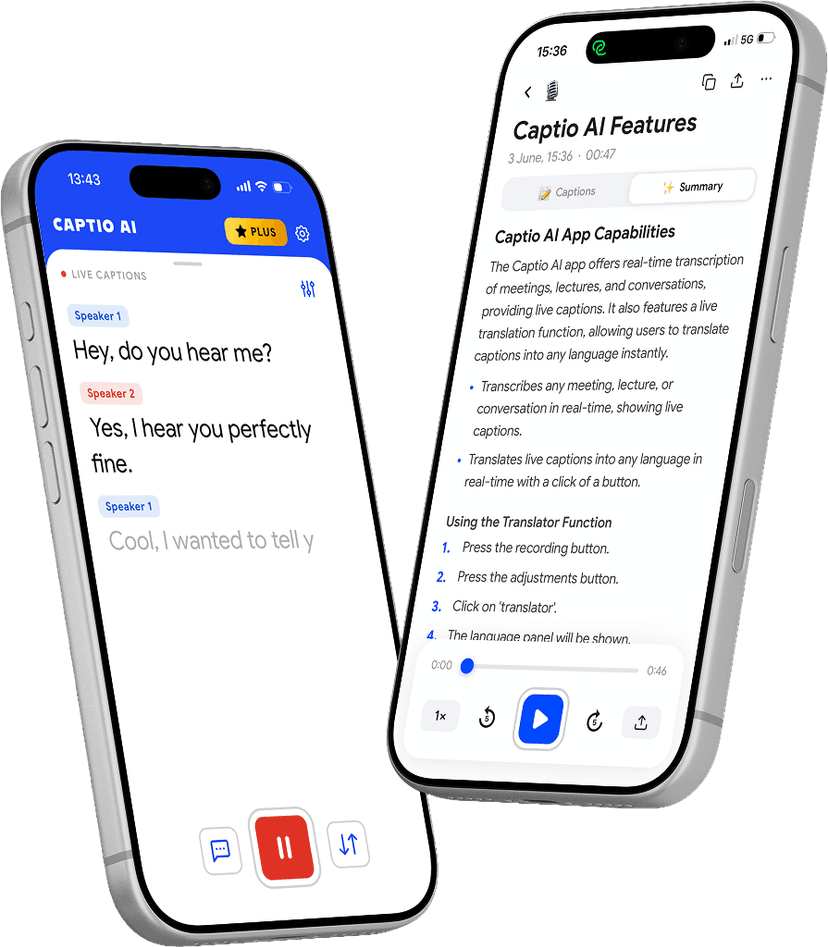
Everything you need to follow Hindi lectures
Four tools built for deaf and hard of hearing Hindi speakers.
Follow the lecture as it happens
- Captions appear word by word while the lecturer is still speaking
- Works in lecture halls, seminars, and tutorials
- No setup — place the phone on your desk and start
- Any accent, any pace
For courses in another language
- Captions and translates in real time
- For international students or foreign-language courses
- 60+ languages, no switching
- Follow the lecture in the language you read best
Full transcript to study from
- Record the lecture and upload it for a complete written transcript
- Searchable, copyable, shareable
- Review at your own pace after class
- Works on any lecture recording
Key points extracted automatically
- Important concepts and takeaways pulled from any transcript
- Organised into sections — not one continuous block
- Useful for revision and exam preparation
- Works on any saved lecture transcript
Download for free
Every situation covered
Designed for the real moments that matter — not just quiet controlled environments.
Indian university lecture halls can be large with variable PA quality. Place your phone on the desk pointing toward the nearest PA speaker. Captio AI captions fast Hindi academic delivery from any seat, regardless of room acoustics.
Indian university seminars involve rapid discussion in Hindi and English. Students from different states contribute with regional phonetic variation. Captio AI follows whoever is speaking so you track every argument without asking for repeats.
NPTEL, SWAYAM, and institutional learning management systems host Hindi lectures. Auto-captions frequently fail on regional-accented Hindi and aspirated consonants. Put the lecture on speaker and point Captio AI at the audio for accurate captions.
Hostel rooms, library corners, campus canteen tables. Fast conversational Hindi in revision sessions where a lot of learning happens. Captio AI captions whoever is speaking so you follow every explanation.
IIT and IIM lectures mix Hindi explanation with English technical vocabulary. Live Translator captions in real time so Hindi-English code-switching is not the reason you fall behind.
Visiting professors from different Hindi-speaking states, industry speakers, government officials. Accents from Bihar, UP, Rajasthan, and Haryana vary significantly. Captio AI covers any speaker at any campus without prior arrangement.
Most accurate and fastest models
word accuracy
independent benchmark, 2025
real-time captions
first word appears as you speak
Download for free
Built for the pace and pressure of a real lecture
Follow without splitting your attention
Lip-reading and note-taking at the same time is an impossible cognitive load. Captio AI handles the following so you can direct all your attention to understanding what is being said.
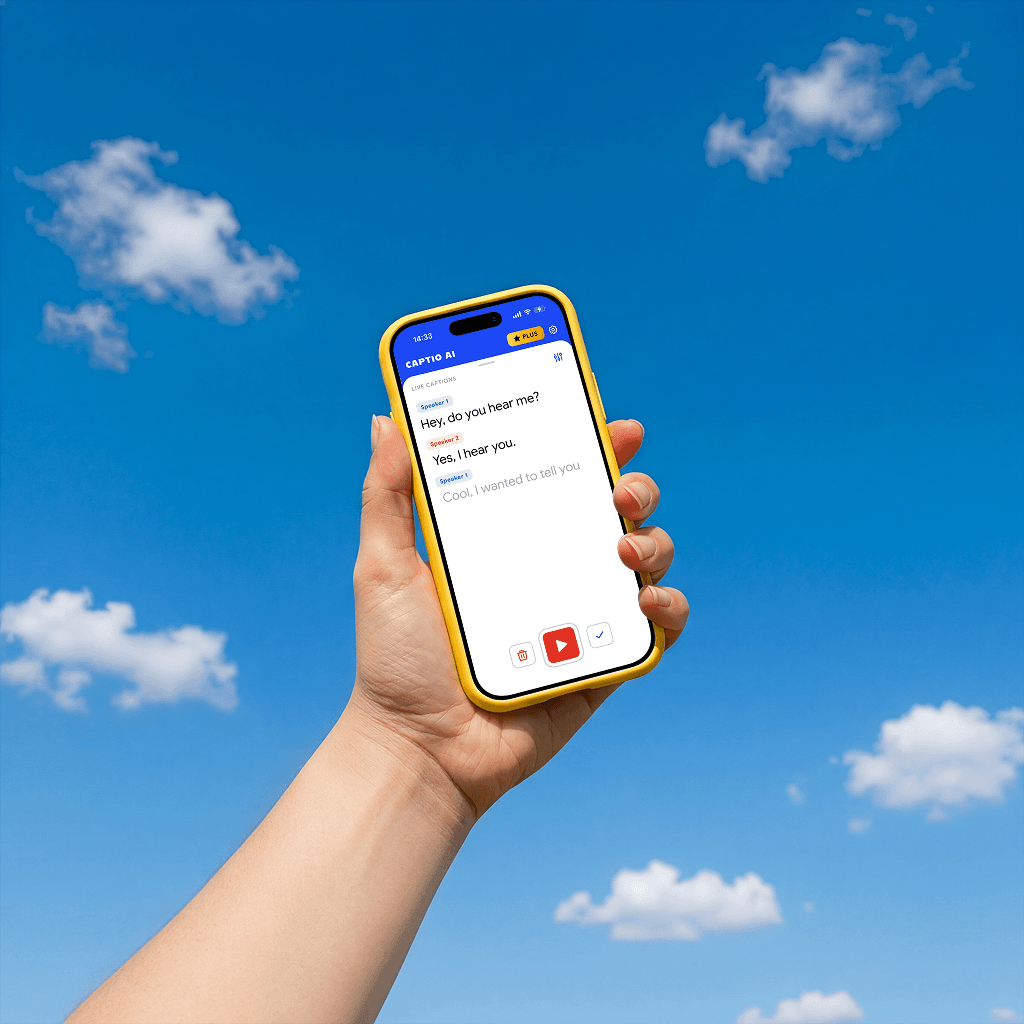
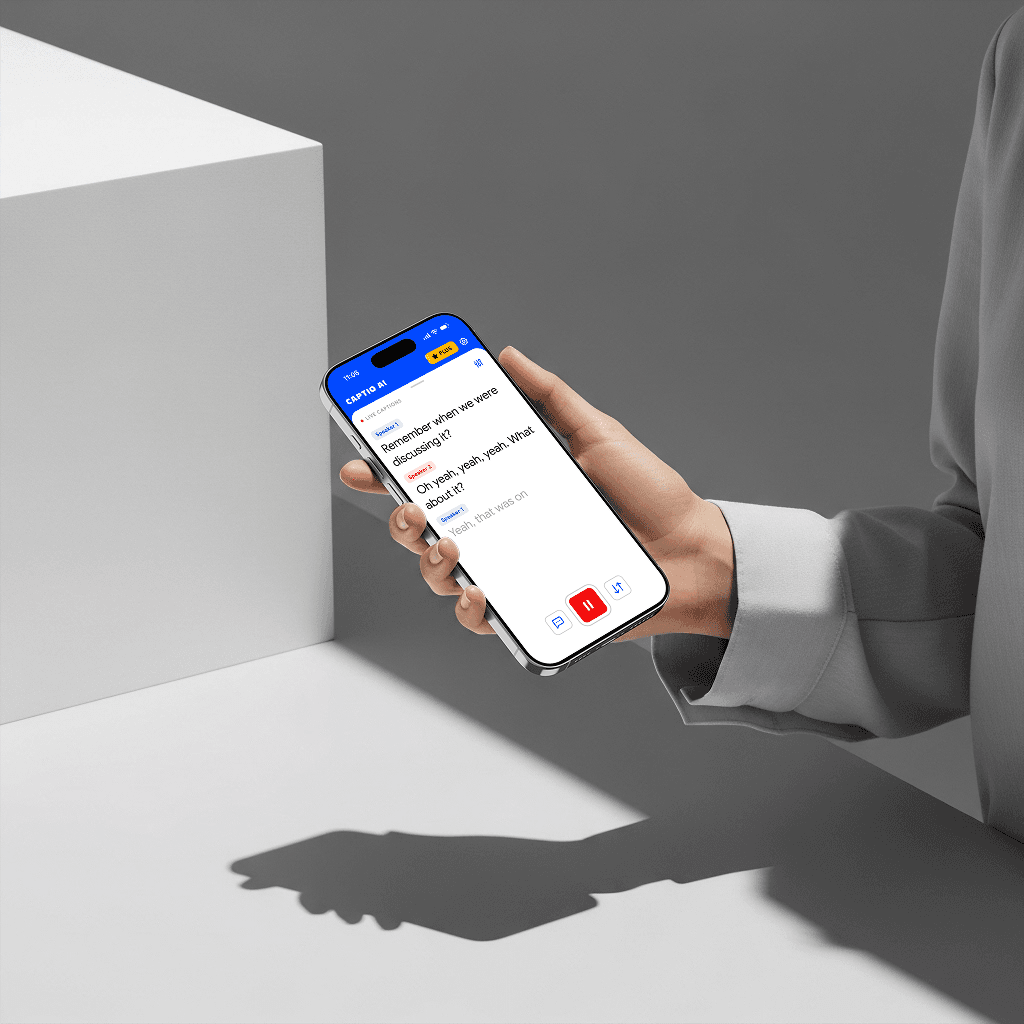
Captions while the lecturer is still speaking
Words appear on your screen as they are said — not after the sentence ends. You stay in sync with the lecture rather than always being a beat behind.
Works in any lecture setting
Lecture halls, seminar rooms, online classes, study groups. Place the phone on your desk, point it toward the audio source, and Captio AI handles the rest.
A full transcript to study from
Record the lecture and upload it to Audio Transcription after class. Get a complete written record you can search, annotate, and revise from — at your own pace.
60+ languages
For international students, students studying abroad, or courses taught in a second language. Captio AI captions or translates in real time with no manual setup.
No advance notice needed
Official university captioning requires booking in advance and is not available for every session. Captio AI works for any lecture, any time, with no prior arrangement.
Why Hindi is hard to understand
Retroflex vs dental
- Hindi has four stop consonant pairs that are all invisible on the lips
- Hindi distinguishes dental and retroflex stops: /t̪/ vs /ʈ/, /d̪/ vs /ɖ/, plus voiceless and voiced variants of each. These four variants look identical on the lips. The retroflex is produced with the tongue curled back to touch the palate — no visible change on the face. In a lecture, technical vocabulary uses all four series extensively, and a deaf student cannot distinguish any of them.
Aspiration contrast
- Hindi uses aspiration phonemically — and aspiration is completely invisible
- Hindi contrasts aspirated and unaspirated consonants: /p/ vs /pʰ/, /k/ vs /kʰ/, /b/ vs /bʱ/, /g/ vs /gʱ/. Aspiration is purely acoustic — a burst of air following the release. On the lips, aspirated and unaspirated pairs look absolutely identical. Hindi has five aspirated series; a deaf student misses the phonemic contrast in every stop and affricate in the lecture.
Regional Hindi variation
- The Hindi of a professor from UP, Bihar, or Rajasthan sounds different on every lip-reader's map
- Hindi lecture delivery varies by region. Bihari Hindi uses heavy retroflex consonants and different vowel length. Rajasthani Hindi drops phonemes that Delhi Hindi retains. Maharashtra-accented Hindi carries Marathi phonological patterns. A deaf student who has calibrated lip-reading to Standard Hindi (khari boli) will find regional-accented professors a partially different visual task.
Sanskrit academic register
- Hindi academic vocabulary is built from Sanskrit compounds with no everyday lip-reading anchor
- Hindi university lectures in humanities and social sciences use Sanskrit-derived (tatsama) vocabulary that appears rarely in casual speech. These terms are built from complex consonant clusters and syllable structures. In fast lecture delivery, Sanskrit compound terms are compressed into flowing syllable streams — and their unfamiliarity means a deaf student has no context to reconstruct a missed syllable.
Hindi-English code-switching
- Lectures switch between Hindi and English mid-sentence, shifting the entire phonological system
- Indian university lectures routinely switch between Hindi and English for technical vocabulary. The mouth profile shifts between phonological systems — retroflex Hindi consonants to English plosives — within the same sentence. A deaf student must track two distinct visual-speech grammars simultaneously, without any signal that the switch is coming.
Download for free
18 million deaf and hard of hearing people in India. A higher education system without them.
The National Association for the Deaf in India estimates 18 million deaf and hard of hearing people in the country — more than three times the 2011 census figure of five million, which many consider a significant undercount. There are only 387 schools for deaf and hard of hearing children across India, serving a country of 1.4 billion. A 2014 study found that approximately 19% of deaf and hard of hearing schoolchildren aged 6–13 were out of school entirely, compared to a national average of 2.97% for all children of the same age. Those who do reach university have already navigated a system with minimal specialist support (360info, 2025).
India's 2016 Rights of Persons with Disabilities Act requires educational institutions to provide inclusive education — including instruction in 'the most appropriate languages and modes and means of communication' for deaf students. In practice, Indian Sign Language (ISL) has no official government recognition as a language, and the Indian Sign Language Research and Training Centre (ISLRTC) remains underfunded relative to the interpreter training need. At most Indian universities, the lecture remains the only format — no captions, no interpreter, no transcript — and the deaf student is expected to manage with whatever hearing they have.
A 2025 study published in Language Policy documented India's structural failure: a policy framework that acknowledges sign language users as a linguistic minority but provides no mechanism to translate that recognition into classroom access (Springer, 2025). For the majority of India's 18 million deaf and hard of hearing people who navigate daily life without formal support, the university lecture hall is simply another setting where the infrastructure does not reach them.
Download for free
What you hear stays with you.
Gone the moment it ends
Captio AI processes your audio in real time and discards it immediately. Nothing is recorded. Nothing is kept.
Not a product
Your conversations are not something Captio AI sells, shares, or monetizes — to anyone, for any reason.
Not used to train anything
What you say in a doctor's appointment or a job interview never ends up in a training dataset. Not ours. Not anyone else's.

Private by default
Captio AI supports 60+ languages
Download for free
Frequently asked questions
Follow every lecture in Hindi.
Captio AI is free to start
Download for free