

Malayalam live captions and productivity tool for lectures
For deaf and hard of hearing people.
Download for free


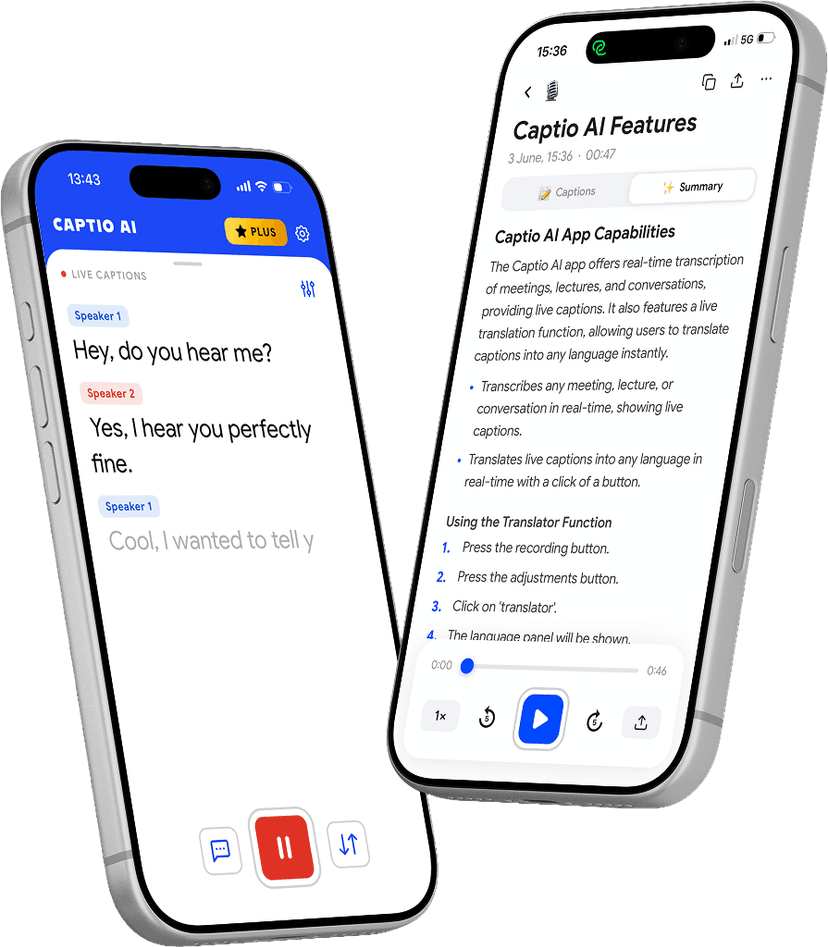
Everything you need to follow Malayalam lectures
Four tools built for deaf and hard of hearing Malayalam speakers.
Follow the lecture as it happens
- Captions appear word by word while the lecturer is still speaking
- Works in lecture halls, seminars, and tutorials
- No setup — place the phone on your desk and start
- Any accent, any pace
For courses in another language
- Captions and translates in real time
- For international students or foreign-language courses
- 60+ languages, no switching
- Follow the lecture in the language you read best
Full transcript to study from
- Record the lecture and upload it for a complete written transcript
- Searchable, copyable, shareable
- Review at your own pace after class
- Works on any lecture recording
Key points extracted automatically
- Important concepts and takeaways pulled from any transcript
- Organised into sections — not one continuous block
- Useful for revision and exam preparation
- Works on any saved lecture transcript
Download for free
Every situation covered
Designed for the real moments that matter — not just quiet controlled environments.
Kerala University, Calicut University, MG University Kottayam, and CUSAT lecture halls. Malayalam-medium lectures at academic pace in formal academic register. Place the phone on the desk facing the speaker. Captio AI captions from any row.
Kerala university seminars where students present in formal Malayalam and discuss in mixed colloquial. Captio AI captions whoever is speaking so you follow every argument across both registers.
Recorded Malayalam lectures on university portals or shared recordings. Put the recording on speaker and point Captio AI at the audio for accurate captions in real time.
Study groups in Thiruvananthapuram, Kochi, or Kozhikode — fast colloquial Malayalam mixed with English. Captio AI follows whoever is speaking regardless of register or code-switching.
Malayalam students in English-medium programmes, or international students following Malayalam-medium lectures. Live Translator captions in real time so language is not the access barrier.
Visiting academics and diaspora Malayalam speakers from the Gulf, UK, and US. Captio AI handles standard Kerala Malayalam, Gulf Malayalam, and UK Malayali varieties — any speaker at any venue.
Most accurate and fastest models
word accuracy
independent benchmark, 2025
real-time captions
first word appears as you speak
Download for free
Built for the pace and pressure of a real lecture
Follow without splitting your attention
Lip-reading and note-taking at the same time is an impossible cognitive load. Captio AI handles the following so you can direct all your attention to understanding what is being said.
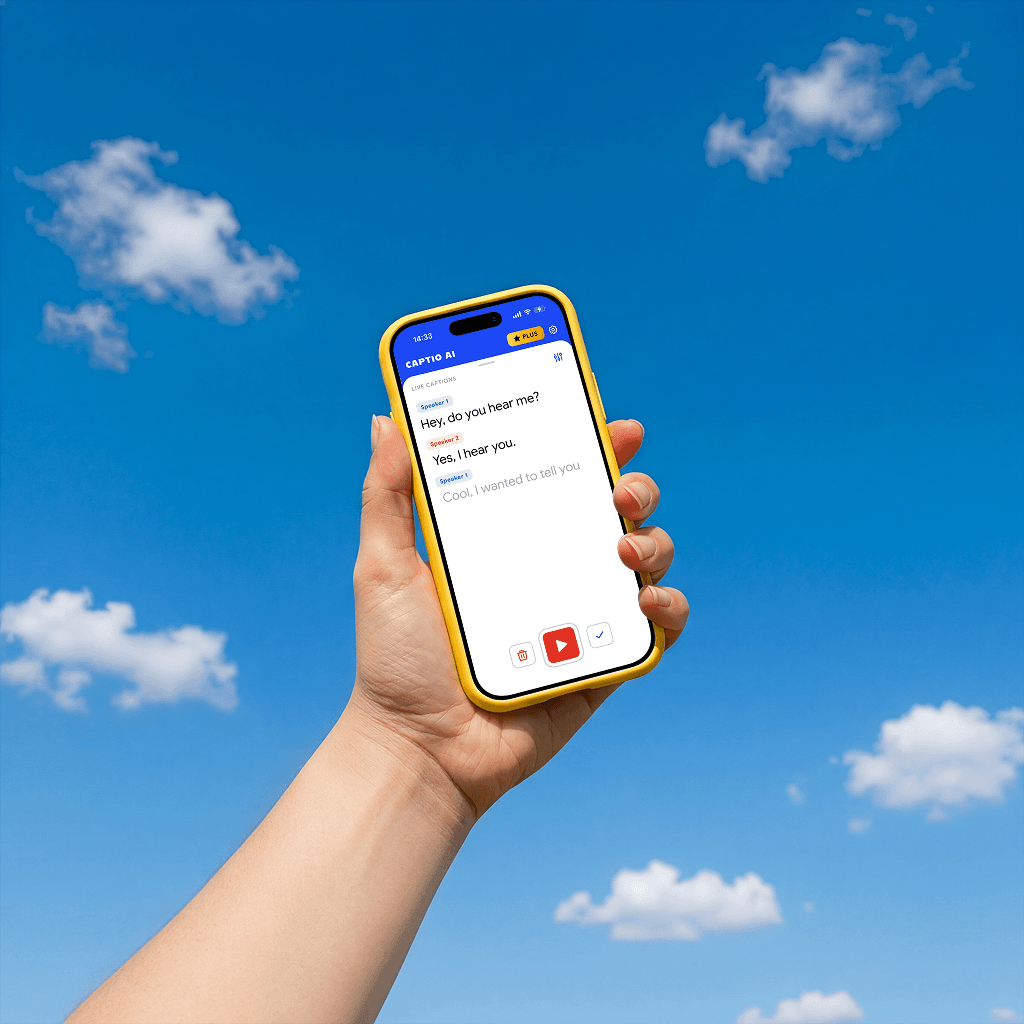
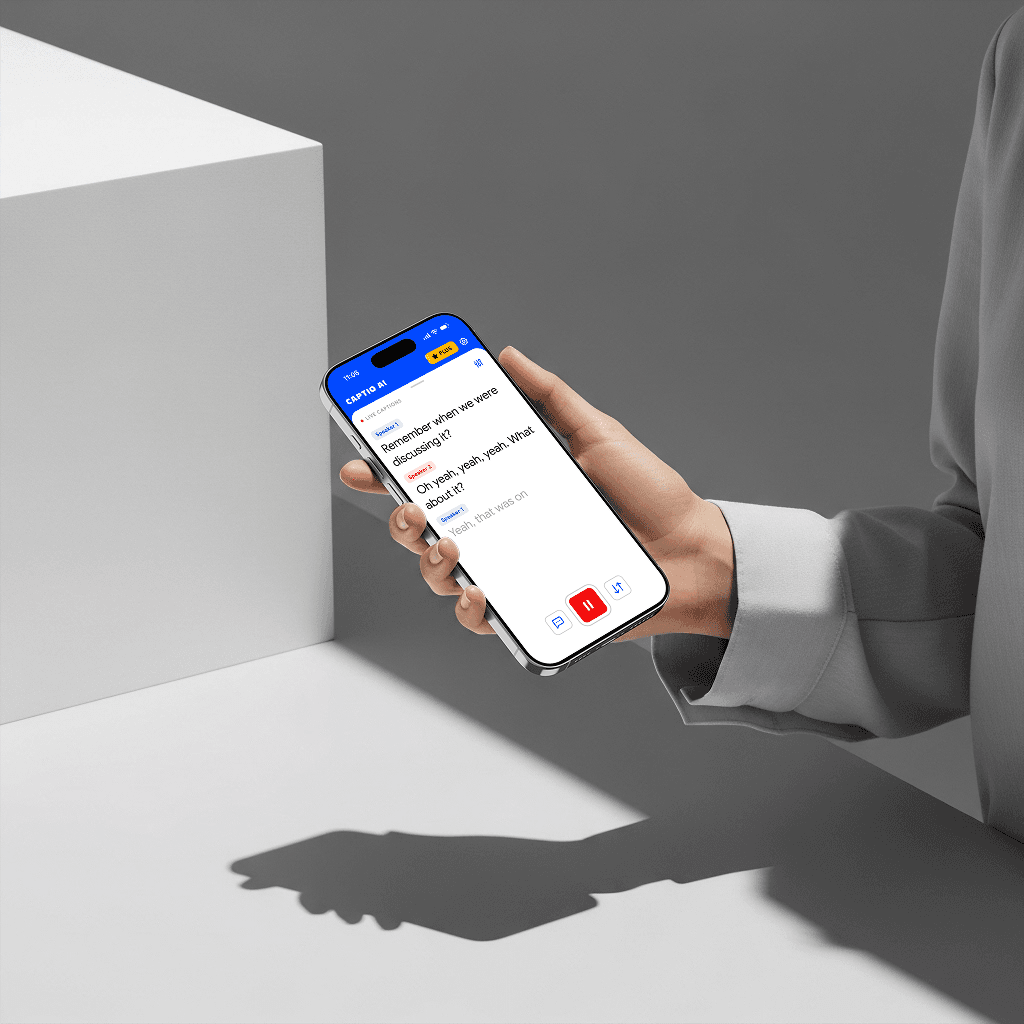
Captions while the lecturer is still speaking
Words appear on your screen as they are said — not after the sentence ends. You stay in sync with the lecture rather than always being a beat behind.
Works in any lecture setting
Lecture halls, seminar rooms, online classes, study groups. Place the phone on your desk, point it toward the audio source, and Captio AI handles the rest.
A full transcript to study from
Record the lecture and upload it to Audio Transcription after class. Get a complete written record you can search, annotate, and revise from — at your own pace.
60+ languages
For international students, students studying abroad, or courses taught in a second language. Captio AI captions or translates in real time with no manual setup.
No advance notice needed
Official university captioning requires booking in advance and is not available for every session. Captio AI works for any lecture, any time, with no prior arrangement.
Why Malayalam is hard to understand
Richest retroflex inventory
- Malayalam has more distinct retroflex consonants than any other South Asian language — and all of them are invisible on the lips
- Malayalam distinguishes dental, alveolar, and retroflex places of articulation across its lateral, nasal, and stop consonants. The retroflex lateral /ɭ/ (ള), alveolar lateral /l/ (ല), and dental lateral exist as distinct phonemes — as do retroflex nasal /ɳ/ (ണ) and dental nasal /n/ (ന). Research confirms that Malayalam's retroflex inventory is the most extensive of any South Asian language. In a lecture, these distinctions appear throughout every sentence and are produced entirely inside the mouth — invisible on the lips.
Dental-alveolar-retroflex triple distinction
- Malayalam makes three-way place-of-articulation distinctions that most other languages collapse into one or two — all invisible
- While most languages distinguish at most two tongue positions for coronals (dental vs. retroflex, or dental vs. alveolar), Malayalam systematically distinguishes three: dental, alveolar, and retroflex. This triple distinction applies to nasals, laterals, and stops. In a Malayalam university lecture, these three-way contrasts appear in the most common vocabulary — and none of them produce any visible lip change.
Gemination and vowel length
- Malayalam distinguishes long and short versions of both consonants and vowels — both contrasts invisible on the lips
- Malayalam has phonemic vowel length (5 short vs. 6 long vowels) and phonemic consonant gemination (length). A geminated consonant is produced by holding the closure or fricative longer — with no change in lip shape. In a lecture, vowel and consonant length distinctions carry lexical meaning throughout, and all of them are invisible. A study published in PMC (PMC11639911) specifically investigated the difficulty of vowel identification in Malayalam for individuals with hearing loss, confirming the challenge.
Formal-colloquial register gap
- Academic Malayalam uses a formal register that differs from everyday colloquial Malayalam in vocabulary, morphology, and phonology
- Malayalam has a well-documented formal-colloquial divide: written academic Malayalam uses classical forms, Sanskrit-derived vocabulary, and formal morphology that differ significantly from the everyday spoken variety. In a university lecture, a professor shifts between formal academic register (for definitions and established content) and colloquial Malayalam (for explanation and asides). Each shift changes the phonological and lexical landscape a deaf student is tracking.
Gulf Malayalam diaspora
- Kerala's large Gulf diaspora community has evolved distinct Malayalam varieties — mixing Arabic and English loanwords in patterns unique to each host country
- Kerala has one of India's largest overseas worker populations, predominantly in Gulf states (UAE, Qatar, Saudi Arabia, Kuwait). Gulf-returned speech mixes Arabic loanwords and Gulf-specific English into Malayalam in patterns that differ from standard Kerala Malayalam. For a deaf student at a Kerala university whose family includes Gulf-returned workers, everyday conversation is already multilingual before any formal lecture begins.
Download for free
63 million with hearing loss in India — Kerala's literacy rates have not built deaf accessibility into university lecture halls
India has approximately 63 million people with significant auditory loss nationally. Kerala — with a population of 35 million and India's highest literacy rate — has one of the better health infrastructure records in the country. Kerala established centralized newborn hearing screening in Ernakulam, and awareness of hearing impairment is relatively higher in Kerala than in many Indian states. Yet high literacy and health awareness have not translated into systematic university-level captioning for deaf and hard of hearing students. The lecture hall gap exists in Kerala as it does across India: no mandated real-time captioning, ISL not officially recognized, and interpreter provision ad hoc.
Research specific to Malayalam and hearing loss published in PMC (PMC11639911) investigated the identification of spoken disyllabic words in Malayalam for individuals with hearing loss, confirming that Malayalam's vowel distinctions — even with hearing aids — pose significant comprehension challenges. This extends directly to the lecture environment: a deaf student using a hearing aid in a Kerala university lecture hall still faces significant word-level ambiguity in Malayalam, compounded by the retroflexes, gemination, and formal-colloquial register shifts that characterize academic Malayalam.
Kerala's large diaspora population in Gulf states, the UK, US, and Singapore creates an additional dimension of linguistic complexity. Deaf students at Kerala universities whose families include Gulf-returned workers navigate a home language that mixes Arabic loanwords and Gulf English into Malayalam in patterns that are not documented in any formal educational resource. For these students, the lecture hall represents both a formal challenge (academic Malayalam) and a home-life parallel (Gulf Malayalam) — both without captioning infrastructure.
Download for free
What you hear stays with you.
Gone the moment it ends
Captio AI processes your audio in real time and discards it immediately. Nothing is recorded. Nothing is kept.
Not a product
Your conversations are not something Captio AI sells, shares, or monetizes — to anyone, for any reason.
Not used to train anything
What you say in a doctor's appointment or a job interview never ends up in a training dataset. Not ours. Not anyone else's.

Private by default
Captio AI supports 60+ languages
Download for free
Frequently asked questions
Follow every lecture in Malayalam.
Captio AI is free to start
Download for free