

Malay live captions and productivity tool for lectures
For deaf and hard of hearing people.
Download for free


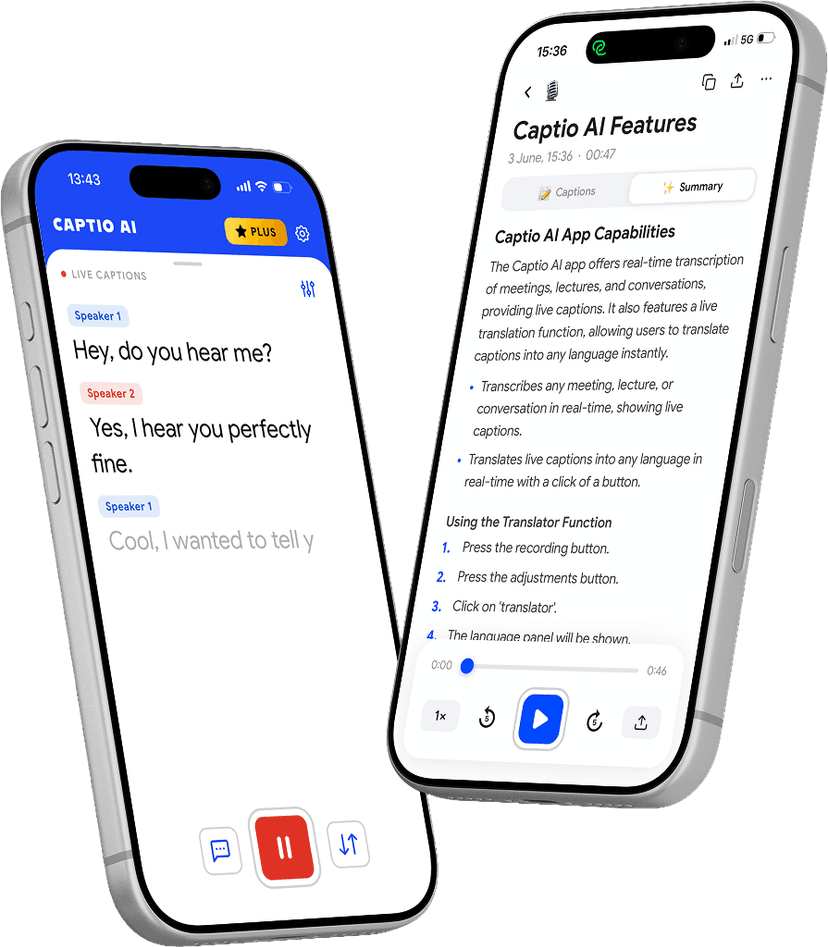
Everything you need to follow Malay lectures
Four tools built for deaf and hard of hearing Malay speakers.
Follow the lecture as it happens
- Captions appear word by word while the lecturer is still speaking
- Works in lecture halls, seminars, and tutorials
- No setup — place the phone on your desk and start
- Any accent, any pace
For courses in another language
- Captions and translates in real time
- For international students or foreign-language courses
- 60+ languages, no switching
- Follow the lecture in the language you read best
Full transcript to study from
- Record the lecture and upload it for a complete written transcript
- Searchable, copyable, shareable
- Review at your own pace after class
- Works on any lecture recording
Key points extracted automatically
- Important concepts and takeaways pulled from any transcript
- Organised into sections — not one continuous block
- Useful for revision and exam preparation
- Works on any saved lecture transcript
Download for free
Every situation covered
Designed for the real moments that matter — not just quiet controlled environments.
Universiti Malaya, UiTM, UPM, USM, and UTM lecture halls. Malay-medium lectures at academic pace, often mixing English for technical content. Place the phone on the desk facing the speaker. Captio AI captions from any row.
Malaysian university seminars mixing Malay and English in discussion. Students from peninsular Malaysia, Sabah, and Sarawak contributing with regional varieties. Captio AI captions whoever is speaking.
Recorded lectures on university portals, Zoom recordings, or YouTube academic channels. Put the recording on speaker and point Captio AI at the audio for accurate captions in real time.
Study groups in Kuala Lumpur, Penang, or Johor Bahru — fast conversational Malay mixed with English and sometimes Mandarin. Captio AI follows whoever is explaining without switching.
International students at Malaysian universities following Malay-medium lectures, or Malaysian students in English-medium programmes. Live Translator captions in real time so language is not the access barrier.
Visiting academics and guest speakers from across Malaysia and Indonesia. Captio AI handles KL standard Malay, regional varieties, and Indonesian — any speaker at any venue.
Most accurate and fastest models
word accuracy
independent benchmark, 2025
real-time captions
first word appears as you speak
Download for free
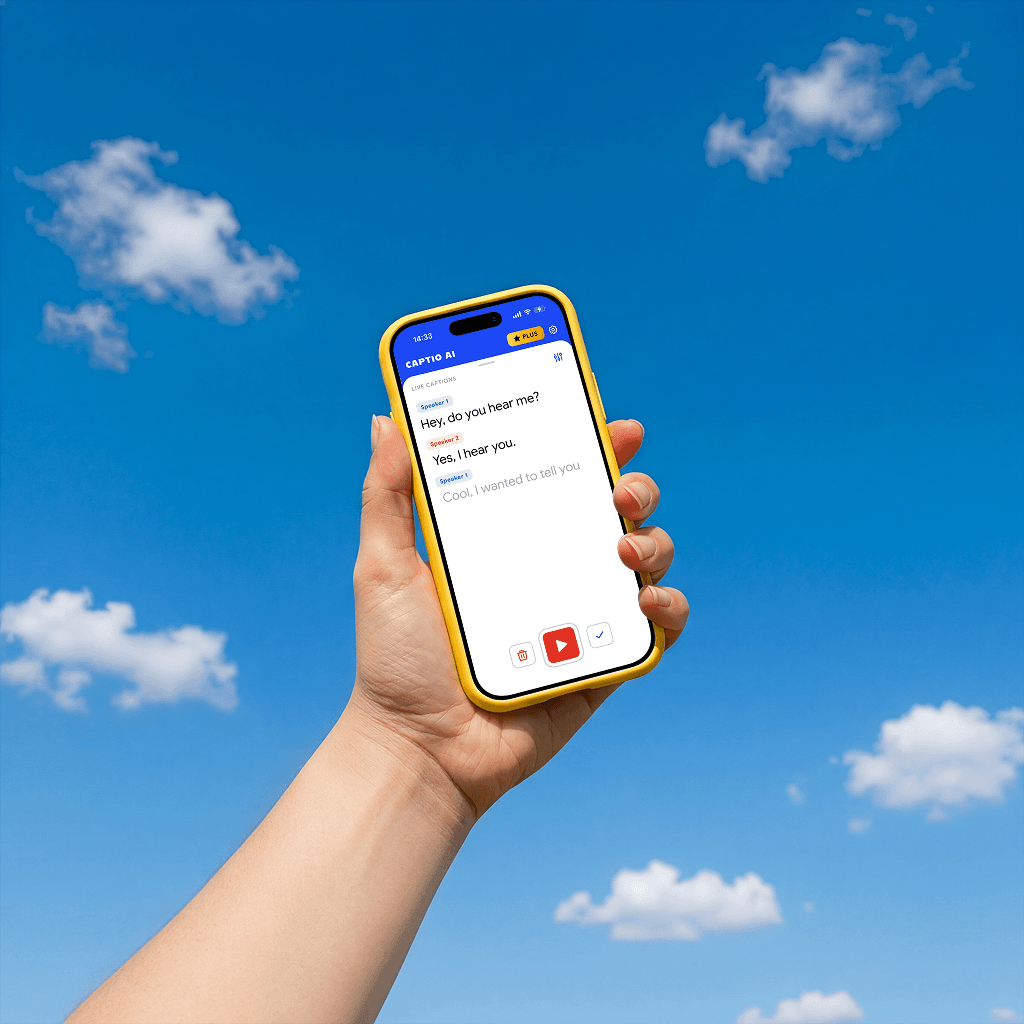
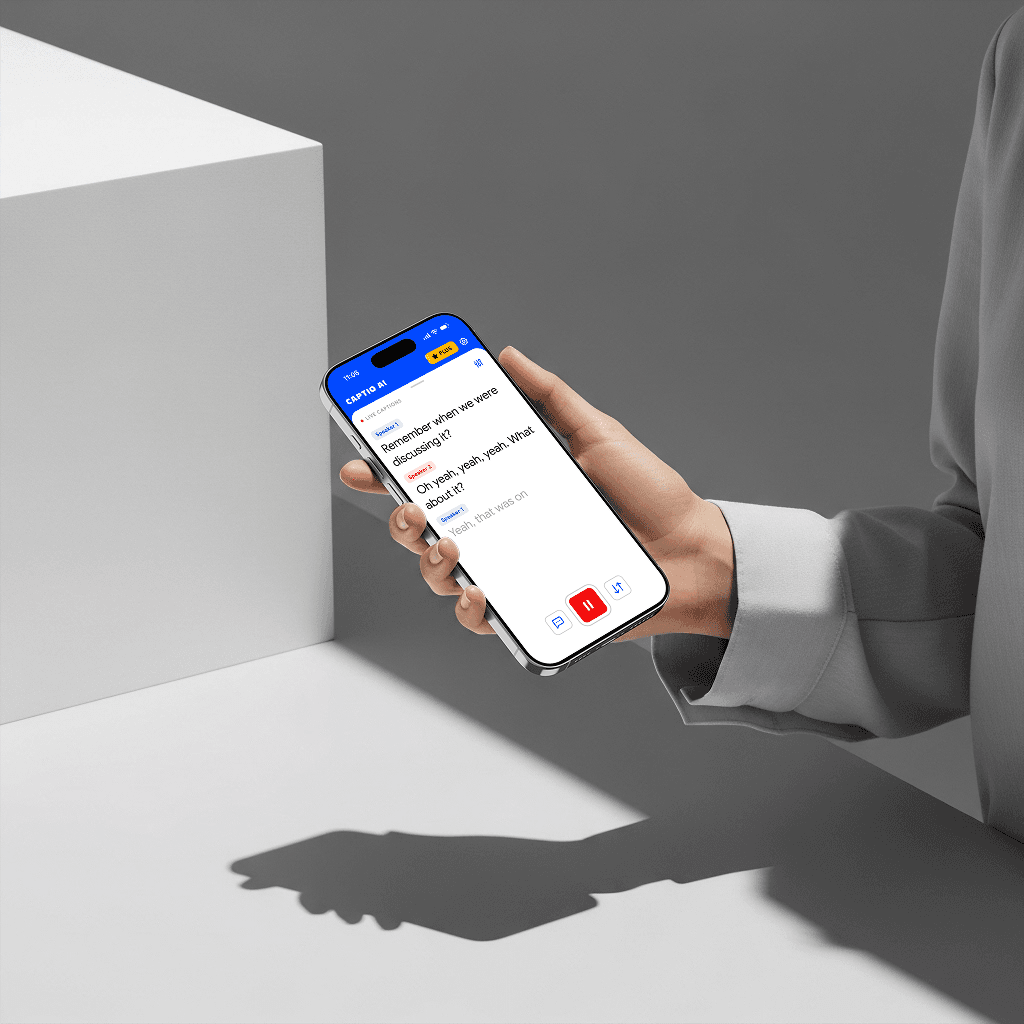
Built for the pace and pressure of a real lecture
Follow without splitting your attention
Lip-reading and note-taking at the same time is an impossible cognitive load. Captio AI handles the following so you can direct all your attention to understanding what is being said.
Captions while the lecturer is still speaking
Words appear on your screen as they are said — not after the sentence ends. You stay in sync with the lecture rather than always being a beat behind.
Works in any lecture setting
Lecture halls, seminar rooms, online classes, study groups. Place the phone on your desk, point it toward the audio source, and Captio AI handles the rest.
A full transcript to study from
Record the lecture and upload it to Audio Transcription after class. Get a complete written record you can search, annotate, and revise from — at your own pace.
60+ languages
For international students, students studying abroad, or courses taught in a second language. Captio AI captions or translates in real time with no manual setup.
No advance notice needed
Official university captioning requires booking in advance and is not available for every session. Captio AI works for any lecture, any time, with no prior arrangement.
Why Malay is hard to understand
Final glottal stop
- Written final /k/ in Malay is often realized as a glottal stop — completely invisible on the lips
- In Malay, words ending in written -k are frequently realized not as a released velar stop but as a glottal stop /ʔ/ in natural speech. The word budak (child) ends in a closure at the back of the throat — invisible on the lips. A deaf student who has learned that final-k looks like a velar closure encounters instead a closed glottis with no visible lip or tongue movement. In a lecture, final glottal stops appear across high-frequency vocabulary and are systematically invisible.
Dialect and variety divergence
- Kelantan, Terengganu, Kedah, and Sabah Malay produce dramatically different vowel and consonant patterns from standard KL Malay
- Malaysian regional dialects deviate substantially from standard Kuala Lumpur Malay. Kelantan Malay has different vowel shifts (final /a/ → /e/), distinct consonant realizations, and different prosody from KL standard. Kedah Malay has different vowels. Sabah Malay has Kadazan substrate features. A deaf student calibrated to standard KL Malay encounters genuinely different lip profiles when the lecturer grew up speaking a northern, eastern, or Sabahan variety. Malaysian universities draw from all these regions.
Malay-English-Mandarin mixing
- Malaysian university lectures mix Malay, English, and sometimes Mandarin mid-sentence — each requiring a different lip-reading calibration
- In Malaysian universities, Malay-medium lectures routinely incorporate English for technical vocabulary and, in some contexts, Mandarin or Cantonese for explanation. The phonological system, stress pattern, and lip profile change each time the code-switch occurs. A deaf student must track multiple distinct phonological systems simultaneously. Taylor's University research (2025) documented that Deaf Malaysians in academic settings often face precisely this multilingual barrier without any sign language or captioning support.
Standard-colloquial register gap
- Bahasa Malaysia formal academic register differs from colloquial Bahasa Melayu in vocabulary and structure — affecting lip patterns throughout
- Formal written Bahasa Malaysia (academic register) uses vocabulary and sentence structures that differ from colloquial Bahasa Melayu. Academic Malay uses Latinate and English loanwords in Malay phonological form (universiti, teknikal, paradigma) alongside Malay roots. Colloquial Malay uses different words. A professor who shifts between formal register and informal explanation is shifting vocabulary and phonological profile throughout the lecture.
Indonesian-Malay divergence
- Indonesian and Malay are written similarly but sound different on the lips — and students from both sides are present in Malaysian universities
- Bahasa Indonesia and Bahasa Malaysia are closely related but phonologically distinct: Indonesian has /a/ in final open syllables while Malaysian has schwa /ə/ in the same position. Loan pronunciation, prosodic patterns, and some consonant realizations differ. Malaysian universities have Indonesian students, and vice versa. A deaf student who has practised with one variety encounters different lip shapes for the same written words with the other variety's speaker.
Download for free
42,652 registered with hearing impairment in Malaysia — hearing aid uptake under 5% despite 73.6% having some loss
Malaysia's Department of Statistics (DOSM) recorded 42,652 persons with hearing impairment in 2023 — 6.69% of all registered persons with disabilities and 0.13% of the total population. A scoping review of hearing care services in Malaysia published in Tandfonline (2023) found that among adults, 73.6% had at least mild hearing loss (≥25 dB HL) and 24.6% had at least moderate hearing loss (≥40 dB HL) — far exceeding the registered disability figures, indicating massive under-registration. Despite this prevalence, hearing aid uptake was only 2.7–4.4% among those with at least mild hearing loss.
Research documented by Taylor's University (2025) on the situation of deaf Malaysians found that in special education settings, deaf students are often encouraged to lip-read or speak aloud rather than receive sign language or captioning support. Many grow up in hearing families who do not know Bahasa Isyarat Malaysia (BIM), and mainstream university classrooms rarely provide interpretation or captioning. BIM, Malaysia's national sign language based on British Sign Language, is used by the deaf community but is not a mandated provision in university lecture halls.
For deaf and hard of hearing students at Malaysian universities, the lecture environment presents multilingual complexity that compounds the institutional gap. Malay-medium lectures routinely incorporate English, and in some contexts Mandarin — requiring a deaf student to track multiple phonological systems simultaneously, across a language whose final glottal stops and regional dialect variation already demand full acoustic access for accurate comprehension. Without real-time captioning, the content is inaccessible at the level at which it matters.
Download for free
What you hear stays with you.
Gone the moment it ends
Captio AI processes your audio in real time and discards it immediately. Nothing is recorded. Nothing is kept.
Not a product
Your conversations are not something Captio AI sells, shares, or monetizes — to anyone, for any reason.
Not used to train anything
What you say in a doctor's appointment or a job interview never ends up in a training dataset. Not ours. Not anyone else's.

Private by default
Captio AI supports 60+ languages
Download for free
Frequently asked questions
Follow every lecture in Malay.
Captio AI is free to start
Download for free