

Japanese live captions and productivity tool for lectures
For deaf and hard of hearing people.
Download for free


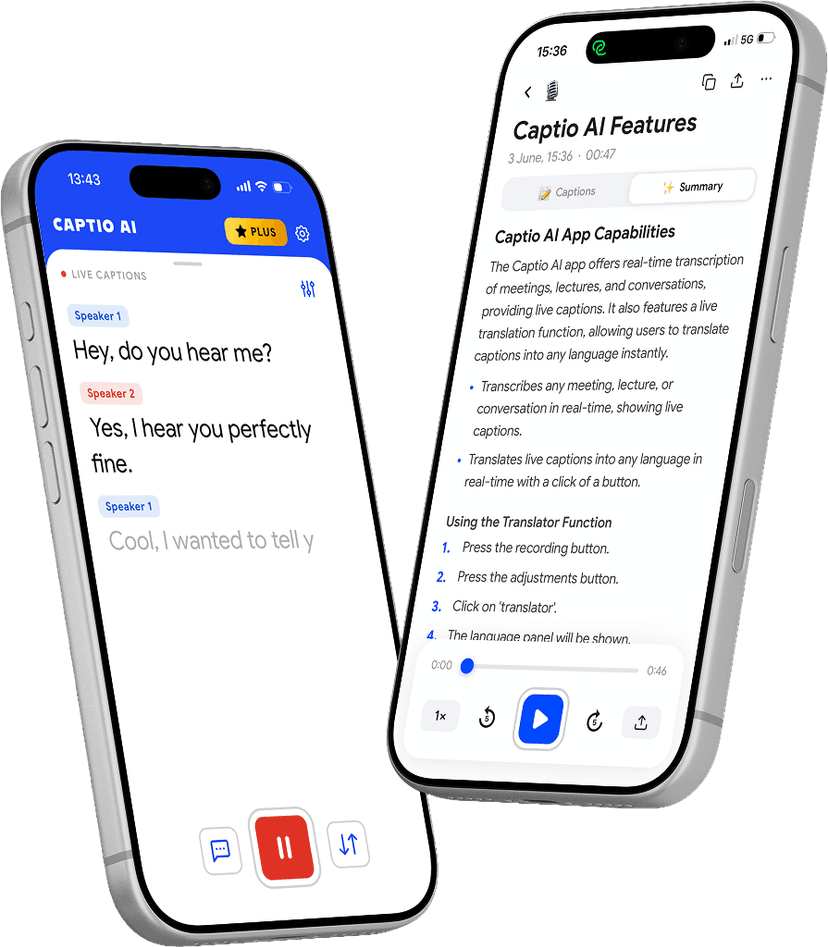
Everything you need to follow Japanese lectures
Four tools built for deaf and hard of hearing Japanese speakers.
Follow the lecture as it happens
- Captions appear word by word while the lecturer is still speaking
- Works in lecture halls, seminars, and tutorials
- No setup — place the phone on your desk and start
- Any accent, any pace
For courses in another language
- Captions and translates in real time
- For international students or foreign-language courses
- 60+ languages, no switching
- Follow the lecture in the language you read best
Full transcript to study from
- Record the lecture and upload it for a complete written transcript
- Searchable, copyable, shareable
- Review at your own pace after class
- Works on any lecture recording
Key points extracted automatically
- Important concepts and takeaways pulled from any transcript
- Organised into sections — not one continuous block
- Useful for revision and exam preparation
- Works on any saved lecture transcript
Download for free
Every situation covered
Designed for the real moments that matter — not just quiet controlled environments.
Japanese university lecture halls at Tokyo University, Kyoto University, Waseda, or Keio seat hundreds of students in formal settings. Professors deliver formal academic Japanese with minimal gesture. Place the phone on the desk facing the lecturer. Captio AI captions the lecture at any pace.
Japanese university seminars (ゼミ, zemi) are small group discussions where students present and respond in academic Japanese. Captio AI captions whoever is speaking so you follow every exchange without asking for repeats.
Recorded lectures on Coursera Japan, university LMS portals, or Zoom recordings. Auto-captions miss academic Japanese register. Put the lecture on speaker and point Captio AI at the audio for accurate captions.
Study groups and zemi preparation sessions in the library or campus café. Fast colloquial Japanese mixed with academic vocabulary. Captio AI follows whoever is explaining without any switching.
International students at Japanese universities following Japanese-medium lectures. Live Translator captions in real time. Japanese students in English-medium programmes are equally supported.
Guest speakers from industry or visiting academics. Japanese academic talks draw speakers from different regional backgrounds — Kansai-dialect Japanese, Osaka-accented delivery, or Tokyo standard. Captio AI handles all of them.
Most accurate and fastest models
character accuracy
independent benchmark, 2025
real-time captions
first word appears as you speak
Download for free
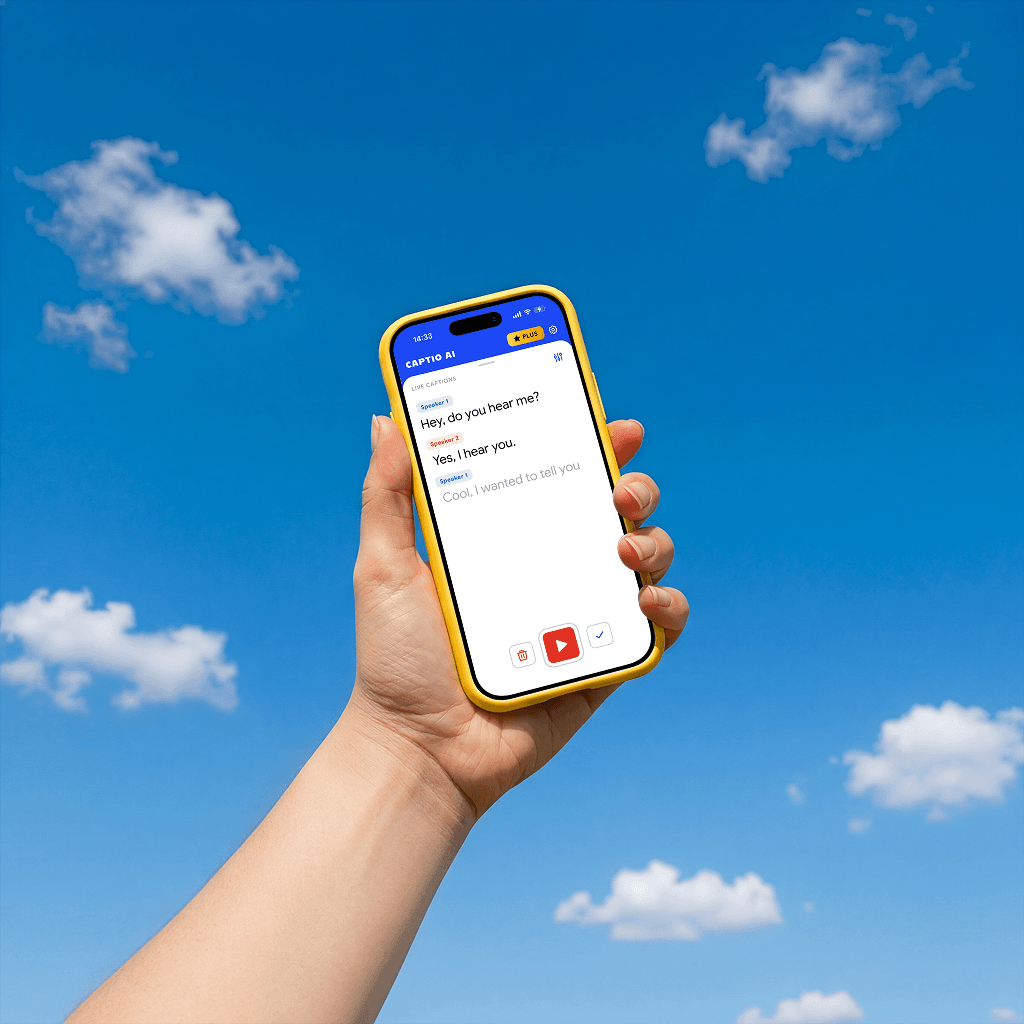
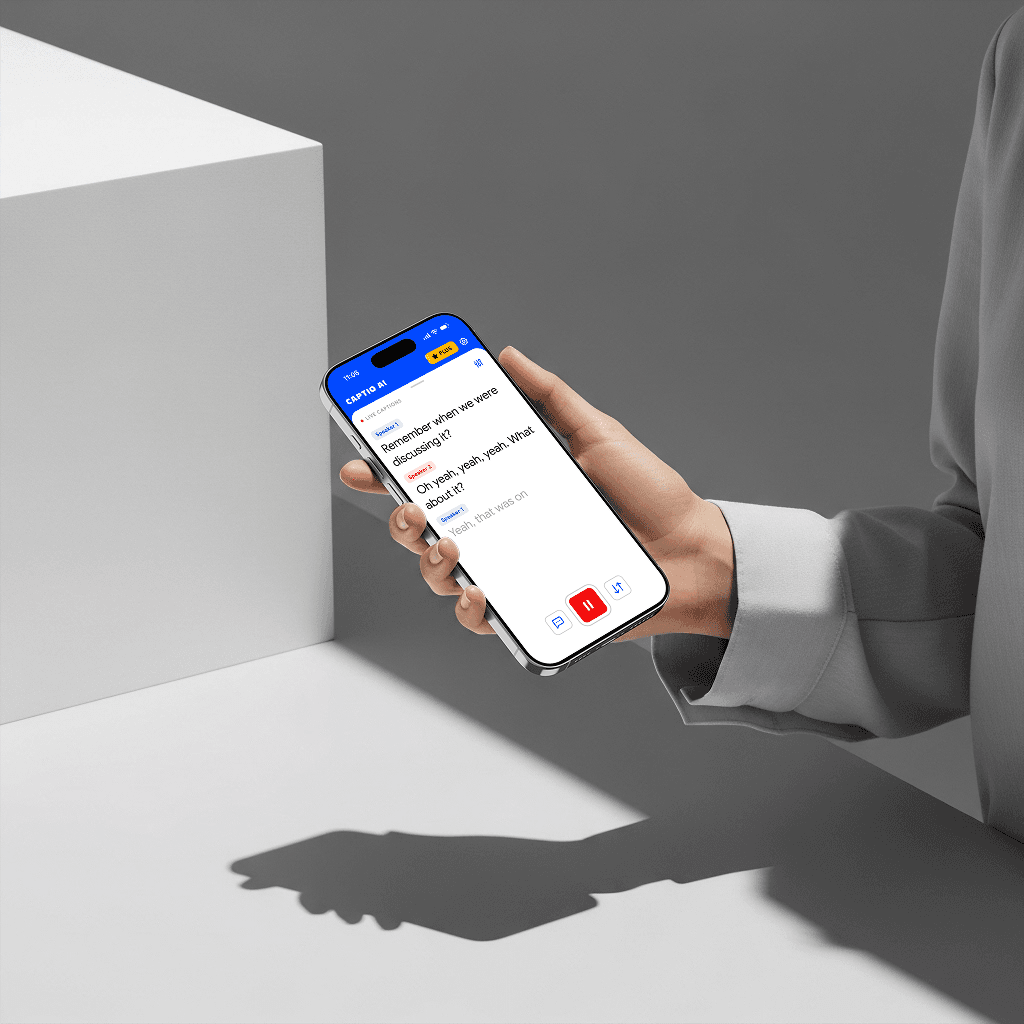
Built for the pace and pressure of a real lecture
Follow without splitting your attention
Lip-reading and note-taking at the same time is an impossible cognitive load. Captio AI handles the following so you can direct all your attention to understanding what is being said.
Captions while the lecturer is still speaking
Words appear on your screen as they are said — not after the sentence ends. You stay in sync with the lecture rather than always being a beat behind.
Works in any lecture setting
Lecture halls, seminar rooms, online classes, study groups. Place the phone on your desk, point it toward the audio source, and Captio AI handles the rest.
A full transcript to study from
Record the lecture and upload it to Audio Transcription after class. Get a complete written record you can search, annotate, and revise from — at your own pace.
60+ languages
For international students, students studying abroad, or courses taught in a second language. Captio AI captions or translates in real time with no manual setup.
No advance notice needed
Official university captioning requires booking in advance and is not available for every session. Captio AI works for any lecture, any time, with no prior arrangement.
Why Japanese is hard to understand
Minimal lip movement
- Japanese speakers use far less lip movement than European-language speakers — and this is culturally reinforced in formal settings
- Research comparing Japanese and English speakers found that Japanese speakers rely less on visual speech information and produce less visible articulatory movement. In a university lecture, a professor speaking formal academic Japanese produces even more restrained, inward articulation than in casual speech. Covering the mouth when speaking, minimal facial expression, and avoidance of direct eye contact are all socially normative in formal Japanese settings — all reducing the information available from lip-reading.
Pitch accent invisibility
- Japanese pitch accent distinguishes meaning — and is entirely invisible on the lips
- Tokyo-dialect Japanese has a pitch accent system where the relative pitch of morae determines word meaning: 橋 (bridge, high-low) vs 箸 (chopsticks, low-high) vs 端 (edge, low-high-low). In a lecture, these tonal distinctions carry semantic information that cannot be recovered from lip shape alone. A deaf student sees the same lip movement for words with completely different meanings.
No word boundaries
- Japanese speech flows as continuous sound with no pauses between words — making segmentation impossible without hearing
- Japanese is spoken as a continuous stream with no acoustic or visual word boundaries. Written Japanese uses distinct scripts (hiragana, katakana, kanji) to mark word structure, but spoken lecture Japanese gives no segmentation cues. A deaf student must simultaneously lip-read continuous movement, parse words from context, and follow sentence structure — with none of the boundary markers that help in European languages.
Keigo register gap
- Academic keigo — the formal honorific register used in lectures — sounds and looks entirely different from the Japanese deaf students practise with
- Japanese formal academic speech uses keigo (敬語) — an honorific register with different verb forms, different vocabulary, and different sentence endings from colloquial Japanese. A deaf student who lip-reads everyday Japanese encounters a different lexical and phonological system in the lecture hall. The verb form ~でございます replaces ~です/~だ; the vocabulary shifts toward Sino-Japanese readings that have different mouth shapes from their colloquial equivalents.
Sino-Japanese academic vocabulary
- Japanese academic lectures lean heavily on on'yomi (Sino-Japanese) readings — which differ entirely from everyday word forms
- Japanese academic vocabulary uses on'yomi (Chinese-derived) readings of kanji that are phonologically distinct from the kun'yomi (native Japanese) readings used in everyday speech. 研究 (kenkyuu, research) vs 調べる (shiraberu, to investigate) — same concept, completely different phonetic shape. A deaf student who has learnt to lip-read everyday Japanese encounters unfamiliar mouth patterns when the professor uses on'yomi vocabulary throughout a lecture.
Download for free
Hearing loss is prevalent in Japan — but only 14% of those affected use hearing aids
Japan has one of the world's oldest populations, and age-related hearing loss is correspondingly prevalent. A study published in PMC (PMC9220865) found that 43.7% of Japanese men and 27.7% of Japanese women aged 65–69 had measurable hearing loss. More broadly, Japan's government registry of people with physical disability certificates for hearing impairment recorded hundreds of thousands of registrants — representing only a fraction of actual prevalence, since many people with partial hearing loss do not register. Yet a survey published in The Hearing Review found that only 14% of hearing-impaired people in Japan actually use hearing aids — among the lowest adoption rates in any developed country, compared to 41% in France and 48% in the UK.
For deaf and hard of hearing university students in Japan, the structural situation is constrained. Tsukuba University of Technology (NTUT) is the only university in Japan specifically designed for deaf and hard of hearing students. Students at mainstream universities must request accommodations individually, and provision is inconsistent. A 2022 study (PMC12708076) documented Japan's adoption of the Washington Group Short Set disability assessment, noting that previous surveys had systematically undercounted people with functional hearing difficulty. The consequence for higher education is that the true number of deaf and hard of hearing university students is substantially larger than institutional records suggest.
Research published in PMC (PMC4317178) documented the specific social dimensions of hearing loss in Japan, finding that Japanese women with hearing loss faced compounded difficulties in marriage prospects, mental health outcomes, and social participation — indicators of broader structural exclusion beyond the individual accommodation request. For deaf and hard of hearing students at Japanese universities, the lecture hall represents the most acute daily manifestation of this exclusion: formal academic Japanese delivered at pace, with minimal lip movement, in settings where asking for a repeat is socially awkward.
[1]PMC9220865 — Prevalence of Hearing Impairment by Age in Japan
[2]Hearing Review — Only 14% of hearing-impaired people in Japan use hearing aids
[3]PMC4317178 — Triple Difficulties for Japanese Women with Hearing Loss
[4]PMC12708076 — Washington Group Short Set in Japan: Hearing Disability Assessment (2022)
Download for free
What you hear stays with you.
Gone the moment it ends
Captio AI processes your audio in real time and discards it immediately. Nothing is recorded. Nothing is kept.
Not a product
Your conversations are not something Captio AI sells, shares, or monetizes — to anyone, for any reason.
Not used to train anything
What you say in a doctor's appointment or a job interview never ends up in a training dataset. Not ours. Not anyone else's.

Private by default
Captio AI supports 60+ languages
Download for free
Frequently asked questions
Follow every lecture in Japanese.
Captio AI is free to start
Download for free