

Dutch live captions and productivity tool for lectures
For deaf and hard of hearing people.
Download for free
Everything you need to follow Dutch lectures
Four tools built for deaf and hard of hearing Dutch speakers.
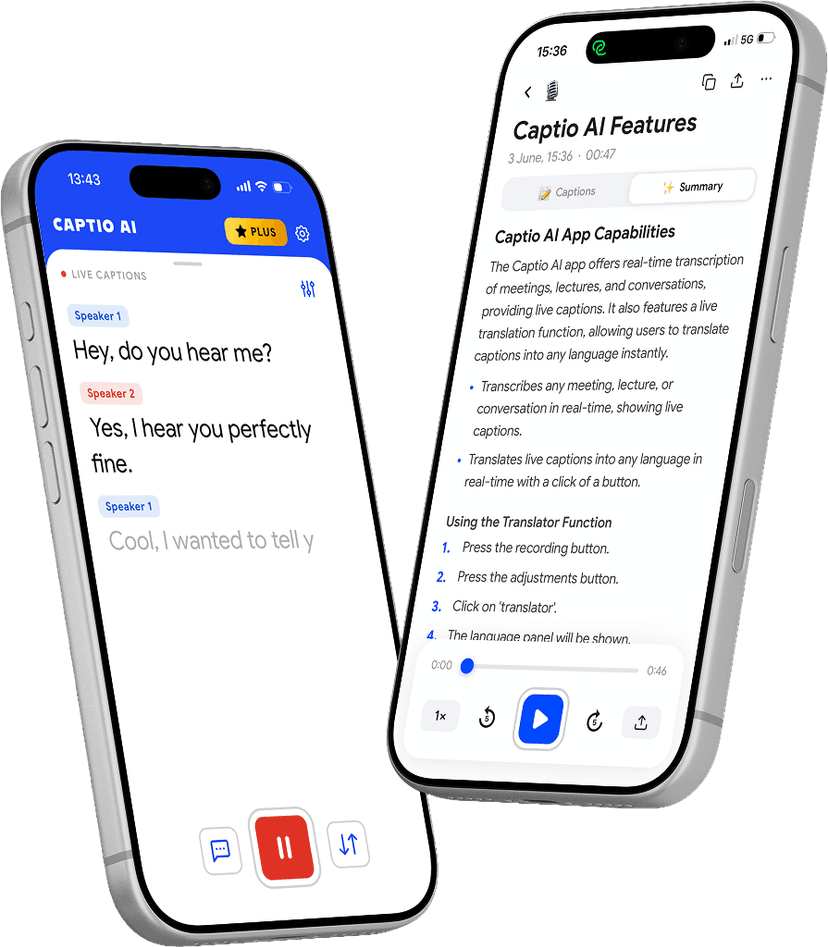
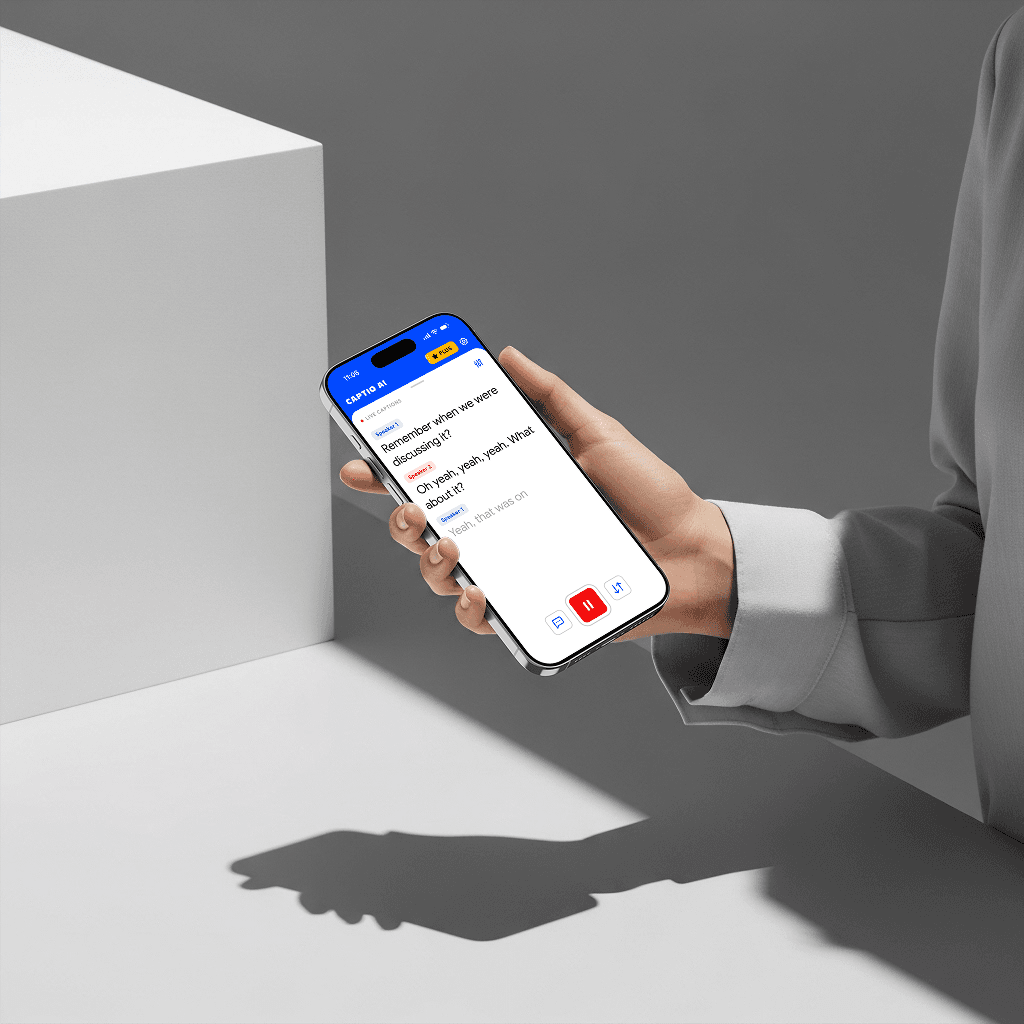
Follow the lecture as it happens
- Captions appear word by word while the lecturer is still speaking
- Works in lecture halls, seminars, and tutorials
- No setup — place the phone on your desk and start
- Any accent, any pace
For courses in another language
- Captions and translates in real time
- For international students or foreign-language courses
- 60+ languages, no switching
- Follow the lecture in the language you read best
Full transcript to study from
- Record the lecture and upload it for a complete written transcript
- Searchable, copyable, shareable
- Review at your own pace after class
- Works on any lecture recording
Key points extracted automatically
- Important concepts and takeaways pulled from any transcript
- Organised into sections — not one continuous block
- Useful for revision and exam preparation
- Works on any saved lecture transcript
Download for free
Every situation covered
Designed for the real moments that matter — not just quiet controlled environments.
Large lecture theatres at Leiden, Amsterdam (UvA), Groningen, and TU Delft — Dutch-medium instruction at full academic pace. Captio AI captions the professor in real time from any seat.
Seminars and werkgroepen (tutorial groups) where discussion happens in Dutch and English. Captio AI handles Dutch and English without manual switching.
Recorded college online (OCW) content and university portal lectures — play on speaker and Captio AI captions whatever is playing in real time.
Study groups (studiegroepen) reviewing Dutch lecture material. Captio AI captions whoever is speaking so you follow each contributor's point.
Guest lecturers from Flemish universities (KU Leuven, UGent) whose Dutch carries Flemish phonological patterns. Captio AI handles both Dutch and Flemish varieties.
Online courses and webinars delivered by Dutch universities in Dutch or English. Captio AI captions any audio source in real time.
Most accurate and fastest models
word accuracy
independent benchmark, 2025
real-time captions
first word appears as you speak
Download for free
Built for the pace and pressure of a real lecture
Follow without splitting your attention
Lip-reading and note-taking at the same time is an impossible cognitive load. Captio AI handles the following so you can direct all your attention to understanding what is being said.
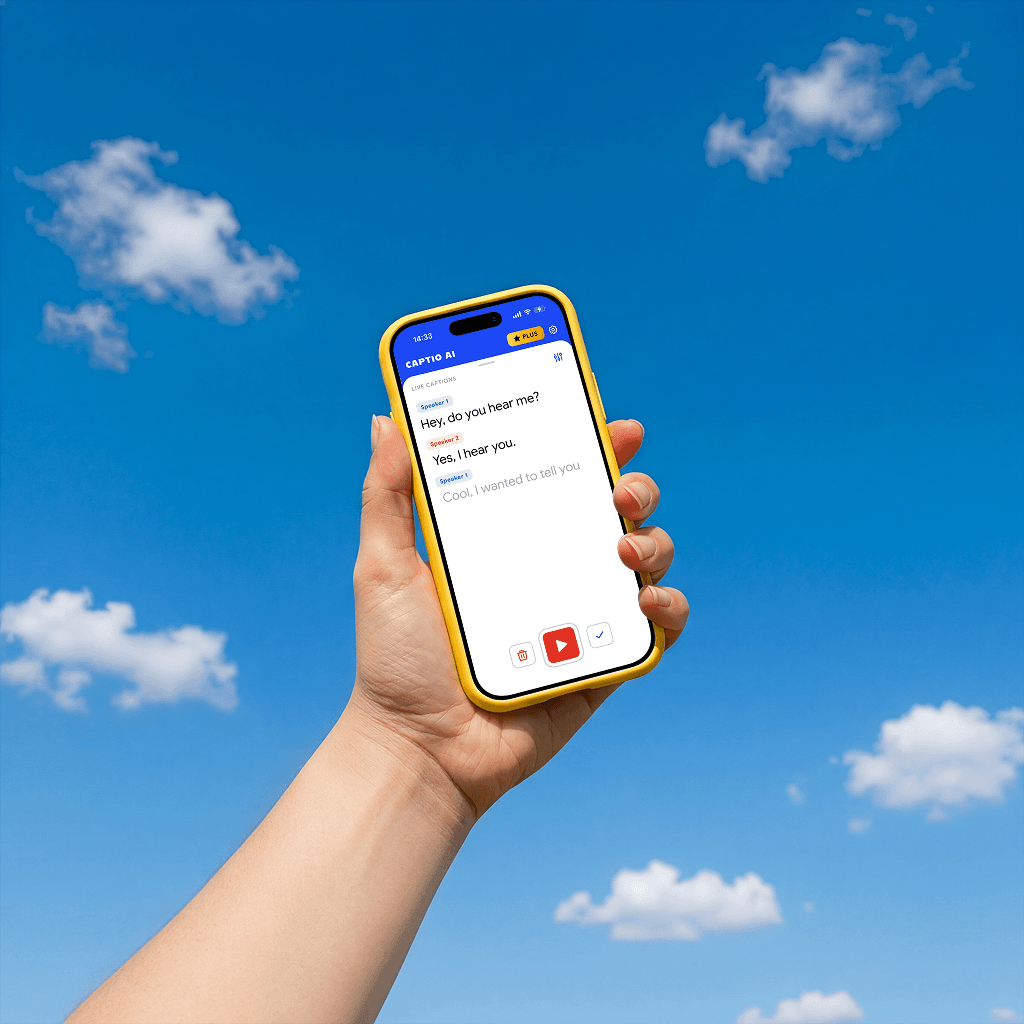
Captions while the lecturer is still speaking
Words appear on your screen as they are said — not after the sentence ends. You stay in sync with the lecture rather than always being a beat behind.
Works in any lecture setting
Lecture halls, seminar rooms, online classes, study groups. Place the phone on your desk, point it toward the audio source, and Captio AI handles the rest.
A full transcript to study from
Record the lecture and upload it to Audio Transcription after class. Get a complete written record you can search, annotate, and revise from — at your own pace.
60+ languages
For international students, students studying abroad, or courses taught in a second language. Captio AI captions or translates in real time with no manual setup.
No advance notice needed
Official university captioning requires booking in advance and is not available for every session. Captio AI works for any lecture, any time, with no prior arrangement.
Why Dutch is hard to understand
Velar fricatives
- The Dutch hard-G is produced at the back of the throat — invisible from the front
- Dutch /x/ and /ɣ/ — the voiced and voiceless velar fricatives at the heart of Dutch consonant identity — are produced at the very back of the mouth. From a lecture hall seat, the mouth barely opens. These fricatives distinguish dozens of Dutch word pairs but produce no visible lip movement that a deaf student can track.
Diphthong compression
- Dutch diphthongs compress into one lip shape at lecture speed
- The three Dutch diphthongs /ɛi/, /œy/, and /ɑu/ are long vowel glides spanning two positions. In careful speech they are visible; at full lecture speed they compress. A deaf student tracking the starting and ending position of each diphthong has a fraction of a second to register both before the next word arrives.
Schwa reduction
- Unstressed syllables collapse to schwa — Dutch lectures lose their syllable shapes
- Dutch reduces unstressed syllables heavily to schwa /ə/. In fast academic speech, the prefix 'be-', the suffix '-en', and the article 'de' all converge on the same brief mouth closure. A long Dutch academic sentence at full pace produces extended stretches of schwa-reduced lip movements indistinguishable from each other.
Flemish-Randstad variation
- Flemish and Dutch academics move their mouths differently for the same words
- Dutch universities draw faculty and students from the Netherlands and Belgium. Flemish Dutch differs from Randstad Dutch in vowel quality, prosody, and fricative realisation. Antwerp and Ghent speech uses a softer fricative than Amsterdam or Rotterdam Dutch. For a deaf student, a visiting Flemish lecturer presents an entirely different set of lip patterns for Dutch phonology.
Word-final clusters
- Dutch clusters -ngt, -rkt, -rst pack multiple consonants into one brief lip moment
- Dutch word-final consonant clusters like -ngt ('zingt', sings), -rkt ('werkt', works), -rst ('eerst', first) pack three or four consonants into the last position of a word at lecture speed. The individual consonant shapes that are readable in isolation become one brief lip compression at pace.
Download for free
900,000 Dutch people with significant hearing loss — in the last Western European country to legally recognise its sign language
An estimated 900,000 people in the Netherlands have disabling hearing loss. A 2025 study examining employment outcomes of 5,609 deaf and hard of hearing people who claimed sensory disability care in the Netherlands between 2015 and 2019 found that, despite comparable employment participation rates, DHH workers earn lower average hourly wages, work fewer hours per week, work in different employment sectors, and are more likely to receive income from sick leave or disability benefits than matched hearing peers. The gap begins in education — not the labour market.
Nederlandse Gebarentaal (NGT) — Dutch Sign Language — did not receive formal legal recognition until 2021, making the Netherlands one of the last Western European countries to recognise its deaf community's primary language. Before recognition, NGT users had no statutory right to interpretation in public settings. Universities in the Netherlands provide interpretation under student finance (DUO) arrangements, but the hours are capped, specialised academic interpreters are scarce, and deaf students in technical or scientific programmes routinely exhaust their interpreter allocation before the academic year ends.
Dutch disability law — the Wet gelijke behandeling op grond van handicap of chronische ziekte (WGBH/CZ) — prohibits discrimination on grounds of disability, but the gap between legal protection and lived accessibility in Dutch lecture halls remains wide. No Dutch university provides systematic live captioning to all enrolled deaf students as a standard service. Captio AI captions Dutch lectures in real time — in a Leiden seminar room, a TU Delft lab briefing, or a Dutch-language university webinar — so the lecture is accessible without prior arrangement.
Download for free
What you hear stays with you.
Gone the moment it ends
Captio AI processes your audio in real time and discards it immediately. Nothing is recorded. Nothing is kept.
Not a product
Your conversations are not something Captio AI sells, shares, or monetizes — to anyone, for any reason.
Not used to train anything
What you say in a doctor's appointment or a job interview never ends up in a training dataset. Not ours. Not anyone else's.

Private by default
Captio AI supports 60+ languages
Download for free
Frequently asked questions
Follow every lecture in Dutch.
Captio AI is free to start
Download for free