

Persian live captions and productivity tool for lectures
For deaf and hard of hearing people.
Download for free


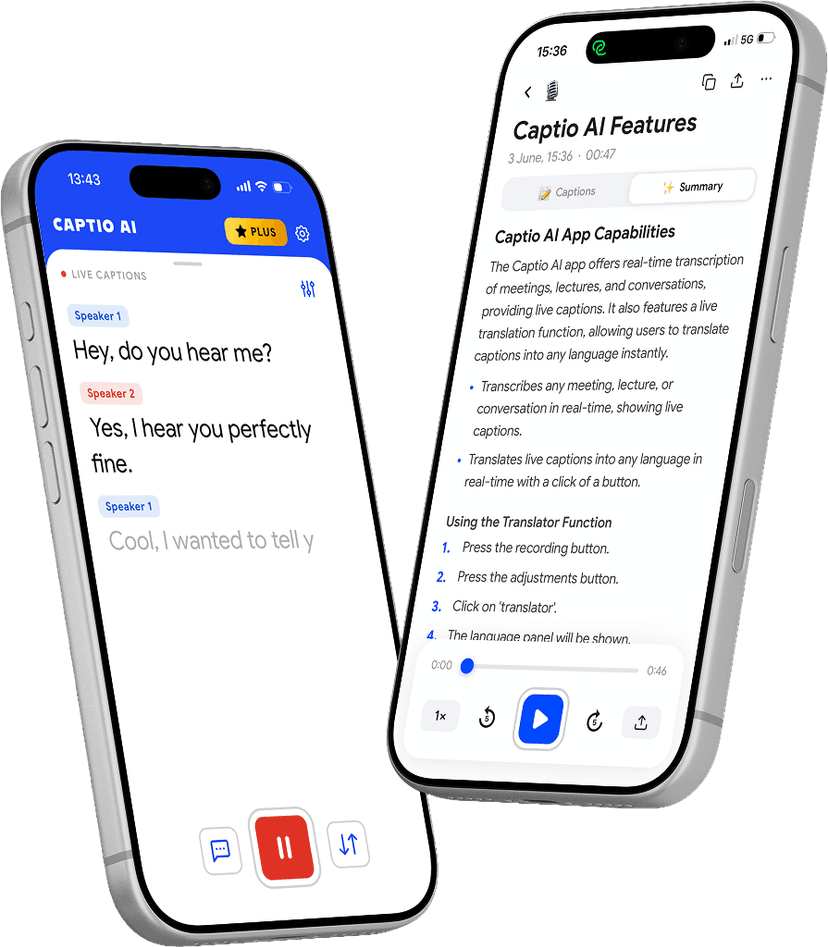
Everything you need to follow Persian lectures
Four tools built for deaf and hard of hearing Persian speakers.
Follow the lecture as it happens
- Captions appear word by word while the lecturer is still speaking
- Works in lecture halls, seminars, and tutorials
- No setup — place the phone on your desk and start
- Any accent, any pace
For courses in another language
- Captions and translates in real time
- For international students or foreign-language courses
- 60+ languages, no switching
- Follow the lecture in the language you read best
Full transcript to study from
- Record the lecture and upload it for a complete written transcript
- Searchable, copyable, shareable
- Review at your own pace after class
- Works on any lecture recording
Key points extracted automatically
- Important concepts and takeaways pulled from any transcript
- Organised into sections — not one continuous block
- Useful for revision and exam preparation
- Works on any saved lecture transcript
Download for free
Every situation covered
Designed for the real moments that matter — not just quiet controlled environments.
University of Tehran, Sharif University, Isfahan University, and Amirkabir lecture halls. Persian-medium lectures in formal academic Persian at pace. Place the phone on the desk facing the speaker. Captio AI captions from any row.
Persian university seminars where students present and discuss in formal Persian, often mixing English technical terms. Captio AI captions whoever is speaking so you follow every argument.
Recorded lectures on Iranian university portals or YouTube academic channels. Put the recording on speaker and point Captio AI at the audio for accurate captions in real time.
Study groups in Tehran, Isfahan, or Mashhad — fast colloquial Persian mixed with English for scientific topics. Captio AI follows whoever is speaking and handles both registers.
Afghan students following Dari-medium courses alongside Iranian-Persian professors, or international students in Persian-medium programmes. Live Translator captions in real time so language is not the access barrier.
Visiting academics and guest speakers from Iran, Afghanistan, and Tajikistan. Captio AI handles Iranian Persian, Dari, and Tajik varieties — any speaker at any venue.
Most accurate and fastest models
word accuracy
independent benchmark, 2025
real-time captions
first word appears as you speak
Download for free
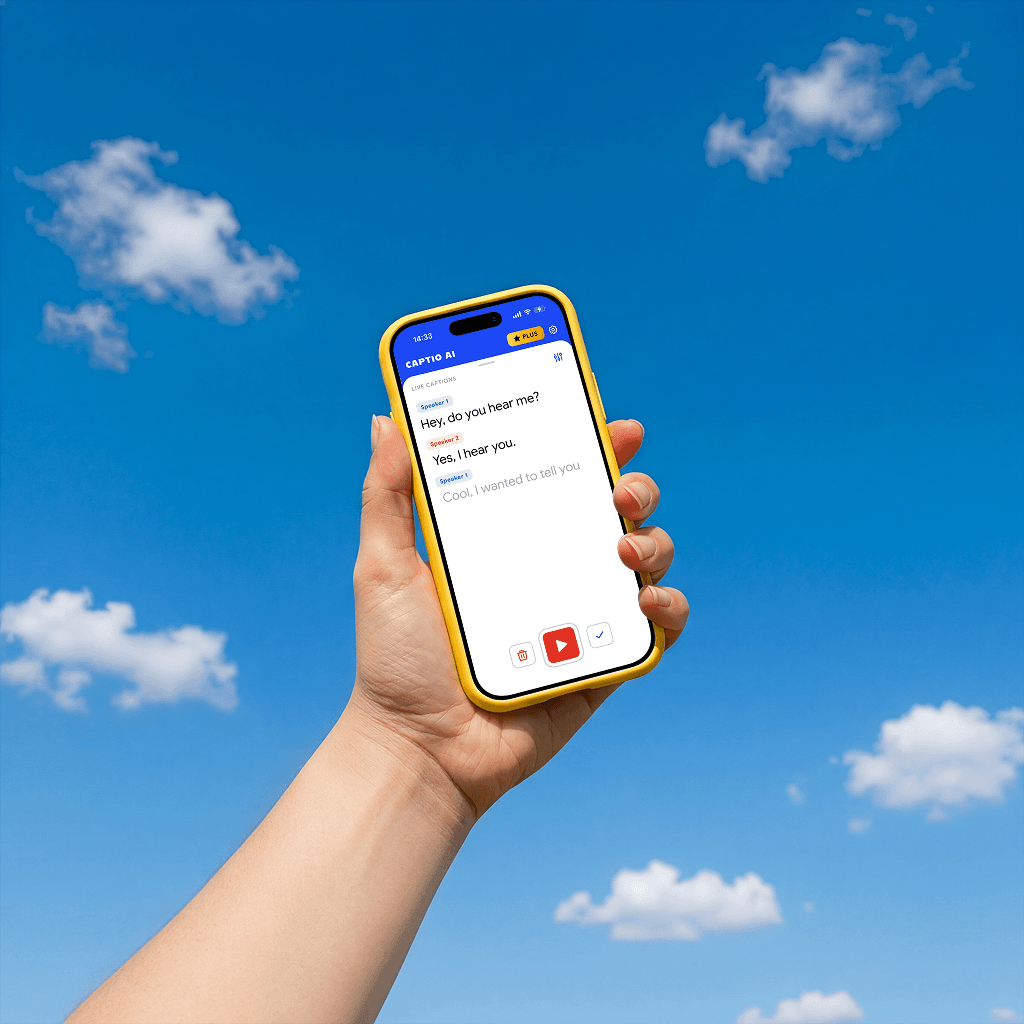
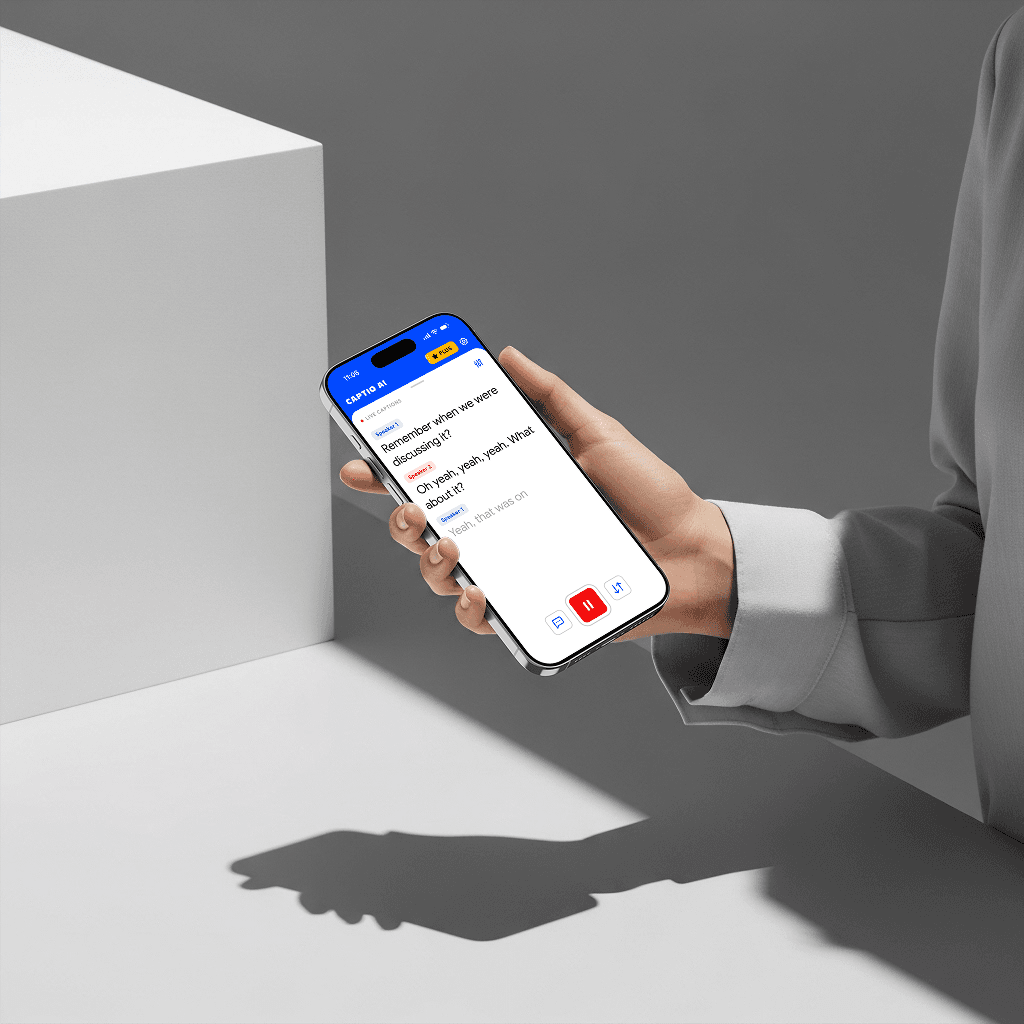
Built for the pace and pressure of a real lecture
Follow without splitting your attention
Lip-reading and note-taking at the same time is an impossible cognitive load. Captio AI handles the following so you can direct all your attention to understanding what is being said.
Captions while the lecturer is still speaking
Words appear on your screen as they are said — not after the sentence ends. You stay in sync with the lecture rather than always being a beat behind.
Works in any lecture setting
Lecture halls, seminar rooms, online classes, study groups. Place the phone on your desk, point it toward the audio source, and Captio AI handles the rest.
A full transcript to study from
Record the lecture and upload it to Audio Transcription after class. Get a complete written record you can search, annotate, and revise from — at your own pace.
60+ languages
For international students, students studying abroad, or courses taught in a second language. Captio AI captions or translates in real time with no manual setup.
No advance notice needed
Official university captioning requires booking in advance and is not available for every session. Captio AI works for any lecture, any time, with no prior arrangement.
Why Persian is hard to understand
Pharyngeal consonants
- Persian's pharyngeal consonants /ħ/ and /ʕ/ are produced deep in the throat — invisible on the lips
- Formal Persian retains pharyngeal consonants (ح /ħ/ and ع /ʕ/) borrowed from Arabic vocabulary. These are produced in the pharynx, deep behind the visible articulators — producing virtually no lip, teeth, or tongue-tip movement visible on the face. In a lecture, Arabic-origin academic vocabulary containing ح and ع is pervasive in formal Persian, particularly in humanities, law, and religious studies. A deaf student sees the surrounding vowels and misses the consonant entirely.
Uvular consonants
- Persian uvular consonants — /q/, /χ/, /ɣ/ — are produced at the back of the mouth, producing no lip information
- Persian has uvular stops and fricatives (ق /q/, خ /χ/, غ /ɣ/) that are produced with the back of the tongue against the uvula. None of these produce visible lip movement — the lips may be slightly open, but the articulation is entirely at the back of the mouth. Academic Persian vocabulary is dense with these uvular consonants, particularly in technical and formal registers. From the lips alone, a deaf student cannot distinguish uvular from velar consonants.
Dari-Iranian vowel divergence
- Dari (Afghan) and Iranian Persian have undergone different vowel shifts — producing different lip patterns for the same written words
- Iranian Persian and Dari (Afghan Persian) have diverged significantly in their vowel systems. Classical Persian /ā/ became /ɑː/ in Iran but /ɔː/ in Dari; classical /ū/ became /u/ in Iran but retained as /uː/ in Dari. Iranian universities draw Dari-speaking students from Afghanistan, and Afghan universities have Iranian-trained professors. A deaf student calibrated to Tehran Persian encounters different lip shapes for the same written words when listening to a Dari speaker.
Tehran vowel reduction
- Tehran Persian is actively losing its long/short vowel distinction — creating new homophones that did not exist a generation ago
- Standard literary Persian has a clear long/short vowel distinction (/iː/ vs /e/, /uː/ vs /o/, /ɑː/ vs /a/). Tehran colloquial Persian is in the process of merging several of these — producing new homophones in fast speech. In a university lecture, a professor may shift between literary pronunciation (for reading passages) and Tehran colloquial (for explanation) within a single sentence. A deaf student must track two phonological systems simultaneously.
Right-to-left script dual task
- Persian script runs right-to-left — creating an additional cognitive load when reading captions while watching a speaker
- Persian is written in the Nastaliq/Naskh scripts, running right to left. A deaf person reading Persian captions at the bottom of a screen while simultaneously watching the speaker faces a directional conflict: lips move left to right, text runs right to left. This dual-task cognitive burden is absent in left-to-right captioning environments and adds a measurable processing cost in the lecture setting.
Download for free
14% hearing impairment prevalence in Tehran — with a national screening programme still expanding
A population-based study in Tehran published in PMC (PMC5632326) found that hearing impairment prevalence was 14.27%, with 0.48% of the population classified as deaf and 5.19% with disabling hearing impairment. School-age data shows even higher figures in some regions: a study of children in northern Iran (PMC7085924) found that 9.8% of first and second grade students had measurable hearing loss. Iran's national programme for ear and hearing health has been working toward 100% newborn screening coverage and increased screening for children aged 3–6, but full implementation across all provinces is ongoing.
Iran has a significant deaf population navigating university education with limited institutional support. Iranian Sign Language (ZabanEshareh / زبان اشاره) is used by the deaf community but does not have formal legal recognition equivalent to spoken Persian in educational settings. The University of Social Welfare and Rehabilitation Sciences in Tehran has historically provided some specialist provision, but mainstream universities — where the majority of deaf and hard of hearing students enroll — have no systematic real-time captioning infrastructure. Afghan deaf students studying in Iran, and Iranian deaf students in Afghanistan, face the additional challenge of Dari-Iranian Persian divergence in a setting with no captioning provision.
The GBD 2019 study (PMC7960691) placed the WHO Eastern Mediterranean region — which includes Iran and Afghanistan — among the regions with significant hearing loss burden. For deaf and hard of hearing students at Persian-medium universities, the lecture hall concentrates multiple access challenges: formal academic Persian with Arabic-derived vocabulary dense in pharyngeal and uvular consonants, fast academic delivery, and a writing system that runs right to left — all without captioning.
Download for free
What you hear stays with you.
Gone the moment it ends
Captio AI processes your audio in real time and discards it immediately. Nothing is recorded. Nothing is kept.
Not a product
Your conversations are not something Captio AI sells, shares, or monetizes — to anyone, for any reason.
Not used to train anything
What you say in a doctor's appointment or a job interview never ends up in a training dataset. Not ours. Not anyone else's.

Private by default
Captio AI supports 60+ languages
Download for free
Frequently asked questions
Follow every lecture in Persian.
Captio AI is free to start
Download for free