

Indonesian live captions and productivity tool for lectures
For deaf and hard of hearing people.
Download for free


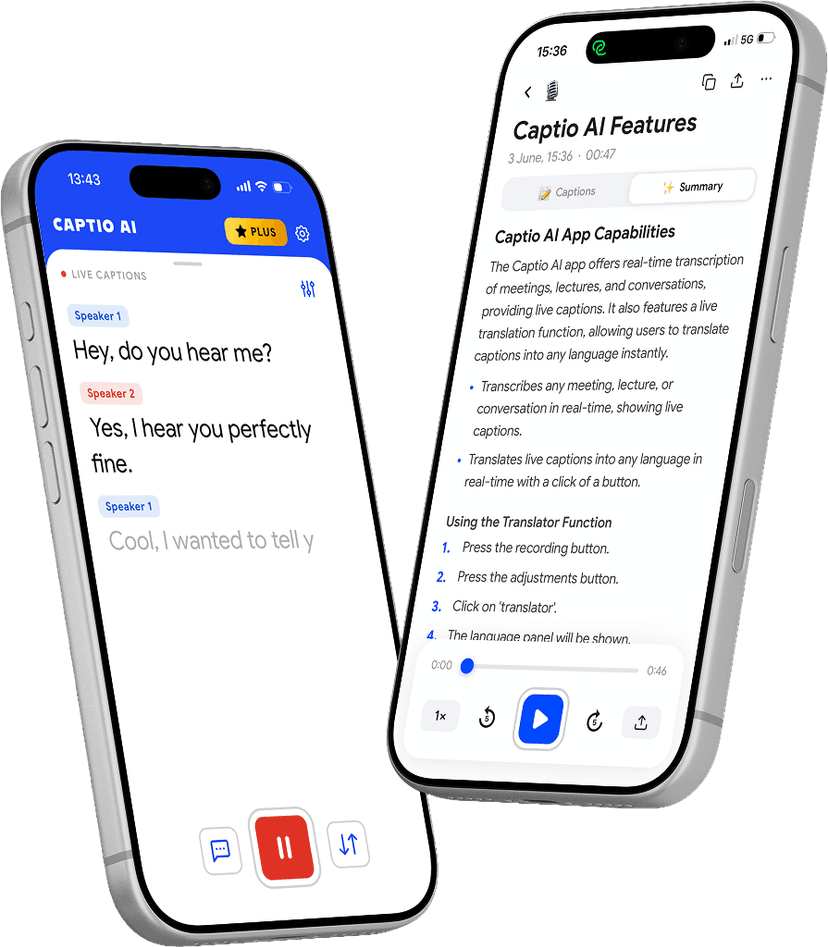
Everything you need to follow Indonesian lectures
Four tools built for deaf and hard of hearing Indonesian speakers.
Follow the lecture as it happens
- Captions appear word by word while the lecturer is still speaking
- Works in lecture halls, seminars, and tutorials
- No setup — place the phone on your desk and start
- Any accent, any pace
For courses in another language
- Captions and translates in real time
- For international students or foreign-language courses
- 60+ languages, no switching
- Follow the lecture in the language you read best
Full transcript to study from
- Record the lecture and upload it for a complete written transcript
- Searchable, copyable, shareable
- Review at your own pace after class
- Works on any lecture recording
Key points extracted automatically
- Important concepts and takeaways pulled from any transcript
- Organised into sections — not one continuous block
- Useful for revision and exam preparation
- Works on any saved lecture transcript
Download for free
Every situation covered
Designed for the real moments that matter — not just quiet controlled environments.
Indonesian university auditoria and lecture halls at UI, ITB, UGM, and Unpad hold hundreds of students. Professors deliver in Bahasa Indonesia colored by their regional L1. Place your phone on the desk facing the PA speaker. Captio AI captions any regional substrate variety accurately.
Indonesian university seminars blend formal Bahasa Indonesia with informal discussion. Students from different regional backgrounds contribute with varying phonetic profiles. Captio AI follows whoever is speaking so you track every argument without asking for repeats.
Indonesian MOOC platforms like Ruangguru and institutional video lecture systems host academic content. Auto-captions often struggle with regional substrate phonology. Put the lecture on speaker and point Captio AI at the audio for accurate real-time captions.
Campus library areas, boarding house (kost) study rooms, university canteen tables. Fast conversational Indonesian in revision sessions. Captio AI captions whoever is speaking so you follow every explanation.
International students at Indonesian universities following Bahasa Indonesia-medium courses, or Indonesian students in English-medium programmes. Live Translator captions in real time so language is not the access barrier.
Visiting academics, NGO representatives, industry practitioners. Indonesian academic talks draw speakers with Javanese, Sundanese, Batak, or other regional L1 phonetics. Captio AI covers any speaker at any venue without prior arrangement.
Most accurate and fastest models
word accuracy
independent benchmark, 2025
real-time captions
first word appears as you speak
Download for free
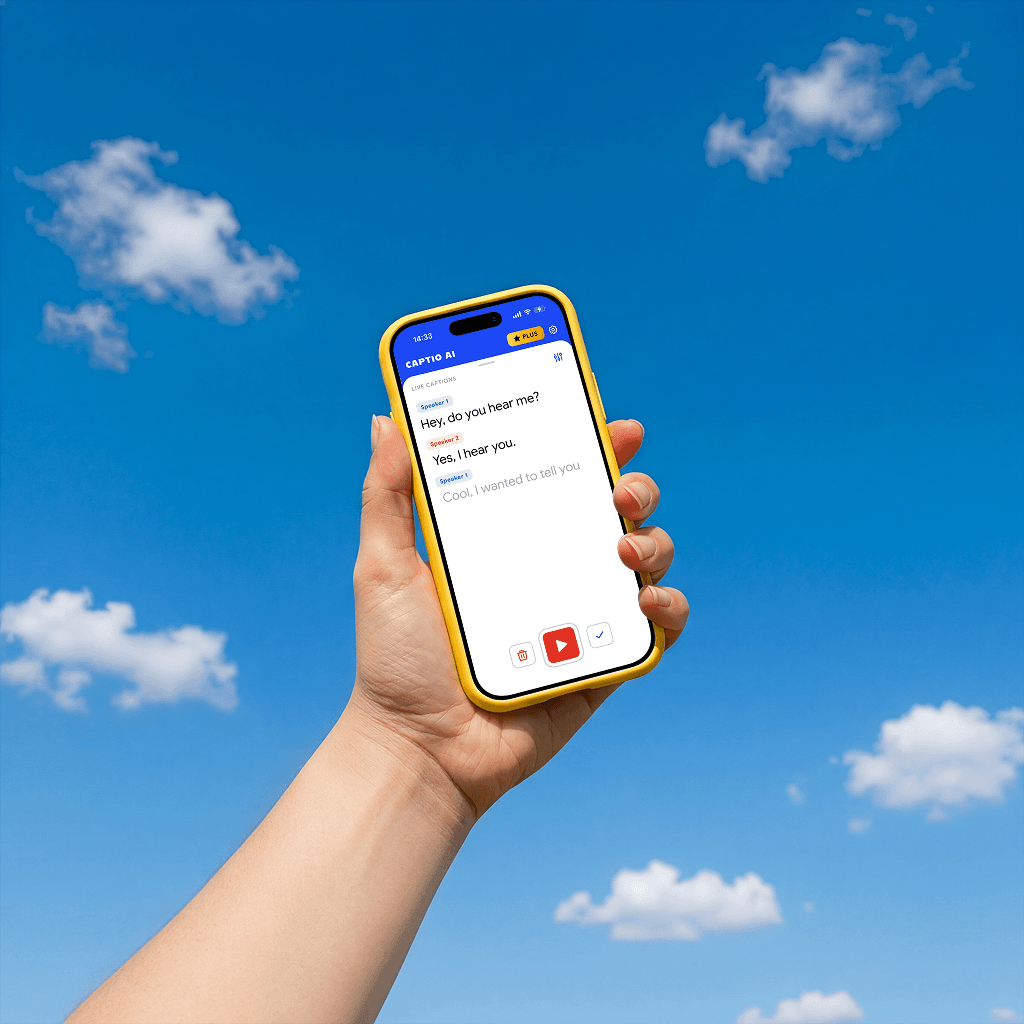
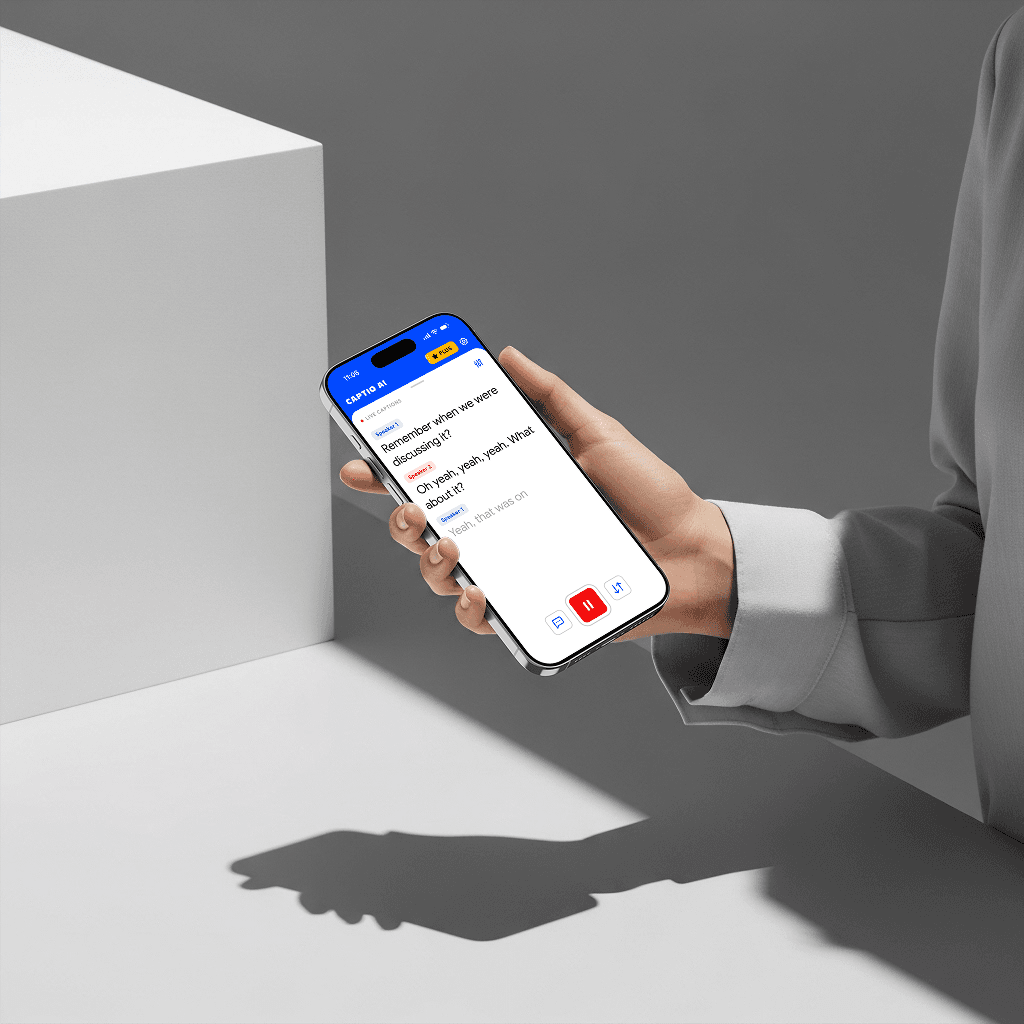
Built for the pace and pressure of a real lecture
Follow without splitting your attention
Lip-reading and note-taking at the same time is an impossible cognitive load. Captio AI handles the following so you can direct all your attention to understanding what is being said.
Captions while the lecturer is still speaking
Words appear on your screen as they are said — not after the sentence ends. You stay in sync with the lecture rather than always being a beat behind.
Works in any lecture setting
Lecture halls, seminar rooms, online classes, study groups. Place the phone on your desk, point it toward the audio source, and Captio AI handles the rest.
A full transcript to study from
Record the lecture and upload it to Audio Transcription after class. Get a complete written record you can search, annotate, and revise from — at your own pace.
60+ languages
For international students, students studying abroad, or courses taught in a second language. Captio AI captions or translates in real time with no manual setup.
No advance notice needed
Official university captioning requires booking in advance and is not available for every session. Captio AI works for any lecture, any time, with no prior arrangement.
Why Indonesian is hard to understand
Regional substrate phonology
- Most Indonesian professors speak Bahasa Indonesia as a second language — each with a different phonetic substrate
- Indonesia has over 700 regional languages. For the majority of Indonesians, Bahasa Indonesia is a learned second language — and lecture delivery carries the phonological substrate of the lecturer's L1. A Javanese-L1 professor produces Indonesian with Javanese vowel quality and rhythm. A Sundanese-L1 professor has different sibilant realizations. A Minangkabau-L1 professor carries different prosody. A deaf student who has calibrated lip-reading to Standard Indonesian encounters a different visual profile in every lecture from a different regional background.
Javanese influence
- Javanese phonology permeates Indonesian in Java — where most major universities are located
- Javanese is Indonesia's largest L1, spoken by approximately 80 million people. The University of Indonesia (UI), ITB, UGM, and most of Indonesia's major universities are located in Java. In lecture halls on Java, the Indonesian delivered is routinely shaped by Javanese phonology: vowel lengthening in stressed positions, specific sibilant realizations (/ɕ/ vs /s/), and prosodic patterns distinct from Standard Indonesian. A deaf student who has practised Standard Indonesian encounters Javanese-substrate delivery as the default, not the exception.
Formal-informal register shift
- Lecturers shift between formal Bahasa Indonesia and informal Bahasa Gaul — changing phonotactics mid-lecture
- Indonesian lectures routinely blend formal register (Bahasa Indonesia resmi) with informal colloquial Indonesian (Bahasa Gaul) when lecturers explain concepts informally or address individual students. The register shift changes pace, vowel quality, and syllable structure simultaneously. A deaf student tracking formal Indonesian suddenly encounters a different phonological system when the lecturer switches to casual mode for an aside.
Indonesian-English code-switching
- STEM lectures mix Bahasa Indonesia and English technical vocabulary without visual warning
- Indonesian university STEM lectures routinely switch to English for technical vocabulary. The phonological system, stress pattern, and lip profile shift from Indonesian to English mid-sentence. A deaf student must track two distinct phonological systems — Indonesian and English — and the switch happens at the exact moments when the technical content is most important.
Low nasal-oral contrast
- Nasal vowels and consonants vary substantially across regional varieties — making nasalization an unreliable lip-reading cue
- Indonesian's nasal phonemes (/m/, /n/, /ŋ/, /ɲ/) are realized differently across regional varieties. Javanese nasalization patterns differ from Sundanese or Madurese. For a deaf student, the nasalization cue — which in other languages helps identify consonant class — is inconsistent across the lectures they sit in, reducing its value as a lip-reading anchor.
Download for free
Nine million Indonesians with hearing difficulty — and a higher education system built around hearing
Indonesia's Central Statistics Agency found in 2015 that almost nine million Indonesians over the age of 10 had difficulty hearing. By 2020, the same agency estimated more than 22 million Indonesians with any disability — approximately 5% of the total population — with hearing-related disability representing a significant portion. The WHO places the Southeast Asia region as having the second-highest global burden of hearing loss, with approximately 109.5 million people affected (PMC7960691). For a country of 280 million, the number of people navigating daily life — and university education — without functional hearing is substantial.
A study by the Jakarta-based SMERU Research Institute found that Indonesians with disabilities experience significant discrimination, tending to have lower education levels, more limited employment opportunities, and less access to public facilities than non-disabled peers. For deaf and hard of hearing students at Indonesian universities, the lecture hall presents the same structural absence as in many countries: no real-time captioning, no standardised sign language interpreter provision, and an expectation of hearing that the infrastructure does not challenge. Indonesian Sign Language (BISINDO) has no official national recognition, and interpreter training at the university level remains nascent.
A platform specifically designed to provide accessible information for deaf and hard of hearing audiences in Indonesia was documented by the International Journalists' Network (IJNET, 2023) as filling a gap that no public institution addresses: the systematic absence of accessible Indonesian-language content for deaf and hard of hearing people. In a university context, this absence is most acute in the lecture hall — where a deaf student sits through the same sessions as hearing peers but without the same access to the content being delivered.
Download for free
What you hear stays with you.
Gone the moment it ends
Captio AI processes your audio in real time and discards it immediately. Nothing is recorded. Nothing is kept.
Not a product
Your conversations are not something Captio AI sells, shares, or monetizes — to anyone, for any reason.
Not used to train anything
What you say in a doctor's appointment or a job interview never ends up in a training dataset. Not ours. Not anyone else's.

Private by default
Captio AI supports 60+ languages
Download for free
Frequently asked questions
Follow every lecture in Indonesian.
Captio AI is free to start
Download for free