

Portuguese live captions and productivity tool for lectures
For deaf and hard of hearing people.
Download for free


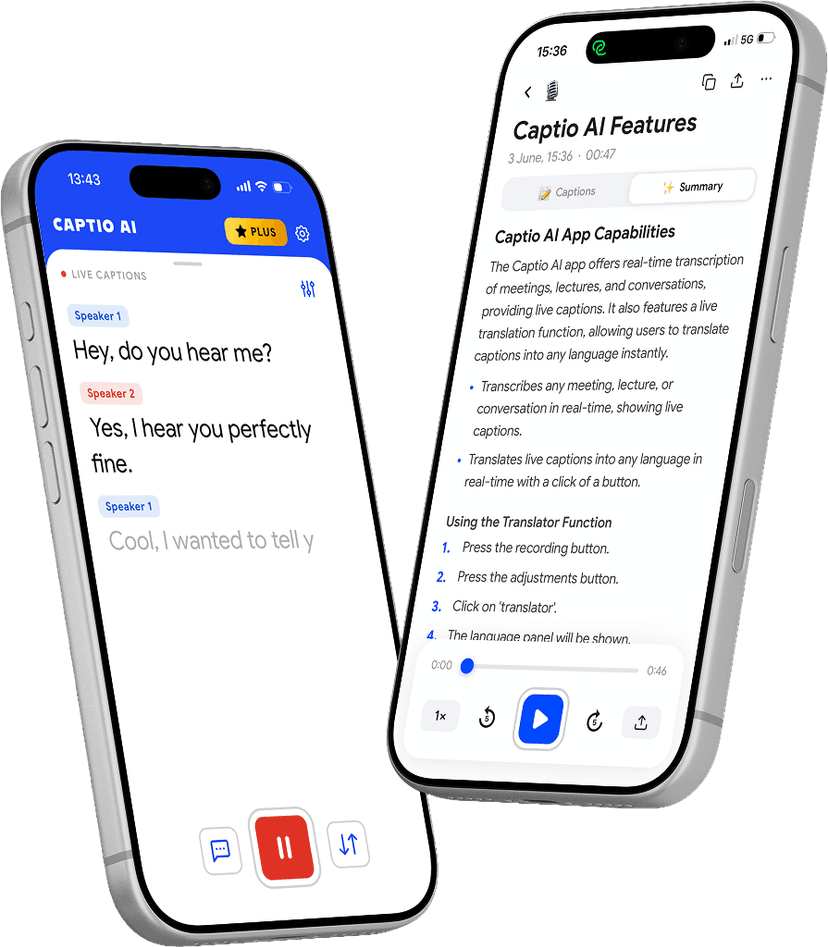
Everything you need to follow Portuguese lectures
Four tools built for deaf and hard of hearing Portuguese speakers.
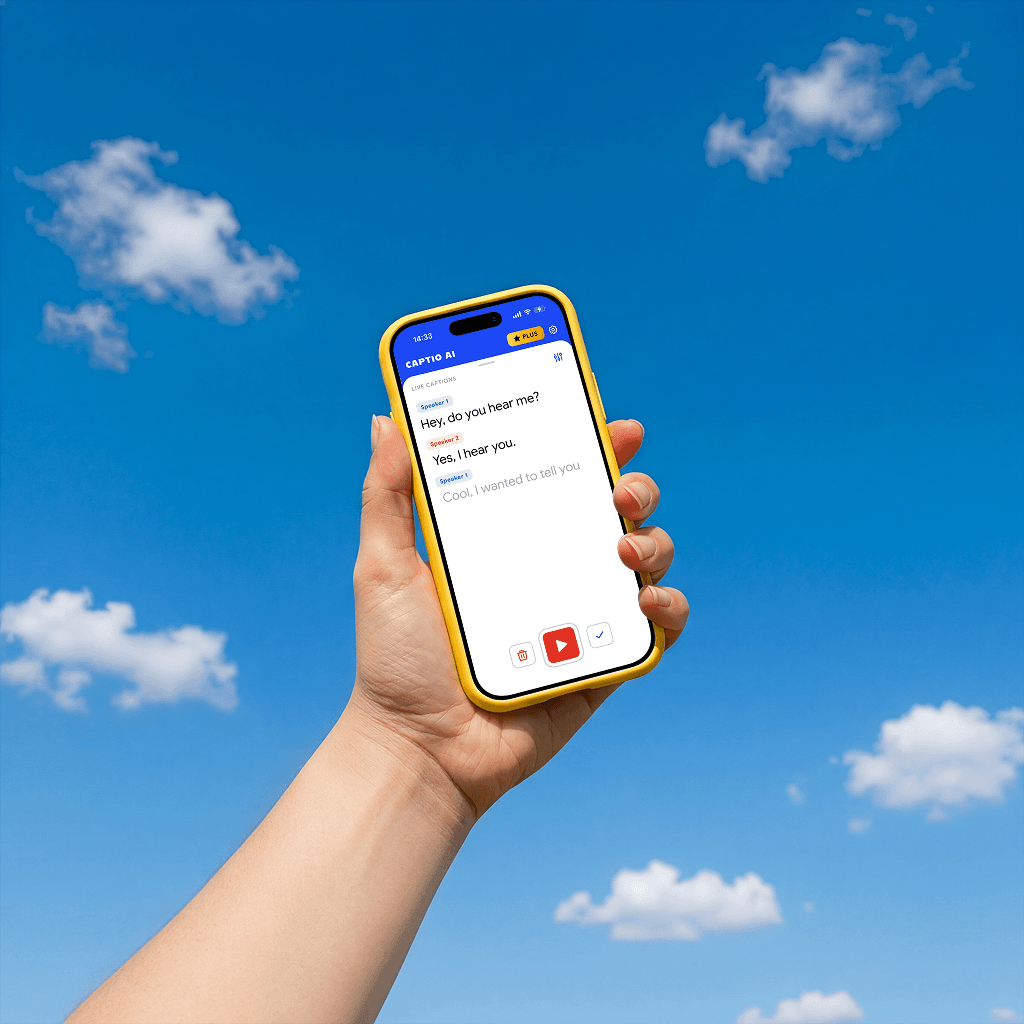
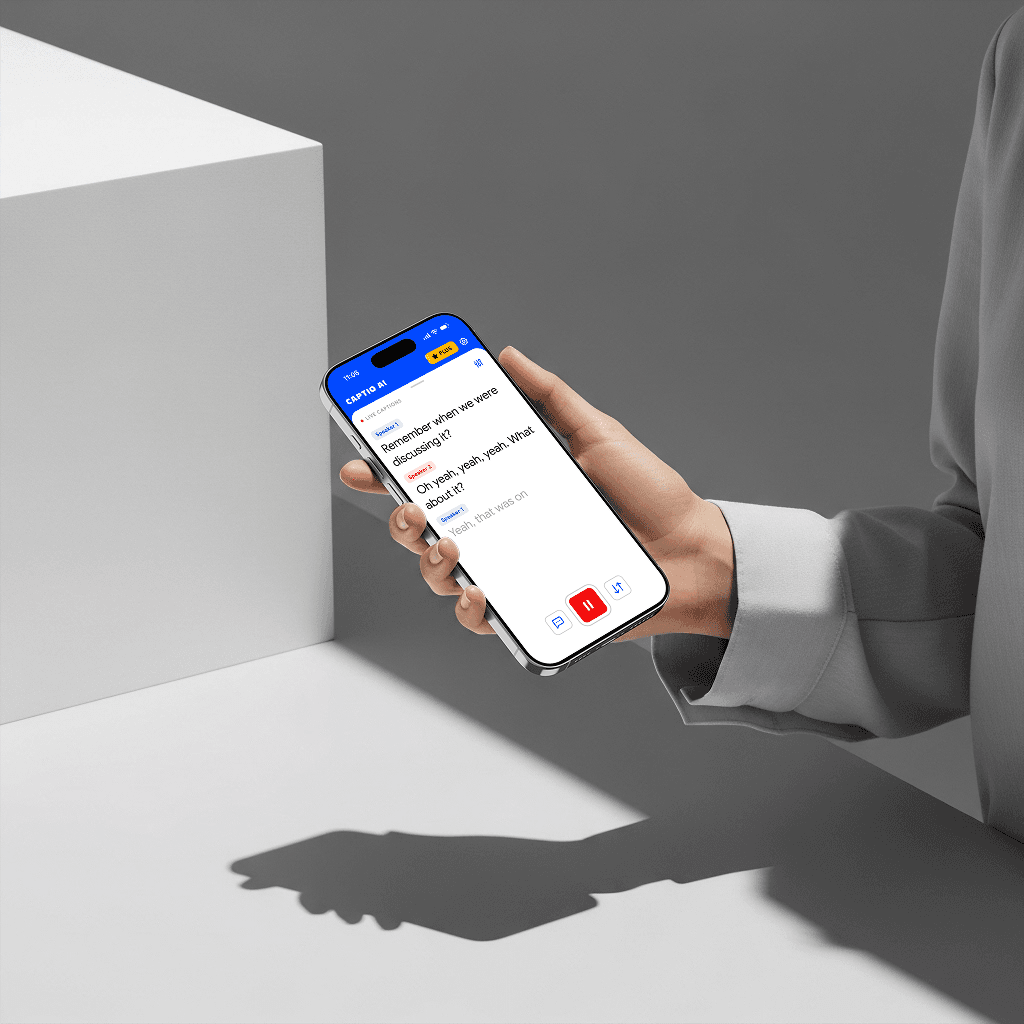
Follow the lecture as it happens
- Captions appear word by word while the lecturer is still speaking
- Works in lecture halls, seminars, and tutorials
- No setup — place the phone on your desk and start
- Any accent, any pace
For courses in another language
- Captions and translates in real time
- For international students or foreign-language courses
- 60+ languages, no switching
- Follow the lecture in the language you read best
Full transcript to study from
- Record the lecture and upload it for a complete written transcript
- Searchable, copyable, shareable
- Review at your own pace after class
- Works on any lecture recording
Key points extracted automatically
- Important concepts and takeaways pulled from any transcript
- Organised into sections — not one continuous block
- Useful for revision and exam preparation
- Works on any saved lecture transcript
Download for free
Every situation covered
Designed for the real moments that matter — not just quiet controlled environments.
Brazilian university auditórios and Portuguese lecture theatres vary widely in acoustics and PA quality. Place your phone on the desk facing the nearest PA speaker. Captio AI captions fast carioca or European Portuguese delivery accurately from any row.
Brazilian and Portuguese university seminars involve fast discussion and heated debate. Regional accent variation mixes across students — paulista, carioca, mineiro, lisboeta, portuense. Captio AI follows whoever is speaking so you track every argument.
Brazil's AVAMEC platform and Portuguese university recording systems host lectures in different Portuguese varieties. Auto-captions often fail on nasal vowels and vowel reduction. Put the lecture on speaker and point Captio AI at the audio for accurate real-time captions.
University library corners, campus cafés, student flats. Fast conversational Brazilian or European Portuguese during revision. Captio AI captions whoever is speaking so you follow every explanation and keep up with the discussion.
Brazilian students in English-medium programmes, Portuguese students at Erasmus partner institutions, or international students following Portuguese-medium lectures. Live Translator captions in real time so language is not the access barrier.
Visiting academics from Brazil, Portugal, Angola, Cape Verde — each with a distinct Portuguese variety. Captio AI covers any speaker at any faculty venue without prior arrangement.
Most accurate and fastest models
word accuracy
independent benchmark, 2025
real-time captions
first word appears as you speak
Download for free
Built for the pace and pressure of a real lecture
Follow without splitting your attention
Lip-reading and note-taking at the same time is an impossible cognitive load. Captio AI handles the following so you can direct all your attention to understanding what is being said.
Captions while the lecturer is still speaking
Words appear on your screen as they are said — not after the sentence ends. You stay in sync with the lecture rather than always being a beat behind.
Works in any lecture setting
Lecture halls, seminar rooms, online classes, study groups. Place the phone on your desk, point it toward the audio source, and Captio AI handles the rest.
A full transcript to study from
Record the lecture and upload it to Audio Transcription after class. Get a complete written record you can search, annotate, and revise from — at your own pace.
60+ languages
For international students, students studying abroad, or courses taught in a second language. Captio AI captions or translates in real time with no manual setup.
No advance notice needed
Official university captioning requires booking in advance and is not available for every session. Captio AI works for any lecture, any time, with no prior arrangement.
Why Portuguese is hard to understand
European vowel reduction
- European Portuguese swallows unstressed vowels — European lectures sound unlike any textbook
- European Portuguese is defined by extreme vowel reduction. Unstressed vowels reduce to near-silence or are deleted entirely. In a Lisbon lecture, 'Portugal' sounds closer to /prtugal/ with the first vowel nearly absent; 'professor' becomes /prfsɔr/. For a deaf student, the visible word structure on the lips differs substantially from the spelling or the Brazilian Portuguese they may have practised. A sentence arrives with fewer syllables than expected.
Brazil vs Europe
- Brazilian and European Portuguese are different lip-reading tasks — not accent variants
- Brazilian Portuguese maintains full vowel quality in unstressed syllables. European Portuguese deletes them. These are not minor accent differences — they produce distinctly different syllable counts, rhythm patterns, and lip profiles for the same words. A Brazilian deaf student at a European university, or a European student in Brazil, must recalibrate their entire visual perception model. The lecture they practised for is not the lecture they are sitting in.
Nasal vowels
- Portuguese has five nasal vowels and five nasal diphthongs — all invisible on the lips
- Portuguese has /ã/, /ẽ/, /ĩ/, /õ/, /ũ/ and nasal diphthongs (/ão/, /ãe/, /õe/, /ui/, /ĩ/). The distinction between a nasal and oral vowel is entirely acoustic — velum lowering produces no visible face change. Academic Portuguese vocabulary is dense with nasal vowels (final -ão, -em, -am), all of which look like open oral vowels on the lips. In a lecture, these distinctions carry morphological and semantic information that a deaf student cannot recover visually.
Fast carioca delivery
- Fast Brazilian Portuguese in academic settings drops syllables and blurs word boundaries
- Brazilian academic speech — particularly from São Paulo, Rio, and major university cities — runs at high syllable rate with syllable dropping and morpheme merger in fast casual register. In a lecture, the natural pace of a carioca or paulista professor produces chains of syllables with compressed word boundaries. A deaf student who knows what the words look like on the lips at slow pace cannot track them at the speed of a real lecture.
English-Portuguese code-switching
- STEM lectures in Portuguese switch to English technical vocabulary — two phonological systems in one sentence
- Brazilian university STEM lectures increasingly borrow English vocabulary. A computational biology lecture at USP or UNICAMP moves between Portuguese and English word-forms within the same sentence. The phonological system, stress pattern, and lip profile shift simultaneously with no visual signal. A deaf student must track two distinct phonological systems — and the switch happens at the exact moments the technical content matters most.
Download for free
Millions of deaf and hard of hearing people across the Portuguese-speaking world — and a university system that assumes hearing
Brazil's 2019 National Health Survey (IBGE PNS) found that 2.3 million people in the population aged 2 and above had hearing impairment affecting daily activities — representing 1.1% of the population, though older figures from the 2010 census cited approximately 10 million. Of those with hearing impairment in Brazil, 22.4% were acquainted with Brazilian Sign Language (Libras). Brazil's Libras Law (2002) and Decree 5.626/2005 require Libras interpreters in educational institutions, including universities — but implementation is incomplete. The law mandates what the institution cannot yet provide: there are not enough trained interpreters, and most university lecture halls have no captioning provision at all.
A review of educational rights for deaf people in Brazil found that approximately 67.6% of people with disabilities did not have schooling or had only incomplete primary education — compared to 30.9% for the general population. For those who do reach university, the lecture hall presents the same structural barrier as every other classroom: no captions, no interpreter unless arranged in advance, and an expectation of hearing that the infrastructure does not challenge (SCIRP, 2022). In Portugal, Língua Gestual Portuguesa (LGP) is constitutionally recognised — but interpreter provision at the university level remains limited and unevenly distributed.
A PMC study on hearing loss prevalence in a Brazilian city found that disabling hearing loss was significantly correlated with lower educational attainment, reduced employment, and reduced social participation (PMC7394619). These outcomes are not driven by the hearing loss itself but by the access gap it creates — in classrooms, in lecture halls, and in the informal interactions that accompany formal education. A deaf student in Brazil or Portugal who reaches university has already navigated years of that gap.
Download for free
What you hear stays with you.
Gone the moment it ends
Captio AI processes your audio in real time and discards it immediately. Nothing is recorded. Nothing is kept.
Not a product
Your conversations are not something Captio AI sells, shares, or monetizes — to anyone, for any reason.
Not used to train anything
What you say in a doctor's appointment or a job interview never ends up in a training dataset. Not ours. Not anyone else's.

Private by default
Captio AI supports 60+ languages
Download for free
Frequently asked questions
Follow every lecture in Portuguese.
Captio AI is free to start
Download for free