

Estonian live captions and productivity tool for lectures
For deaf and hard of hearing people.
Download for free


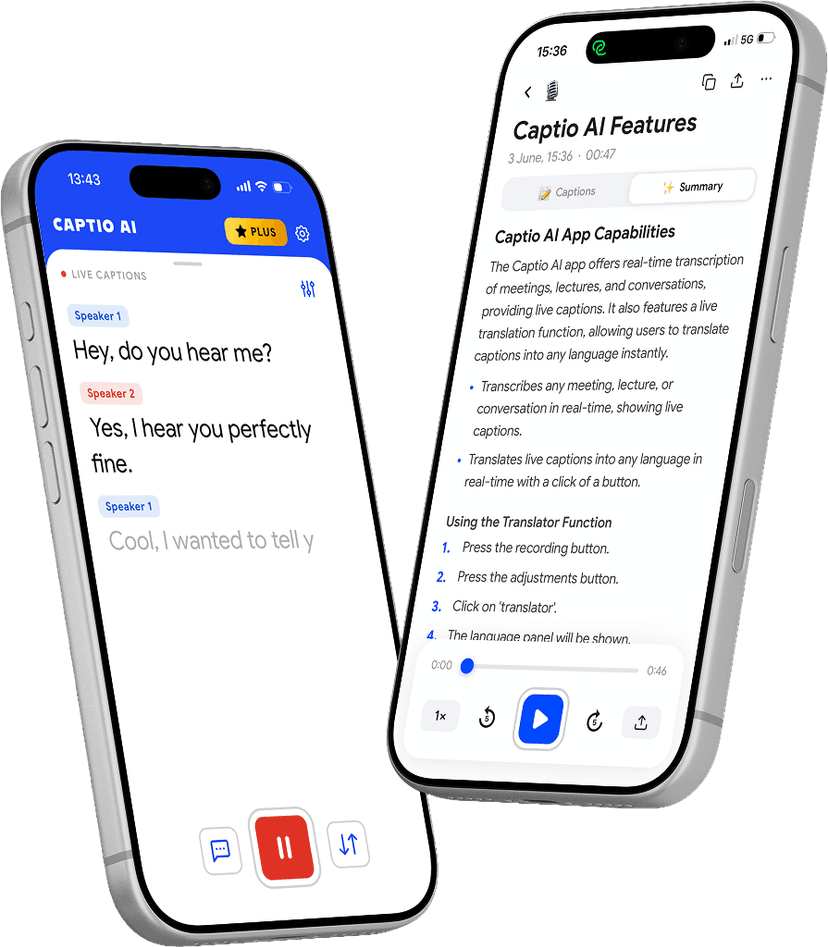
Everything you need to follow Estonian lectures
Four tools built for deaf and hard of hearing Estonian speakers.
Follow the lecture as it happens
- Captions appear word by word while the lecturer is still speaking
- Works in lecture halls, seminars, and tutorials
- No setup — place the phone on your desk and start
- Any accent, any pace
For courses in another language
- Captions and translates in real time
- For international students or foreign-language courses
- 60+ languages, no switching
- Follow the lecture in the language you read best
Full transcript to study from
- Record the lecture and upload it for a complete written transcript
- Searchable, copyable, shareable
- Review at your own pace after class
- Works on any lecture recording
Key points extracted automatically
- Important concepts and takeaways pulled from any transcript
- Organised into sections — not one continuous block
- Useful for revision and exam preparation
- Works on any saved lecture transcript
Download for free
Every situation covered
Designed for the real moments that matter — not just quiet controlled environments.
Large lecture halls at Tartu University and Tallinn University of Technology — where Estonian courses are delivered at academic pace by lecturers from across the country, including southern Estonian regions with distinct phonological varieties.
Seminars and tutorials in Estonian — small group discussion sessions where graduate students present in standard Estonian and debate at a pace far faster than a formal lecture monologue.
Online and recorded lectures on Estonian university platforms — digital content where the three-way quantity system of Estonian must be resolved entirely by the transcription system.
Study groups in Tartu and Tallinn student accommodation — peer study sessions in Estonian, with students from Võro and southern regions bringing dialect-influenced speech into group discussion.
International courses at Estonian universities — EU-funded and Erasmus programmes delivered in Estonian or English with Estonian commentary, where visiting scholars use non-standard Estonian quantity patterns.
Guest speakers and public academics at Estonian cultural institutions — researchers giving lectures at Tartu University or Tallinn cultural venues, often without real-time captioning.
Most accurate and fastest models
word accuracy
independent benchmark, 2025
real-time captions
first word appears as you speak
Download for free
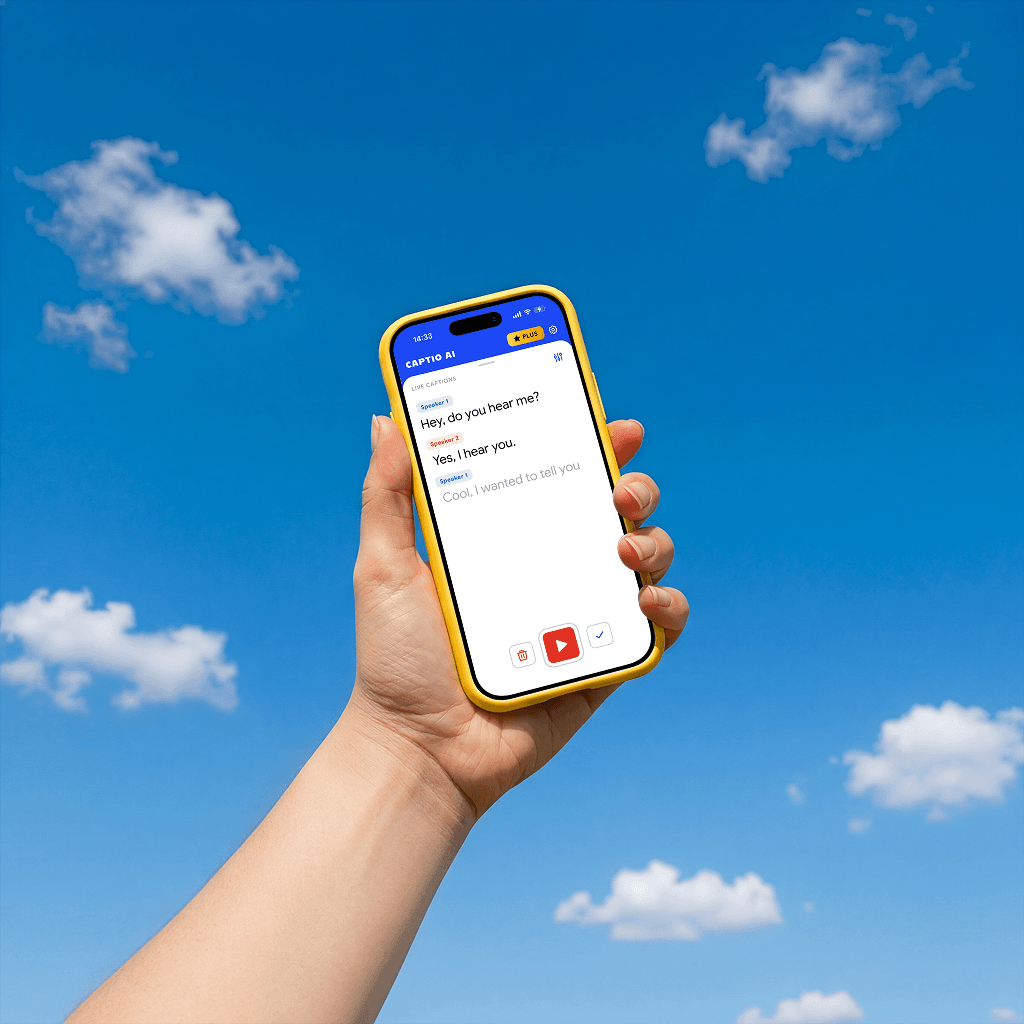
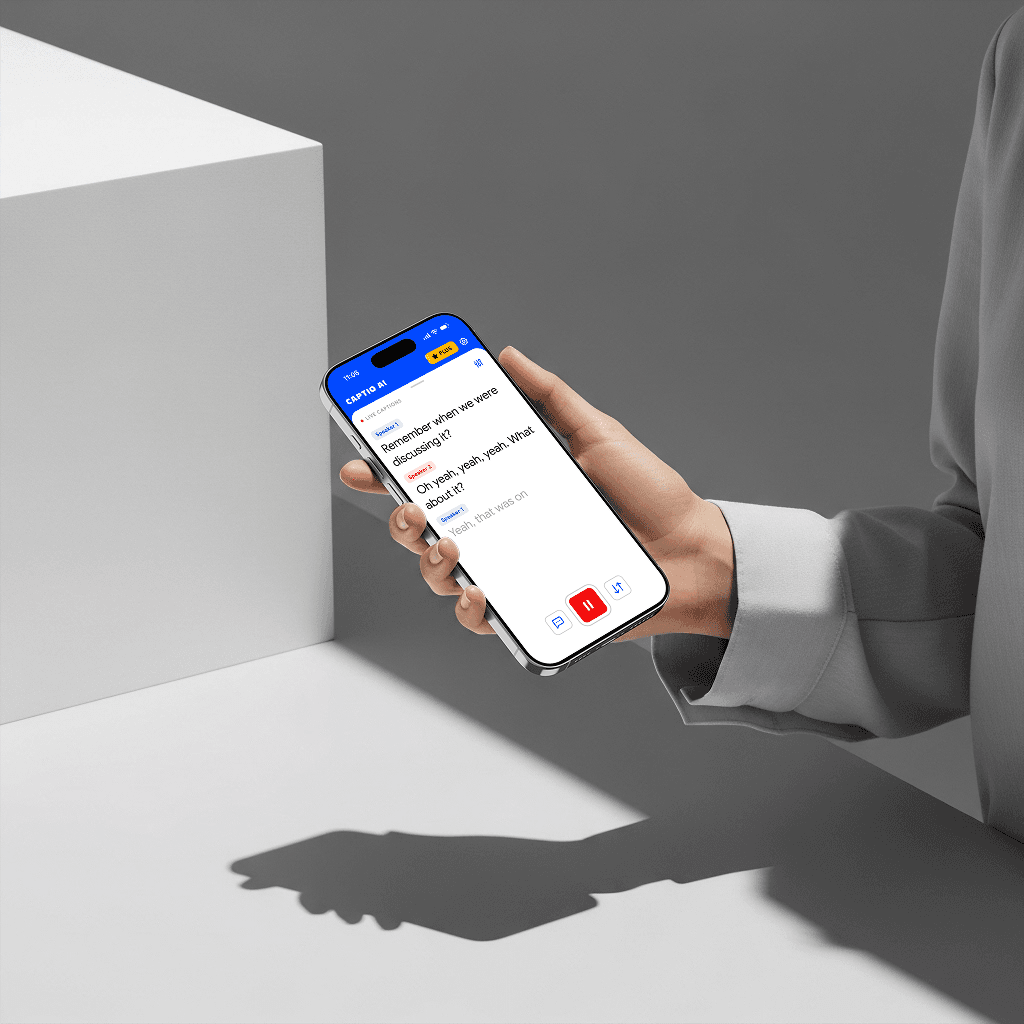
Built for the pace and pressure of a real lecture
Follow without splitting your attention
Lip-reading and note-taking at the same time is an impossible cognitive load. Captio AI handles the following so you can direct all your attention to understanding what is being said.
Captions while the lecturer is still speaking
Words appear on your screen as they are said — not after the sentence ends. You stay in sync with the lecture rather than always being a beat behind.
Works in any lecture setting
Lecture halls, seminar rooms, online classes, study groups. Place the phone on your desk, point it toward the audio source, and Captio AI handles the rest.
A full transcript to study from
Record the lecture and upload it to Audio Transcription after class. Get a complete written record you can search, annotate, and revise from — at your own pace.
60+ languages
For international students, students studying abroad, or courses taught in a second language. Captio AI captions or translates in real time with no manual setup.
No advance notice needed
Official university captioning requires booking in advance and is not available for every session. Captio AI works for any lecture, any time, with no prior arrangement.
Why Estonian is hard to understand
Three-way quantity
- Estonian has three phonemically distinct quantity grades — short, long, and overlong — in both vowels and consonants
- Estonian is one of very few languages worldwide with a ternary phonemic quantity system. Short (Q1), long (Q2), and overlong (Q3) durations in vowels and consonants all distinguish word meanings — the difference between koli ('junk'), kooli ('to school'), and kooli ('of school' genitive) is entirely in the vowel duration ratio. All three grades look identical on the lips: same jaw aperture, same lip shape, same tongue position. A deaf student at Tartu University has no visual basis to distinguish Q2 from Q3.
Q2/Q3 perception requires two syllables
- The overlong/long distinction requires hearing both syllables of a foot — impossible from the first syllable alone
- Research on Estonian quantity shows the Q2/Q3 distinction is not perceivable from just the first syllable — listeners need the duration ratio between both syllables of a disyllabic foot. For a deaf student lip-reading, neither syllable provides any visual information about quantity — the perceptual problem is compounded without the acoustic signal.
Nine-vowel inventory
- Estonian's nine vowels include front-rounded ü and ö that look like u and o on the lips
- Estonian has nine monophthong vowels — /a e i o u õ ä ö ü/ — where front-rounded /ö/ and /ü/ are produced with rounded lips like /o/ and /u/ but with a forward tongue position. The lip rounding is visually similar or identical for front and back rounded pairs. At lecture speed, a deaf student cannot reliably distinguish ü from u or ö from o from lip position alone.
Southern Estonian divergence
- Võro and Seto southern Estonian varieties differ substantially from standard North Estonian
- Southern Estonian varieties — Võro and Seto — have different vowel inventories, different quantity patterns, and different morphological structures from standard North Estonian. A lecturer from southern Estonia brings an entirely different set of lip shapes and phonological patterns that do not match the standard Estonian cues a deaf student has practiced.
Estonian–Russian code-switching
- Urban Tallinn academic discourse switches between Estonian and Russian
- A significant Russian-speaking minority lives in Tallinn and northeastern Estonia. University settings in Tallinn sometimes involve informal switching between Estonian and Russian in Q&A sessions and study groups. The two languages have completely different phonological inventories, and a deaf student tracking Estonian lip shapes encounters a systematic mismatch when a speaker switches to Russian without a visual signal.
Download for free
Estonia's deaf community: a century of organized advocacy — and a university system where real-time captioning is still not standard provision
The Estonian Deaf community has one of the oldest organizational histories in the region — a national deaf community was established as early as 1922, and following Estonia's restoration of independence in 1991, the community rebuilt international ties with European and global deaf organisations. Estonian Sign Language (EVK) has been recognised as a minority language and is subject to preservation policy. The early organizational history reflects the community's resilience, but organizational longevity has not automatically translated into systematic university accessibility.
Estonian Sign Language interpreting for academic settings is constrained by the small size of the country and the limited pool of qualified academic interpreters. Estonia has approximately 1.3 million inhabitants, and the deaf community numbers in the low thousands — a scale at which training and maintaining specialist academic interpreters in all subject areas is economically challenging. Deaf students in STEM, law, or medical programmes at Tallinn University of Technology or Tartu University may find no qualified academic interpreter available for their specific curriculum.
The GBD 2019 study on hearing loss found that it accounted for approximately 6% of global disability-adjusted life years — among the most prevalent causes of disability worldwide. Estonia has the infrastructure to address this but has not yet embedded real-time captioning as a baseline provision in university lecture halls. For a deaf student at Tartu University navigating lectures in Estonian with its three-way quantity system — entirely invisible from lip position — Captio AI provides real-time captions that resolve the acoustic distinctions no lip-reader can detect.
Download for free
What you hear stays with you.
Gone the moment it ends
Captio AI processes your audio in real time and discards it immediately. Nothing is recorded. Nothing is kept.
Not a product
Your conversations are not something Captio AI sells, shares, or monetizes — to anyone, for any reason.
Not used to train anything
What you say in a doctor's appointment or a job interview never ends up in a training dataset. Not ours. Not anyone else's.

Private by default
Captio AI supports 60+ languages
Download for free
Frequently asked questions
Follow every lecture in Estonian.
Captio AI is free to start
Download for free