

Swahili live captions and productivity tool for lectures
For deaf and hard of hearing people.
Download for free


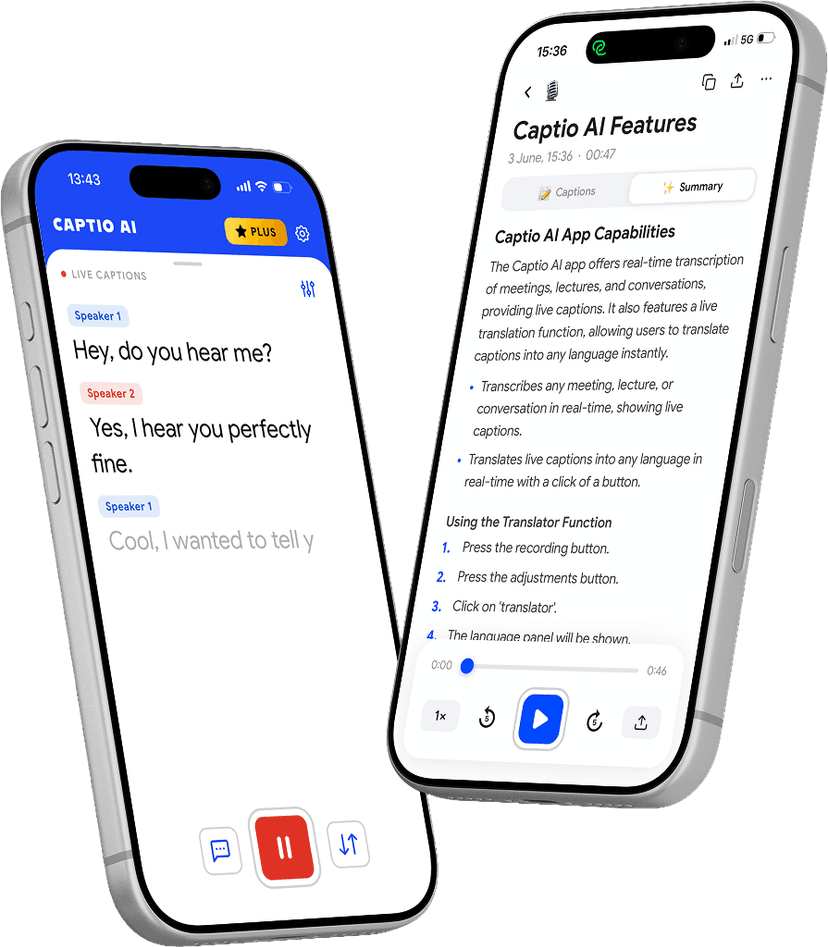
Everything you need to follow Swahili lectures
Four tools built for deaf and hard of hearing Swahili speakers.
Follow the lecture as it happens
- Captions appear word by word while the lecturer is still speaking
- Works in lecture halls, seminars, and tutorials
- No setup — place the phone on your desk and start
- Any accent, any pace
For courses in another language
- Captions and translates in real time
- For international students or foreign-language courses
- 60+ languages, no switching
- Follow the lecture in the language you read best
Full transcript to study from
- Record the lecture and upload it for a complete written transcript
- Searchable, copyable, shareable
- Review at your own pace after class
- Works on any lecture recording
Key points extracted automatically
- Important concepts and takeaways pulled from any transcript
- Organised into sections — not one continuous block
- Useful for revision and exam preparation
- Works on any saved lecture transcript
Download for free
Every situation covered
Designed for the real moments that matter — not just quiet controlled environments.
University of Nairobi, University of Dar es Salaam, Makerere, or Kenyatta University lecture halls. Swahili-medium lectures at natural academic pace. Place the phone on the desk facing the speaker. Captio AI captions the lecture from any seat.
University seminars and tutorial sessions in East Africa mixing Swahili and English in discussion. Multiple speakers, different regional varieties. Captio AI captions whoever is contributing so you follow every argument.
Recorded lectures on university portals, YouTube academic channels, or WhatsApp shared lecture recordings. Put the recording on speaker and point Captio AI at the audio for accurate captions in real time.
Study groups in Nairobi or Dar es Salaam — fast conversational Swahili mixed with English for technical topics. Captio AI follows whoever is speaking without any switching.
International students following Swahili-medium courses, or East African students in English-medium programmes. Live Translator captions in real time so language is not the access barrier.
Guest speakers and visiting academics from across East and Central Africa. Captio AI handles Standard Swahili, Nairobi variety, coastal varieties, and Kingwana — any speaker at any venue.
Most accurate and fastest models
word accuracy
independent benchmark, 2025
real-time captions
first word appears as you speak
Download for free
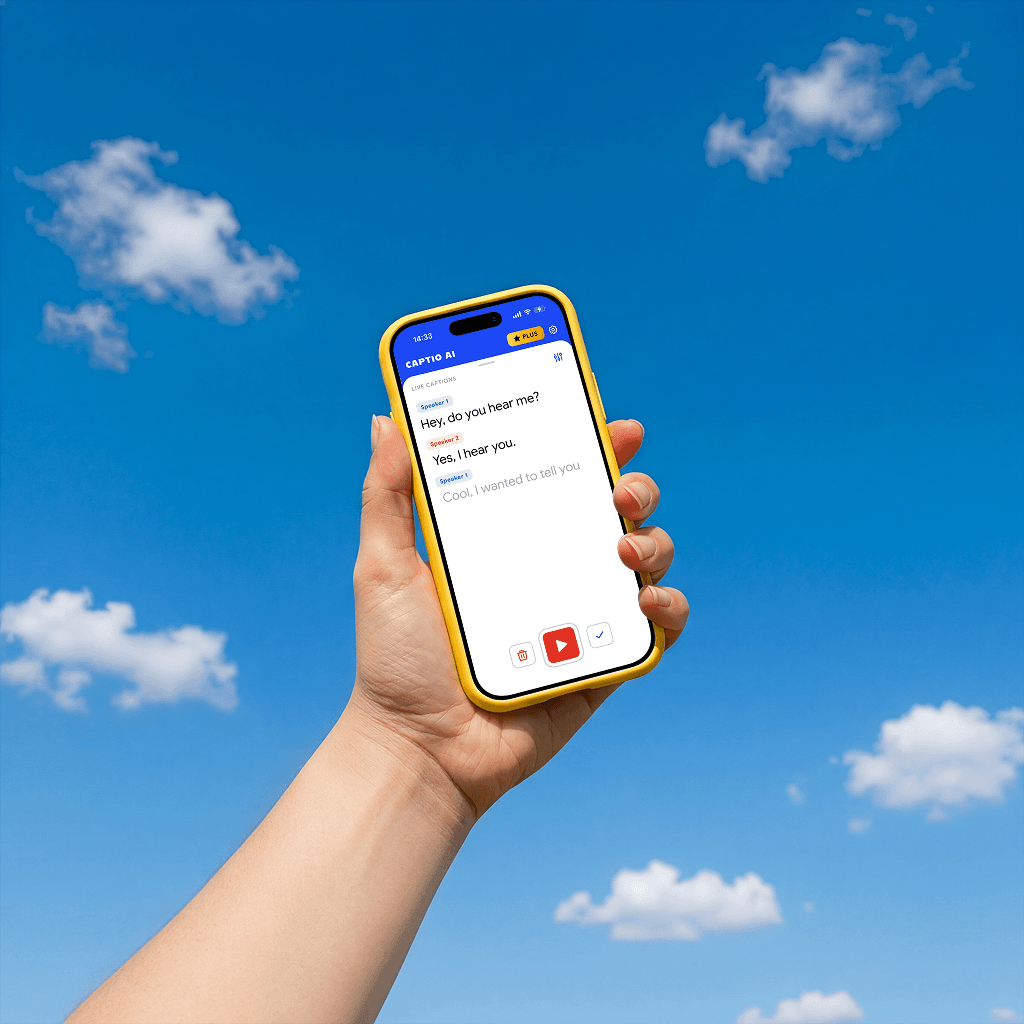
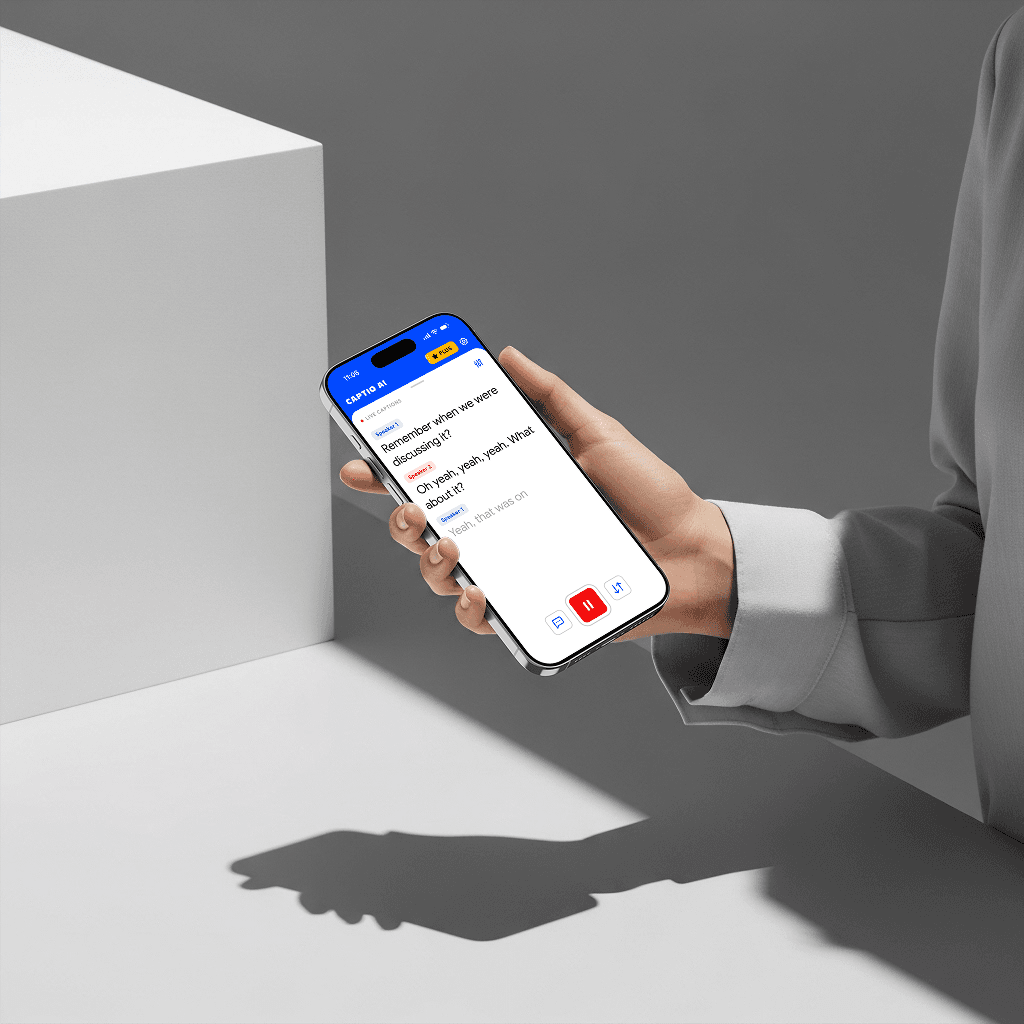
Built for the pace and pressure of a real lecture
Follow without splitting your attention
Lip-reading and note-taking at the same time is an impossible cognitive load. Captio AI handles the following so you can direct all your attention to understanding what is being said.
Captions while the lecturer is still speaking
Words appear on your screen as they are said — not after the sentence ends. You stay in sync with the lecture rather than always being a beat behind.
Works in any lecture setting
Lecture halls, seminar rooms, online classes, study groups. Place the phone on your desk, point it toward the audio source, and Captio AI handles the rest.
A full transcript to study from
Record the lecture and upload it to Audio Transcription after class. Get a complete written record you can search, annotate, and revise from — at your own pace.
60+ languages
For international students, students studying abroad, or courses taught in a second language. Captio AI captions or translates in real time with no manual setup.
No advance notice needed
Official university captioning requires booking in advance and is not available for every session. Captio AI works for any lecture, any time, with no prior arrangement.
Why Swahili is hard to understand
Prenasalized consonant invisibility
- Swahili prenasalized consonants — mb, nd, ng, nj — combine nasal and stop in a single gesture invisible on the lips
- Swahili has a distinctive set of prenasalized consonants (mb-, nd-, ng'-, nj-) where a nasal phoneme fuses with the following stop into a single articulatory gesture. On the lips, these sounds look like the stop alone — the nasal component is produced inside the mouth with no visible lip distinction. In a lecture, words built around these consonants (mbali, ndani, ngazi, njia) are systematically harder to differentiate by lip-reading than in languages without prenasalization.
16-class noun system
- Swahili's noun class prefixes change the shape of every word in a sentence — and shift without visible cue
- Swahili organizes all nouns into 16 grammatical classes, and every associated verb, adjective, and pronoun carries a prefix matching the class. The same root word changes form completely across classes: mtoto (child, class 1), watoto (children, class 2), utoto (childhood, class 14). In a lecture, a deaf student must simultaneously track lip movement and infer the class prefix — which carries meaning — from a movement that looks identical to other class prefixes.
Dialect and regional variation
- Standard Swahili diverges from coastal Kiamu, Mombasa Kimvita, and Congolese Kingwana — all heard in East African universities
- Swahili's regional varieties include Kiamu (Lamu archipelago), Kimvita (Mombasa), Kipemba (Pemba island), and Kingwana (DRC). Each has distinct vowel quality, prosody, and some phoneme realizations that differ from Standard Swahili taught in schools. East African universities draw students and lecturers from across the region. A deaf student calibrated to Standard Swahili encounters different lip profiles when the lecturer grew up speaking a coastal or Congolese variety.
Swahili-English code-switching
- University lectures in Kenya and Tanzania routinely switch between Swahili and English mid-sentence
- Kenyan and Tanzanian university lectures mix Swahili and English in patterns that shift without warning. A lecturer may deliver the conceptual explanation in Swahili and switch to English for the technical term, or vice versa. The phonological system, stress, and lip profile change each time. A deaf student must track two distinct systems simultaneously, with the switch occurring precisely when the technical content is most important.
Fast academic delivery
- Academic Swahili is delivered faster than colloquial speech — and the tempo eliminates the lip movement visibility that slower speech provides
- Lecturers speaking at academic pace in Swahili produce more connected speech, more reduction of unstressed vowels, and faster transitions between consonants than in careful colloquial speech. The visual speech cues that a deaf student has practised with in careful conversation are systematically degraded in the lecture environment. Vowel reductions and connected speech effects common in fast Swahili academic delivery collapse distinctions that would otherwise be recoverable.
Download for free
Hearing loss is rising across East Africa — with almost no university captioning infrastructure
The WHO's Regional Office for Africa has projected that the burden of hearing loss across Africa could rise to 54 million people by 2030 without urgent intervention. Kenya's National Population Census 2019 recorded 153,381 deaf people aged five and above — the vast majority (129,518) in rural areas with limited access to educational support services. A paper published in PMC (PMC10854416) documenting hearing loss detection strategies in Kenya noted that nearly all countries in sub-Saharan Africa screen 0–1% of newborns for hearing loss, meaning most hearing impairments in the region go undetected until school age or later, delaying intervention significantly.
Kenya's 2010 Constitution recognized Kenyan Sign Language (KSL) as the country's third official language — a landmark policy achievement. In practice, however, KSL interpreter provision in university settings remains extremely limited. Neither the University of Nairobi nor most East African public universities maintain systematic real-time captioning or interpreter provision for deaf and hard of hearing students in ordinary lectures. Tanzania similarly lacks national infrastructure for deaf higher education, and its sign language (TASHL) has no formal university interpreter training programme at scale.
Hearing loss carries an estimated annual cost of US$27 billion across Africa, according to the WHO African Region status report on ear and hearing care — a figure that captures both direct healthcare costs and productivity losses. For a deaf or hard of hearing student in Nairobi or Dar es Salaam, the lecture hall is one of the most acute access gaps: the content is delivered in a language whose complexity is manageable with hearing, but nearly inaccessible without it — and no institutional solution exists.
Download for free
What you hear stays with you.
Gone the moment it ends
Captio AI processes your audio in real time and discards it immediately. Nothing is recorded. Nothing is kept.
Not a product
Your conversations are not something Captio AI sells, shares, or monetizes — to anyone, for any reason.
Not used to train anything
What you say in a doctor's appointment or a job interview never ends up in a training dataset. Not ours. Not anyone else's.

Private by default
Captio AI supports 60+ languages
Download for free
Frequently asked questions
Follow every lecture in Swahili.
Captio AI is free to start
Download for free