

Russian live captions and productivity tool for lectures
For deaf and hard of hearing people.
Download for free


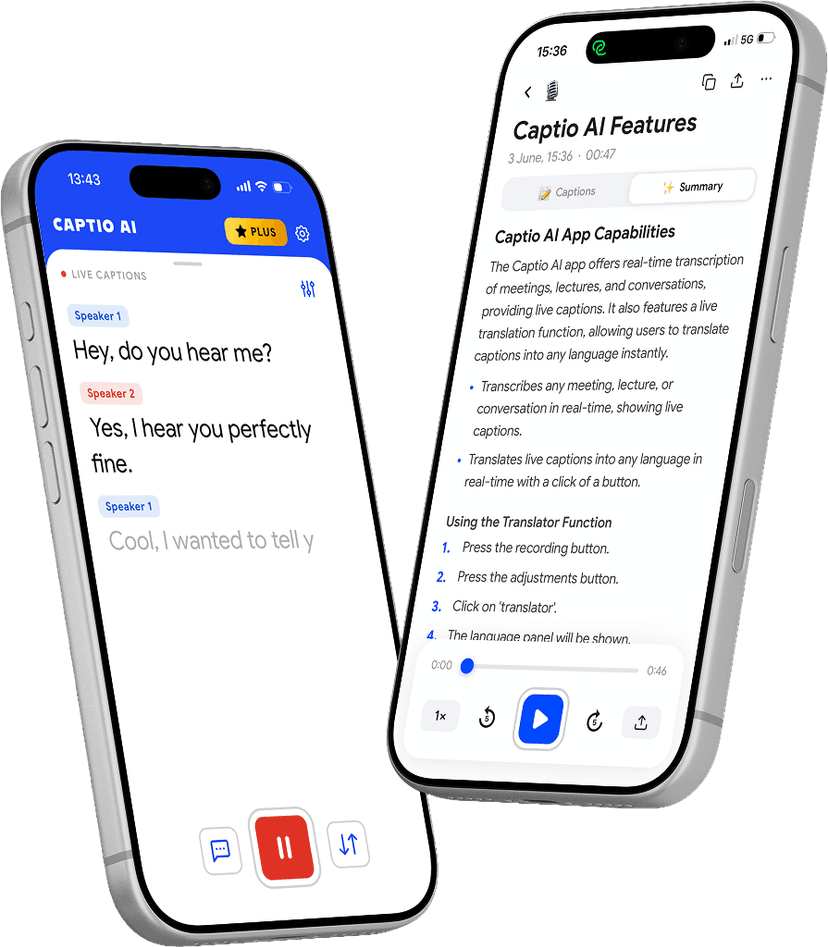
Everything you need to follow Russian lectures
Four tools built for deaf and hard of hearing Russian speakers.
Follow the lecture as it happens
- Captions appear word by word while the lecturer is still speaking
- Works in lecture halls, seminars, and tutorials
- No setup — place the phone on your desk and start
- Any accent, any pace
For courses in another language
- Captions and translates in real time
- For international students or foreign-language courses
- 60+ languages, no switching
- Follow the lecture in the language you read best
Full transcript to study from
- Record the lecture and upload it for a complete written transcript
- Searchable, copyable, shareable
- Review at your own pace after class
- Works on any lecture recording
Key points extracted automatically
- Important concepts and takeaways pulled from any transcript
- Organised into sections — not one continuous block
- Useful for revision and exam preparation
- Works on any saved lecture transcript
Download for free
Every situation covered
Designed for the real moments that matter — not just quiet controlled environments.
Russian university лектории can hold 200–400 students. Professors deliver dense academic Russian at pace, often with complex syntax. Place your phone on the desk facing the PA speaker. Captio AI captions fast academic Russian accurately from any row.
Russian university seminars (семинары) involve rapid discussion in formal academic Russian. Students and professors contribute in quick succession. Captio AI follows whoever is speaking so you track every argument and every contribution.
Russian lecture recordings on Open Education (openedu.ru) and institutional platforms are often delivered without captions. Put the lecture on speaker and point Captio AI at the audio for accurate real-time captions on any platform.
Library study rooms, student common areas, dormitory corridors at Russian universities. Fast conversational Russian during revision. Captio AI captions whoever is speaking so you follow every explanation.
International students following Russian-medium courses, or Russian students in English-medium programmes at partner institutions. Live Translator captions in real time so language is not the access barrier.
Visiting academics from across Russia — Moscow, St. Petersburg, Siberia — and international researchers. Regional phonetic variation is wide. Captio AI covers any speaker at any venue without prior arrangement.
Most accurate and fastest models
word accuracy
independent benchmark, 2025
real-time captions
first word appears as you speak
Download for free
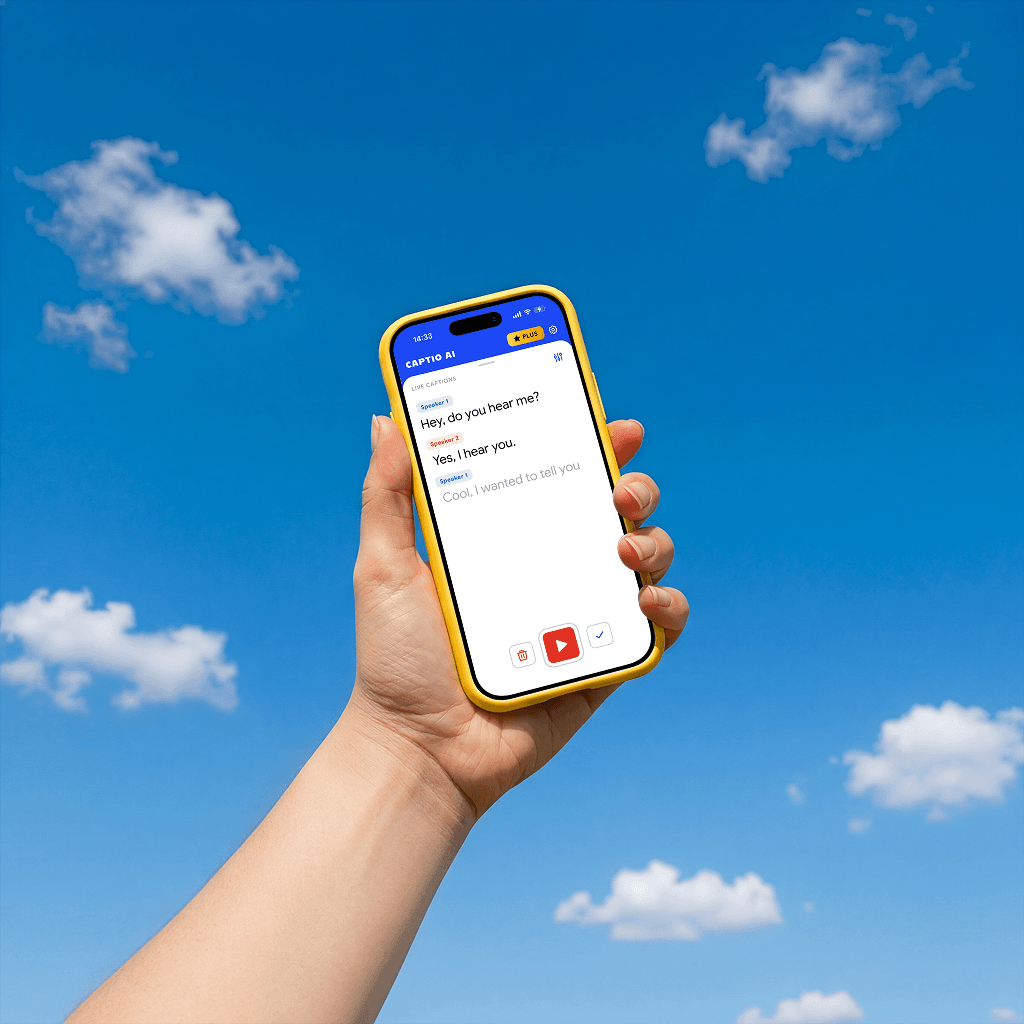
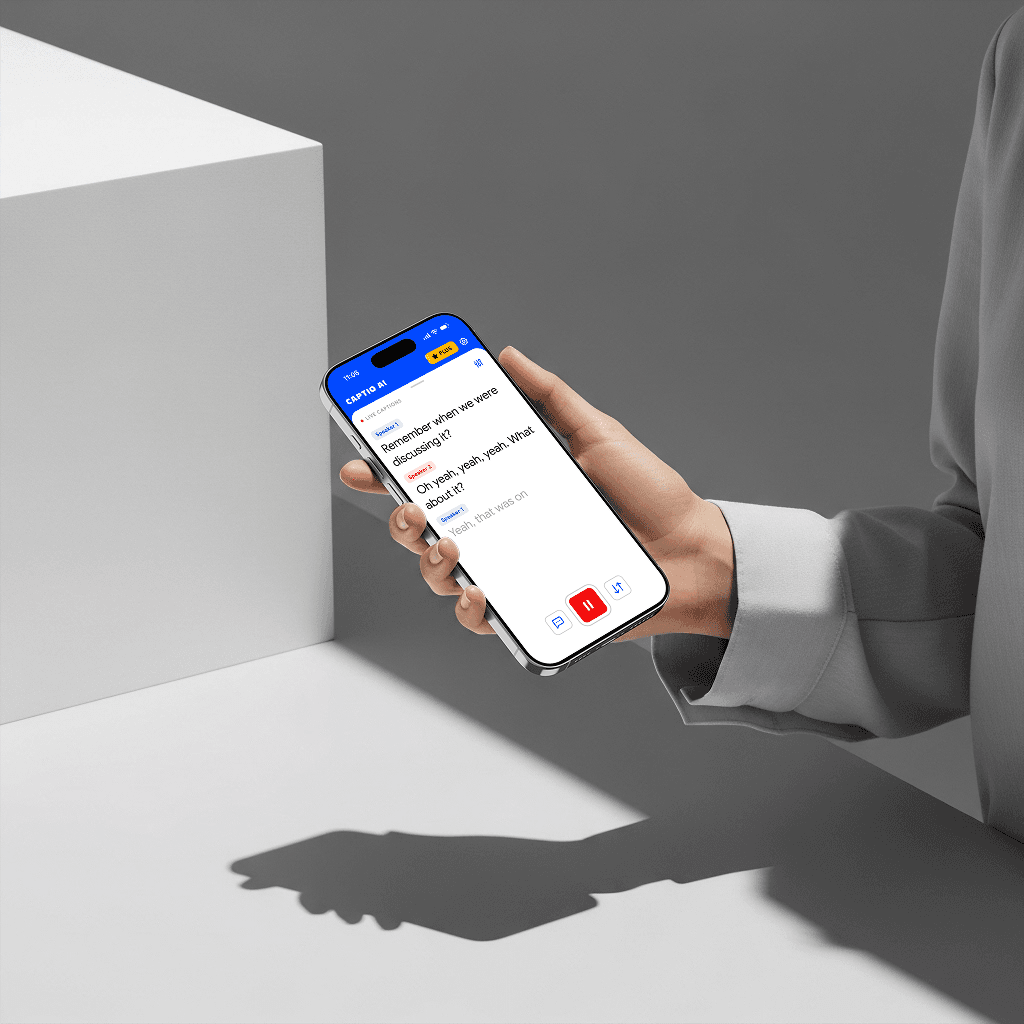
Built for the pace and pressure of a real lecture
Follow without splitting your attention
Lip-reading and note-taking at the same time is an impossible cognitive load. Captio AI handles the following so you can direct all your attention to understanding what is being said.
Captions while the lecturer is still speaking
Words appear on your screen as they are said — not after the sentence ends. You stay in sync with the lecture rather than always being a beat behind.
Works in any lecture setting
Lecture halls, seminar rooms, online classes, study groups. Place the phone on your desk, point it toward the audio source, and Captio AI handles the rest.
A full transcript to study from
Record the lecture and upload it to Audio Transcription after class. Get a complete written record you can search, annotate, and revise from — at your own pace.
60+ languages
For international students, students studying abroad, or courses taught in a second language. Captio AI captions or translates in real time with no manual setup.
No advance notice needed
Official university captioning requires booking in advance and is not available for every session. Captio AI works for any lecture, any time, with no prior arrangement.
Why Russian is hard to understand
Phonemic palatalization
- Russian has 15 hard/soft consonant pairs — all invisible on the lips
- Russian distinguishes palatalized ('soft') and non-palatalized ('hard') versions of most consonants: /p/ vs /pʲ/, /b/ vs /bʲ/, /m/ vs /mʲ/, and 12 more pairs. The palatalization is produced by the middle of the tongue rising toward the palate — an entirely internal articulation that leaves the lips unchanged. But the distinction is phonemically significant: changing /brat/ (brother) to /brʲat/ changes the meaning. A deaf student lip-reading Russian loses half the consonant distinctions in every sentence.
Vowel reduction
- Russian unstressed vowels merge into schwa — and stress position is unpredictable
- In Russian, unstressed /o/ and /a/ both reduce to /ə/ or /ɐ/; unstressed /e/ and /a/ merge in many positions. The same vowel letter produces 3–4 different sounds depending on stress. Stress in Russian can fall on any syllable of any word and shifts between word forms. In a lecture, a professor uses technical vocabulary in multiple grammatical cases — each with different stress, each with different vowel quality — and the lip profile shifts accordingly with no visual warning.
Consonant clusters
- Russian permits consonant clusters of 3–4 consonants that compress into a single lip movement
- Russian allows consonant clusters at word beginnings and ends that English would not permit: /vzd/, /strj/, /ksf/. In fast speech these clusters are compressed into a rapid multi-consonant transition. For a deaf student, a cluster of three consonants produces one brief complex lip movement where they must identify three distinct phonemes. In academic Russian with technical prefixes, unusual clusters appear frequently.
Unpredictable stress
- Russian stress moves through word forms — making prospective lip-reading unreliable
- Unlike French (always final), Czech (always first), or Finnish (always first), Russian stress falls on different syllables for different word forms of the same word. A noun in nominative, genitive, dative, and accusative may have stress on different syllables — each producing different vowel quality. A deaf student cannot predict where emphasis will fall in an unfamiliar technical term. Prospective lip-reading — anticipating the next syllable — fails systematically.
Lecture delivery speed
- Academic Russian is delivered in long compound sentences at high speed with minimal pausing
- Russian academic style favours long embedded clauses with heavy nominal modification and complex participial constructions. Professors deliver these at a fast pace with minimal pause between sentences. In fast academic Russian, schwas disappear completely, consonants assimilate, and entire morphemes elide. A lecture in Russian provides less visual spacing and fewer natural break-points than the equivalent in English or French.
Download for free
Deaf and hard of hearing people in Russia — formal policy, minimal access
A national survey of Russian adults found that 22.2% reported trouble with hearing — yet only 2.2% of those people used hearing aids, one of the lowest rates in Europe and among developed countries globally (PMC10514822, 2023). People with severe and profound hearing loss can receive government-funded hearing aids through the Federal Social Fund, but the gap between those who need support and those who receive it is vast. For deaf and hard of hearing students in Russia's universities, the gap between policy and practice follows the same pattern.
A 2023 study published in Post-Soviet Affairs examined the transitions of deaf and hard of hearing youth through education and into the labour market in contemporary Russia. Despite formal inclusive education policies and legal frameworks, the researchers found that the choices available to deaf and hard of hearing young people remain 'heavily limited' and 'become narrower at each stage of their transitions to adulthood'. The study attributes this to 'the ongoing salience of disabling, medical approaches to deafness; a lack of enabling practices or resources to support DHOH youth in the education system; and widespread discrimination from employers' (Tandfonline, 2023). Russian Sign Language is recognised but not prioritised.
Russian universities operate under an inclusive education mandate that, in practice, delivers minimal in-lecture accommodation. Certified Russian Sign Language interpreters with specialist subject knowledge are rare, and real-time captioning in lecture halls is not a standard provision. A deaf student in a Russian university lecture hall encounters the same structural absence as deaf students in many countries — but with fewer civil society organisations and advocacy routes to challenge it.
Download for free
What you hear stays with you.
Gone the moment it ends
Captio AI processes your audio in real time and discards it immediately. Nothing is recorded. Nothing is kept.
Not a product
Your conversations are not something Captio AI sells, shares, or monetizes — to anyone, for any reason.
Not used to train anything
What you say in a doctor's appointment or a job interview never ends up in a training dataset. Not ours. Not anyone else's.

Private by default
Captio AI supports 60+ languages
Download for free
Frequently asked questions
Follow every lecture in Russian.
Captio AI is free to start
Download for free