

German live captions and productivity tool for lectures
For deaf and hard of hearing people.
Download for free


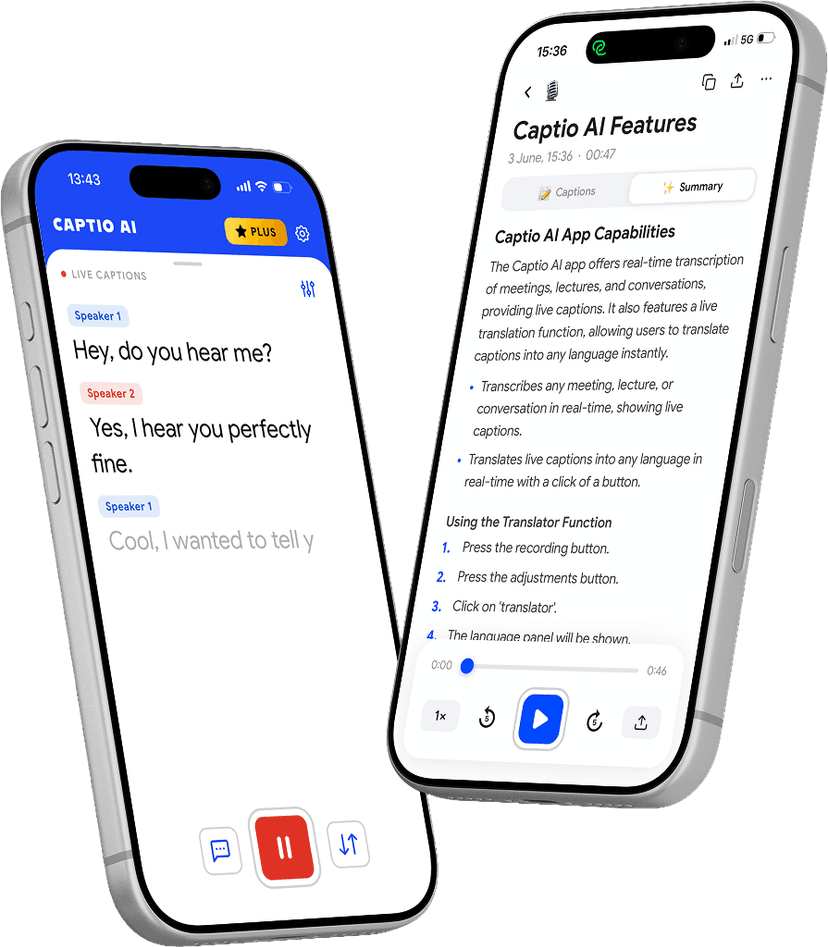
Everything you need to follow German lectures
Four tools built for deaf and hard of hearing German speakers.
Follow the lecture as it happens
- Captions appear word by word while the lecturer is still speaking
- Works in lecture halls, seminars, and tutorials
- No setup — place the phone on your desk and start
- Any accent, any pace
For courses in another language
- Captions and translates in real time
- For international students or foreign-language courses
- 60+ languages, no switching
- Follow the lecture in the language you read best
Full transcript to study from
- Record the lecture and upload it for a complete written transcript
- Searchable, copyable, shareable
- Review at your own pace after class
- Works on any lecture recording
Key points extracted automatically
- Important concepts and takeaways pulled from any transcript
- Organised into sections — not one continuous block
- Useful for revision and exam preparation
- Works on any saved lecture transcript
Download for free
Every situation covered
Designed for the real moments that matter — not just quiet controlled environments.
Lecture halls at LMU Munich, Humboldt Berlin, Heidelberg, or TU Dresden seat hundreds of students. Professors deliver academic German at full speed. Place the phone on the desk facing the PA system. Captio AI captions the lecture from any row.
German university seminars (Seminare) run as discussion sessions with students presenting and arguing in fast academic German. Captio AI captions whoever is speaking so you follow every argument without losing your place.
Recorded lectures on university portals, RWTH Aachen MOOC platforms, or Zoom session replays. Auto-captions miss fast academic German. Put the recording on speaker and point Captio AI at the audio for accurate captions.
Revision groups in the library, Lernräume, or student flats. Academic German at conversational speed, mixing standard German with regional varieties. Captio AI follows whoever is explaining.
Erasmus and international students at German-medium universities, or German students following English-medium seminars. Live Translator captions in real time so language is not the access barrier.
Visiting academics and guest lecturers. German university talks draw speakers from Austria, Switzerland, and across Germany — each with different regional phonetics. Captio AI covers any speaker at any venue.
Most accurate and fastest models
word accuracy
independent benchmark, 2025
real-time captions
first word appears as you speak
Download for free
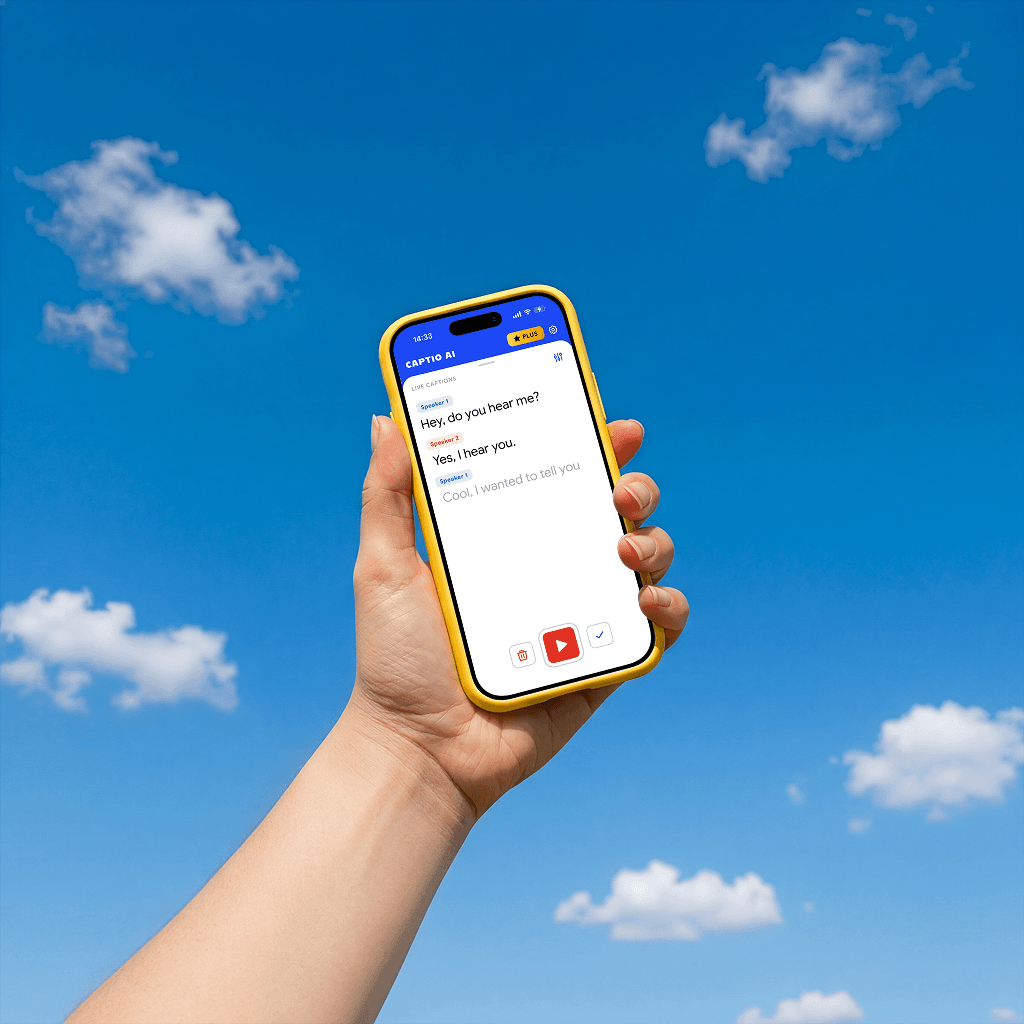
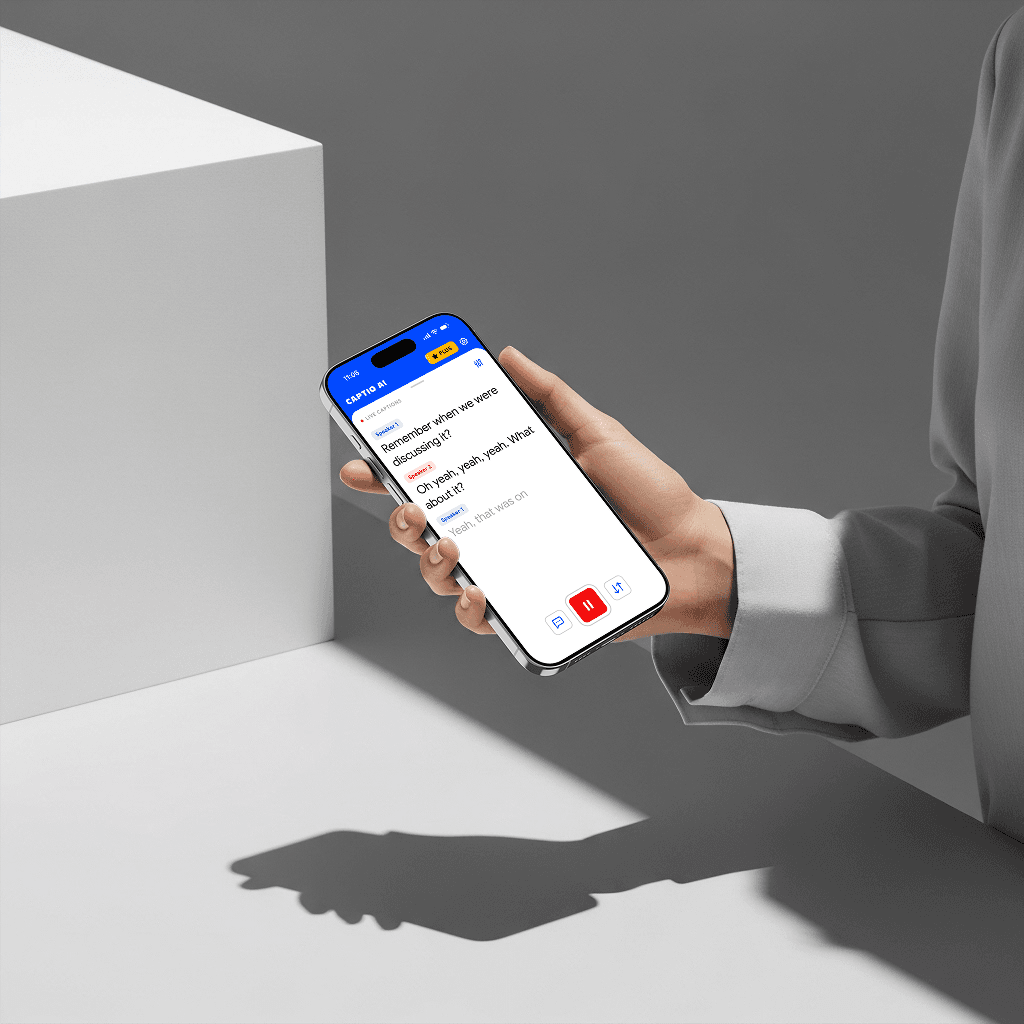
Built for the pace and pressure of a real lecture
Follow without splitting your attention
Lip-reading and note-taking at the same time is an impossible cognitive load. Captio AI handles the following so you can direct all your attention to understanding what is being said.
Captions while the lecturer is still speaking
Words appear on your screen as they are said — not after the sentence ends. You stay in sync with the lecture rather than always being a beat behind.
Works in any lecture setting
Lecture halls, seminar rooms, online classes, study groups. Place the phone on your desk, point it toward the audio source, and Captio AI handles the rest.
A full transcript to study from
Record the lecture and upload it to Audio Transcription after class. Get a complete written record you can search, annotate, and revise from — at your own pace.
60+ languages
For international students, students studying abroad, or courses taught in a second language. Captio AI captions or translates in real time with no manual setup.
No advance notice needed
Official university captioning requires booking in advance and is not available for every session. Captio AI works for any lecture, any time, with no prior arrangement.
Why German is hard to understand
Compound word collapse
- German compounds merge into single unbroken lip shapes — impossible to segment without sound
- German routinely joins multiple words into a single compound: Rechtswissenschaft, Vorlesungsverzeichnis, Haushaltsausschuss. On the lips, the compound reads as one continuous, indistinct movement. In a lecture, these long compounds carry the exact technical meaning of the sentence — and they are the words most likely to defeat lip-reading entirely.
Connected speech reduction
- Unstressed syllables reduce or delete entirely in natural academic German
- German unstressed vowels reduce toward schwa, and in fast academic delivery entire syllables drop. The definite article 'das' becomes 'd'', 'haben' becomes 'ham', 'werden' becomes 'wern'. The written form and the lip-read form diverge substantially in continuous lecture speech. Research on German lip-reading confirms that sentence frequency and articulation quality are primary determinants of comprehension — and natural lecture delivery is neither slow nor careful.
Regional accent divergence
- German universities draw professors from Austria, Switzerland, and all 16 German states — each with distinct lip profiles
- Hochdeutsch is the standard, but lecture delivery varies enormously: Bavarian fronts certain vowels, Saxon softens consonants, Swiss German has entirely different prosody, and northern Low German influence produces different fricative realizations. A deaf student calibrated to one variety encounters different lip patterns in each lecture from a different regional speaker.
Obstruent neutralization
- German final obstruent devoicing removes auditory contrasts that never existed visually
- German devoices all obstruents in syllable-final position: /d/ → /t/, /b/ → /p/, /g/ → /k/, /z/ → /s/. The acoustic contrast disappears. On the lips, these contrasts were never visible to begin with — /d/ and /t/ are visually identical. In a lecture, this means a deaf student cannot distinguish plural from singular or verb tense from lip shape alone.
Academic register gap
- German academic vocabulary layers Latin and Greek roots over everyday speech — unrecognizable on the lips
- German lectures use a formal academic register with Latin-derived terminology (Paradigmenwechsel, Äquivalenzprinzip, epistemologisch) that sounds and looks completely different from colloquial German. Even a fluent deaf German speaker accustomed to everyday speech encounters unfamiliar lip shapes when the professor shifts to academic terminology.
Download for free
16 million Germans with hearing loss — and university lecture halls built around hearing
Germany's Gutenberg Health Study, published in 2023, found that among adults aged 25–86, prevalence of mild hearing impairment stood at 28.2% and moderate impairment at 10.1%, with a total of 38.7% of the study population experiencing some degree of hearing loss. These figures are consistent with broader German epidemiological data showing approximately 16 million people with significant hearing difficulty — one in five Germans. Despite Germany's reputation for robust social infrastructure, hearing aid uptake remains at approximately 37%, among the lower rates in Western Europe.
German universities are legally required to provide accessibility under Sozialgesetzbuch IX (Social Code Book IX) and the Behindertengleichstellungsgesetz (BGG, Federal Disability Equality Act), but the practical provision of real-time captioning in lecture halls is inconsistent. Most German universities offer accessibility through Disabilities Officers (Behindertenbeauftragte) but do not systematically provide live captions for deaf and hard of hearing students in ordinary lectures. This gap is documented by the Informations- und Beratungsstelle Studium und Behinderung (IBS), which coordinates between disability organizations and German higher education. Deaf students who cannot use sign language interpreters must typically negotiate accessibility individually with each faculty.
The Deutscher Gehörlosenbund (DGB, German Association of the Deaf) represents approximately 80,000 prelingually deaf people in Germany. The association has consistently documented that deaf and hard of hearing students face structural barriers in higher education — barriers that exist not in formal policy but in the gap between policy and implementation. German Sign Language (Deutsche Gebärdensprache, DGS) has been legally recognized since 2002, yet qualified DGS interpreter provision for university lectures remains geographically uneven, with rural institutions and specialized technical universities particularly underserved.
Download for free
What you hear stays with you.
Gone the moment it ends
Captio AI processes your audio in real time and discards it immediately. Nothing is recorded. Nothing is kept.
Not a product
Your conversations are not something Captio AI sells, shares, or monetizes — to anyone, for any reason.
Not used to train anything
What you say in a doctor's appointment or a job interview never ends up in a training dataset. Not ours. Not anyone else's.

Private by default
Captio AI supports 60+ languages
Download for free
Frequently asked questions
Follow every lecture in German.
Captio AI is free to start
Download for free