

Thai live captions and productivity tool for lectures
For deaf and hard of hearing people.
Download for free


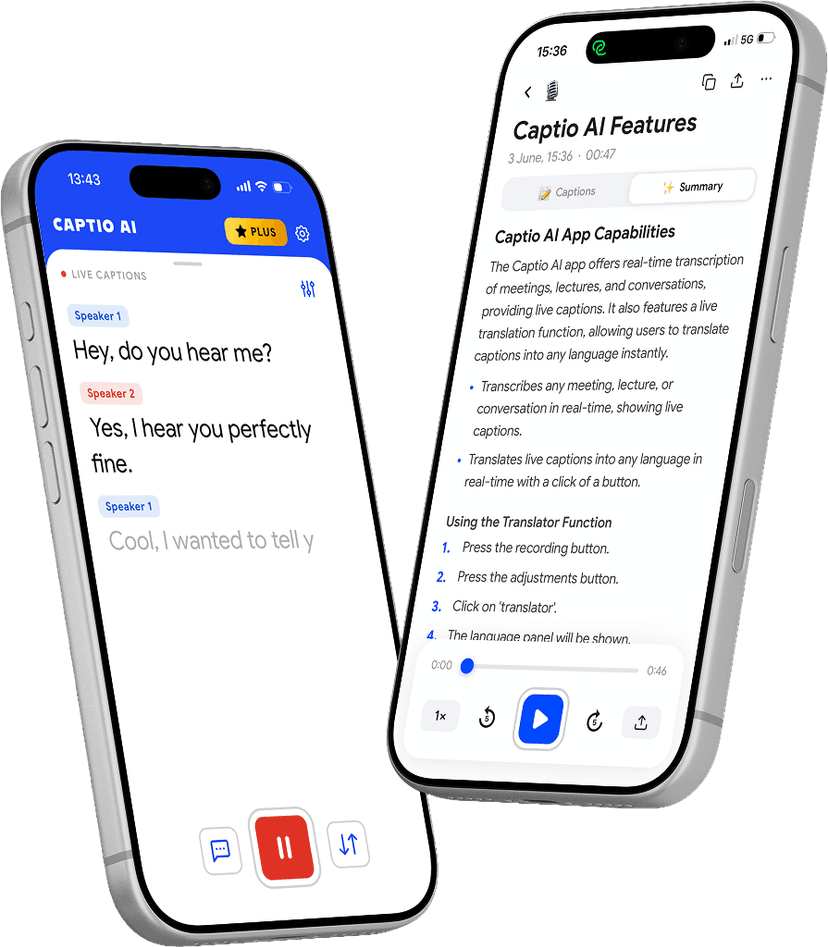
Everything you need to follow Thai lectures
Four tools built for deaf and hard of hearing Thai speakers.
Follow the lecture as it happens
- Captions appear word by word while the lecturer is still speaking
- Works in lecture halls, seminars, and tutorials
- No setup — place the phone on your desk and start
- Any accent, any pace
For courses in another language
- Captions and translates in real time
- For international students or foreign-language courses
- 60+ languages, no switching
- Follow the lecture in the language you read best
Full transcript to study from
- Record the lecture and upload it for a complete written transcript
- Searchable, copyable, shareable
- Review at your own pace after class
- Works on any lecture recording
Key points extracted automatically
- Important concepts and takeaways pulled from any transcript
- Organised into sections — not one continuous block
- Useful for revision and exam preparation
- Works on any saved lecture transcript
Download for free
Every situation covered
Designed for the real moments that matter — not just quiet controlled environments.
Chulalongkorn, Mahidol, Kasetsart, and Chiang Mai University lecture halls. Thai-medium lectures at academic pace. Place the phone on the desk facing the speaker. Captio AI captions from any row.
Thai university seminars where students present and debate in academic Thai, often mixing English. Captio AI captions whoever is speaking so you follow every argument.
Recorded lectures on university portals, Coursera Thailand, or YouTube academic channels. Put the recording on speaker and point Captio AI at the audio for accurate captions in real time.
Study groups in Bangkok, Chiang Mai, or Khon Kaen — fast conversational Thai mixed with English. Captio AI follows whoever is explaining, whether Central, Northern, or Isan Thai variety.
Thai students in English-medium programmes, or international students at Thai universities. Live Translator captions in real time so language is not the access barrier.
Visiting academics and guest speakers from across Thailand's regions. Captio AI handles Central Thai, Northern Lanna Thai, and Isan Thai — any speaker at any venue.
Most accurate and fastest models
character accuracy
independent benchmark, 2025
real-time captions
first word appears as you speak
Download for free

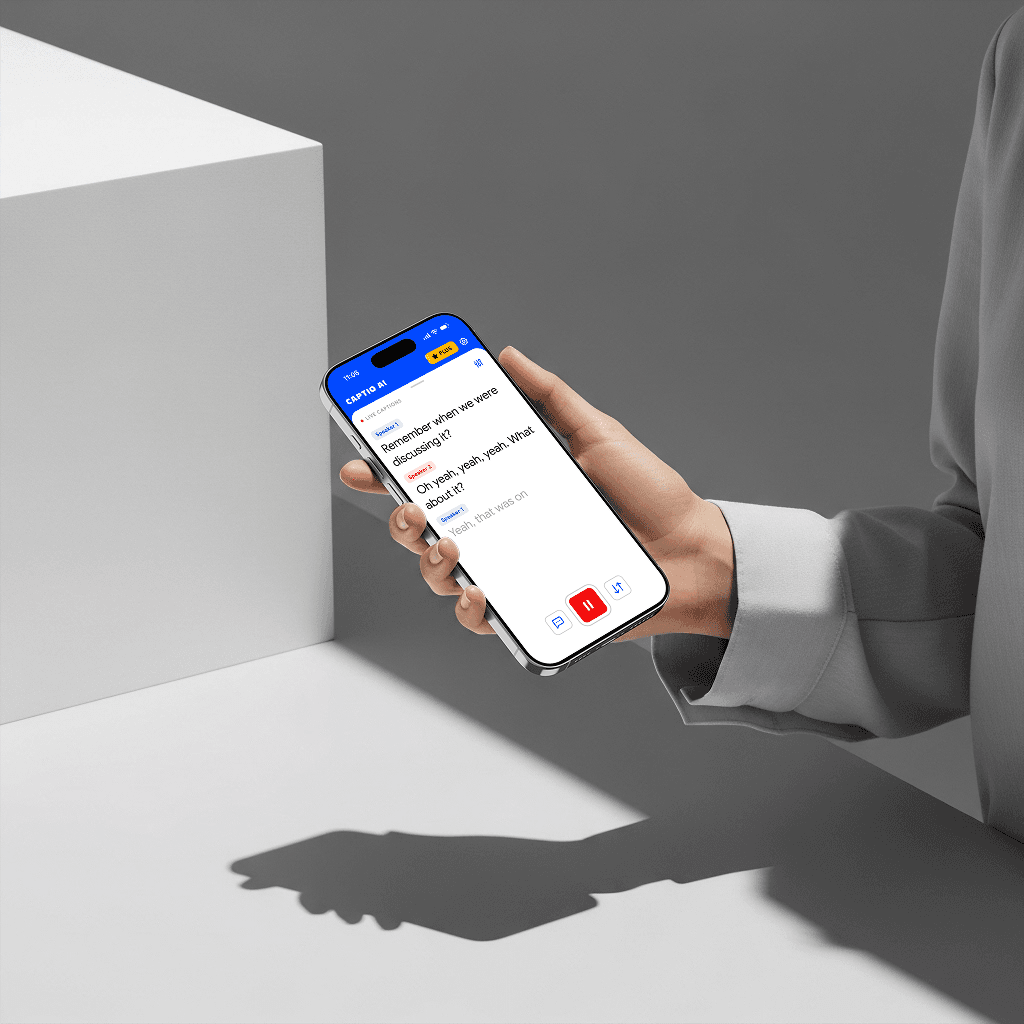
Built for the pace and pressure of a real lecture
Follow without splitting your attention
Lip-reading and note-taking at the same time is an impossible cognitive load. Captio AI handles the following so you can direct all your attention to understanding what is being said.
Captions while the lecturer is still speaking
Words appear on your screen as they are said — not after the sentence ends. You stay in sync with the lecture rather than always being a beat behind.
Works in any lecture setting
Lecture halls, seminar rooms, online classes, study groups. Place the phone on your desk, point it toward the audio source, and Captio AI handles the rest.
A full transcript to study from
Record the lecture and upload it to Audio Transcription after class. Get a complete written record you can search, annotate, and revise from — at your own pace.
60+ languages
For international students, students studying abroad, or courses taught in a second language. Captio AI captions or translates in real time with no manual setup.
No advance notice needed
Official university captioning requires booking in advance and is not available for every session. Captio AI works for any lecture, any time, with no prior arrangement.
Why Thai is hard to understand
Five invisible tones
- Thai has five lexical tones — mid, low, falling, high, and rising — and every single one is invisible on the lips
- Thai is a tonal language where pitch determines word meaning: the syllable /maː/ means 'dog' (falling), 'come' (mid), 'horse' (rising), 'wood' (low), or 'burn' (high) depending on tone. These five tones differ by pitch contour, phonation type, and duration — none of which is visible on the speaker's lips. In a Thai lecture, every syllable is potentially tonal and every tonal distinction is acoustically encoded. A deaf student sees the same lip shape for five completely different words.
Three-way stop contrast
- Thai distinguishes voiceless unaspirated, voiceless aspirated, and voiced stops — but all three produce the same lip closure
- Thai has a three-way consonant contrast for stops: voiceless unaspirated (ป /p/), voiceless aspirated (พ /pʰ/), and voiced (บ /b/). These three categories produce identical lip shapes — the distinction is aspiration and voicing, both acoustic. In a Thai lecture, these contrasts carry meaning throughout the session and are all invisible to a lip-reader.
32 vowel distinctions
- Thai distinguishes 9 long and 9 short monophthong vowels plus diphthongs — length distinction is invisible on the lips
- Thai has an extensive vowel system: 9 short monophthong vowels paired with 9 long equivalents (18 monophthongs total), plus numerous diphthongs and triphthongs. Short/long vowel pairs look identical on the lips. In a Thai lecture, vowel length distinguishes word meaning (เขา /kʰǎw/ he/she vs เขา /kʰǎːw/ horn/rice) — and the length distinction is invisible.
Northern-Southern tonal divergence
- Isan, Northern Thai (Lanna), and Central Thai use different tonal systems — producing different lip-reading cues for the same written words
- Central Thai (the university standard) has five tones. Isan (Northeastern Thai, spoken by approximately one third of Thailand's population) is closely related to Lao and has different tonal categories. Northern Thai (Lanna/Yuan) has a different six-tone system. Thai universities draw students and lecturers from across these regions. A deaf student calibrated to Central Thai encounters different prosodic patterns when the lecturer is an Isan or Northern Thai speaker.
Final consonant restriction
- Thai syllable-final consonants are unreleased — producing no visible lip or tongue movement at word endings
- Thai syllables can only end in a restricted set of consonants (/p/, /t/, /k/, /m/, /n/, /ŋ/, /j/, /w/, or no coda). Crucially, final stops (/p/, /t/, /k/) are unreleased — held but not released with an audible burst. This means the mouth is in closure position but produces no visible movement at the end of the syllable. A deaf student cannot determine from lip shape whether a syllable ends in a stop or is open.
Download for free
53% hearing loss prevalence in Bangkok — with universities accessible to deaf students only through Mahidol's specialist provision
A hearing health survey of Bangkok's population published in PMC (PMC11015571) found that hearing loss prevalence was 53.02% in the capital, increasing sharply with age. A broader national cohort study of 87,134 Thai adults found that 8.5% reported trouble hearing. Thailand has over 2 million people with disability cards, of whom approximately 18% are hearing-impaired — representing roughly 360,000 people with registered hearing disability. These figures represent only the registered population; the actual number of people with any hearing difficulty is substantially larger.
Thai Sign Language was recognized as the national language of deaf people in Thailand in 1999, and the Persons with Disabilities Empowerment Act was passed in 2007. Mahidol University established higher education provision for people with disabilities in 1998 — a relatively early initiative by regional standards. However, Mahidol's specialist provision reaches only a small number of students. The majority of deaf and hard of hearing students in Thailand attend mainstream universities — Chulalongkorn, Kasetsart, Chiang Mai — where real-time captioning in ordinary lectures does not exist as a standard provision.
A study published in Frontiers in Digital Health (2023) on attitudes toward hearing difficulties and hearing aid use in Thailand found that uptake of hearing services among Thai adults is low, with stigma and cost as primary barriers. For deaf and hard of hearing students at Thai universities, the lecture hall combines the most demanding aspects of Thai phonology — five invisible tones, a three-way consonant contrast, and extensive vowel length distinctions — with no institutional captioning solution and a Thai Sign Language interpreter provision that is concentrated in Bangkok and absent from regional universities.
Download for free
What you hear stays with you.
Gone the moment it ends
Captio AI processes your audio in real time and discards it immediately. Nothing is recorded. Nothing is kept.
Not a product
Your conversations are not something Captio AI sells, shares, or monetizes — to anyone, for any reason.
Not used to train anything
What you say in a doctor's appointment or a job interview never ends up in a training dataset. Not ours. Not anyone else's.

Private by default
Captio AI supports 60+ languages
Download for free
Frequently asked questions
Follow every lecture in Thai.
Captio AI is free to start
Download for free