

Hebrew live captions and productivity tool for lectures
For deaf and hard of hearing people.
Download for free


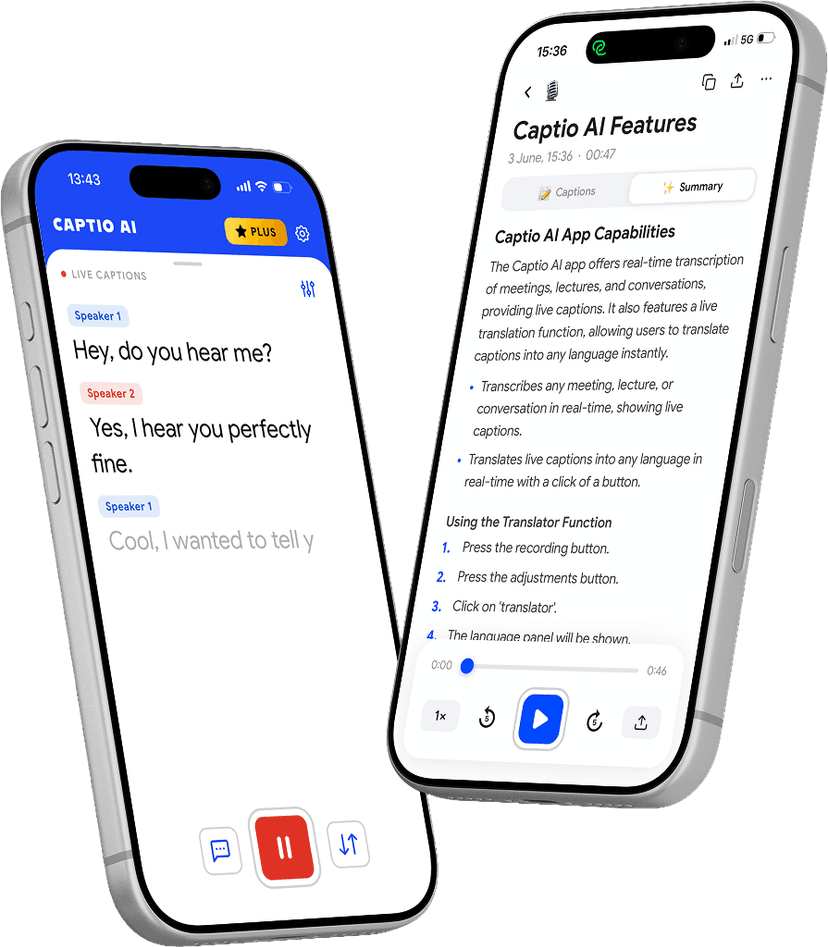
Everything you need to follow Hebrew lectures
Four tools built for deaf and hard of hearing Hebrew speakers.
Follow the lecture as it happens
- Captions appear word by word while the lecturer is still speaking
- Works in lecture halls, seminars, and tutorials
- No setup — place the phone on your desk and start
- Any accent, any pace
For courses in another language
- Captions and translates in real time
- For international students or foreign-language courses
- 60+ languages, no switching
- Follow the lecture in the language you read best
Full transcript to study from
- Record the lecture and upload it for a complete written transcript
- Searchable, copyable, shareable
- Review at your own pace after class
- Works on any lecture recording
Key points extracted automatically
- Important concepts and takeaways pulled from any transcript
- Organised into sections — not one continuous block
- Useful for revision and exam preparation
- Works on any saved lecture transcript
Download for free
Every situation covered
Designed for the real moments that matter — not just quiet controlled environments.
Large lecture halls at the Hebrew University of Jerusalem, Tel Aviv University, and the Technion — Hebrew-medium instruction at full academic pace. Captio AI captions the professor in real time.
Seminars and shiurim (tutorial sessions) where discussion is in Hebrew, often with English technical terminology. Captio AI handles both without manual switching.
Recorded lectures on university portals (Moodle, university e-learning systems) or shared as video files — play on speaker and Captio AI captions whatever is playing in real time.
Study group sessions in Israeli student accommodation reviewing Hebrew lecture content. Captio AI captions whoever is speaking.
Lectures from Mizrahi, Sephardic, or Russian-influenced Hebrew speakers whose phonology differs from Ashkenazi-standard Hebrew. Captio AI handles Israeli Hebrew across its phonological variation.
Online courses and webinars delivered by Israeli universities. Captio AI captions any audio source in real time.
Most accurate and fastest models
word accuracy
independent benchmark, 2025
real-time captions
first word appears as you speak
Download for free
Built for the pace and pressure of a real lecture
Follow without splitting your attention
Lip-reading and note-taking at the same time is an impossible cognitive load. Captio AI handles the following so you can direct all your attention to understanding what is being said.
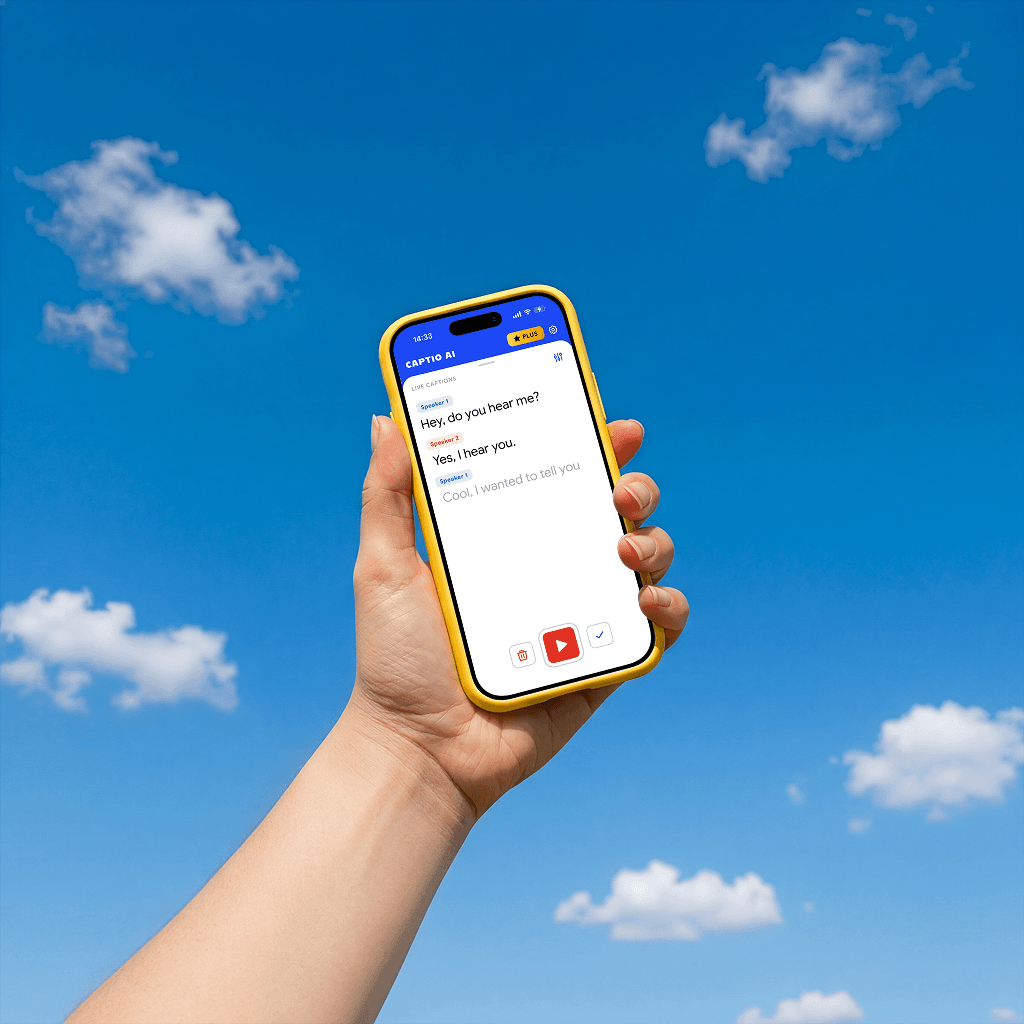
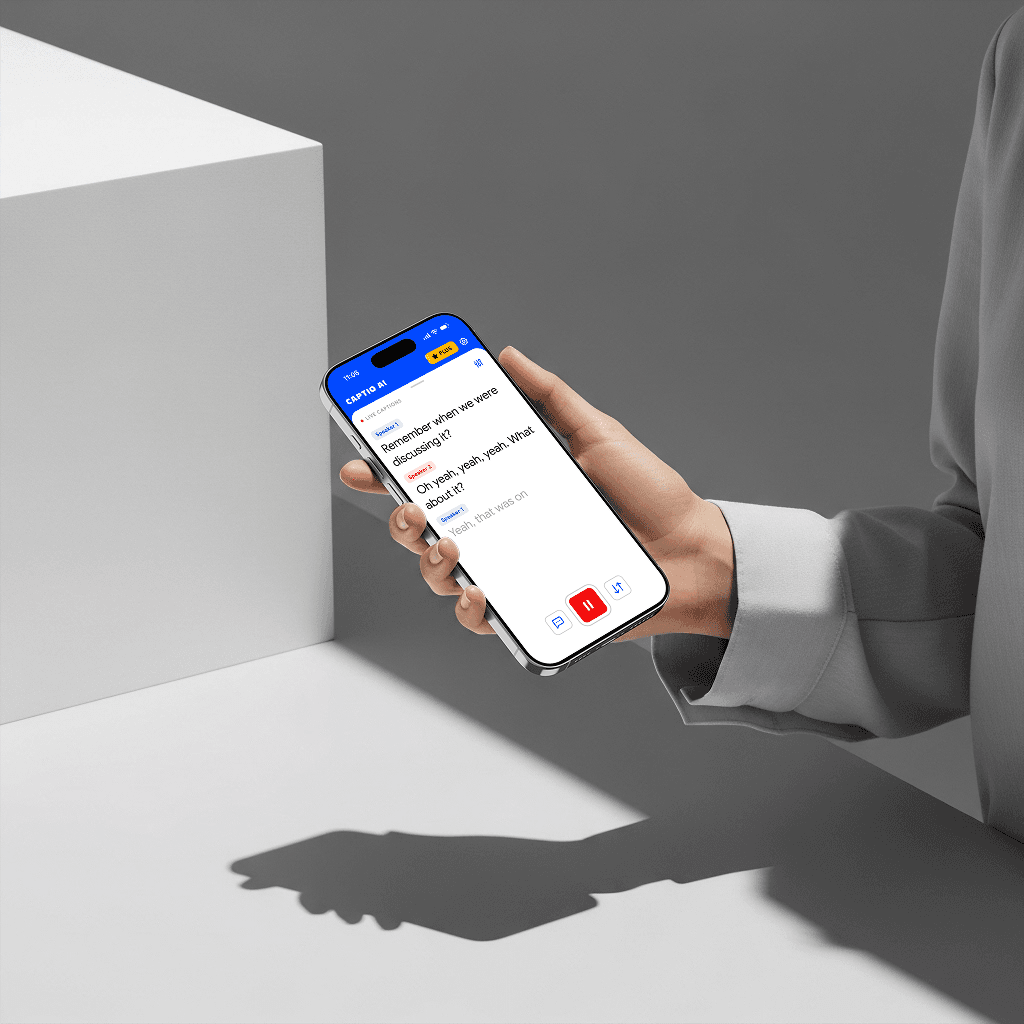
Captions while the lecturer is still speaking
Words appear on your screen as they are said — not after the sentence ends. You stay in sync with the lecture rather than always being a beat behind.
Works in any lecture setting
Lecture halls, seminar rooms, online classes, study groups. Place the phone on your desk, point it toward the audio source, and Captio AI handles the rest.
A full transcript to study from
Record the lecture and upload it to Audio Transcription after class. Get a complete written record you can search, annotate, and revise from — at your own pace.
60+ languages
For international students, students studying abroad, or courses taught in a second language. Captio AI captions or translates in real time with no manual setup.
No advance notice needed
Official university captioning requires booking in advance and is not available for every session. Captio AI works for any lecture, any time, with no prior arrangement.
Why Hebrew is hard to understand
Pharyngeal-velar merge
- Hebrew pharyngeal sounds merge with velars — but Mizrahi speakers retain them differently
- Standard Modern Hebrew (Ashkenazi-influenced) merges the pharyngeal consonants /ħ/ and /ʕ/ with velar /x/ and glottal /ʔ/. But Mizrahi and Sephardic lecturers retain distinct pharyngeals produced deep in the throat. In an Israeli university lecture, the same Hebrew word can arrive with two entirely different throat articulations depending on the professor — neither of which is visible on the lips.
Unvoweled script
- Written Hebrew has no vowels — slides give a deaf student no visual support for what is being said
- Hebrew is written without vowel marks in standard adult text. A deaf student watching a professor speak and consulting slides for support cannot use the written word to predict or confirm the vowel sounds they are trying to read on the lips. The visual disambiguation that written text provides in other languages is absent.
Root-pattern morphology
- Hebrew trilateral roots produce complex inflected words — root consonants hidden inside fast speech
- Hebrew derives words from three-consonant roots using vowel patterns applied around the root: 'hitpalalti' (I prayed) from root p-l-l. In a lecture at full academic speed, these morphologically complex words arrive as extended lip sequences where the meaning-carrying root consonants are separated by vowel patterns that alter the word's shape. Tracking the root through the pattern at lecture pace is a significant decoding task.
Hebrew-English-Arabic mixing
- Israeli academic speech mixes Hebrew, English terminology, and Arabic cognates
- Israeli university lectures mix Hebrew instruction with English technical vocabulary and, in Arabic studies or social science contexts, Arabic cognates. The shift between Hebrew phonology, English phonology, and Arabic phonology produces abrupt lip pattern transitions with no visual warning. For a deaf student, each language switch requires recalibrating what mouth shapes correspond to which sounds.
Fast Israeli speech rate
- Modern Israeli Hebrew is spoken fast — vowels reduce and syllables compress
- Israeli Hebrew is spoken at one of the faster rates in the Semitic language family. Academic Hebrew in a Tel Aviv or Hebrew University seminar is delivered at full conversational speed with reduced unstressed vowels. The vowel-light written system compounds this: a deaf student has no written vowel anchor to predict which of several possible Hebrew words the compressed lip movement represents.
Download for free
10,000 profoundly deaf and up to 200,000 hard of hearing Israelis — in a system that protects on paper more than in practice
The Israel Deaf Association and the Central Bureau of Statistics estimate approximately 10,000 profoundly deaf people and between 150,000 and 200,000 hard of hearing individuals among Israel's adult population. Israel's Equal Rights for People with Disabilities Law establishes strong statutory protections — equal access to public services, employment, education, and government — but research consistently documents the gap between legal protection and daily reality. Emergency communication obstacles for deaf people in Israel remain significant even in high-stakes situations, as documented in a 2017 PMC study examining deaf people's experience during security emergencies.
Israeli universities operate under disability access regulations that require reasonable accommodation for students with disabilities, including hearing loss. In practice, sign language interpreters are provided for deaf students who register formally with the disability office — but interpreter availability for specialised academic content in medicine, law, engineering, or natural sciences is limited. Informal academic life — study groups, office hours, informal supervision meetings — receives no formal support. A deaf Israeli student at the Hebrew University, Tel Aviv University, or the Technion attends the formal lecture with arranged support but navigates everything else unaided.
Israel has a unique demographic dimension: a significant portion of the deaf and hard of hearing community are Hebrew speakers from Mizrahi and Sephardic backgrounds, who retain distinct phonological patterns from Ashkenazi-standard Hebrew. Sign language provision, interpreter training, and captioning tools calibrated to standard Hebrew may systematically underserve the phonological variation present in Israeli higher education. Captio AI captions Israeli Hebrew in real time — in a Hebrew University amphitheatre in Jerusalem, a Tel Aviv seminar room, or a Technion engineering lecture — across the full range of Israeli Hebrew's phonological diversity.
Download for free
What you hear stays with you.
Gone the moment it ends
Captio AI processes your audio in real time and discards it immediately. Nothing is recorded. Nothing is kept.
Not a product
Your conversations are not something Captio AI sells, shares, or monetizes — to anyone, for any reason.
Not used to train anything
What you say in a doctor's appointment or a job interview never ends up in a training dataset. Not ours. Not anyone else's.

Private by default
Captio AI supports 60+ languages
Download for free
Frequently asked questions
Follow every lecture in Hebrew.
Captio AI is free to start
Download for free