

Spanish live captions and productivity tool for lectures
For deaf and hard of hearing people.
Download for free


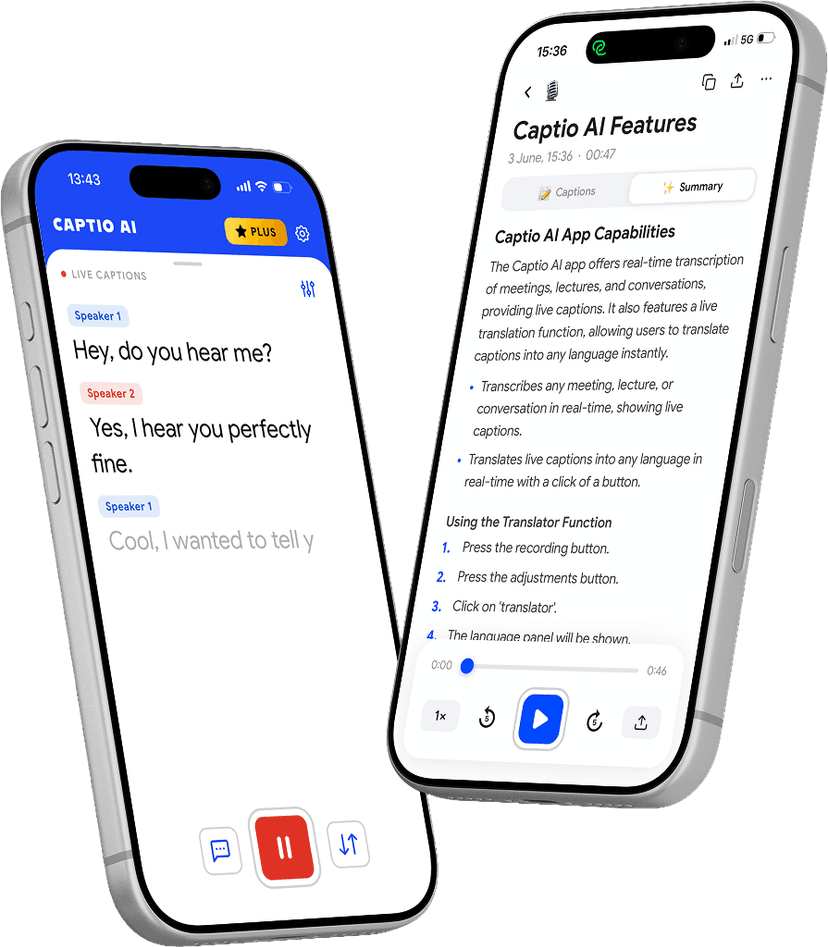
Everything you need to follow Spanish lectures
Four tools built for deaf and hard of hearing Spanish speakers.
Follow the lecture as it happens
- Captions appear word by word while the lecturer is still speaking
- Works in lecture halls, seminars, and tutorials
- No setup — place the phone on your desk and start
- Any accent, any pace
For courses in another language
- Captions and translates in real time
- For international students or foreign-language courses
- 60+ languages, no switching
- Follow the lecture in the language you read best
Full transcript to study from
- Record the lecture and upload it for a complete written transcript
- Searchable, copyable, shareable
- Review at your own pace after class
- Works on any lecture recording
Key points extracted automatically
- Important concepts and takeaways pulled from any transcript
- Organised into sections — not one continuous block
- Useful for revision and exam preparation
- Works on any saved lecture transcript
Download for free
Every situation covered
Designed for the real moments that matter — not just quiet controlled environments.
Spanish university lecture halls and Latin American auditorios hold hundreds of students. Professors speak fast at the front. Place your phone on the desk facing the nearest PA speaker. Captio AI captions from any seat across the full range of Spanish regional accents.
Spanish university seminars and Latin American tutorías move fast, with debate and rapid student contribution. Regional accent variation — Castellano, Mexican, Rioplatense — mixes in the same room. Captio AI follows whoever is speaking so you track every argument.
Spanish virtual campus systems (Moodle, Blackboard) and Latin American university platforms host recorded lectures in many Spanish varieties. Auto-captions often fail on regional accents. Put the lecture on speaker and point Captio AI at the audio for accurate captions.
University library study areas, shared apartments, faculty cafés. Spanish student study groups debate and explain at full conversational pace. Captio AI captions whoever is speaking so you follow every explanation.
Spanish-speaking students in English-medium courses, or international students following lectures in Spanish. Live Translator captions in real time so the language barrier does not become an access barrier.
Visiting academics from across Latin America and Spain, international researchers, alumni conferences. Each brings a distinct Spanish variety. Captio AI covers any speaker at any faculty venue without prior arrangement.
Most accurate and fastest models
word accuracy
independent benchmark, 2025
real-time captions
first word appears as you speak
Download for free
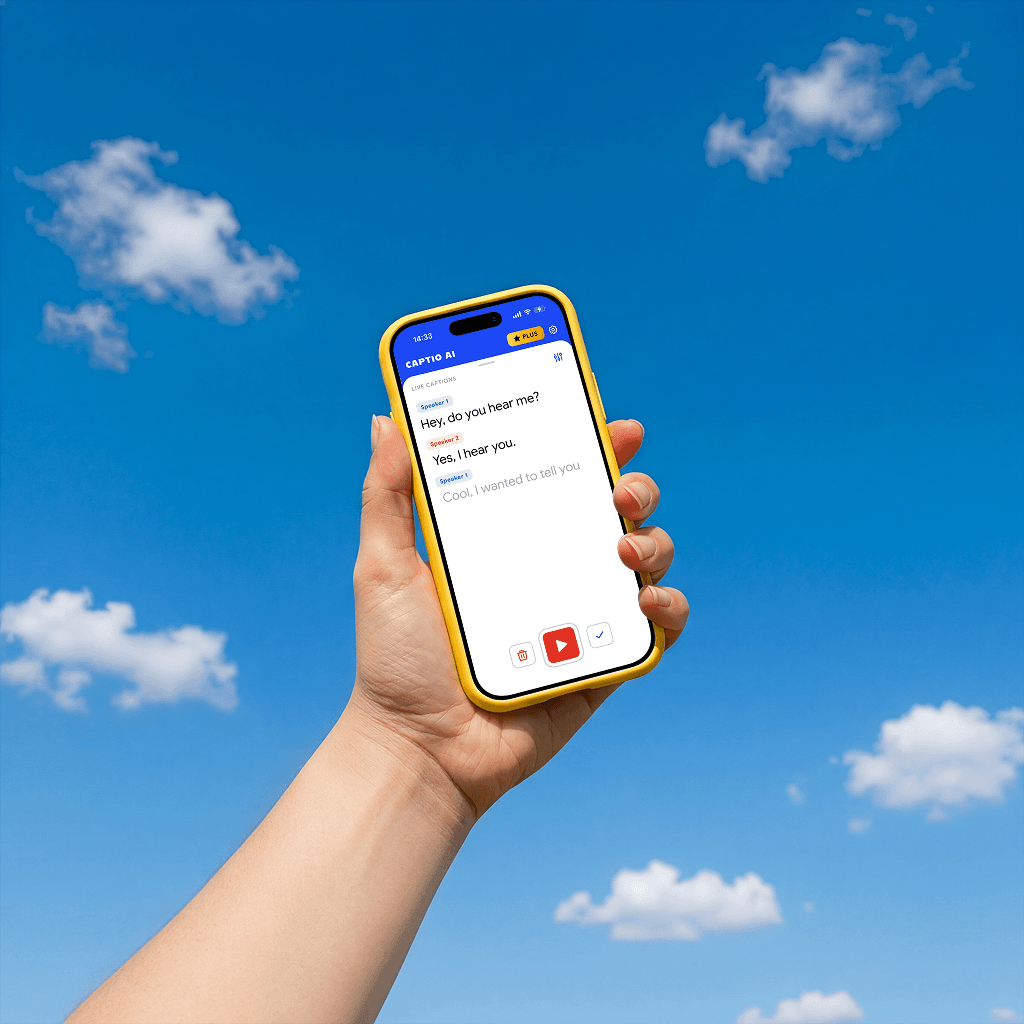
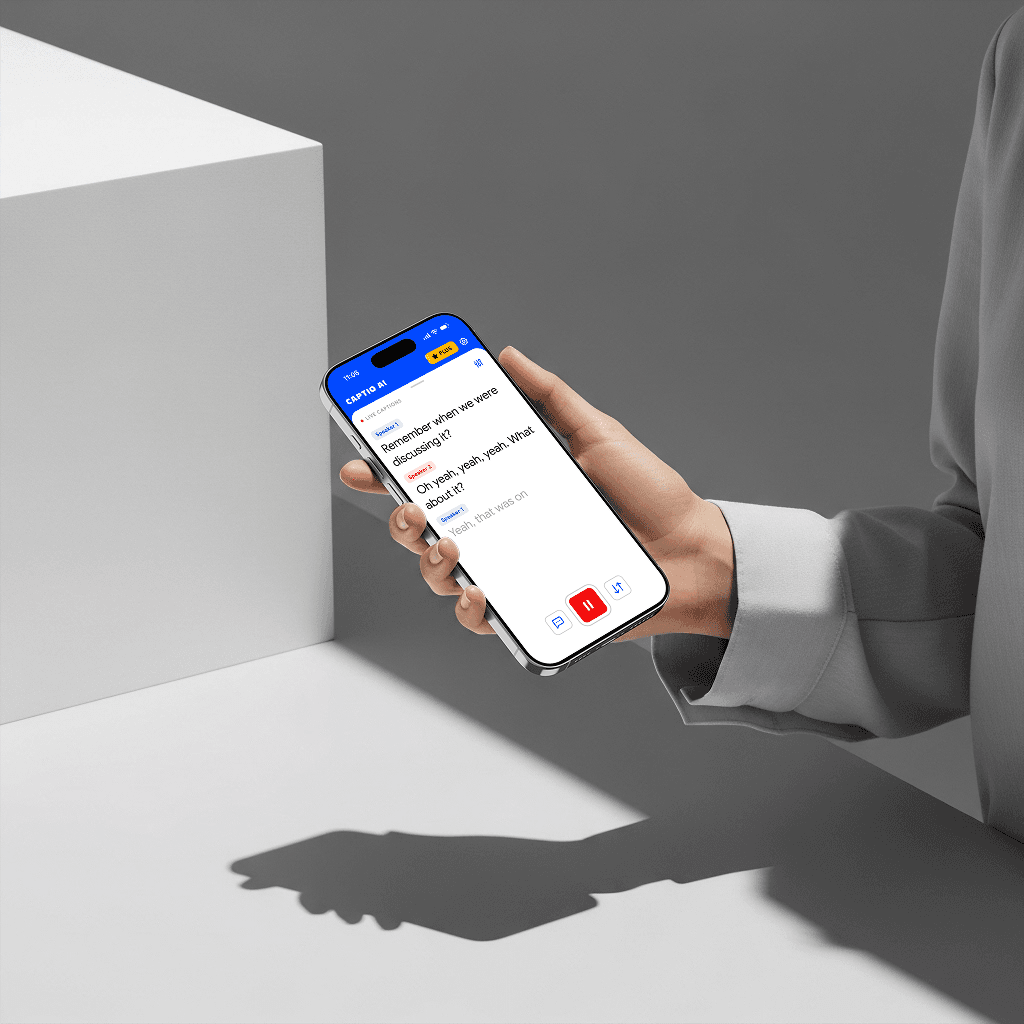
Built for the pace and pressure of a real lecture
Follow without splitting your attention
Lip-reading and note-taking at the same time is an impossible cognitive load. Captio AI handles the following so you can direct all your attention to understanding what is being said.
Captions while the lecturer is still speaking
Words appear on your screen as they are said — not after the sentence ends. You stay in sync with the lecture rather than always being a beat behind.
Works in any lecture setting
Lecture halls, seminar rooms, online classes, study groups. Place the phone on your desk, point it toward the audio source, and Captio AI handles the rest.
A full transcript to study from
Record the lecture and upload it to Audio Transcription after class. Get a complete written record you can search, annotate, and revise from — at your own pace.
60+ languages
For international students, students studying abroad, or courses taught in a second language. Captio AI captions or translates in real time with no manual setup.
No advance notice needed
Official university captioning requires booking in advance and is not available for every session. Captio AI works for any lecture, any time, with no prior arrangement.
Why Spanish is hard to understand
Speed
- Spanish is one of the fastest spoken languages in the world — and lectures are faster still
- Spanish is consistently measured as one of the highest syllable-rate languages, at approximately 7.82 syllables per second — faster than English, French, or German at equivalent text density. Academic lectures add pace without adding pausing. For a deaf student lip-reading a Spanish professor, each syllable arrives before the previous one has been fully processed. The volume of information per second is higher than in almost any other language.
Dialect divergence
- Spanish in Spain and Spanish in Latin America are different lip-reading tasks
- Castilian Spanish uses the dental fricative /θ/ for c and z, which changes the visible tongue-teeth contact. Caribbean Spanish deletes or aspirates coda /s/ entirely, changing the rhythm and syllable profile. River Plate Spanish (Buenos Aires) uses /ʃ/ or /ʒ/ for ll and y, which looks different from the lateral /ʎ/ in other varieties. A deaf student calibrated to one variety faces significant additional ambiguity when the lecturer is from another.
Sibilant variation
- The /s/-/θ/ distinction creates two different tooth-tongue contact profiles that swap without warning
- Castilian Spanish: /s/, /θ/, and /z/ are three distinct sounds. Latin American Spanish and Canarian: all three merge into /s/ (seseo). Andalusian: all three merge into /θ/ (ceceo). A deaf student who has learned to track one system — whether the Castilian interdental or the Latin American alveolar — encounters a different visual pattern without warning when the lecturer or guest speaker comes from another variety.
Academic formality gap
- Formal academic Spanish sounds different from the conversational Spanish a deaf student has practised lip-reading
- Spanish academic lectures use passive constructions, complex subjunctive forms, and nominal phrases with dense modification that appear rarely in everyday speech. The formal register compresses articulation, reduces coarticulation, and increases speech rate simultaneously. A deaf student who has calibrated their lip-reading to informal conversational Spanish finds the lecture register visually less familiar at exactly the moment accuracy matters most.
Fast reduction in Latin American lecture contexts
- Carioca, rioplatense, and Caribbean academic speech reduce in ways that multiply lip-reading ambiguity
- Brazilian Portuguese is nearby, but within Spanish: fast rioplatense academic delivery in Buenos Aires drops final syllables; fast Caribbean delivery in Havana or San Juan deletes final consonants; fast costeño Colombian delivery produces open syllable chains. Each regional fast-speech reduction pattern changes the visible word profile in a different direction, making a deaf student's preparation specific to one variety not transferable to others.
Download for free
Millions of deaf and hard of hearing students across the Spanish-speaking world — and no caption in the room
A 2023 Inter-American Development Bank (IDB) study found that 5.4 million students across Latin America and the Caribbean face hearing difficulties — yet fewer than 3% of these students are officially recognised by the education system. Over 5.2 million children with hearing impairments are effectively invisible to the schools they attend. The IDB describes this as an identification gap: without recognition, there is no accommodation, no captioning, no support (IDB, 2023). In Spain, the INE survey found approximately 1,064,000 people with significant hearing loss — in a university system where hearing disabilities represent 7.2% of all reported student disabilities, but almost no provision of in-lecture captioning exists.
A 2025 PMC study on university adjustment among deaf and hard of hearing students confirmed that communication barriers in lecture-based settings remain the primary driver of academic underperformance across multiple countries — independent of students' intellectual capacity (PMC12505907, 2025). Spanish-language universities have been slow to implement real-time captioning: interpreter training is limited, and in much of Latin America there is no consistent national standard for sign language interpreter provision in higher education. In Mexico, Colombia, Argentina, and Peru, deaf students report navigating university lecture halls with minimal or no formal support.
The structural gap is compounded by the diversity of Spanish itself. A deaf student in Caracas who has worked to develop lip-reading skills for Venezuelan Spanish encounters a Madrid professor whose Castilian sibilants and rhythm feel visually foreign. The support mechanisms that exist — where they exist — are designed for a single national variety, not the full range of Spanish-speaking university contexts a deaf student may move through.
Download for free
What you hear stays with you.
Gone the moment it ends
Captio AI processes your audio in real time and discards it immediately. Nothing is recorded. Nothing is kept.
Not a product
Your conversations are not something Captio AI sells, shares, or monetizes — to anyone, for any reason.
Not used to train anything
What you say in a doctor's appointment or a job interview never ends up in a training dataset. Not ours. Not anyone else's.

Private by default
Captio AI supports 60+ languages
Download for free
Frequently asked questions
Follow every lecture in Spanish.
Captio AI is free to start
Download for free