

Basque live captions and productivity tool for lectures
For deaf and hard of hearing people.
Download for free


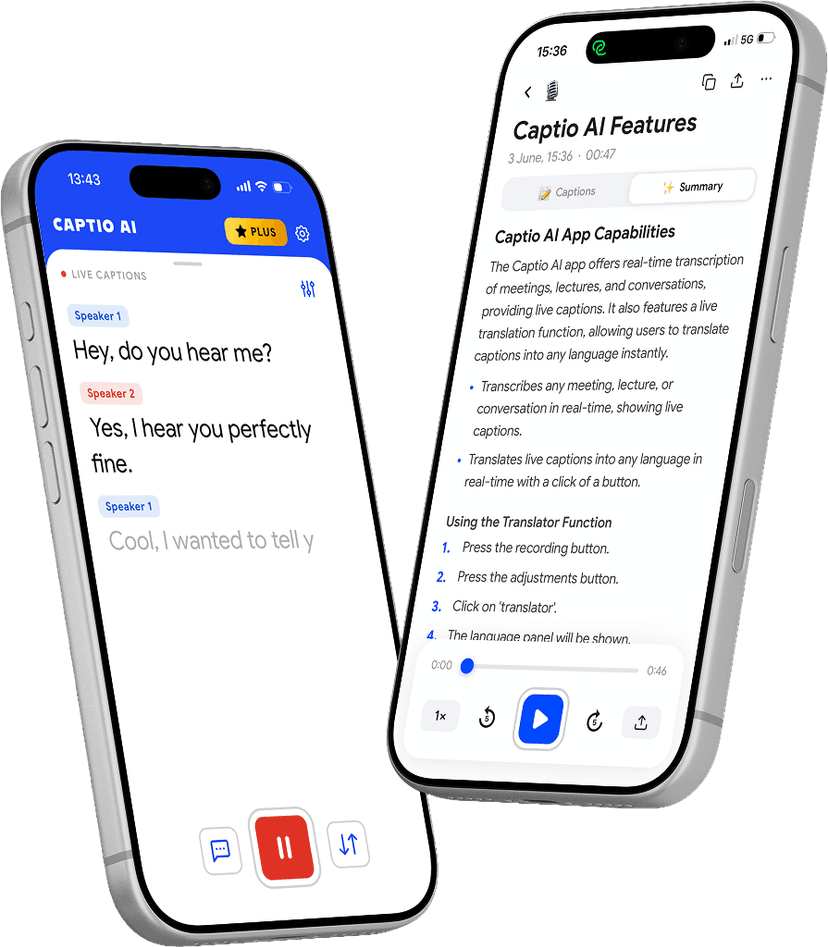
Everything you need to follow Basque lectures
Four tools built for deaf and hard of hearing Basque speakers.
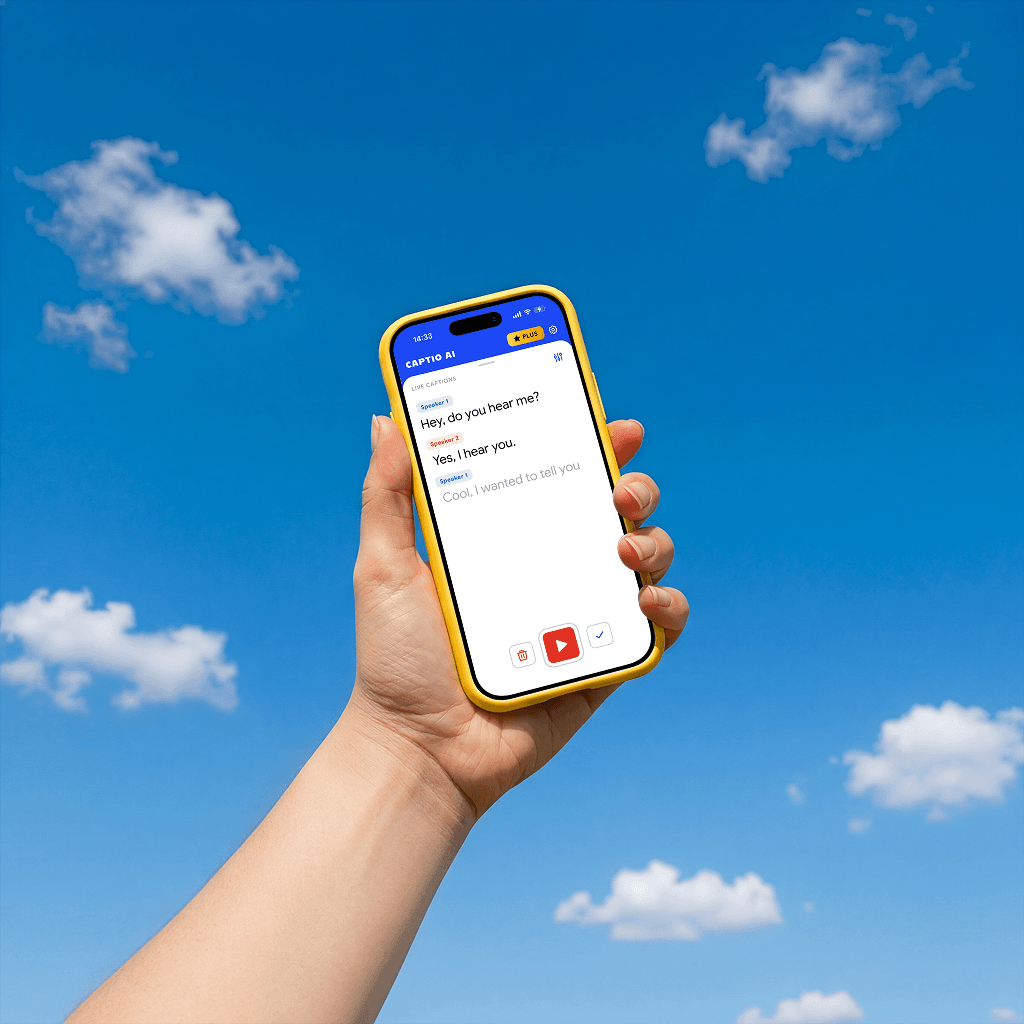
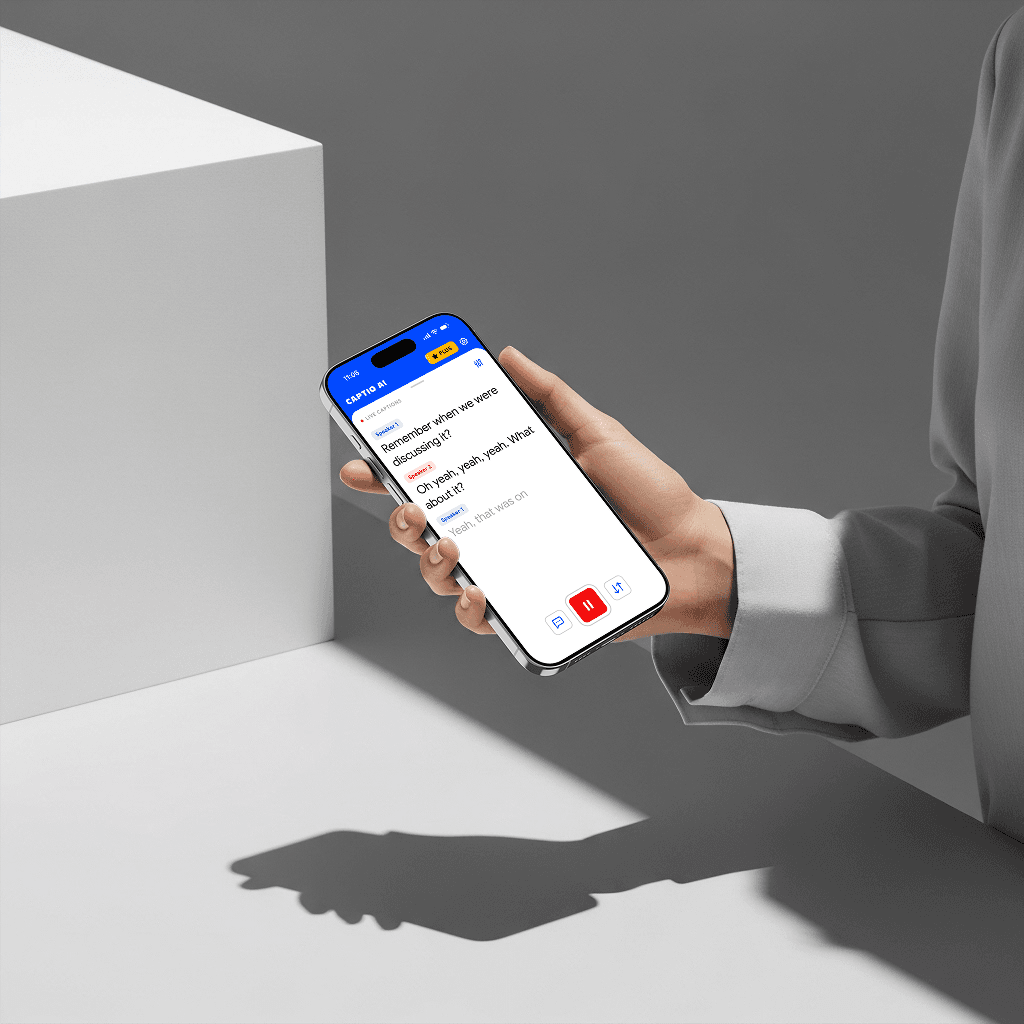
Follow the lecture as it happens
- Captions appear word by word while the lecturer is still speaking
- Works in lecture halls, seminars, and tutorials
- No setup — place the phone on your desk and start
- Any accent, any pace
For courses in another language
- Captions and translates in real time
- For international students or foreign-language courses
- 60+ languages, no switching
- Follow the lecture in the language you read best
Full transcript to study from
- Record the lecture and upload it for a complete written transcript
- Searchable, copyable, shareable
- Review at your own pace after class
- Works on any lecture recording
Key points extracted automatically
- Important concepts and takeaways pulled from any transcript
- Organised into sections — not one continuous block
- Useful for revision and exam preparation
- Works on any saved lecture transcript
Download for free
Every situation covered
Designed for the real moments that matter — not just quiet controlled environments.
Large lecture halls at the University of the Basque Country (EHU/UPV) in Bilbao, Donostia-San Sebastián, and Vitoria-Gasteiz — where Basque-medium degree programmes are taught in standard Batua by lecturers from different Basque dialect backgrounds.
Seminars and Ikastola alumni discussion sessions — small group academic settings where participants debate in Basque, mixing Batua standard with regional Biscayan or Guipuzcoan variety influences.
Online and recorded Basque-medium lectures on EHU/UPV platforms — digital content where the apical/laminal sibilant distinction and northern dialect aspiration must be resolved acoustically without captions.
Study groups in Bilbao and Donostia student accommodation — peer discussion in Basque, with students from different Basque-speaking regions bringing Biscayan, Guipuzcoan, or French Basque varieties into group study.
Cross-border academic programmes with French Basque universities — lectures delivered partly in southern Batua and partly in northern Lapurdian or Souletin variety, adding aspiration and the sixth vowel as extra phonological complexity.
Guest speakers and public academics at Basque cultural institutions — researchers and writers giving public talks in Basque at Bilbao's Guggenheim or EHU/UPV symposia, often without real-time captioning.
Most accurate and fastest models
word accuracy
independent benchmark, 2025
real-time captions
first word appears as you speak
Download for free
Built for the pace and pressure of a real lecture
Follow without splitting your attention
Lip-reading and note-taking at the same time is an impossible cognitive load. Captio AI handles the following so you can direct all your attention to understanding what is being said.
Captions while the lecturer is still speaking
Words appear on your screen as they are said — not after the sentence ends. You stay in sync with the lecture rather than always being a beat behind.
Works in any lecture setting
Lecture halls, seminar rooms, online classes, study groups. Place the phone on your desk, point it toward the audio source, and Captio AI handles the rest.
A full transcript to study from
Record the lecture and upload it to Audio Transcription after class. Get a complete written record you can search, annotate, and revise from — at your own pace.
60+ languages
For international students, students studying abroad, or courses taught in a second language. Captio AI captions or translates in real time with no manual setup.
No advance notice needed
Official university captioning requires booking in advance and is not available for every session. Captio AI works for any lecture, any time, with no prior arrangement.
Why Basque is hard to understand
Language isolate
- Basque is a language isolate — lip-readers cannot use cognate-language knowledge to fill in missed sounds
- Basque is the only pre-Indo-European language surviving in Western Europe — it has no known relatives and shares no vocabulary, phonology, or grammar with Spanish, French, or any other language in the region. A deaf student lip-reading Basque cannot use knowledge of Spanish or French to infer missed words, fill in ambiguous lip shapes, or predict word endings from grammatical context. Every ambiguous visual moment in a Basque lecture must be resolved from Basque alone.
Aspiration
- Northern Basque dialects use phonemic aspiration that is invisible on the lips
- Northern Basque dialects — Lapurdian, Lower Navarrese, and Souletin — distinguish aspirated from plain stop consonants. Word-initial /p/, /t/, and /k/ contrast with aspirated /pʰ/, /tʰ/, and /kʰ/. Aspiration is a puff of air produced at the glottis after the consonant release — entirely invisible from the front. A deaf student from the southern Basque Country encountering a northern lecturer at EHU/UPV faces an additional phonemic contrast carried entirely in an invisible acoustic feature.
Apical–laminal sibilant distinction
- Basque distinguishes apical vs. laminal sibilants — three sibilant contrasts mostly invisible from the front
- Basque has two contrastive /s/ sounds — an apical /s̺/ (tongue tip behind teeth) and a laminal /s̻/ (tongue blade behind teeth) — plus a palatal /ʃ/ in some dialects. All three sibilants are produced with similar lip shapes: slightly open, teeth close together, lips pulled back. A lip-reader sees essentially the same mouth shape for all three — but these sibilants distinguish words throughout the Basque vocabulary.
Final syllable stress
- Basque stress falls near the end of words — opposite of Spanish and French, disrupting rhythm expectations
- Basque has a predominantly penultimate or final syllable stress pattern in most varieties — a stress location opposite to what a deaf student calibrated to Spanish or French expects. A lip-reader who has learned to watch for stressed syllables toward the beginning of words must recalibrate entirely, or miss the most acoustically prominent syllable in every Basque word.
Five main dialect groups
- Basque has five major dialect groups with substantial phonological differences between them
- Standard Batua was created in 1968 to provide a common written form, but spoken Basque remains highly dialectal. A Biscayan-speaking student at EHU/UPV in Bilbao encounters different phonology from a Guipuzcoan lecturer in Donostia, and different again from a Souletin speaker from French Basque Country — who uniquely has a sixth oral vowel /y/ and nasal vowels entirely absent in southern varieties.
Download for free
Over a million deaf and hard of hearing people in Spain — and a Basque-speaking deaf community navigating the gap between Spanish and Basque accessibility provision
Spain has approximately 1,064,000 people who are deaf or have some hearing disability — 2.3% of the national population according to the National Statistics Institute (INE EDAD survey). The Basque Country (Euskadi) is one of Spain's most economically developed autonomous communities, but its deaf and hard of hearing population faces a specific challenge: the Basque-speaking community uses both Spanish Sign Language (LSE) and its own Basque Sign Language varieties, and Basque-medium university instruction — a priority of regional language policy — has no parallel system of Basque-medium sign language interpretation at university level.
The Basque Government has invested significantly in Basque-medium education — the ikastola system has educated generations of Basque speakers, and EHU/UPV is Europe's largest Basque-language university. However, the push for Basque-medium higher education has outpaced the development of Basque-medium accessibility services. Deaf students who choose Basque-medium degree programmes typically receive LSE interpreters working in Spanish, not Basque — meaning the language of instruction and the language of interpretation are different, introducing an additional translation step that reduces comprehension.
The WHO Global Hearing Report and GBD 2019 data confirm that hearing loss is the most prevalent sensory disability globally, with approximately 430 million people worldwide requiring rehabilitation services. For a deaf student at EHU/UPV in Bilbao following a lecture in Basque Batua — a language isolate with no cognate support, apical/laminal sibilant contrasts invisible from the lips, and five major dialect varieties — Captio AI provides real-time captions in Basque that work regardless of which dialect variety the lecturer speaks.
Download for free
What you hear stays with you.
Gone the moment it ends
Captio AI processes your audio in real time and discards it immediately. Nothing is recorded. Nothing is kept.
Not a product
Your conversations are not something Captio AI sells, shares, or monetizes — to anyone, for any reason.
Not used to train anything
What you say in a doctor's appointment or a job interview never ends up in a training dataset. Not ours. Not anyone else's.

Private by default
Captio AI supports 60+ languages
Download for free
Frequently asked questions
Follow every lecture in Basque.
Captio AI is free to start
Download for free