

Kannada live captions and productivity tool for lectures
For deaf and hard of hearing people.
Download for free


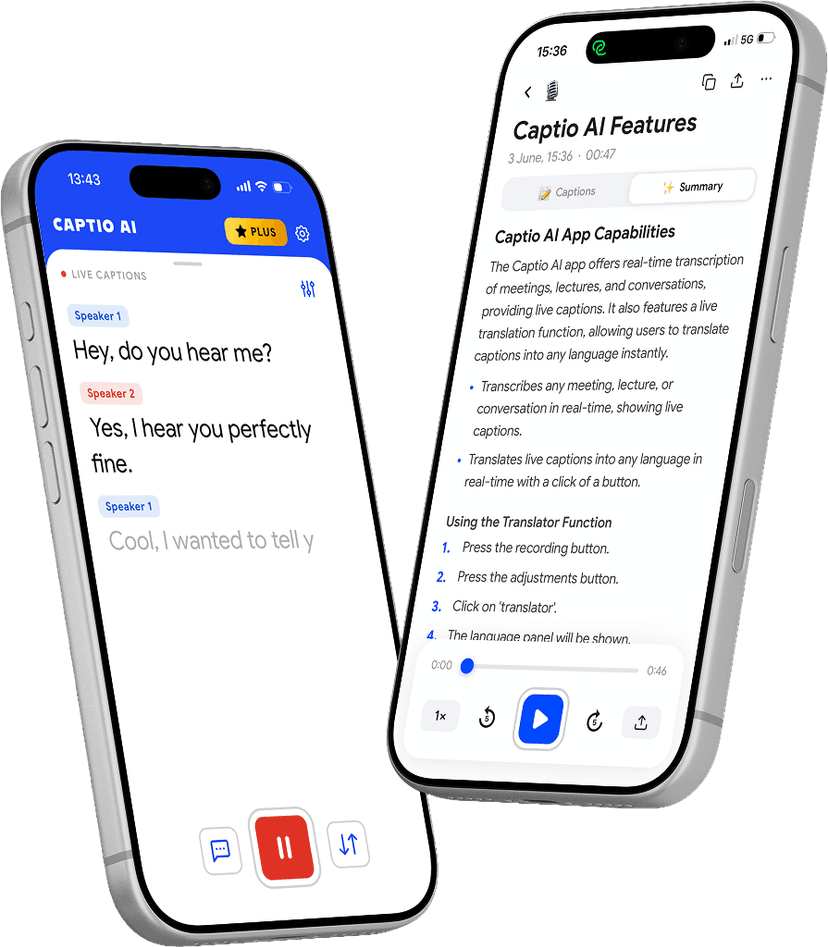
Everything you need to follow Kannada lectures
Four tools built for deaf and hard of hearing Kannada speakers.
Follow the lecture as it happens
- Captions appear word by word while the lecturer is still speaking
- Works in lecture halls, seminars, and tutorials
- No setup — place the phone on your desk and start
- Any accent, any pace
For courses in another language
- Captions and translates in real time
- For international students or foreign-language courses
- 60+ languages, no switching
- Follow the lecture in the language you read best
Full transcript to study from
- Record the lecture and upload it for a complete written transcript
- Searchable, copyable, shareable
- Review at your own pace after class
- Works on any lecture recording
Key points extracted automatically
- Important concepts and takeaways pulled from any transcript
- Organised into sections — not one continuous block
- Useful for revision and exam preparation
- Works on any saved lecture transcript
Download for free
Every situation covered
Designed for the real moments that matter — not just quiet controlled environments.
Bangalore University, University of Mysore, Dharwad University, and Mangalore University lecture halls. Kannada-medium lectures at academic pace. Place the phone on the desk facing the speaker. Captio AI captions from any row.
Kannada university seminars where students present and discuss in academic Kannada. Multiple regional varieties from across Karnataka. Captio AI captions whoever is speaking so you follow every argument.
Recorded Kannada lectures on university portals or shared recordings. Put the recording on speaker and point Captio AI at the audio for accurate captions in real time.
Study groups in Bengaluru, Mysuru, or Dharwad — fast conversational Kannada mixed with English and Hindi. Captio AI follows whoever is explaining and handles all three languages without switching.
Kannada students in English-medium programmes at IISC or BMS, or international students following Kannada-medium lectures. Live Translator captions in real time so language is not the access barrier.
Visiting academics and guest speakers from across Karnataka's regions. Captio AI handles Mysore-Bangalore, Dharwad, and Mangalore coastal Kannada — any speaker at any venue.
Most accurate and fastest models
word accuracy
independent benchmark, 2025
real-time captions
first word appears as you speak
Download for free
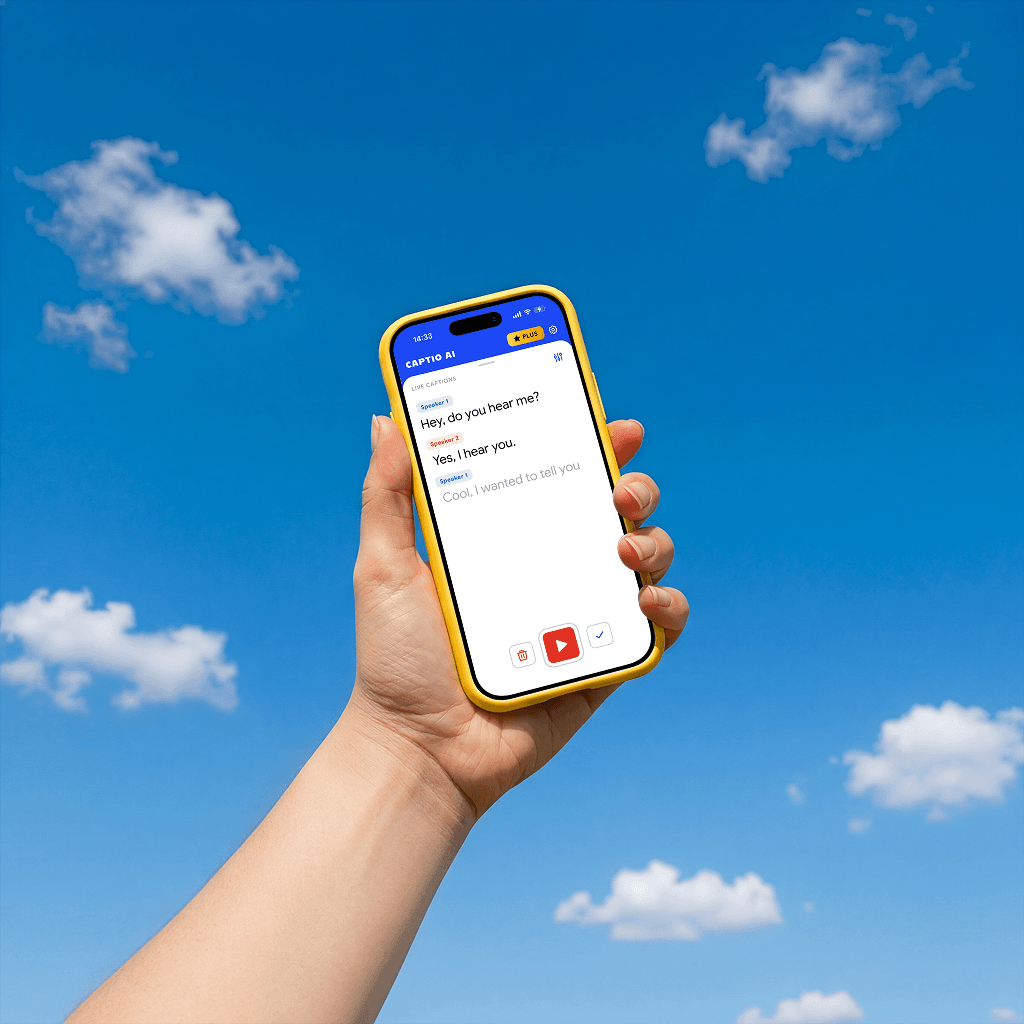
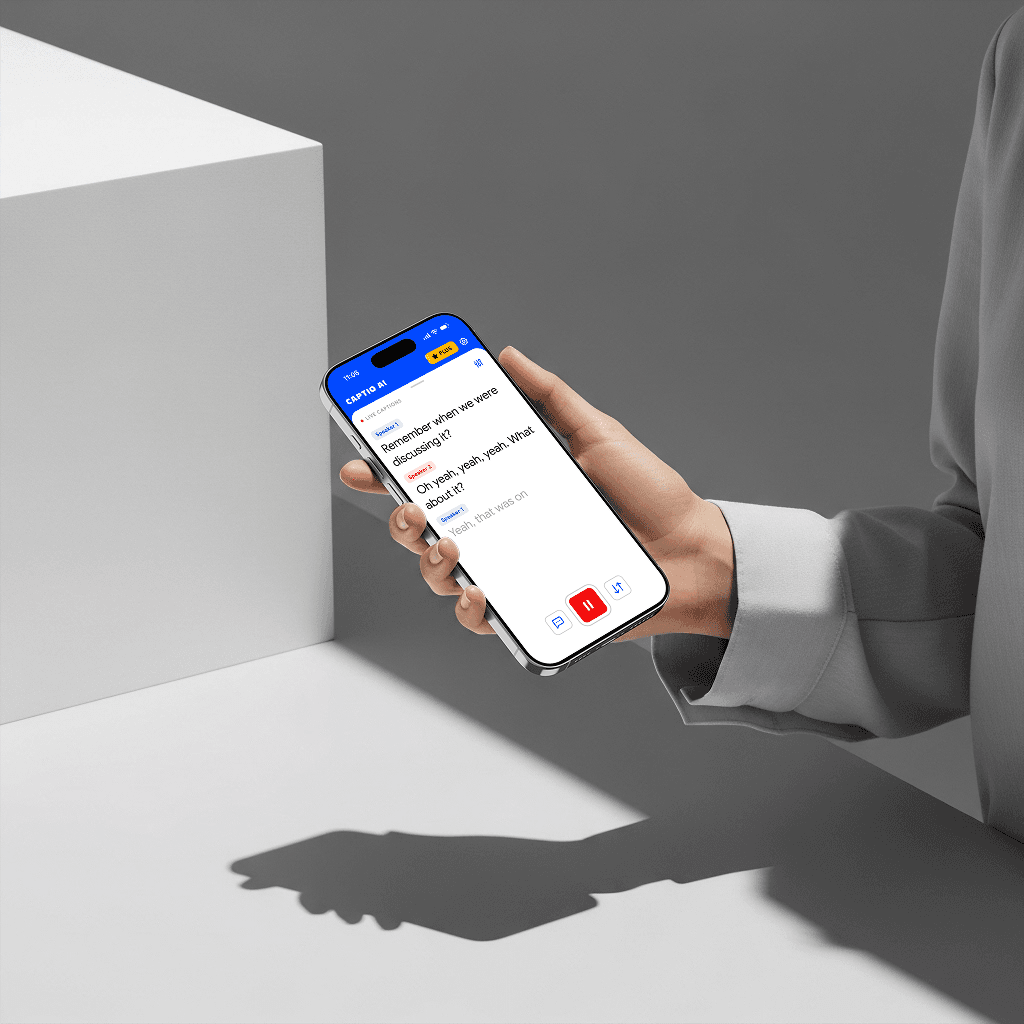
Built for the pace and pressure of a real lecture
Follow without splitting your attention
Lip-reading and note-taking at the same time is an impossible cognitive load. Captio AI handles the following so you can direct all your attention to understanding what is being said.
Captions while the lecturer is still speaking
Words appear on your screen as they are said — not after the sentence ends. You stay in sync with the lecture rather than always being a beat behind.
Works in any lecture setting
Lecture halls, seminar rooms, online classes, study groups. Place the phone on your desk, point it toward the audio source, and Captio AI handles the rest.
A full transcript to study from
Record the lecture and upload it to Audio Transcription after class. Get a complete written record you can search, annotate, and revise from — at your own pace.
60+ languages
For international students, students studying abroad, or courses taught in a second language. Captio AI captions or translates in real time with no manual setup.
No advance notice needed
Official university captioning requires booking in advance and is not available for every session. Captio AI works for any lecture, any time, with no prior arrangement.
Why Kannada is hard to understand
4-way aspiration grid
- Kannada's four-way stop contrast — voiceless/voiced × unaspirated/aspirated — is entirely invisible on the lips
- Kannada distinguishes voiceless unaspirated (ಪ, ತ, ಕ), voiceless aspirated (ಫ, ಥ, ಖ), voiced unaspirated (ಬ, ದ, ಗ), and voiced aspirated or breathy (ಭ, ಧ, ಘ). All four categories produce the same lip shape — the distinctions are in aspiration and voice onset time, which are entirely acoustic. In a Kannada lecture, these contrasts appear throughout every sentence, and none of them are recoverable from lip movement alone.
Retroflex series
- Kannada's retroflex consonants — ಟ, ಠ, ಡ, ಢ, ಣ, ಳ — are produced inside the mouth with no visible lip distinction from dentals
- Kannada has a full retroflex series including a retroflex lateral /ɭ/ (ಳ) that is distinct from the dental lateral /l/ (ಲ). The retroflex is produced by curling the tongue back — entirely inside the mouth, producing no visible lip movement. In a Kannada lecture, retroflex-dental contrasts appear throughout and are all invisible. The retroflex lateral in particular is a distinctive feature of Kannada that causes word-level ambiguity in lip-reading.
Caste sociolect variation
- Kannada caste sociolects — Brahmin, non-Brahmin, and rural varieties — have distinct phonology, all present in Karnataka universities
- Kannada has well-documented caste-based sociolects with differences in lexicon, phonology, morphology, and syntax. Brahmin Kannada, non-Brahmin Kannada, and rural regional varieties have distinct vowel quality and consonant realization. Karnataka universities draw students and faculty from across these caste and regional backgrounds. A deaf student calibrated to one variety encounters different lip profiles when the lecturer grew up speaking another sociolect.
Three major regional dialects
- Mysore-Bangalore standard, Dharwad-Hubli, and Mangalore coastal Kannada produce different phonological profiles in the lecture hall
- Kannada has three major dialect regions: Mysore-Bangalore (the prestige academic standard), Dharwad-Hubli in the north (with different vowel quality and some consonant differences), and Mangalore/coastal Kannada (with Tulu and Konkani substrate influence producing different sibilant and vowel realizations). A deaf student calibrated to Bangalore Kannada encounters different lip patterns when the lecturer is from a Dharwad or coastal background.
Kannada-Hindi-English mixing
- Bengaluru tech university lectures mix Kannada, English, and Hindi — shifting phonological systems mid-sentence
- University lectures in Bengaluru routinely blend Kannada with English for technical vocabulary and, depending on the course, Hindi for administrative or broader academic framing. Each code-switch changes the phonological system, stress pattern, and lip profile simultaneously. At institutions like IISC, NIMHANS, and BMS College of Engineering, this three-language mixing is the default lecture environment — and a deaf student must track all three systems simultaneously.
Download for free
63 million with hearing loss in India — Karnataka's research institutions lead in hearing science but not in lecture-hall accessibility
India has approximately 63 million people with significant auditory loss nationally. Karnataka — with a population of approximately 70 million — carries a proportionate share. Karnataka is notable in the Indian context for hosting the All India Institute of Speech and Hearing (AIISH) in Mysuru — one of India's premier research institutions for speech and hearing science. Research from Karnataka on hearing rehabilitation in rural communities (PMC2763682) documented the significant gap between urban research capacity and rural access to hearing services. Despite this research concentration, university-level captioning infrastructure in Karnataka lecture halls is absent.
A study on disability among school children across India (PMC12199054) found that hearing impairment affected approximately 9.9% of disabled school-age children nationally — a figure that implies a significant cohort moving toward higher education without any captioning provision waiting for them. Karnataka's tech sector dominance (Bengaluru is India's tech capital) has not translated into systematic captioning deployment at Karnataka universities. IISC, NIMHANS, and the Bengaluru tech universities operate in a multilingual environment (Kannada, English, Hindi) with no real-time captioning standard for deaf and hard of hearing students.
Indian Sign Language (ISL) remains without official national recognition despite the RPDA 2016 framework, and Karnataka Sign Language — a distinct regional variety — has even less institutional support. Research published in Springer Language Policy (2025) documented that ISL speakers fall outside India's formal language rights framework, meaning no mandate exists for sign language or captioning provision in Karnataka university lectures. Deaf and hard of hearing students at Bangalore University, University of Mysore, or IISC must negotiate accommodation individually with each faculty.
Download for free
What you hear stays with you.
Gone the moment it ends
Captio AI processes your audio in real time and discards it immediately. Nothing is recorded. Nothing is kept.
Not a product
Your conversations are not something Captio AI sells, shares, or monetizes — to anyone, for any reason.
Not used to train anything
What you say in a doctor's appointment or a job interview never ends up in a training dataset. Not ours. Not anyone else's.

Private by default
Captio AI supports 60+ languages
Download for free
Frequently asked questions
Follow every lecture in Kannada.
Captio AI is free to start
Download for free