

French live captions and productivity tool for lectures
For deaf and hard of hearing people.
Download for free
Everything you need to follow French lectures
Four tools built for deaf and hard of hearing French speakers.
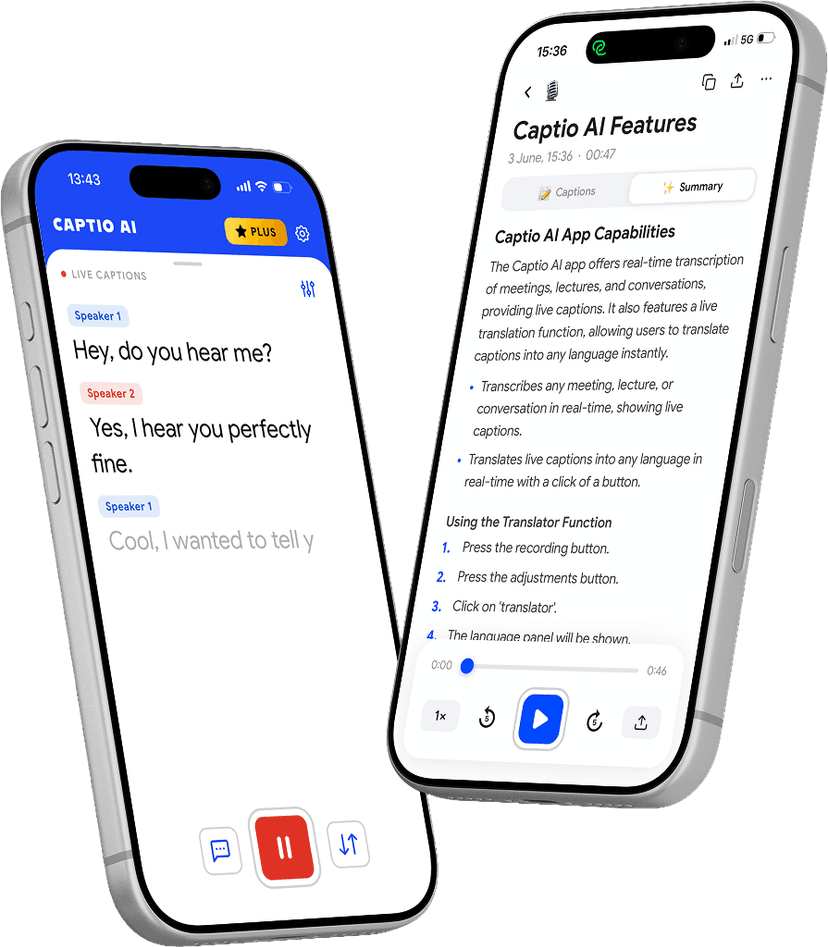
Follow the lecture as it happens
- Captions appear word by word while the lecturer is still speaking
- Works in lecture halls, seminars, and tutorials
- No setup — place the phone on your desk and start
- Any accent, any pace
For courses in another language
- Captions and translates in real time
- For international students or foreign-language courses
- 60+ languages, no switching
- Follow the lecture in the language you read best
Full transcript to study from
- Record the lecture and upload it for a complete written transcript
- Searchable, copyable, shareable
- Review at your own pace after class
- Works on any lecture recording
Key points extracted automatically
- Important concepts and takeaways pulled from any transcript
- Organised into sections — not one continuous block
- Useful for revision and exam preparation
- Works on any saved lecture transcript
Download for free
Every situation covered
Designed for the real moments that matter — not just quiet controlled environments.
Sorbonne, Sciences Po, École Polytechnique, and grandes écoles lecture halls. French-medium lectures in fast academic French, often Parisian standard. Place the phone on the desk facing the speaker. Captio AI captions from any row.
French university CM (cours magistral) and TD (travaux dirigés) sessions. Fast academic French in lecture format followed by seminar-style TD. Captio AI captions whoever is speaking throughout.
Recorded lectures on FUN-MOOC, university portals, or Zoom recordings. Put the recording on speaker and point Captio AI at the audio for accurate captions in real time.
Study groups in Paris, Lyon, or Bordeaux — fast conversational French mixed with English for academic terms. Captio AI follows whoever is explaining without any switching.
International students at French universities following French-medium courses. Live Translator captions in real time so language is not the access barrier.
Visiting academics from Francophone Africa, Belgium, Canada, and Switzerland. Captio AI handles Parisian French, Québécois, Belgian, and West African varieties — any speaker at any venue.
Most accurate and fastest models
word accuracy
independent benchmark, 2025
real-time captions
first word appears as you speak
Download for free
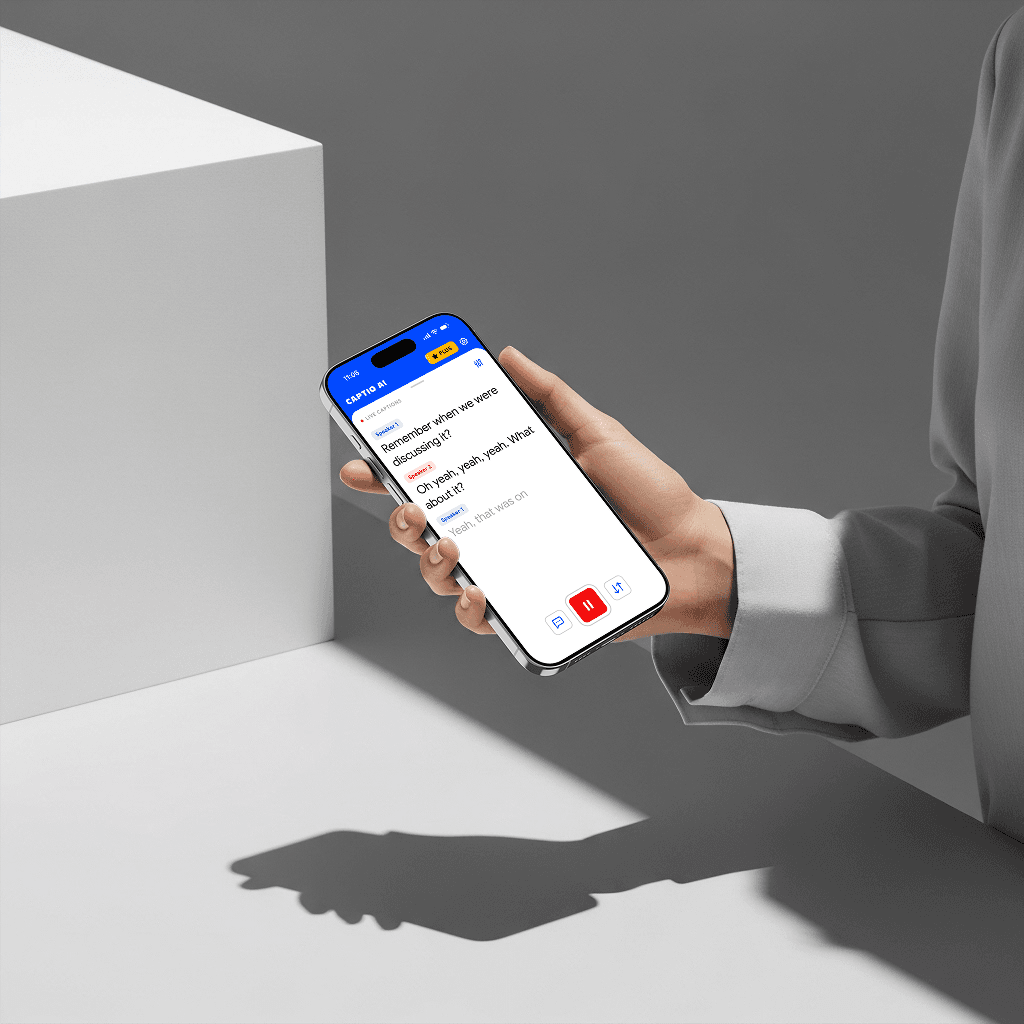
Built for the pace and pressure of a real lecture
Follow without splitting your attention
Lip-reading and note-taking at the same time is an impossible cognitive load. Captio AI handles the following so you can direct all your attention to understanding what is being said.
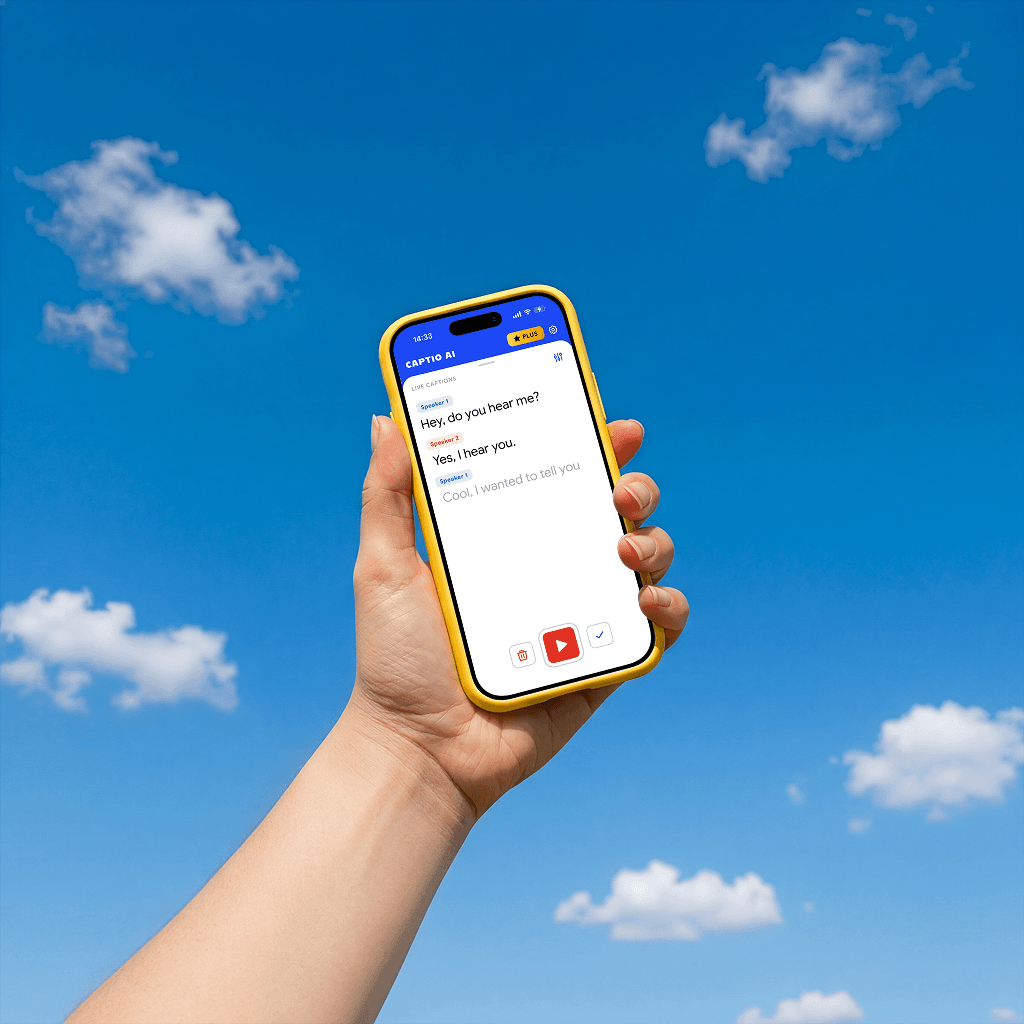
Captions while the lecturer is still speaking
Words appear on your screen as they are said — not after the sentence ends. You stay in sync with the lecture rather than always being a beat behind.
Works in any lecture setting
Lecture halls, seminar rooms, online classes, study groups. Place the phone on your desk, point it toward the audio source, and Captio AI handles the rest.
A full transcript to study from
Record the lecture and upload it to Audio Transcription after class. Get a complete written record you can search, annotate, and revise from — at your own pace.
60+ languages
For international students, students studying abroad, or courses taught in a second language. Captio AI captions or translates in real time with no manual setup.
No advance notice needed
Official university captioning requires booking in advance and is not available for every session. Captio AI works for any lecture, any time, with no prior arrangement.
Why French is hard to understand
Liaison unpredictability
- French liaison inserts consonants that don't exist in isolated words — appearing without any visual warning
- French liaison causes a word-final latent consonant to be pronounced before a vowel-initial word: les enfants (/lezɑ̃fɑ̃/) has a /z/ that is absent in les seuls (/leˈsœl/). In a lecture, liaison adds and removes sounds at word boundaries in patterns that depend on whether the next word begins with a vowel. On the lips, this creates additional movement between words with no visual warning — a deaf student cannot predict from the first word's lip shape whether a liaison consonant will follow.
Nasal vowel invisibility
- French nasal vowels — the primary distinction between hundreds of word pairs — are entirely invisible on the lips
- French has four nasal vowels (/ɑ̃/, /ɛ̃/, /ɔ̃/, /œ̃/) that distinguish meaning from their oral counterparts: beau vs. bon, fin vs. fait, sans vs. ses. Nasality is produced in the nasal cavity — no lip or tongue movement distinguishes a nasal vowel from its oral equivalent on the lips. In a lecture, every sentence contains nasal vowels that carry lexical meaning, and every one of them is invisible.
Front rounded vowels
- French front rounded vowels /y/, /ø/, /œ/ have no equivalent in English — and produce distinctive but easily confused lip shapes
- French distinguishes front rounded vowels (lune /yn/, peu /pø/, peur /pœʁ/) that English lacks entirely. These vowels require rounded lips in a front position — a combination that English-influenced lip-reading produces incorrectly. In a French lecture, words containing /y/ and /u/ are frequently confused from lip shape alone, and the three-way front rounded vs. back rounded vs. unrounded distinction collapses without the acoustic signal.
Enchaînement and elision
- French connected speech restructures syllable boundaries in ways that make visual word segmentation impossible
- French enchaînement (linking) and elision restructure syllable boundaries across word boundaries: il arrive sounds like /i.la.ʁiv/, not /il.a.ʁiv/. Combined with liaison, elision of /ə/ (schwa) deletion, and fast lecture pace, French connected speech produces syllable groupings that bear no relationship to the written word forms a deaf student is familiar with. What looks like one word on paper is lip-read as another.
French dialect divergence
- Parisian French, Québécois, Belgian French, and West African French have different prosody and vowel realizations — all present in French academia
- French universities draw academics from across the Francophone world. Québécois French has distinctly different vowel quality and prosody from Parisian French. Belgian French retains phoneme distinctions collapsed in Parisian. West African French carries different rhythmic patterns. A deaf student calibrated to Parisian standard encounters different lip profiles when the professor trained in Montreal, Brussels, or Dakar.
Download for free
10 million hearing-impaired in France — and a 2005 inclusion law that left deaf students without specialist support
France has approximately 10 million hearing-impaired people (16.1% of the population), of whom approximately 6 million experience disabling hearing loss affecting daily life. A study published in JAMA Network Open (PMC9206187), drawing on France's CONSTANCES cohort, examined hearing loss prevalence and hearing aid use in French adults, finding that prevalence rises sharply with age and that hearing aid adoption remains below clinical need across all age groups. Adults over 50 are disproportionately affected — one third of this group — and this cohort includes university lecturers and professors whose own hearing affects lecture clarity for students.
France's 2005 disability inclusion law (Loi pour l'égalité des droits et des chances) integrated deaf and hard of hearing students into mainstream schools and universities — removing much of the specialist support that previously existed in dedicated deaf educational settings. The Fédération Nationale des Sourds de France (FNSF), which represents the deaf community across 89 organizations, has consistently documented that DHH students integrated into mainstream universities often fall behind because staff are not trained or funded to provide effective captioning or signing support. French Sign Language (Langue des Signes Française, LSF) was officially recognized in 2005, but interpreter provision in university lecture halls remains geographically uneven.
For deaf and hard of hearing students at French universities, the lecture hall presents the challenge in concentrated form: fast academic French, dense with liaison, nasal vowels, front rounded vowels, and connected speech restructuring — a phonological system that research confirms is among the most difficult in the world for visual speech perception. A study in PMC on cued speech and lip-reading in French (PMC5371603) confirmed that spoken French, without supplementary visual cues, is not reliably decodable by lip-reading alone. Yet most French lecture halls have no real-time captioning provision.
Download for free
What you hear stays with you.
Gone the moment it ends
Captio AI processes your audio in real time and discards it immediately. Nothing is recorded. Nothing is kept.
Not a product
Your conversations are not something Captio AI sells, shares, or monetizes — to anyone, for any reason.
Not used to train anything
What you say in a doctor's appointment or a job interview never ends up in a training dataset. Not ours. Not anyone else's.

Private by default
Captio AI supports 60+ languages
Download for free
Frequently asked questions
Follow every lecture in French.
Captio AI is free to start
Download for free