

Kazakh live captions and productivity tool for lectures
For deaf and hard of hearing people.
Download for free


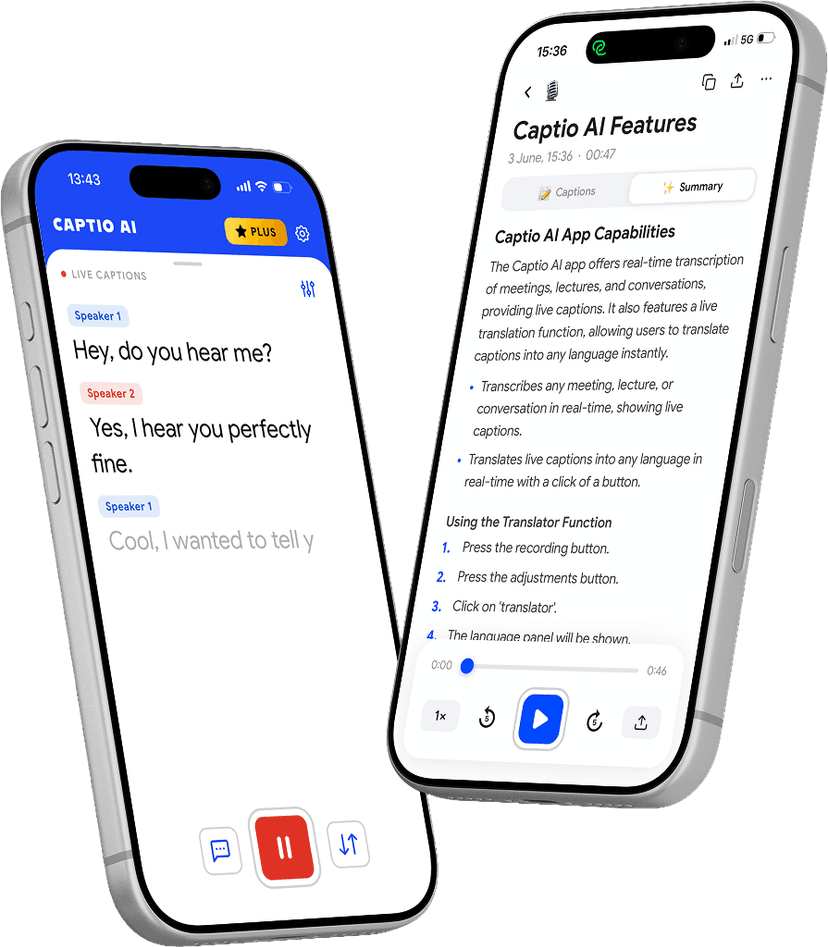
Everything you need to follow Kazakh lectures
Four tools built for deaf and hard of hearing Kazakh speakers.
Follow the lecture as it happens
- Captions appear word by word while the lecturer is still speaking
- Works in lecture halls, seminars, and tutorials
- No setup — place the phone on your desk and start
- Any accent, any pace
For courses in another language
- Captions and translates in real time
- For international students or foreign-language courses
- 60+ languages, no switching
- Follow the lecture in the language you read best
Full transcript to study from
- Record the lecture and upload it for a complete written transcript
- Searchable, copyable, shareable
- Review at your own pace after class
- Works on any lecture recording
Key points extracted automatically
- Important concepts and takeaways pulled from any transcript
- Organised into sections — not one continuous block
- Useful for revision and exam preparation
- Works on any saved lecture transcript
Download for free
Every situation covered
Designed for the real moments that matter — not just quiet controlled environments.
Large lecture halls at Nazarbayev University, KazNU, and universities in Almaty and Astana — Kazakh or Russian instruction at full academic pace. Captio AI captions the professor in real time.
Seminars and tutorial sessions where discussion moves freely between Kazakh and Russian. Captio AI captions both languages without manual switching.
Recorded lectures on university learning portals or uploaded as video files — play on speaker and Captio AI captions whatever is playing in real time.
Study groups in Almaty student accommodation reviewing lecture content in Kazakh and Russian. Captio AI captions whoever is speaking.
Lectures delivered in Kazakh by faculty from different regions — southern, western, or Shinjang Kazakh varieties. Captio AI handles regional accented Kazakh.
Online courses and webinars delivered in Kazakh by Kazakhstani institutions. Captio AI captions any audio source in real time.
Most accurate and fastest models
word accuracy
independent benchmark, 2025
real-time captions
first word appears as you speak
Download for free
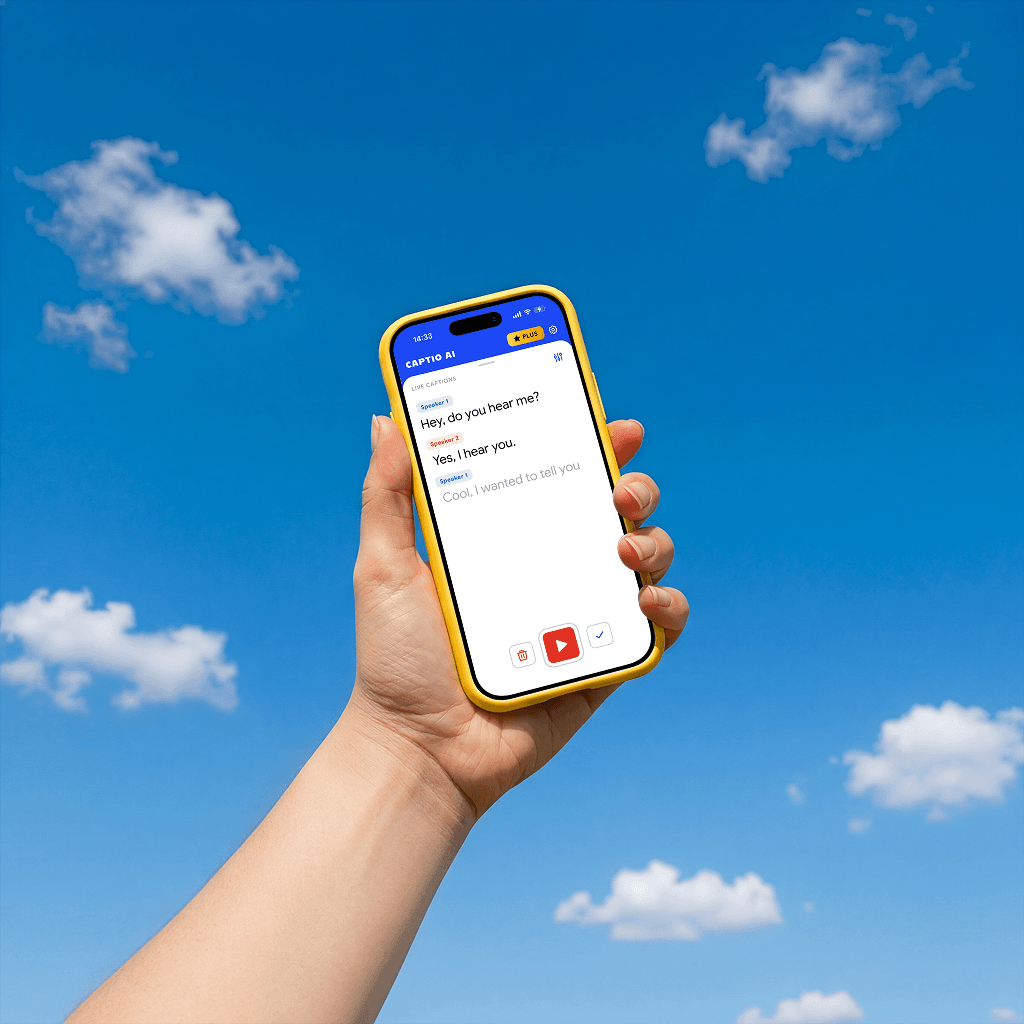
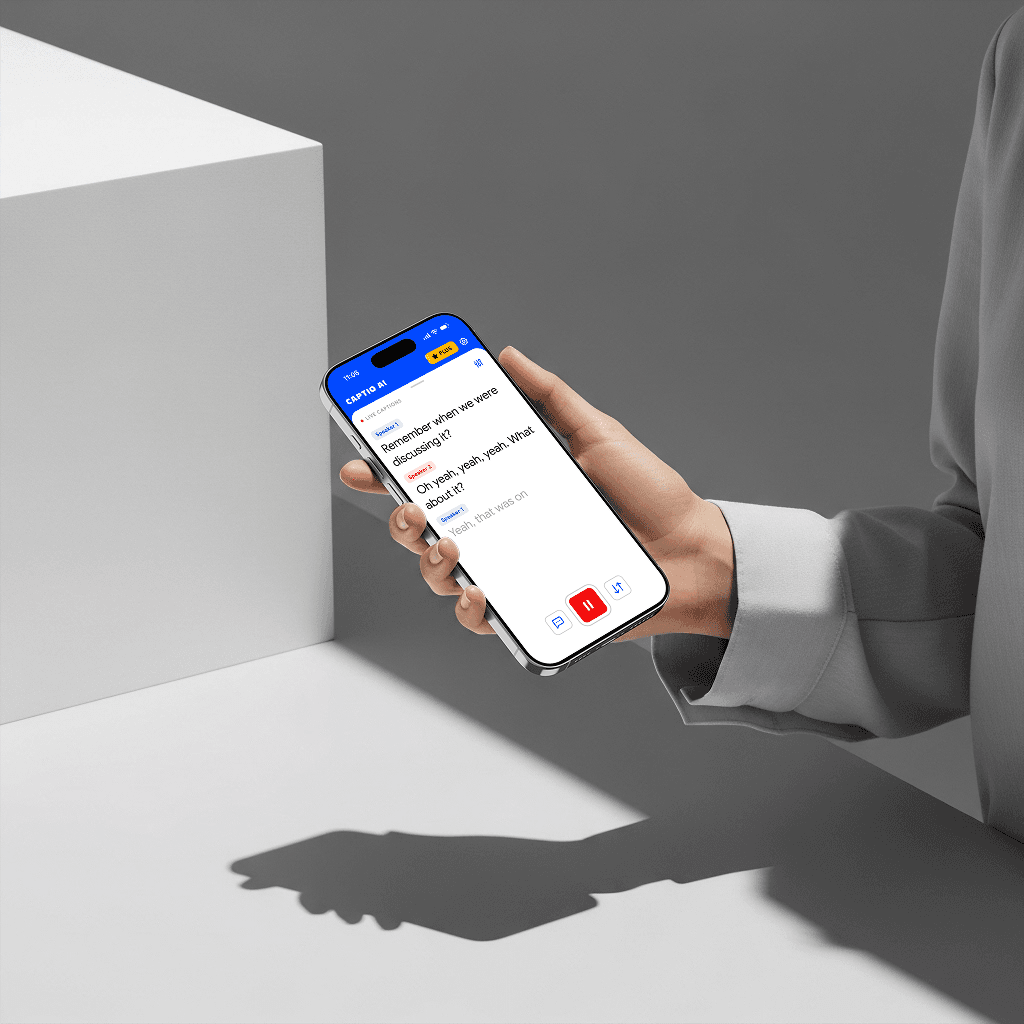
Built for the pace and pressure of a real lecture
Follow without splitting your attention
Lip-reading and note-taking at the same time is an impossible cognitive load. Captio AI handles the following so you can direct all your attention to understanding what is being said.
Captions while the lecturer is still speaking
Words appear on your screen as they are said — not after the sentence ends. You stay in sync with the lecture rather than always being a beat behind.
Works in any lecture setting
Lecture halls, seminar rooms, online classes, study groups. Place the phone on your desk, point it toward the audio source, and Captio AI handles the rest.
A full transcript to study from
Record the lecture and upload it to Audio Transcription after class. Get a complete written record you can search, annotate, and revise from — at your own pace.
60+ languages
For international students, students studying abroad, or courses taught in a second language. Captio AI captions or translates in real time with no manual setup.
No advance notice needed
Official university captioning requires booking in advance and is not available for every session. Captio AI works for any lecture, any time, with no prior arrangement.
Why Kazakh is hard to understand
Uvular consonants
- Kazakh /q/ and /ɢ/ are produced at the back of the throat — completely invisible
- Kazakh has uvular stops /q/ and /ɢ/ and uvular fricatives that occur in native words. These sounds are produced with the back of the tongue against the uvula — from the front, the lips barely move. In an Almaty or Astana lecture hall, the uvular consonants that distinguish word pairs are entirely invisible to a deaf student.
Vowel harmony compression
- Kazakh vowel harmony with 9 vowel phonemes — rounded vowels look alike at lecture speed
- Kazakh uses front-back and rounding vowel harmony across up to nine vowel phonemes. The rounded vowels /ø/, /y/, /o/, /u/ all require lip rounding, producing similar lip shapes at lecture speed. In fast academic Kazakh, the harmony cues that identify the word class collapse into one indistinct rounded lip position.
Kazakh-Russian switching
- Kazakh university lectures switch between Kazakh and Russian mid-sentence
- Kazakhstan is functionally bilingual. Lectures at Nazarbayev University, KazNU, or Almaty universities regularly switch between Kazakh and Russian — sometimes mid-sentence, sometimes by topic. For a deaf student, this means tracking two phonologically different languages simultaneously with no auditory warning of the switch.
Script transition load
- Kazakhstan's Cyrillic-to-Latin script transition creates inconsistent slide visuals
- Kazakhstan is transitioning its writing system from Cyrillic to Latin script. Lecture slides may use Cyrillic Kazakh, Latin Kazakh, or a mix within the same presentation. For a deaf student tracking lip movement and reading slides simultaneously, this visual inconsistency adds cognitive load on top of the phonological tracking task.
Fast academic delivery
- Fast Kazakh drops unstressed vowels — academic speech loses trackable syllable shapes
- At normal lecture pace, Kazakh unstressed short vowels reduce. The vowel harmony patterns most distinctive in slow speech — the patterns that let a deaf person predict word boundaries — compress at speed. A Kazakh academic delivering a full lecture at conversational pace produces lip shapes significantly different from careful speech.
Download for free
250,000 Kazakhstanis with hearing impairment — and 30 hours of sign language access per year
Approximately 150,000 Kazakhstanis are officially registered as having hearing impairments, but experts estimate the true figure may reach 250,000 — reflecting limited national screening coverage. A 2026 study published in Frontiers in Public Health examining hearing loss burden in Kazakhstan found that 20% of participants in a cross-sectional analysis had audiometrically confirmed hearing loss, with the prevalence rising sharply after age 60. The study found that mild impairment accounts for the largest share of the burden, suggesting that a significant portion of hearing-impaired Kazakhstanis receive no formal diagnosis or support.
Kazakhstan's disability support system classifies hearing-impaired people in the 'third group' of disability — the lowest category — which limits access to state housing support, certain benefits, and rehabilitation services. The government provides 30 hours of sign language interpretation per year, equivalent to two and a half hours per month. For a deaf or hard of hearing university student attending 20–30 hours of lectures per week, this allocation covers one afternoon of one week — and nothing after that.
Kazakhstan has invested in rehabilitation infrastructure — 12 regional centres are planned — but university-level academic access for deaf students is not a stated priority. Lectures at KazNU, Nazarbayev University, and regional universities are delivered in spoken Kazakh or Russian with no systematic captioning. For a deaf student in Almaty or Astana, every lecture is a high-stakes auditory environment with no fallback. Captio AI captions Kazakh and Russian lecture speech in real time, covering both languages of Kazakhstan's bilingual lecture halls.
[1]Burden of hearing loss in Kazakhstan — Frontiers in Public Health, 2026
[2]Kazakhstan's Deaf Population Works Toward Greater Integration — Astana Times, 2015
[3]Expert Says the Deaf Still Face Challenges in Kazakhstan — Astana Times, 2016
[4]GBD 2019 — Hearing loss prevalence and years lived with disability (PMC7960691)
Download for free
What you hear stays with you.
Gone the moment it ends
Captio AI processes your audio in real time and discards it immediately. Nothing is recorded. Nothing is kept.
Not a product
Your conversations are not something Captio AI sells, shares, or monetizes — to anyone, for any reason.
Not used to train anything
What you say in a doctor's appointment or a job interview never ends up in a training dataset. Not ours. Not anyone else's.

Private by default
Captio AI supports 60+ languages
Download for free
Frequently asked questions
Follow every lecture in Kazakh.
Captio AI is free to start
Download for free