

Galician live captions and productivity tool for lectures
For deaf and hard of hearing people.
Download for free


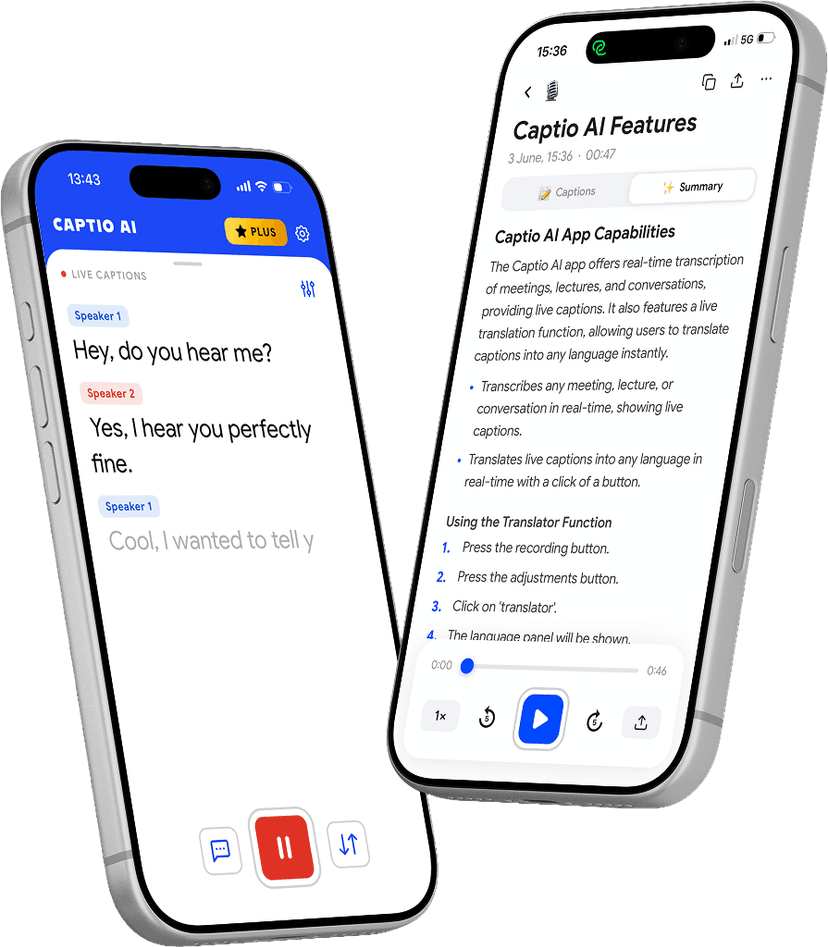
Everything you need to follow Galician lectures
Four tools built for deaf and hard of hearing Galician speakers.
Follow the lecture as it happens
- Captions appear word by word while the lecturer is still speaking
- Works in lecture halls, seminars, and tutorials
- No setup — place the phone on your desk and start
- Any accent, any pace
For courses in another language
- Captions and translates in real time
- For international students or foreign-language courses
- 60+ languages, no switching
- Follow the lecture in the language you read best
Full transcript to study from
- Record the lecture and upload it for a complete written transcript
- Searchable, copyable, shareable
- Review at your own pace after class
- Works on any lecture recording
Key points extracted automatically
- Important concepts and takeaways pulled from any transcript
- Organised into sections — not one continuous block
- Useful for revision and exam preparation
- Works on any saved lecture transcript
Download for free
Every situation covered
Designed for the real moments that matter — not just quiet controlled environments.
Large lecture halls at the Universidade de Santiago de Compostela — where courses in law, humanities, and sciences are delivered in Galician or Galician-Spanish mixed register, by lecturers from across Galicia with varying dialectal backgrounds.
Seminars and tutorial discussions at Galician universities — small group sessions where students and lecturers debate in Galician, shifting between formal academic Galician and colloquial varieties influenced by local dialects.
Online and recorded lectures on Galician university platforms — digital content delivered in Galician where gheada or seseo varieties create additional parsing challenges without captions.
Study groups in Santiago de Compostela, Vigo, and A Coruña — peer study sessions in conversational Galician, faster and more dialect-influenced than formal lecture language, mixing Galician and Spanish freely.
International courses at Galician institutions — where visiting professors from Spain or Portugal deliver presentations in Galician with non-standard vowel systems influenced by their own regional backgrounds.
Guest speakers and public lectures at Galician cultural institutions — writers, politicians, and researchers giving public talks in Galician, often broadcast on Galician public media.
Most accurate and fastest models
word accuracy
independent benchmark, 2025
real-time captions
first word appears as you speak
Download for free
Built for the pace and pressure of a real lecture
Follow without splitting your attention
Lip-reading and note-taking at the same time is an impossible cognitive load. Captio AI handles the following so you can direct all your attention to understanding what is being said.
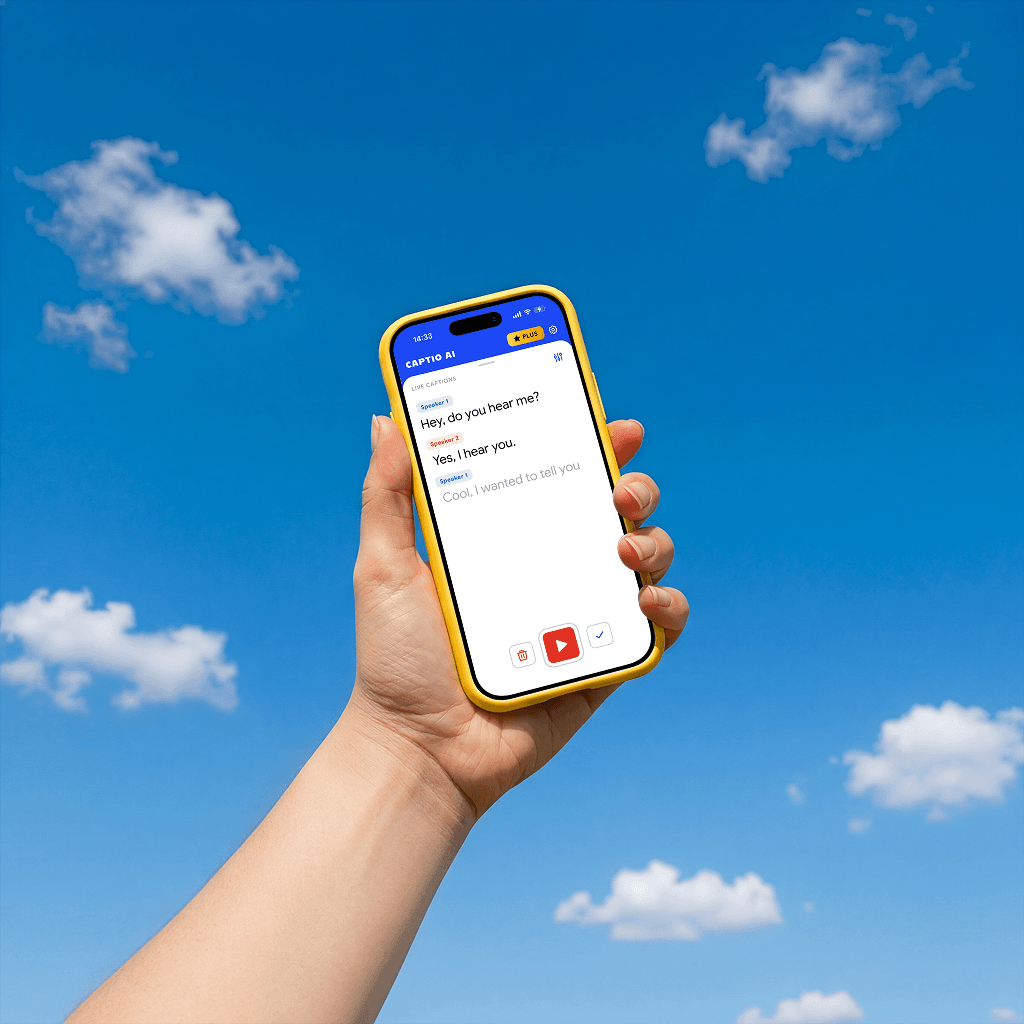
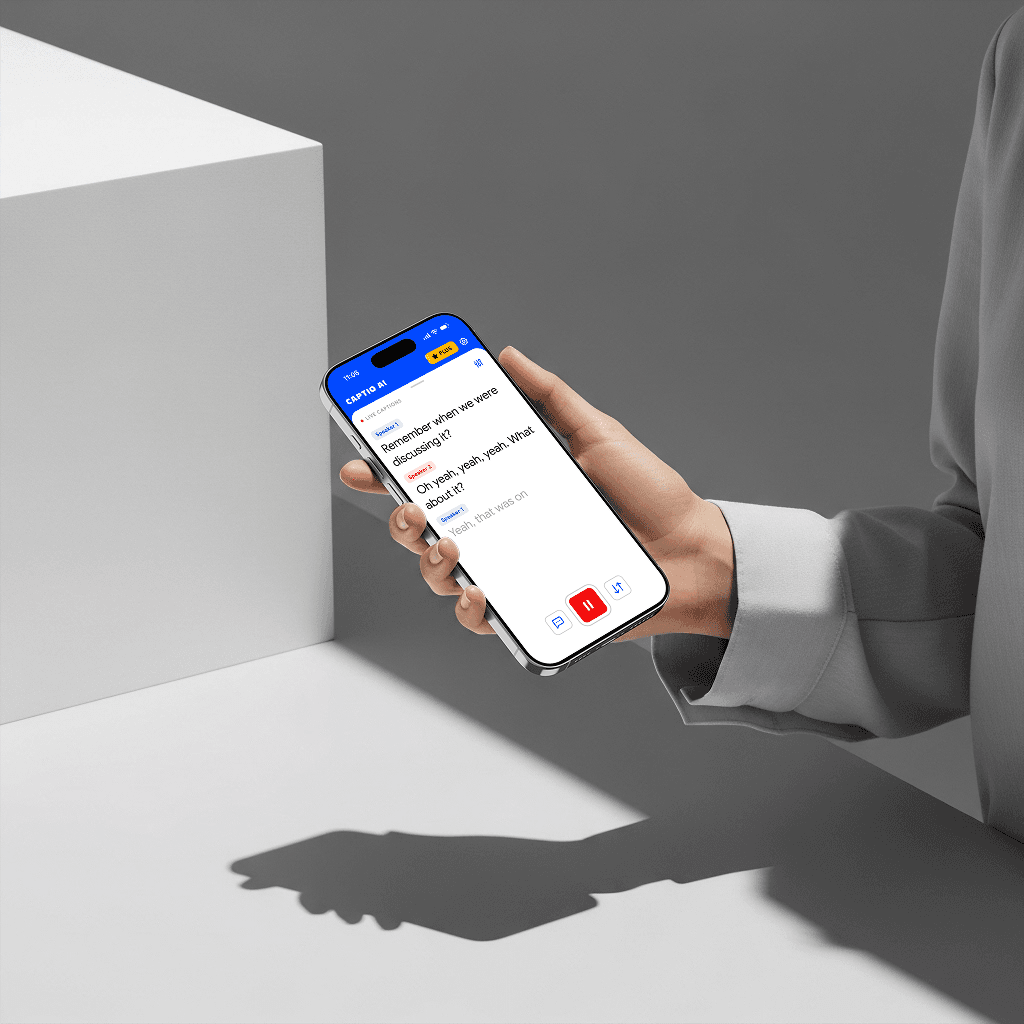
Captions while the lecturer is still speaking
Words appear on your screen as they are said — not after the sentence ends. You stay in sync with the lecture rather than always being a beat behind.
Works in any lecture setting
Lecture halls, seminar rooms, online classes, study groups. Place the phone on your desk, point it toward the audio source, and Captio AI handles the rest.
A full transcript to study from
Record the lecture and upload it to Audio Transcription after class. Get a complete written record you can search, annotate, and revise from — at your own pace.
60+ languages
For international students, students studying abroad, or courses taught in a second language. Captio AI captions or translates in real time with no manual setup.
No advance notice needed
Official university captioning requires booking in advance and is not available for every session. Captio AI works for any lecture, any time, with no prior arrangement.
Why Galician is hard to understand
Gheada
- In western Galician, /g/ becomes a throat fricative completely invisible from the lips
- Gheada is a prominent feature of western and coastal Galician where /g/ is realized as a voiceless fricative — variously [x], [h], or [ħ] — produced at the back of the throat or glottis. This sound has no visible lip, jaw, or dental contact. A deaf student at the Universidade de Santiago de Compostela whose lecturer comes from A Coruña or Pontevedra encounters gheada in words like galego, gato, or agosto — a throat-sound where their lip-reading schema expects a velar stop, completely invisible.
Seseo
- Seseo varieties collapse s/z/c/θ into one sibilant, eliminating a contrast with visible correlates
- Standard Galician distinguishes /s/ and /θ/, but seseo varieties — prevalent in rural and traditional speech — merge these into [s]. The distinction between the dental /θ/ and alveolar /s/ is partly visible (dental fricatives show more tongue-tip position), but in seseo varieties this contrast disappears entirely. A deaf student calibrated to standard Galician loses a tooth-lip cue they were relying on.
Nasal vowels
- Southern Galician varieties near Portugal include nasal vowels invisible from lip position
- Galician shares deep historical roots with Portuguese, and in border areas near the Minho river, spoken varieties include Portuguese-style nasal vowels. Nasal vowels are produced with the velum lowered — an adjustment entirely internal and invisible from the front. A deaf student from Ourense encountering a lecturer from border zones sees lip shapes consistent with oral vowels but hears nasal sounds, creating a systematic visual mismatch.
Galician–Spanish code-switching
- University lectures shift between Galician and Spanish within the same sentence
- In Galician universities, the language of instruction policy means many courses mix Galician and Spanish — especially when citing Spanish-language sources, addressing administrative topics, or quoting external researchers. Many Galician-Spanish code-switches involve shared cognates that look identical on the lips, giving the deaf student no visual signal that the language has changed.
Seven stressed vowels
- Galician has seven stressed vowels whose open/close distinctions compress visually at speed
- Galician has seven phonemically distinct stressed vowels — /a ɛ e i ɔ o u/ — where the mid-vowel distinctions between open /ɛ/ and close /e/, and between open /ɔ/ and close /o/, carry lexical information. At normal lecture pace, the jaw aperture differences between these pairs reduce, and a lip-reader has almost no visual basis to distinguish /ɛ/ from /e/ or /ɔ/ from /o/.
Download for free
Over a million deaf and hard of hearing people in Spain — and a Galician sign language community navigating fragmented interpreter provision
In Spain as a whole, approximately 1,064,000 people are deaf or have some hearing disability — 2.3% of the national population, according to the National Statistics Institute (INE EDAD 2008 survey). Within Galicia, the community of deaf and hard of hearing people is represented by FAXPG (Federación de Asociacións de Xordos e Xordas de Galicia), which advocates for Galician Sign Language (Lingua de Signos Galega, LSG) — a distinct sign language from the Castilian Spanish Sign Language (LSE) used in the rest of Spain. This linguistic distinctiveness fragments interpreter availability between two sign language systems in the same territory.
The 2007 Spanish Sign Languages Recognition Act recognised LSE and Catalan Sign Language at national level but created an ambiguous legal status for other regional sign languages including LSG. Galician deaf students in university settings may encounter institutions that provide LSE interpreters — interpreters of the wrong language — or no interpreters at all. The gap between the legal recognition of sign language and the practical availability of qualified academic interpreters in Galicia is substantial, and deaf students must often advocate individually for accommodations that are theoretically mandated.
For a deaf student at the Universidade de Santiago de Compostela following a lecture delivered in western Galician with gheada — a /g/ realized as a throat fricative entirely invisible to lip-readers — Captio AI provides real-time captions that resolve the phonological features of Galician that make even partial hearing essential for comprehension, making lectures and seminars fully accessible.
Download for free
What you hear stays with you.
Gone the moment it ends
Captio AI processes your audio in real time and discards it immediately. Nothing is recorded. Nothing is kept.
Not a product
Your conversations are not something Captio AI sells, shares, or monetizes — to anyone, for any reason.
Not used to train anything
What you say in a doctor's appointment or a job interview never ends up in a training dataset. Not ours. Not anyone else's.

Private by default
Captio AI supports 60+ languages
Download for free
Frequently asked questions
Follow every lecture in Galician.
Captio AI is free to start
Download for free