

Tagalog live captions and productivity tool for meetings
For deaf and hard of hearing people.
Download for free


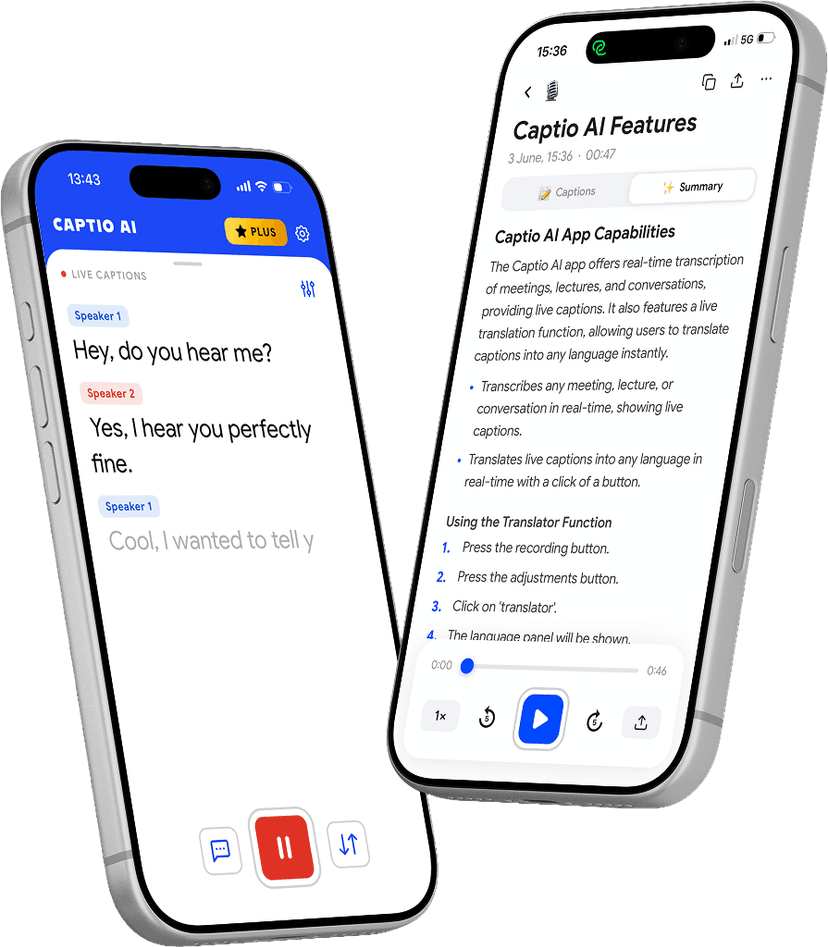
Everything you need to follow Tagalog meetings
Four tools built for deaf and hard of hearing Tagalog speakers.
Follow the meeting as it happens
- Captions appear word by word while speakers are still talking
- Works in conference rooms, boardrooms, and open offices
- Handles fast-paced discussion and multiple speakers
- No setup — place the phone on the table and start
International and multilingual meetings
- Each person speaks their own language
- You read in yours, in real time
- 60+ languages, no mode switching
- Handles mid-sentence language changes
Full transcript after the meeting
- Upload the recording and get a complete written transcript
- Organised by speaker — know exactly who said what
- Review decisions and action items at your own pace
- Searchable, copyable, shareable
Decisions and action items, extracted
- Key points and decisions pulled from any transcript
- Action items surfaced automatically
- Organised into sections — not one continuous block
- Works on any Captio AI meeting transcript
Download for free
Every situation covered
Designed for the real moments that matter — not just quiet controlled environments.
Daily stand-ups and pulong ng team in Filipino offices where updates come in Filipino or English. Captio AI captions each speaker so you follow every item.
Zoom or Teams calls with colleagues locally or with international BPO clients. Put the call on speaker and read captions in real time.
Performance reviews and one-on-one sessions with a supervisor. Important conversations in Philippine corporate culture where every instruction matters. Captio AI transcribes everything.
Company-wide pulong where management addresses all staff. Captio AI captions every word from any seat.
Meetings that mix Filipino and English — standard across Manila's BPO and corporate sector. Live Translator also covers fully cross-language calls.
Merienda break conversations, desk-side questions, corridor catch-ups. The informal moments in Filipino workplaces where working relationships are built. Captio AI covers those too.
Most accurate and fastest models
word accuracy
independent benchmark, 2025
real-time captions
first word appears as you speak
Download for free
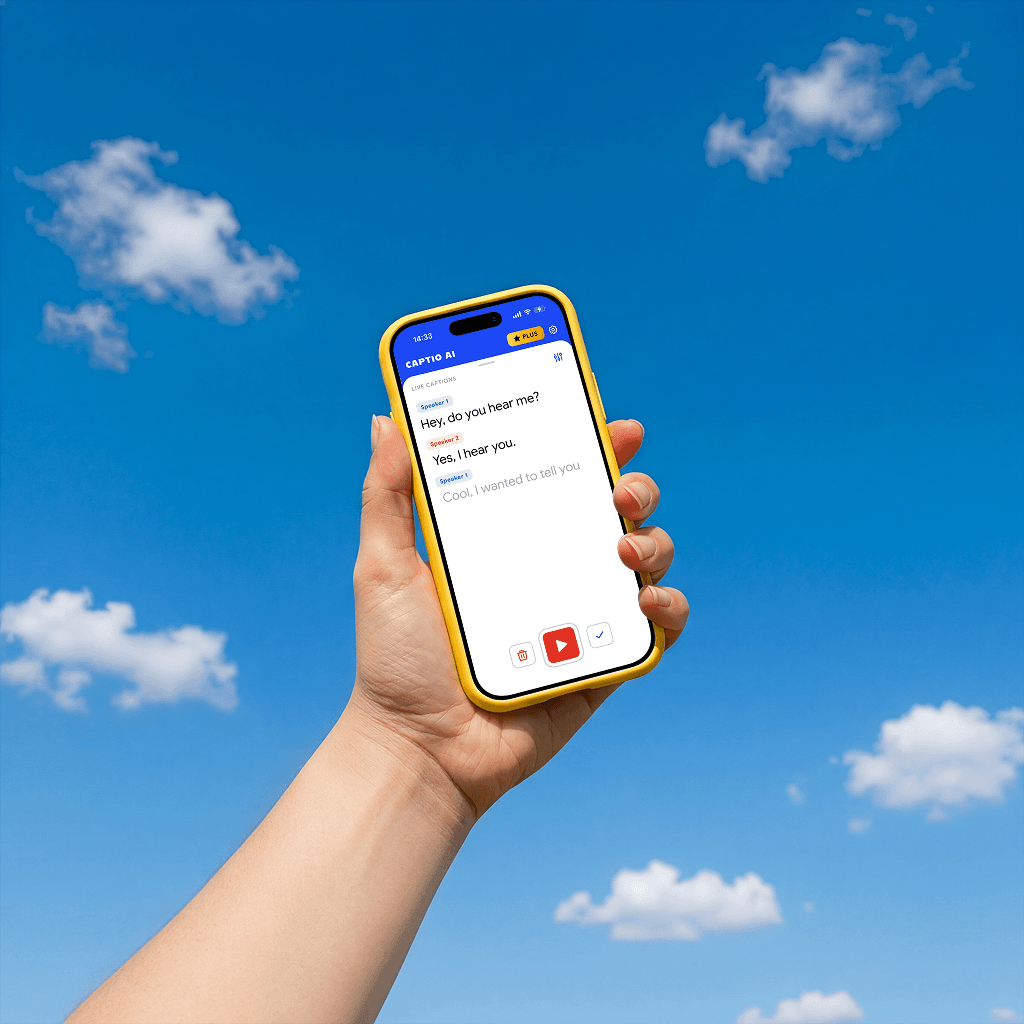
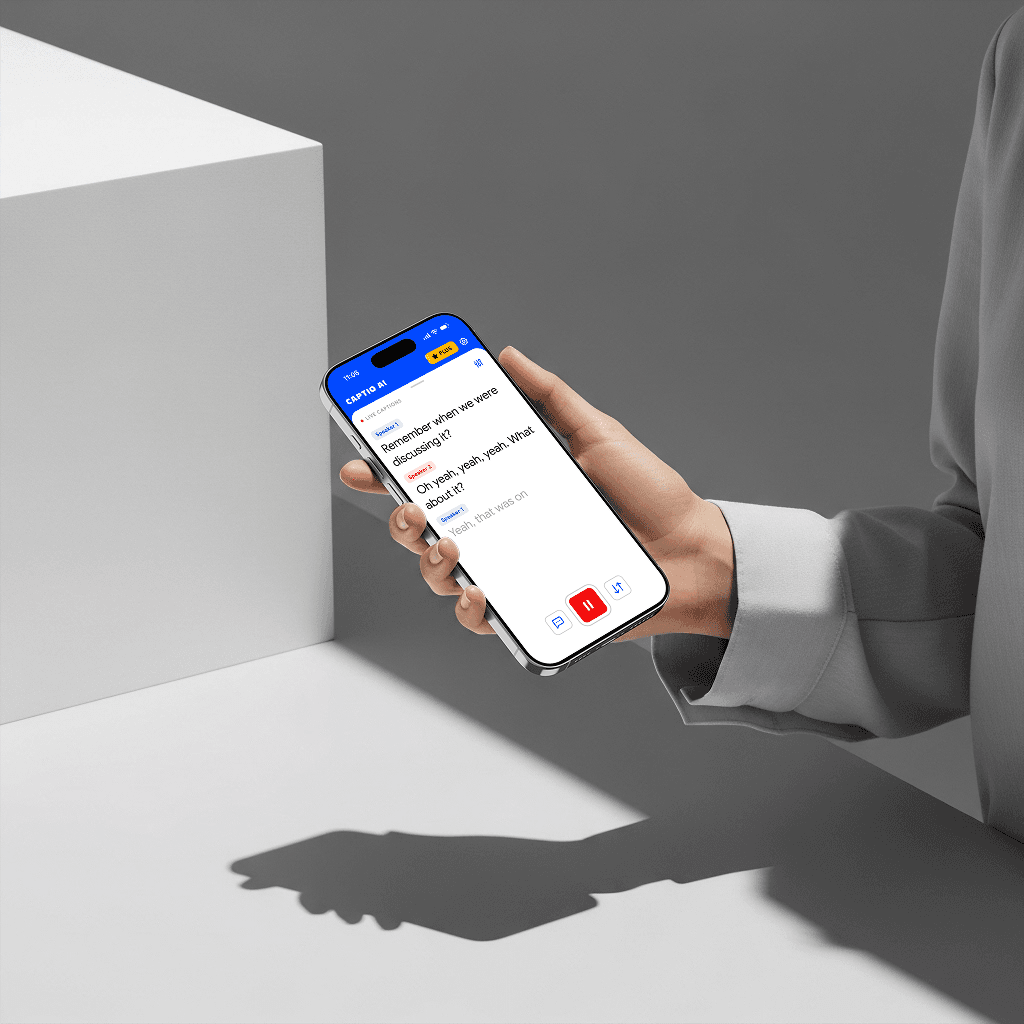
Built for the speed of a real meeting
Captions while they are still speaking
Words appear on screen as each person talks — not after they finish. You read what someone is saying at the same moment everyone else hears it.
Works in any meeting format
Conference rooms, open-plan offices, video calls, all-hands. Place the phone on the table or hold it — Captio AI handles the rest.
Handles fast speech and crosstalk
Captio AI is designed for real meetings, not controlled dictation. It follows whoever is speaking loudest at any moment, keeping up with the natural pace of discussion.
No setup, no explaining
Open the app and place the phone. No pairing, no telling colleagues what you are doing, no requesting anything from the meeting organiser.
Review everything after
Record the meeting and upload it to Audio Transcription for a full written record. Use AI Summary to extract decisions and action items so nothing from the meeting gets lost.
60+ languages
For international teams, multilingual meetings, or colleagues who switch between languages mid-discussion. No setup required — Captio AI detects and captions in real time.
Why Tagalog is hard to understand
Code-switching
- Filipino meetings shift between Tagalog and English mid-sentence, creating a two-language comprehension gap
- Taglish — the fluid Tagalog–English code-switching used in every Filipino workplace — means a single sentence can begin in Tagalog and end in English, with no warning. For a deaf or hard of hearing person, the visual cues shift registers mid-utterance with no transition signal.
Glottal stops
- Final glottal stops and vowel-final syllables collapse into silence at word boundaries
- Tagalog words commonly end in glottal stops which produce no visible lip movement. At natural meeting pace, these boundaries vanish entirely, making word segmentation from visual cues alone nearly impossible — a sentence at speed looks like a continuous flow of open vowel positions with no separating edges.
Stress ambiguity
- Minimal stress pairs in Tagalog change meaning but produce no visible lip difference
- Word-level stress in Tagalog distinguishes meaning — 'báta' (child) vs 'batà' (robe). But stress falls on segments that look identical on the lips, so a deaf lip-reader cannot resolve these minimal pairs from visual cues in a fast-moving meeting.
D/R merger
- The phonemic /d/–/ɾ/ distinction used in formal speech disappears in casual meeting Tagalog
- Standard Tagalog maintains a distinction between /d/ and the alveolar flap /ɾ/, but in natural conversational speech — especially in meetings run at speed — the distinction collapses. A hard of hearing person familiar with careful Tagalog must recalibrate for the fast-speech variant used by colleagues in a briefing.
Regional accent mix
- Philippine workplaces include speakers from Cebu, Davao, and the Ilocos whose Tagalog carries regional phonology that standard lip-reading doesn't cover
- Workplaces in Manila and major Philippine cities frequently include speakers whose Tagalog carries Cebuano, Ilokano, or Hiligaynon phonological influence — different vowel quality, different rhythm, different consonant realisations. A deaf person lip-reading a meeting with four different regional Tagalog accents faces a moving target.
Download for free
Hearing loss and workplace exclusion in the Philippines
As of March 2022, approximately 1.44 million people in the Philippines — 1.57% of the total population — live with a hearing disability, according to the Philippine Statistics Authority. A 2020 national survey published in the Asia Pacific Journal of Public Health found the overall prevalence of moderate or worse hearing loss at 15% across all ages, rising to 49.1% in adults aged 65 and over. These figures are among the highest recorded in Southeast Asia, driven in part by elevated rates of untreated otitis media — particularly in lower-income and rural communities — that go unmanaged due to socioeconomic barriers.
Despite legal protections under the Magna Carta for Persons with Disabilities, the economic reality for deaf Filipinos in the workplace remains severe. Research from the Institute of Developing Economies found that most deaf Filipinos without higher education struggle to find stable employment, with estimated daily earnings for deaf workers at P35–P60 compared with a national average of P290 for hearing workers. Employers in the Philippines consistently report preferring other disability profiles over deaf applicants, citing communication barriers as the primary reason — barriers that inclusive meeting tools directly address.
The Philippines' BPO and technology sectors have grown into one of the largest in Asia, but workplace accessibility has not kept pace. Meeting formats in corporate Manila are heavily verbal and multilingual — formal English documentation followed by Tagalog discussion — with no standardised captioning provision. Filipino deaf advocacy organisations have identified the absence of sign language interpretation or real-time captioning as the most commonly cited barrier to professional advancement, particularly in meeting-heavy corporate roles.
Download for free
What you hear stays with you.
Gone the moment it ends
Captio AI processes your audio in real time and discards it immediately. Nothing is recorded. Nothing is kept.
Not a product
Your conversations are not something Captio AI sells, shares, or monetizes — to anyone, for any reason.
Not used to train anything
What you say in a doctor's appointment or a job interview never ends up in a training dataset. Not ours. Not anyone else's.

Private by default
Captio AI supports 60+ languages
Download for free
Frequently asked questions
Follow every word in Tagalog.
Captio AI is free to start
Download for free