

Hebrew live captions and productivity tool for meetings
For deaf and hard of hearing people.
Download for free
Everything you need to follow Hebrew meetings
Four tools built for deaf and hard of hearing Hebrew speakers.
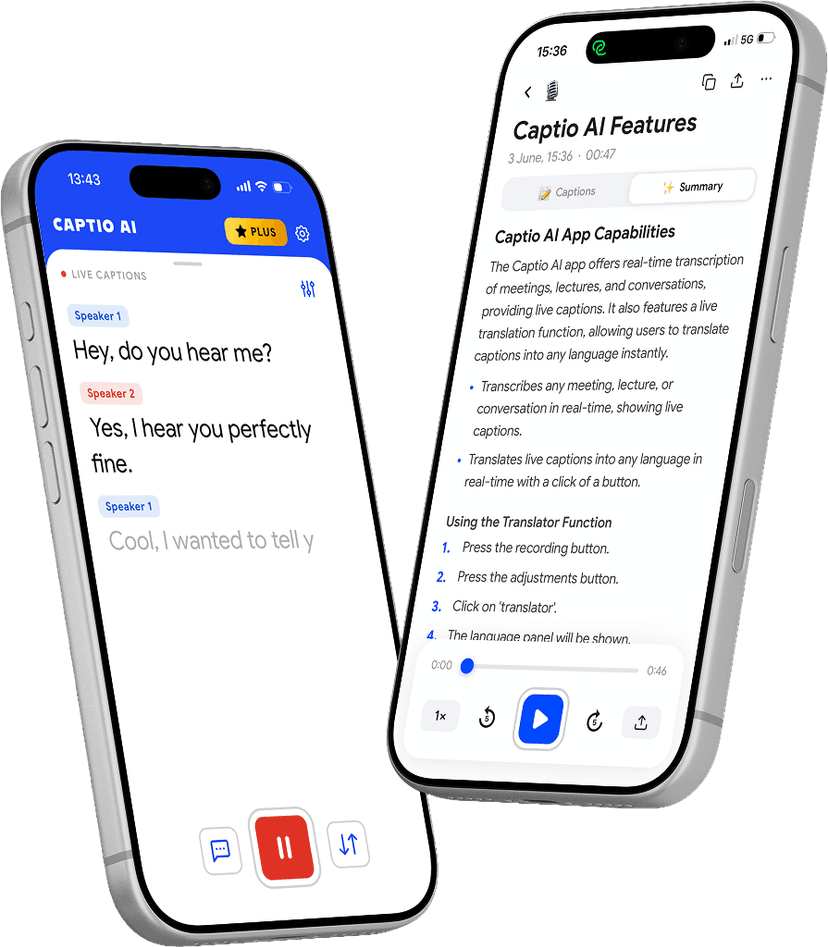
Follow the meeting as it happens
- Captions appear word by word while speakers are still talking
- Works in conference rooms, boardrooms, and open offices
- Handles fast-paced discussion and multiple speakers
- No setup — place the phone on the table and start
International and multilingual meetings
- Each person speaks their own language
- You read in yours, in real time
- 60+ languages, no mode switching
- Handles mid-sentence language changes
Full transcript after the meeting
- Upload the recording and get a complete written transcript
- Organised by speaker — know exactly who said what
- Review decisions and action items at your own pace
- Searchable, copyable, shareable
Decisions and action items, extracted
- Key points and decisions pulled from any transcript
- Action items surfaced automatically
- Organised into sections — not one continuous block
- Works on any Captio AI meeting transcript
Download for free
Every situation covered
Designed for the real moments that matter — not just quiet controlled environments.
Daily stand-ups and פגישות צוות in Israeli offices where updates come quickly in Hebrew. Captio AI captions each speaker so you follow every item.
Zoom or Teams calls with colleagues locally or internationally. Put the call on speaker and read captions in real time.
שיחות הערכה and one-on-one sessions with a מנהל. Important conversations in Israeli corporate culture where directness and precision matter. Captio AI transcribes everything.
Company-wide כינוסים where management addresses all staff. Captio AI captions every word from any seat.
Meetings that mix Hebrew and English — standard in Tel Aviv's tech sector. Live Translator follows any switch in real time.
Coffee break conversations, desk-side questions, corridor catch-ups. The informal moments in Israeli offices where working relationships are built. Captio AI covers those too.
Most accurate and fastest models
word accuracy
independent benchmark, 2025
real-time captions
first word appears as you speak
Download for free
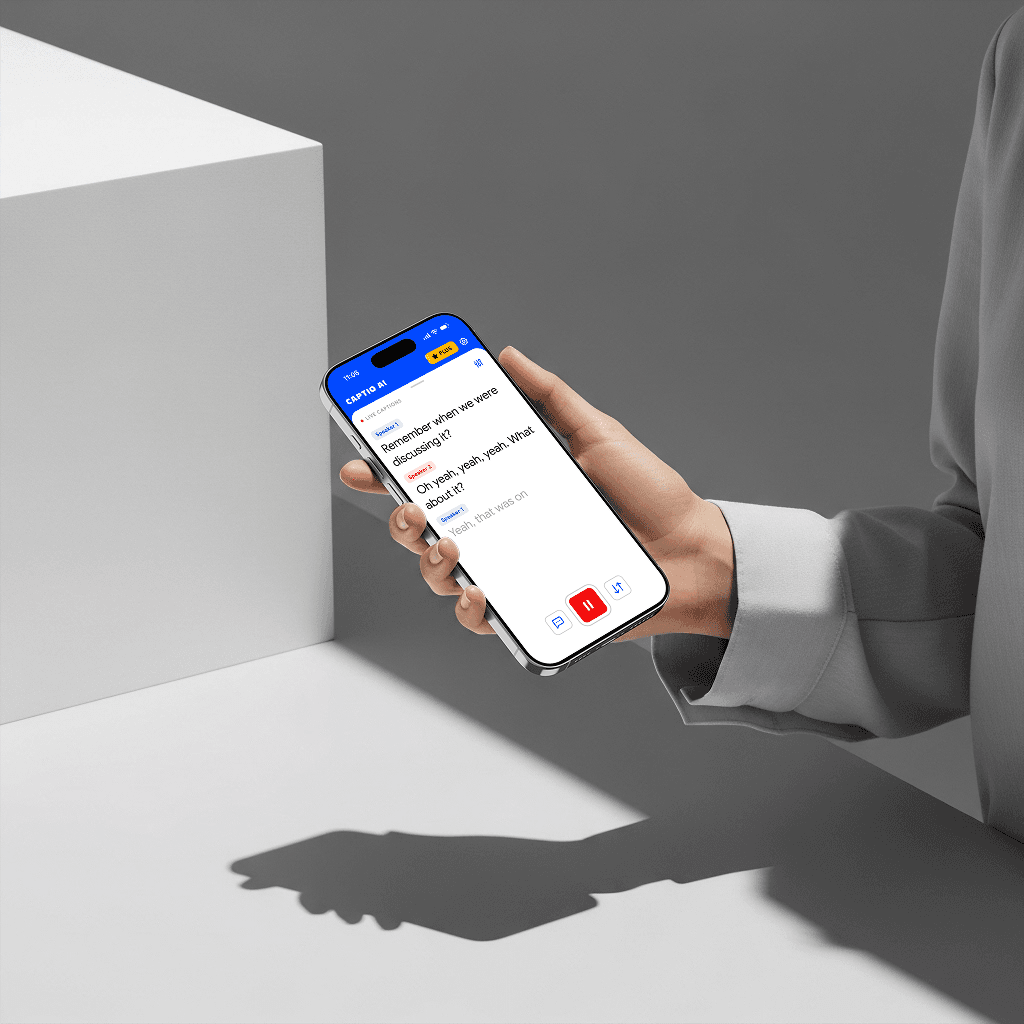
Built for the speed of a real meeting
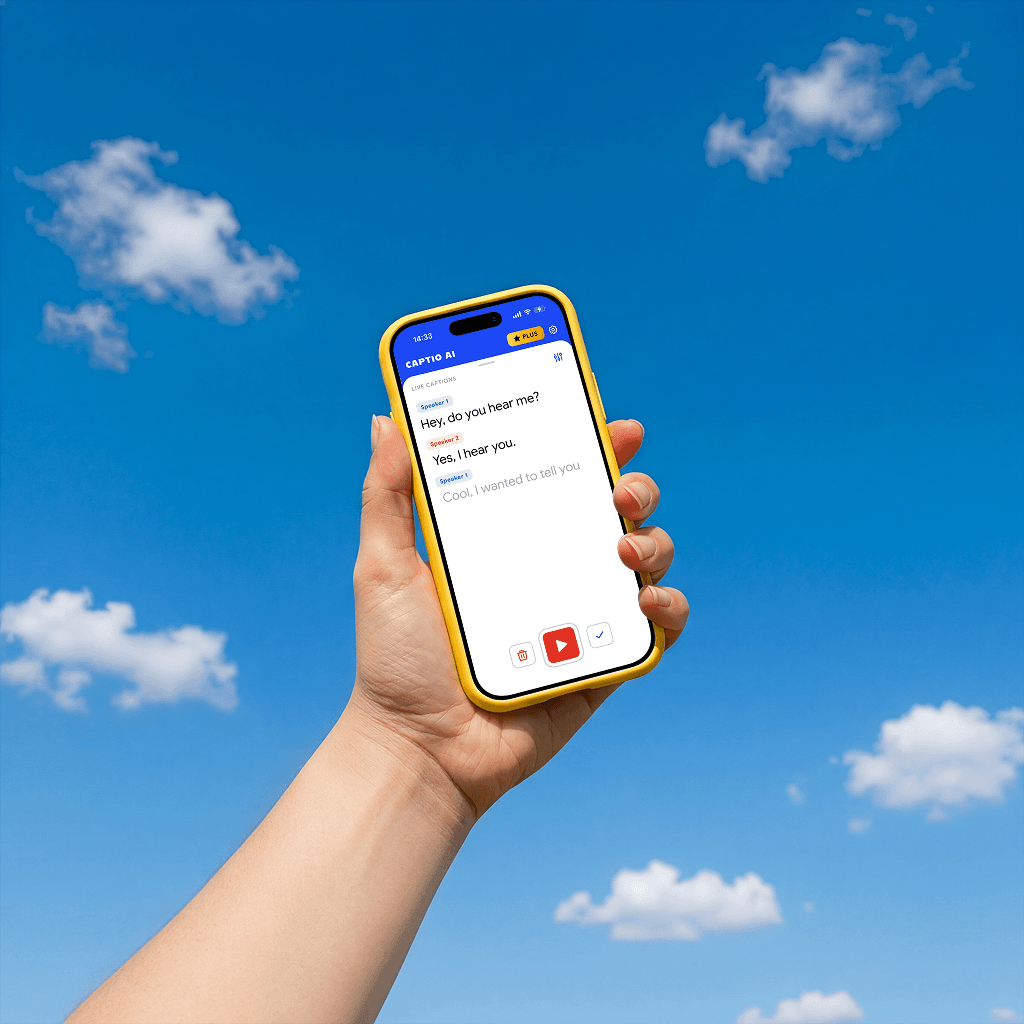
Captions while they are still speaking
Words appear on screen as each person talks — not after they finish. You read what someone is saying at the same moment everyone else hears it.
Works in any meeting format
Conference rooms, open-plan offices, video calls, all-hands. Place the phone on the table or hold it — Captio AI handles the rest.
Handles fast speech and crosstalk
Captio AI is designed for real meetings, not controlled dictation. It follows whoever is speaking loudest at any moment, keeping up with the natural pace of discussion.
No setup, no explaining
Open the app and place the phone. No pairing, no telling colleagues what you are doing, no requesting anything from the meeting organiser.
Review everything after
Record the meeting and upload it to Audio Transcription for a full written record. Use AI Summary to extract decisions and action items so nothing from the meeting gets lost.
60+ languages
For international teams, multilingual meetings, or colleagues who switch between languages mid-discussion. No setup required — Captio AI detects and captions in real time.
Why Hebrew is hard to understand
Pharyngeal consonants
- Hebrew's /ħ/ (ח), /ʕ/ (ע), and /ʁ/ (ר) are produced deep in the throat with no visible lip or tooth movement
- Classical Hebrew distinguishes pharyngeal /ħ/ and /ʕ/ and uvular /ʁ/ — sounds produced at the back of the throat with the lips and teeth completely uninvolved. In formal boardroom Hebrew these consonants remain phonemically active. For a deaf or hard of hearing person lip-reading a colleague in a Hebrew meeting, these consonants — which appear in common words — are acoustically prominent but entirely invisible.
Trilateral root system
- Hebrew's consonant-root morphology means the same three-consonant lip-shape frame means different things depending on the vowel pattern applied
- Hebrew words are built from three-consonant roots that carry core meaning, with vowels and prefixes added around them. In a meeting, a deaf lip-reader sees the consonant frame of a word but cannot determine which vowel pattern was applied — and the vowel pattern is the difference between 'shomer' (guard, noun), 'shmar' (he guarded, verb), and 'leeshmor' (to guard, infinitive). All three share the same consonant skeleton but mean different things.
Vowelless meeting text
- Meeting documents, slides, and notes in Hebrew are unvocalised — no vowels are written — making written backup ambiguous for a deaf attendee
- Standard written Hebrew for adults omits vowel marks (nikud) from everyday text. In a meeting, a deaf or hard of hearing person who relies on slide text to supplement what they see on the speaker's lips encounters a second layer of ambiguity: the written word has no vowels, so they cannot use the text to resolve what they saw on the lips. The two channels that supplement each other in other languages offer only partial signals in Hebrew.
Heritage pronunciation divergence
- Israeli Hebrew, Ashkenazi Hebrew, and Mizrahi Hebrew differ in consonant realisation — the same word sounds different depending on the speaker's background
- Israeli Standard Hebrew has merged some consonant distinctions that Ashkenazi and Mizrahi varieties maintain. In a meeting with speakers from different heritage backgrounds, the same vocabulary word may be pronounced with different consonants depending on whether the speaker's Mizrahi heritage preserves /ħ/ distinctly or their Ashkenazi heritage realises it as /x/. For a deaf lip-reader, these phonological differences map to different visual patterns for the same word.
Fast Tel Aviv speech reduction
- Casual Israeli Hebrew in a startup meeting drops unstressed syllables and word endings in ways that remove grammatical markers from the visual stream
- In fast casual Israeli Hebrew — the register of a Tel Aviv standup — function words reduce heavily, word-final syllables elide, and sentence rhythm accelerates. A deaf or hard of hearing person familiar with careful formal Hebrew encounters a spoken register at meeting pace where grammatical markers, negations, and prepositions have been phonologically swallowed — making grammatical structure unavailable from visual cues.
Download for free
Hearing loss and workplace exclusion in Israel
Israel's Central Bureau of Statistics reported in 2022 that more than 55,000 people with hearing impairments live in Israel, with approximately 10,000 profoundly deaf and a further 150,000 to 200,000 estimated as hard of hearing. Israeli Sign Language (ISL) is the primary language of most deaf Israelis and serves as the main mode of communication across Jewish, Muslim, Christian Arab, Druze, and Bedouin deaf communities. While the government took steps in 2020 to establish a Hebrew Language Academy unit to develop and preserve ISL, formal legislative recognition through the Knesset — which advanced a bill to recognise ISL as the first language of deaf people — has lagged behind the community's needs.
The Equal Rights for People with Disabilities Law requires Israeli employers to provide reasonable accommodations for deaf workers, including assistive technologies, written communication alternatives, and sign language interpreters. However, deaf advocacy organisations in Israel consistently document a gap between legal entitlement and implementation: a large majority of deaf Israelis still experience difficulties with job placement due to employer misconceptions about communication ability and fear of communication complications in team settings — particularly meetings. This gap is most acute in Israel's high-growth tech and startup sector, where fast-paced verbal communication is the dominant meeting style.
Israel's technology sector — one of the highest-density startup ecosystems globally, anchored in Tel Aviv and spanning Haifa's tech corridor — conducts its meetings in a fast, code-switching mix of Hebrew and English that no standard captioning tool was designed for. Research on Hebrew readers with hearing impairment from Springer's Reading and Writing journal documented specific difficulties with Hebrew's unvocalised written text as a comprehension challenge. For a deaf professional in a Hebrew startup, the combination of consonant-heavy root morphology, vowelless written backup, and dense English code-switching creates a compound accessibility challenge unique to this language and setting.
Download for free
What you hear stays with you.
Gone the moment it ends
Captio AI processes your audio in real time and discards it immediately. Nothing is recorded. Nothing is kept.
Not a product
Your conversations are not something Captio AI sells, shares, or monetizes — to anyone, for any reason.
Not used to train anything
What you say in a doctor's appointment or a job interview never ends up in a training dataset. Not ours. Not anyone else's.

Private by default
Captio AI supports 60+ languages
Download for free
Frequently asked questions
Follow every word in Hebrew.
Captio AI is free to start
Download for free