

Belarusian live captions and productivity tool for meetings
For deaf and hard of hearing people.
Download for free


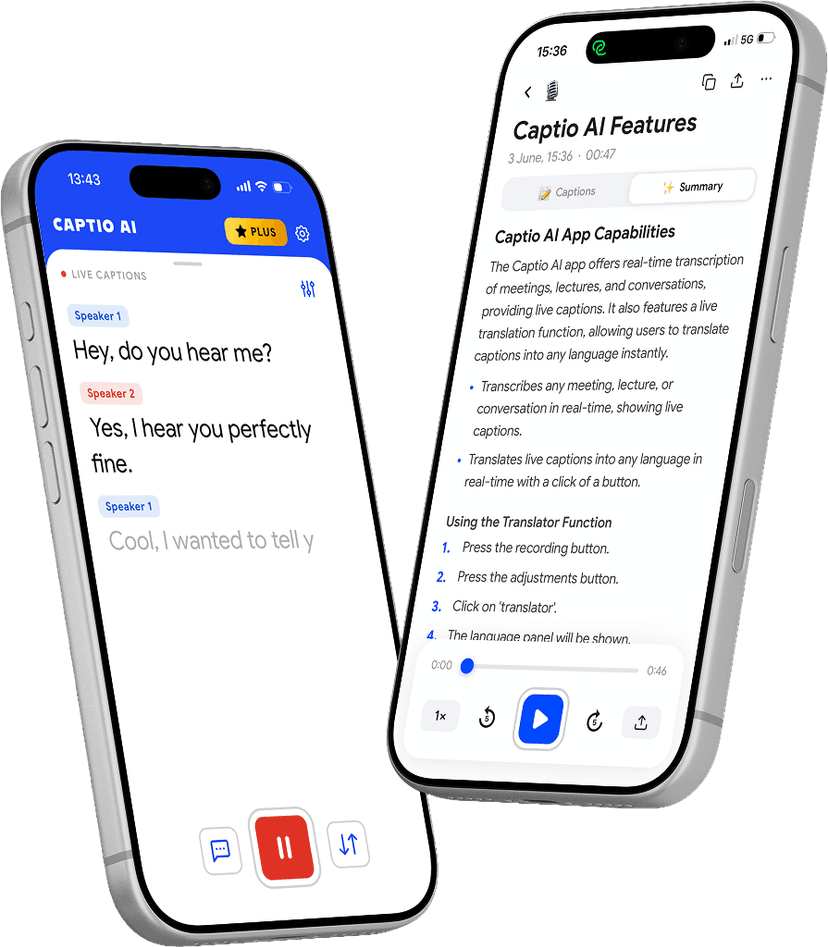
Everything you need to follow Belarusian meetings
Four tools built for deaf and hard of hearing Belarusian speakers.
Follow the meeting as it happens
- Captions appear word by word while speakers are still talking
- Works in conference rooms, boardrooms, and open offices
- Handles fast-paced discussion and multiple speakers
- No setup — place the phone on the table and start
International and multilingual meetings
- Each person speaks their own language
- You read in yours, in real time
- 60+ languages, no mode switching
- Handles mid-sentence language changes
Full transcript after the meeting
- Upload the recording and get a complete written transcript
- Organised by speaker — know exactly who said what
- Review decisions and action items at your own pace
- Searchable, copyable, shareable
Decisions and action items, extracted
- Key points and decisions pulled from any transcript
- Action items surfaced automatically
- Organised into sections — not one continuous block
- Works on any Captio AI meeting transcript
Download for free
Every situation covered
Designed for the real moments that matter — not just quiet controlled environments.
Daily камандныя нарады and stand-ups in Belarusian offices where updates come in Belarusian or Russian. Captio AI captions each speaker so you follow every item.
Zoom or Teams calls with colleagues locally or internationally. Put the call on speaker and read captions in real time.
Performance reviews and one-on-one sessions with a кіраўнік. Important conversations where every word matters. Captio AI transcribes everything.
Company-wide агульныя сходы where management addresses all staff. Captio AI captions every word from any seat.
Meetings that mix Belarusian, Russian, and English. Live Translator follows any switch in real time.
Tea break conversations, desk-side questions, corridor catch-ups. The informal moments in Belarusian workplaces where working relationships are built. Captio AI covers those too.
Most accurate and fastest models
word accuracy
independent benchmark, 2025
real-time captions
first word appears as you speak
Download for free
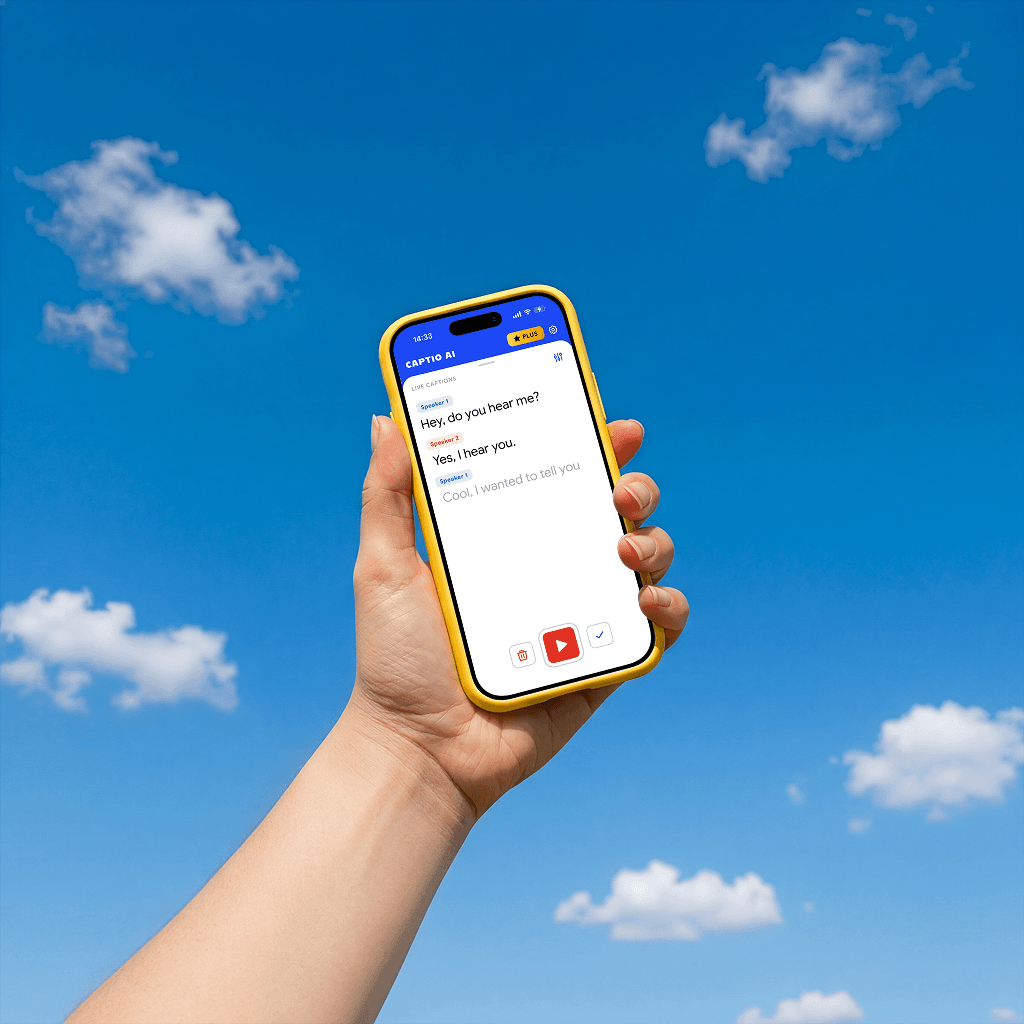
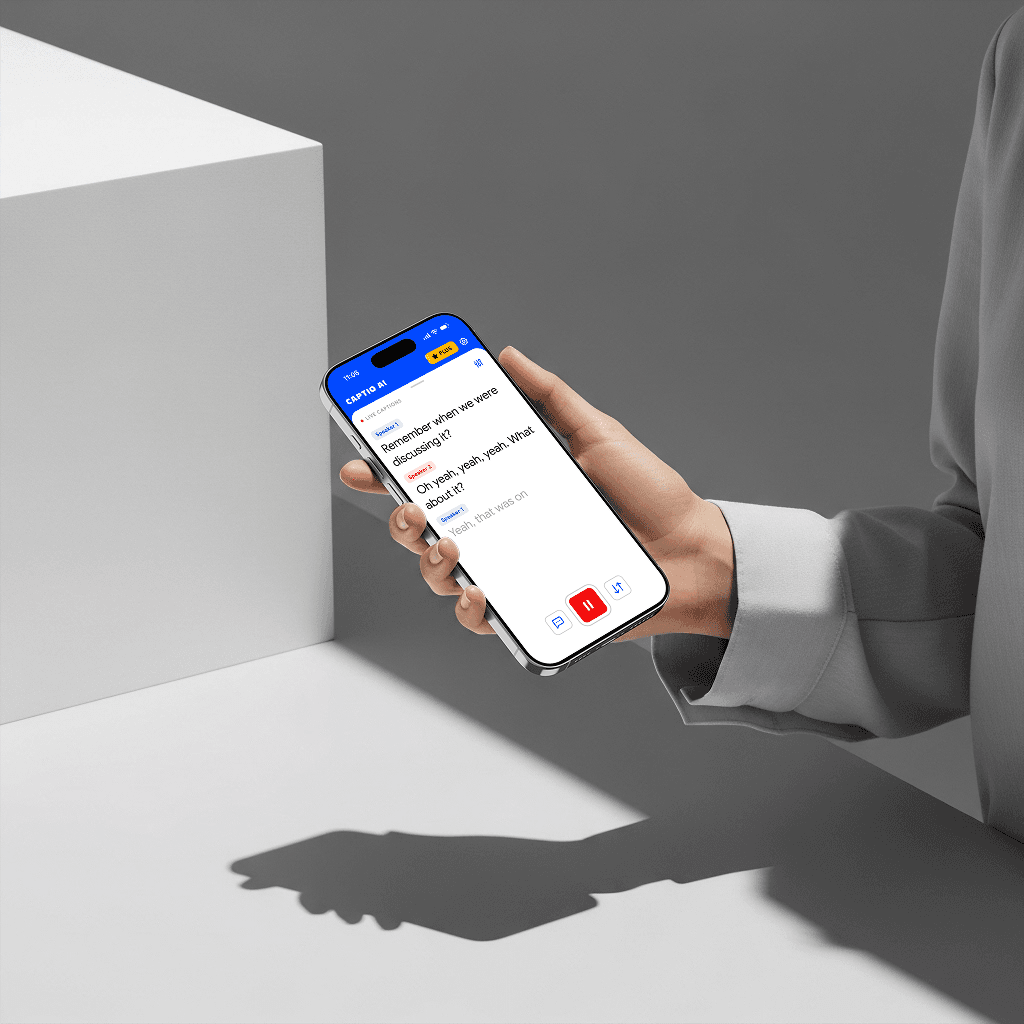
Built for the speed of a real meeting
Captions while they are still speaking
Words appear on screen as each person talks — not after they finish. You read what someone is saying at the same moment everyone else hears it.
Works in any meeting format
Conference rooms, open-plan offices, video calls, all-hands. Place the phone on the table or hold it — Captio AI handles the rest.
Handles fast speech and crosstalk
Captio AI is designed for real meetings, not controlled dictation. It follows whoever is speaking loudest at any moment, keeping up with the natural pace of discussion.
No setup, no explaining
Open the app and place the phone. No pairing, no telling colleagues what you are doing, no requesting anything from the meeting organiser.
Review everything after
Record the meeting and upload it to Audio Transcription for a full written record. Use AI Summary to extract decisions and action items so nothing from the meeting gets lost.
60+ languages
For international teams, multilingual meetings, or colleagues who switch between languages mid-discussion. No setup required — Captio AI detects and captions in real time.
Why Belarusian is hard to understand
Akanye vowel reduction
- Belarusian akanye reduces unstressed /o/ to /a/ throughout the language — massively neutralizing vowel shapes in every sentence of a meeting
- Belarusian akanye is a pervasive phonological process where unstressed /o/ reduces to /a/. In natural speech — including in meetings — this means a large proportion of the vowels in every sentence take a single open /a/ position regardless of the word's orthographic vowel. A deaf or hard of hearing person lip-reading a Belarusian speaker sees many more /a/ positions than the written words would suggest, creating systematic word misidentification.
Palatalization density
- Belarusian has approximately 39 consonants — the densest palatalization system among East Slavic languages — with hard/soft pairs invisible on the lips
- Belarusian's consonant system includes a comprehensive set of hard/soft (palatalized) consonant pairs — distinguished acoustically by second-formant transitions that produce no visible lip change. In a meeting, every palatalized consonant looks identical to its hard counterpart from the front — meaning a deaf lip-reader misses a systematic phonemic layer that native speakers follow acoustically without effort.
Trasianka code-mixing
- Trasianka — the Belarusian-Russian mixed register used in most professional settings — combines two phonological systems without visual transition
- Most Belarusian professional communication occurs in Trasianka — a mixed code blending Belarusian and Russian grammar, vocabulary, and phonology. In a meeting, a speaker may use Russian-influenced vocabulary with Belarusian phonology, or vice versa, in the same sentence. A deaf person lip-reading either pure Belarusian or pure Russian cannot calibrate to Trasianka's hybrid pattern without prior exposure to this specific mixed register.
Northeastern vs Southwestern dialects
- Northeastern Belarusian has soft /r/ and stronger akanye; Southwestern has hard /r/ and moderate akanye — the same word looks different depending on speaker origin
- The two main Belarusian dialect groups differ in /r/ quality (soft vs hard) — a feature that is visible on the lips as a different tongue position — and in akanye intensity. Northern dialects reduce unstressed vowels more aggressively. In a meeting with colleagues from Vitebsk and Grodno, a deaf lip-reader encounters different vowel shapes for the same standard words.
Russian diglossia shift
- Belarus's bilingual situation means a meeting may shift from Belarusian to Russian mid-session — two related but phonologically distinct systems
- Russian is the co-official language of Belarus and is widely used in professional settings. A meeting announced in Belarusian may be conducted largely in Russian. A deaf person who has prepared to lip-read Belarusian in a business context may encounter Russian — a related but distinct phonological system — as the dominant spoken register, requiring real-time recalibration mid-meeting.
Download for free
Hearing loss and workplace exclusion in Belarus
Over 575,000 people in Belarus — approximately 6.12% of the population — are officially registered as persons with disabilities, according to government statistics. The Belarusian Society of the Deaf participates in the country's CRPD review process, and Belarus was reviewed by the UN Committee on the Rights of Persons with Disabilities in 2024. However, the European Disability Forum's 2024 report on disability rights in Belarus documented significant challenges: civil society organisations representing persons with disabilities have faced closures and restrictions on their independence, limiting advocacy for workplace accessibility improvements.
Belarus shares Russian Sign Language as its primary sign language — one of the most widely used sign languages in the former Soviet space. However, the interpreter infrastructure for professional settings — corporate meetings, negotiations, training — remains limited relative to the size of the hearing-impaired population. The 575,000 registered disabled figure represents only officially recognised cases, and hearing loss that falls below the disability threshold for state support goes entirely unaccommodated in professional settings.
Belarus's manufacturing, IT, and state enterprise sectors — major employers in Minsk and regional cities — operate in meeting-heavy professional cultures where verbal communication is continuous. The Trasianka mixed register that characterises everyday professional speech in Belarus adds a layer of phonological complexity that no standard captioning tool was designed to handle: the language in a meeting shifts between Belarusian and Russian vocabulary without visual or lexical transition, requiring a tool that can follow both languages in real time.
Download for free
What you hear stays with you.
Gone the moment it ends
Captio AI processes your audio in real time and discards it immediately. Nothing is recorded. Nothing is kept.
Not a product
Your conversations are not something Captio AI sells, shares, or monetizes — to anyone, for any reason.
Not used to train anything
What you say in a doctor's appointment or a job interview never ends up in a training dataset. Not ours. Not anyone else's.

Private by default
Captio AI supports 60+ languages
Download for free
Frequently asked questions
Follow every word in Belarusian.
Captio AI is free to start
Download for free