

Swahili live captions and productivity tool for meetings
For deaf and hard of hearing people.
Download for free


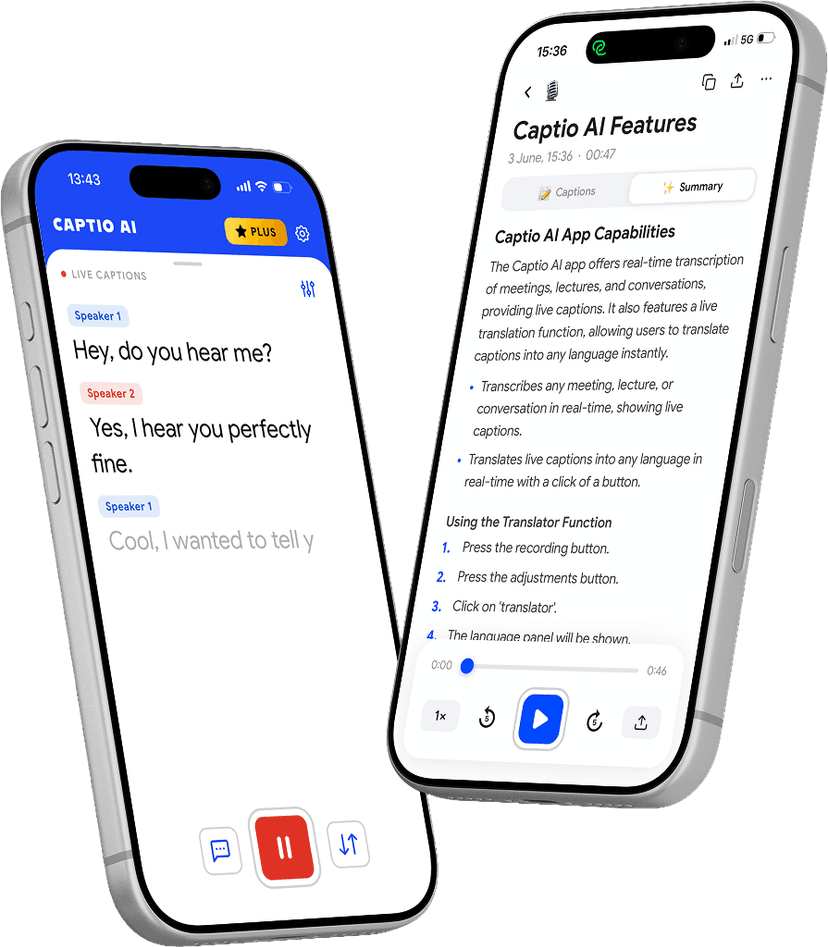
Everything you need to follow Swahili meetings
Four tools built for deaf and hard of hearing Swahili speakers.
Follow the meeting as it happens
- Captions appear word by word while speakers are still talking
- Works in conference rooms, boardrooms, and open offices
- Handles fast-paced discussion and multiple speakers
- No setup — place the phone on the table and start
International and multilingual meetings
- Each person speaks their own language
- You read in yours, in real time
- 60+ languages, no mode switching
- Handles mid-sentence language changes
Full transcript after the meeting
- Upload the recording and get a complete written transcript
- Organised by speaker — know exactly who said what
- Review decisions and action items at your own pace
- Searchable, copyable, shareable
Decisions and action items, extracted
- Key points and decisions pulled from any transcript
- Action items surfaced automatically
- Organised into sections — not one continuous block
- Works on any Captio AI meeting transcript
Download for free
Every situation covered
Designed for the real moments that matter — not just quiet controlled environments.
Daily team meetings and stand-ups in East African offices where updates come in Swahili or English. Captio AI captions each speaker so you follow every item.
Zoom or Google Meet calls with colleagues locally or internationally. Put the call on speaker and read captions in real time.
Tathmini sessions and one-on-one meetings with a supervisor. Important conversations in East African professional environments where every instruction matters. Captio AI transcribes everything.
Company-wide meetings where management addresses all staff. Captio AI captions every word from any seat.
Meetings that mix Swahili and English — standard in Kenyan and Tanzanian professional offices. Live Translator also covers fully cross-language calls in real time.
Tea break conversations, desk-side questions, corridor catch-ups. The informal moments in East African workplaces where working relationships are built. Captio AI covers those too.
Most accurate and fastest models
word accuracy
independent benchmark, 2025
real-time captions
first word appears as you speak
Download for free
Built for the speed of a real meeting
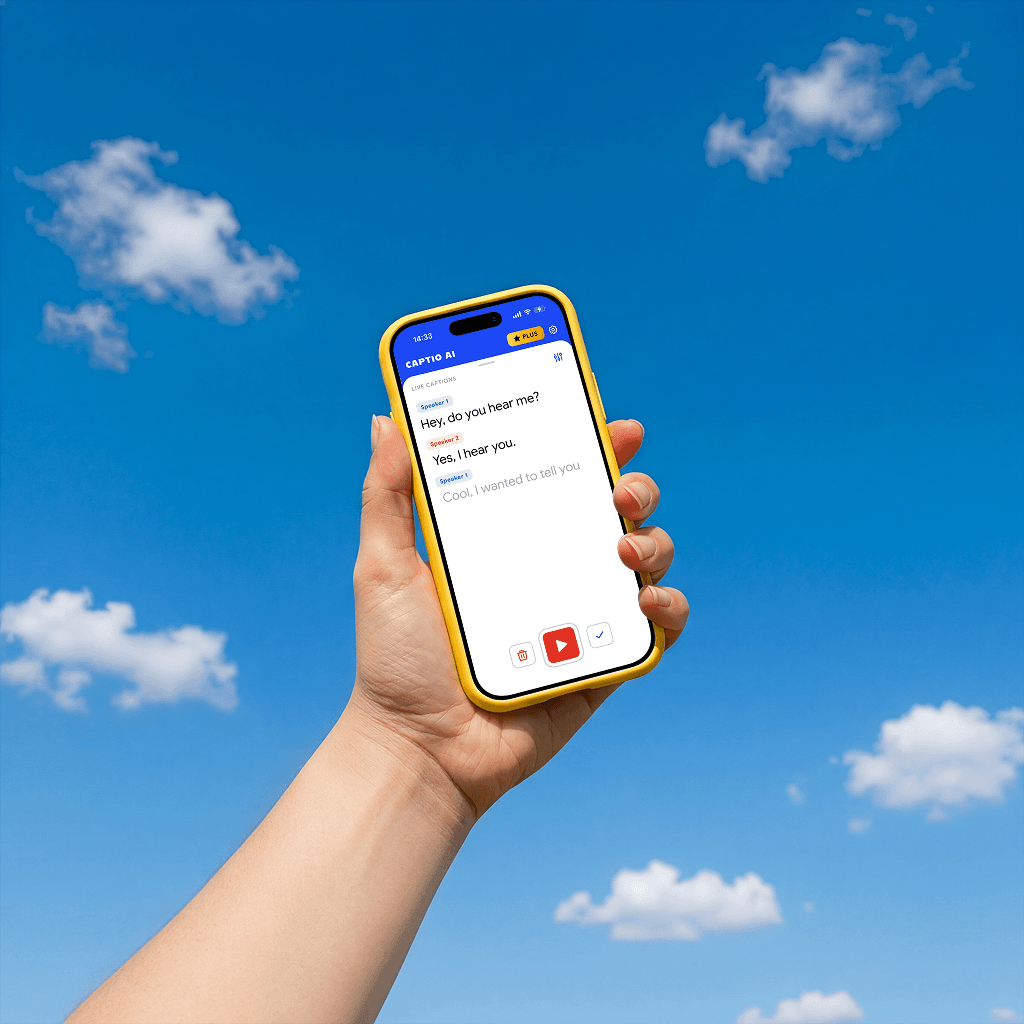
Captions while they are still speaking
Words appear on screen as each person talks — not after they finish. You read what someone is saying at the same moment everyone else hears it.
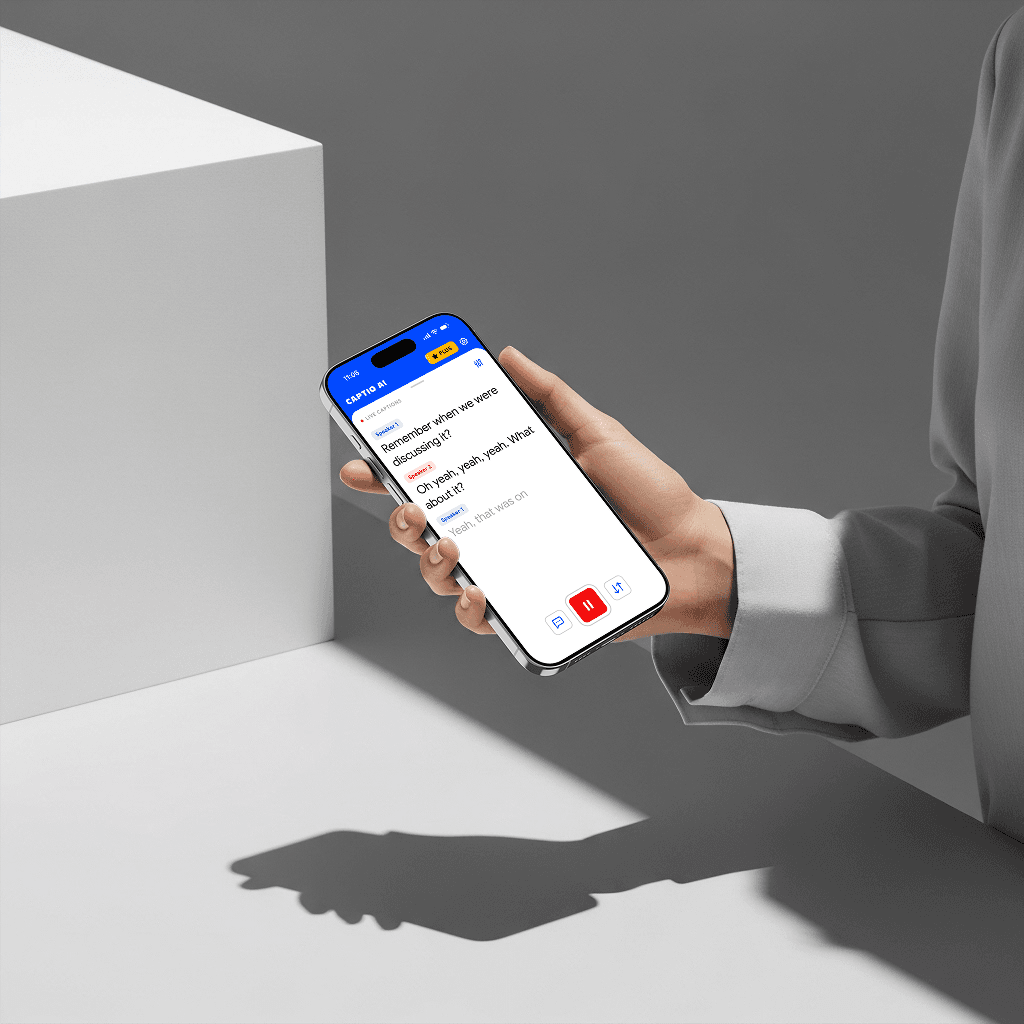
Works in any meeting format
Conference rooms, open-plan offices, video calls, all-hands. Place the phone on the table or hold it — Captio AI handles the rest.
Handles fast speech and crosstalk
Captio AI is designed for real meetings, not controlled dictation. It follows whoever is speaking loudest at any moment, keeping up with the natural pace of discussion.
No setup, no explaining
Open the app and place the phone. No pairing, no telling colleagues what you are doing, no requesting anything from the meeting organiser.
Review everything after
Record the meeting and upload it to Audio Transcription for a full written record. Use AI Summary to extract decisions and action items so nothing from the meeting gets lost.
60+ languages
For international teams, multilingual meetings, or colleagues who switch between languages mid-discussion. No setup required — Captio AI detects and captions in real time.
Why Swahili is hard to understand
Coastal dialect variation
- Coastal and inland Swahili present different phonological systems in the same meeting
- Kiamu and Kimvita coastal dialects differ markedly from the inland Nairobi standard. A colleague from Lamu sounds genuinely different from one trained in Nairobi. In a national company meeting, a deaf participant faces multiple phonological systems at once.
Swahili–English code-switching
- East African meetings switch languages mid-sentence without any warning signal
- East African professional meetings frequently switch mid-sentence between Swahili and English — sometimes mid-clause. For a deaf participant, tracking which language is active requires two separate lip-reading and context-processing systems simultaneously.
Noun class prefix reduction
- Swahili noun class prefixes that carry grammar disappear in fast meeting speech
- Swahili noun class prefixes (ki-, vi-, m-, wa-, u-) carry grammatical information. In fast meeting speech, these short prefixes reduce to near-inaudible consonant gestures — a deaf person using residual hearing loses the grammatical scaffold of the sentence.
Sheng overlay in urban meetings
- Nairobi office speech layers Sheng slang over standard Swahili mid-meeting
- In Nairobi office environments, urban Sheng slang infiltrates business conversation. Technical vocabulary can arrive in Sheng rather than standard Swahili, meaning the word a deaf participant expects in formal Swahili may appear in a completely different form.
Verb extension chains
- Swahili verb extension suffix chains articulate as a single fast blur
- Swahili builds complex meaning through verb extensions — causative, passive, reciprocal — appended as suffixes. In fast professional speech, multi-morpheme verb forms articulate as a single fast spoken unit with no visible boundary between the root and its extensions.
Download for free
Millions of deaf East Africans navigate professional life with almost no workplace support.
Kenya's 2019 National Population Census counted 153,381 deaf people aged over five years, with 63% living in rural areas. Hearing impairment rates are rising: one in ten Kenyans is now estimated to have some form of hearing loss, compared to five to eight per hundred two decades ago, and projections suggest that by 2030 nearly 3.6 million Kenyans will have significant hearing loss. Tanzania faces a comparable burden. In a region where formal employment is already limited, deaf and hard of hearing East Africans face compounded barriers — and the professional meeting, now increasingly conducted via phone or laptop, is where those barriers are most acute.
Neither Kenya Sign Language (KSL) nor Tanzania Sign Language (TSL) has a professional interpreter provision standard for corporate or NGO settings. The two sign languages are significantly different, meaning that an interpreter trained for Kenyan deaf employees cannot directly serve Tanzanian colleagues. Deaf employees navigating the East African professional world encounter not just the absence of workplace communication support, but fragmented community resources that rarely align with formal employment needs.
The WHO African region carries some of the highest rates of unaddressed hearing loss globally, with the majority of people having no access to hearing rehabilitation, audiological services, or any form of hearing device. Sub-Saharan Africa's noise-induced hearing loss burden — particularly in industrial and construction workplaces — adds to the natural hearing loss population. The result is that a large and growing share of East Africa's workforce is navigating meeting-heavy professional environments without any communication access tool. Captio AI captions Swahili in real time — standard Nairobi Swahili, coastal varieties, and the Swahili-English code-switching of a Nairobi corporate office — so that the weekly team meeting is something a deaf employee can fully participate in.
Download for free
What you hear stays with you.
Gone the moment it ends
Captio AI processes your audio in real time and discards it immediately. Nothing is recorded. Nothing is kept.
Not a product
Your conversations are not something Captio AI sells, shares, or monetizes — to anyone, for any reason.
Not used to train anything
What you say in a doctor's appointment or a job interview never ends up in a training dataset. Not ours. Not anyone else's.

Private by default
Captio AI supports 60+ languages
Download for free
Frequently asked questions
Follow every word in Swahili.
Captio AI is free to start
Download for free