

Afrikaans live captions and productivity tool for meetings
For deaf and hard of hearing people.
Download for free


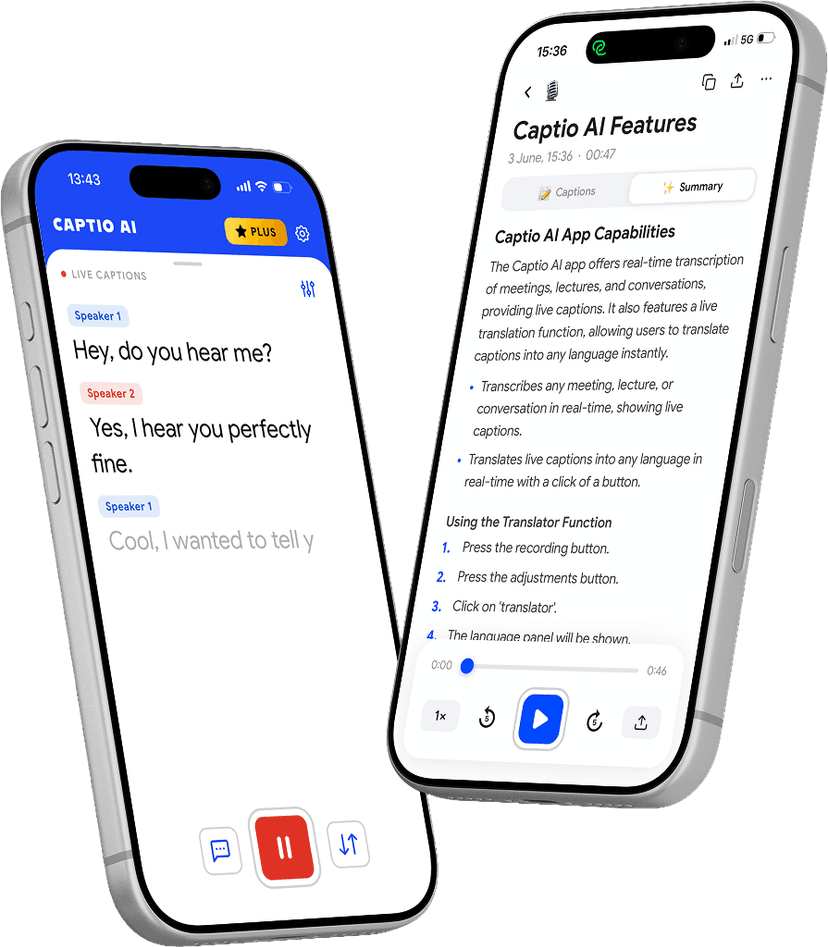
Everything you need to follow Afrikaans meetings
Four tools built for deaf and hard of hearing Afrikaans speakers.
Follow the meeting as it happens
- Captions appear word by word while speakers are still talking
- Works in conference rooms, boardrooms, and open offices
- Handles fast-paced discussion and multiple speakers
- No setup — place the phone on the table and start
International and multilingual meetings
- Each person speaks their own language
- You read in yours, in real time
- 60+ languages, no mode switching
- Handles mid-sentence language changes
Full transcript after the meeting
- Upload the recording and get a complete written transcript
- Organised by speaker — know exactly who said what
- Review decisions and action items at your own pace
- Searchable, copyable, shareable
Decisions and action items, extracted
- Key points and decisions pulled from any transcript
- Action items surfaced automatically
- Organised into sections — not one continuous block
- Works on any Captio AI meeting transcript
Download for free
Every situation covered
Designed for the real moments that matter — not just quiet controlled environments.
Daily spanvergaderings and stand-ups in South African offices where updates come in Afrikaans or English. Captio AI captions each speaker so you follow every item.
Teams or Zoom calls with colleagues across South Africa or internationally. Put the call on speaker and read captions in real time.
Prestasiebeoordelings and one-on-one sessions with a bestuurder. Important conversations in South African corporate culture where every word matters. Captio AI transcribes everything.
Company-wide personeeladres where management speaks to all staff. Captio AI captions every word from any seat.
Meetings that mix Afrikaans and English — standard across South African offices. Live Translator follows any switch in real time.
Koffiebreek conversations, desk-side questions, corridor catch-ups. The informal moments in South African workplaces where working relationships are built. Captio AI covers those too.
Most accurate and fastest models
word accuracy
independent benchmark, 2025
real-time captions
first word appears as you speak
Download for free
Built for the speed of a real meeting
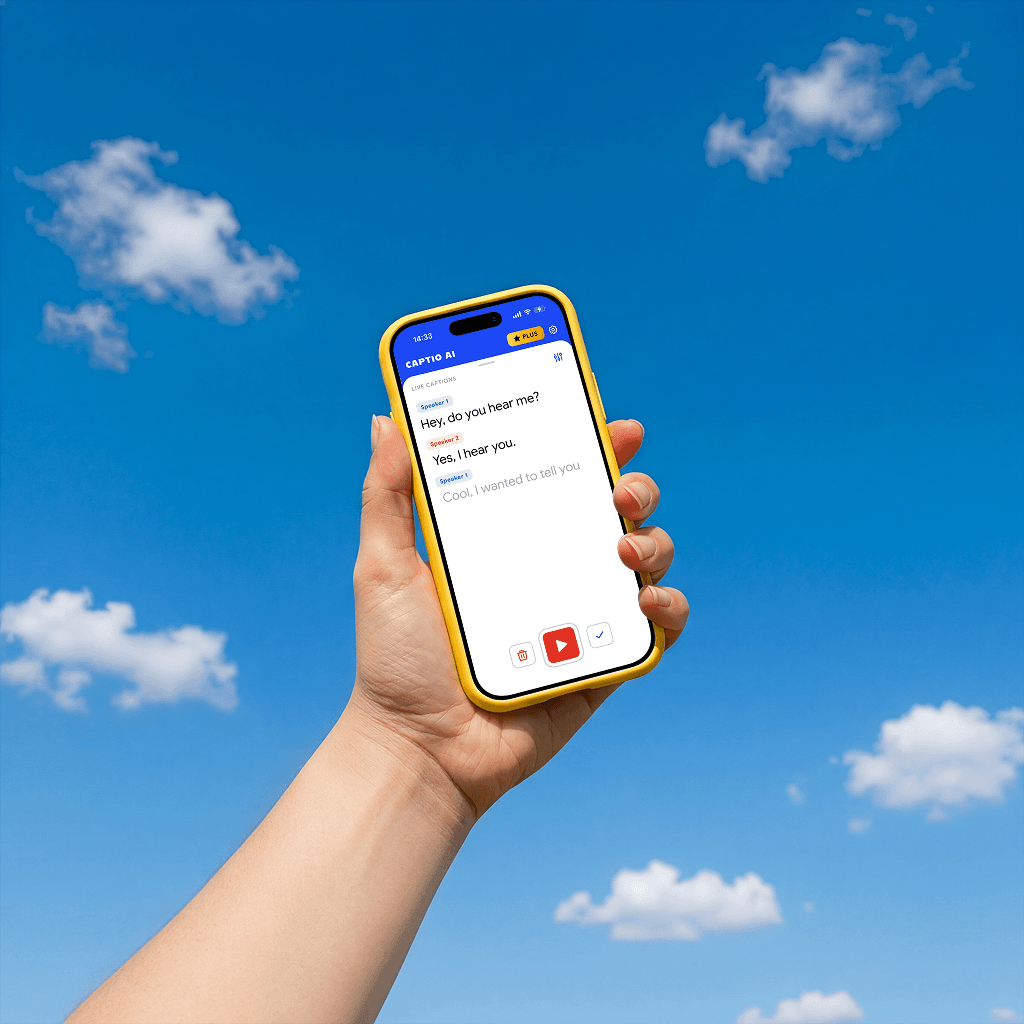
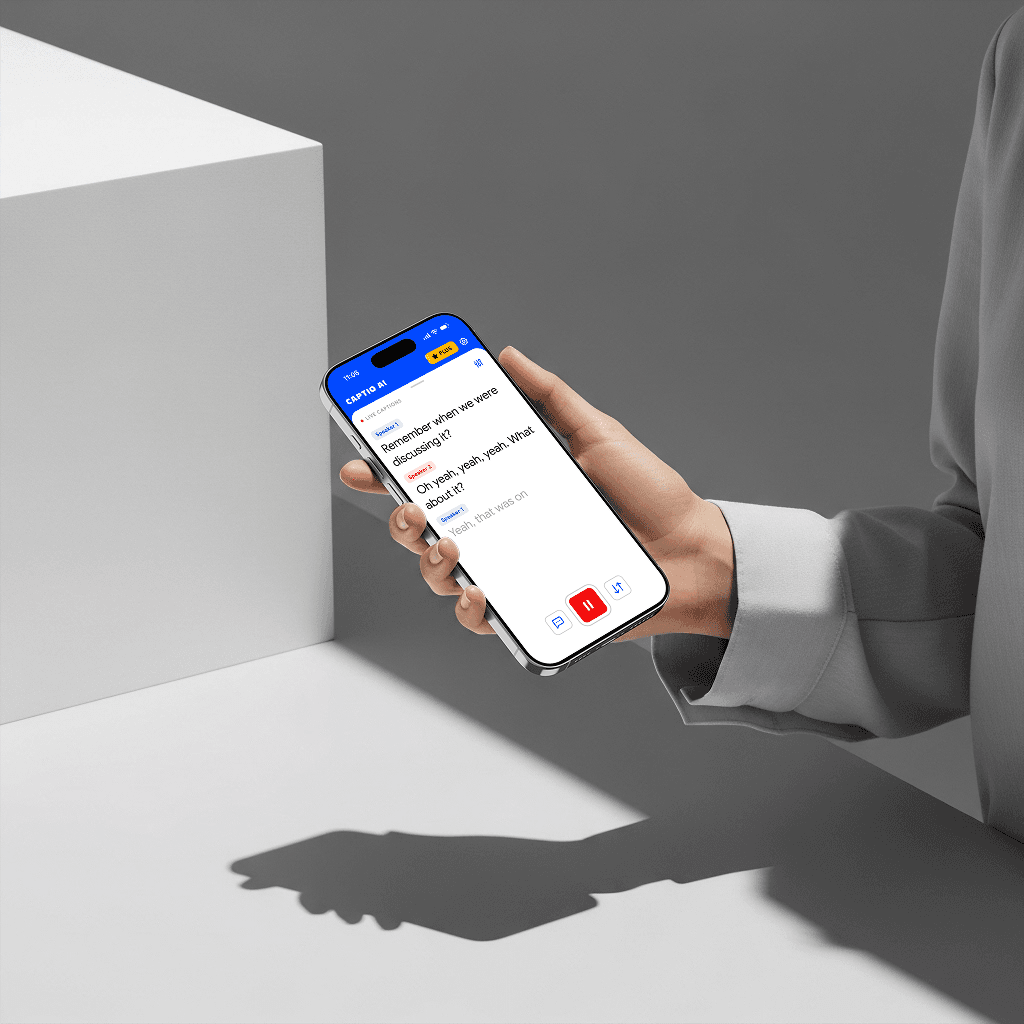
Captions while they are still speaking
Words appear on screen as each person talks — not after they finish. You read what someone is saying at the same moment everyone else hears it.
Works in any meeting format
Conference rooms, open-plan offices, video calls, all-hands. Place the phone on the table or hold it — Captio AI handles the rest.
Handles fast speech and crosstalk
Captio AI is designed for real meetings, not controlled dictation. It follows whoever is speaking loudest at any moment, keeping up with the natural pace of discussion.
No setup, no explaining
Open the app and place the phone. No pairing, no telling colleagues what you are doing, no requesting anything from the meeting organiser.
Review everything after
Record the meeting and upload it to Audio Transcription for a full written record. Use AI Summary to extract decisions and action items so nothing from the meeting gets lost.
60+ languages
For international teams, multilingual meetings, or colleagues who switch between languages mid-discussion. No setup required — Captio AI detects and captions in real time.
Why Afrikaans is hard to understand
Dutch-heritage gutturals
- Afrikaans inherits Dutch-style uvular and velar fricatives — /x/ and /ɣ/ — produced at the back of the throat with no visible lip movement
- Like its Dutch ancestor, Afrikaans has velar and uvular fricatives for the letter 'g' (as in 'goed', 'groot', 'gaan') — sounds produced at the back of the mouth with the lips open and still. In an Afrikaans meeting, these fricatives appear in some of the most common vocabulary — greetings, verbs, adjectives — and are entirely invisible to a deaf person reading lips, leaving only the surrounding vowels as visual cues.
17 vowel phonemes
- Afrikaans has 17 vowel phonemes including diphthongs that reduce at meeting pace into visually similar lip positions
- Afrikaans's 17 vowel phonemes include both monophthongs and a set of diphthongs whose visual distinctiveness depends on careful pronunciation. At meeting pace, these diphthongs glide quickly through two positions that merge into a single mid-position on the lips. A deaf or hard of hearing person lip-reading an Afrikaans meeting at natural speed misses the phonemic distinctions between many vowel sounds.
Cape vs Standard Afrikaans
- Cape Afrikaans (Kaapse Afrikaans) differs in vowel quality and prosody from Standard Afrikaans — creating a visual mismatch in Cape Town meetings
- Cape Afrikaans retains different vowel qualities and a prosodic pattern influenced by the Cape's linguistic diversity. Standard Afrikaans as taught and written differs from the Cape variety used in informal speech. In a Cape Town office meeting, a deaf person who has learned to lip-read Standard Afrikaans encounters the vowel shapes of Cape Afrikaans from colleagues — a systematic mismatch between expected and observed mouth positions.
Afrikaans–English code-switching
- South African workplaces mix Afrikaans and English mid-sentence — creating two phonological systems in a single meeting
- South African professional environments are multilingual, and Afrikaans–English code-switching is common in meetings where Afrikaans-speaking employees work alongside English-speaking colleagues. In a corporate meeting, a sentence may begin in Afrikaans and end in English without transition. A deaf person lip-reading Afrikaans encounters English phonology mid-sentence and must recalibrate for a completely different consonant and vowel system.
Multilingual backdrop
- South Africa's 11 official languages mean corporate meetings can include Zulu, Xhosa, or Sotho-influenced accents within Afrikaans or English speech
- South Africa's linguistic diversity means that meetings in mixed teams include Afrikaans speakers whose speech carries influence from Zulu, Xhosa, Sotho, or other Bantu languages. Phonological features borrowed from these languages — including specific vowel qualities and consonant patterns — appear in Afrikaans-accented speech in ways that a deaf lip-reader trained on Standard Afrikaans will not recognise.
Download for free
Hearing loss and workplace exclusion in South Africa
Approximately 3.4 million South Africans — around 6% of the population — experience hearing loss to some degree, according to the South African National Council for the Deaf. Among these, an estimated 124,000 people experience total hearing loss, while approximately 600,000 Deaf South Africans use South African Sign Language (SASL) as their primary language. A 2020 critical analysis in the South African Journal of Communication Disorders found that occupational hearing loss legislation under COIDA and ODMWA remains inadequate, with many workers in high-noise industries — mining, manufacturing, agriculture — exposed to hearing-damaging noise without adequate protection.
Research published in the SA Journal of Human Resource Management (2024) on the job resources experienced by employees with hearing impairment in South Africa found that this field is critically under-studied, with the study described as the first of its kind in the country. Unemployment is one of the major challenges affecting the majority of persons with disabilities in South Africa, with 7.5% of the population (4.5 million people) living with a disability. Hearing disabilities represent 3.6% of all disability types. The structural barriers in meeting-heavy professional roles — where verbal communication is central — are among the most consistently cited employment barriers.
South Africa's financial, technology, and services sectors — concentrated in Cape Town and Johannesburg — operate in meeting-intensive professional cultures that are linguistically complex: Afrikaans, English, and other official languages are present in the same meeting. For a deaf professional in a Cape Town tech company or a Johannesburg bank, the standard meeting combines Afrikaans phonology (uvular fricatives, 17 vowel phonemes, Cape dialect variation) with Afrikaans–English code-switching that no standard captioning tool was designed to handle simultaneously.
Download for free
What you hear stays with you.
Gone the moment it ends
Captio AI processes your audio in real time and discards it immediately. Nothing is recorded. Nothing is kept.
Not a product
Your conversations are not something Captio AI sells, shares, or monetizes — to anyone, for any reason.
Not used to train anything
What you say in a doctor's appointment or a job interview never ends up in a training dataset. Not ours. Not anyone else's.

Private by default
Captio AI supports 60+ languages
Download for free
Frequently asked questions
Follow every word in Afrikaans.
Captio AI is free to start
Download for free