

Welsh live captions and productivity tool for communicating with deaf & HoH
For deaf and hard of hearing people.
Download for free


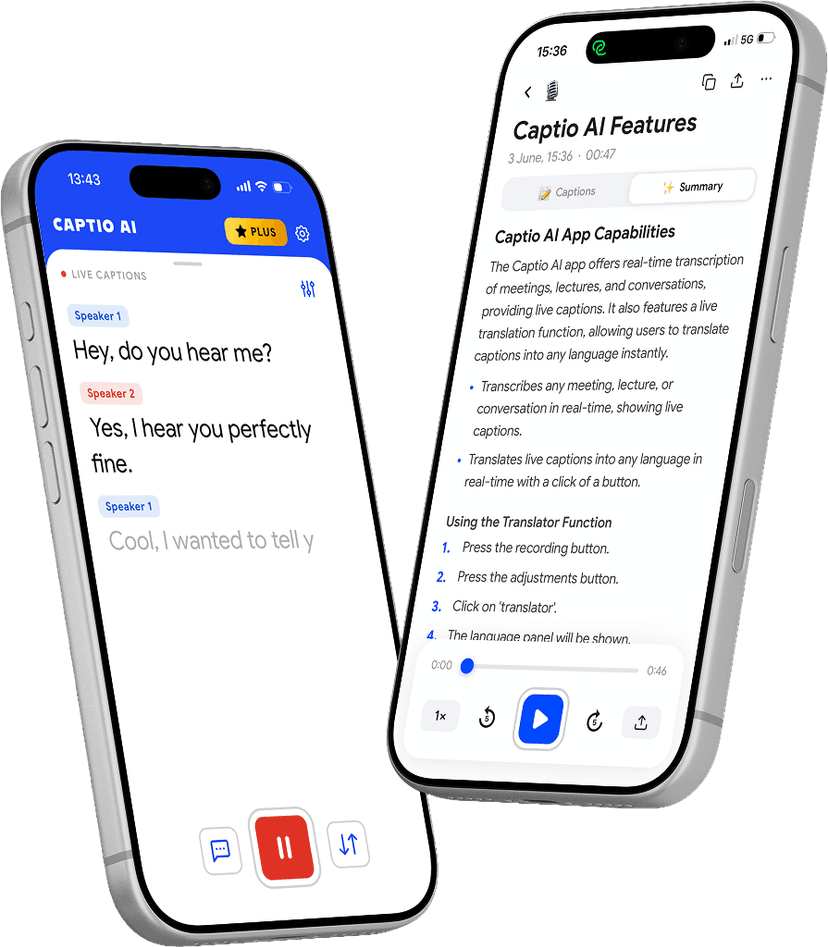
Everything you need to follow Welsh communicating with deaf & HoH
Four tools built for deaf and hard of hearing Welsh speakers.
You speak. They read.
- Your words appear on their screen word by word
- No sign language required from you
- Works at home, at work, anywhere
- Any accent, any pace
When language is also a barrier
- You speak your language, they read in theirs
- Translates in real time as you speak
- 60+ languages, no setup
- Handles mid-sentence switches
Save the conversation for them
- Record and transcribe any exchange
- They can review everything at their own pace
- Organised by speaker
- Any length, any format
Make sure nothing important was missed
- Key points extracted from any transcript
- Useful after appointments, meetings, or important conversations
- Organised into clear sections
- Works on any saved recording
Download for free
Every situation covered
Designed for the real moments that matter — not just quiet controlled environments.
A Welsh-speaking family dinner in Gwynedd, Cardiff, or the Valleys where grandparents speak strong North or South Welsh, parents mix Welsh and English, and children switch freely. Captio AI captions every voice at the table.
A Welsh household where conversations happen spontaneously — morning exchanges in Welsh, remarks in English, and quick switches between the two. Captio AI keeps a deaf or hard of hearing person in those moments.
At home with a hearing partner whose family speaks Northern Welsh — a variety with different vowels and prosody from South Welsh. Captio AI captions their speech correctly so home life does not require extra effort.
Spontaneous exchanges at the local shop, pharmacy, or post office in a Welsh-speaking community. Captio AI captions what the person at the counter is saying in real time — in Welsh, in English, or in both.
A community Eisteddfod event, local gathering, or neighbourhood celebration in a Welsh-speaking town, where conversations move fast between Welsh and English. Captio AI captions the conversation so a deaf or hard of hearing person is part of it.
Meeting a partner's Welsh-speaking family for the first time, or being introduced to neighbours in a Welsh-medium community. Captio AI captures the first conversation in real time.
Most accurate and fastest models
word accuracy
independent benchmark, 2025
real-time captions
first word appears as you speak
Download for free
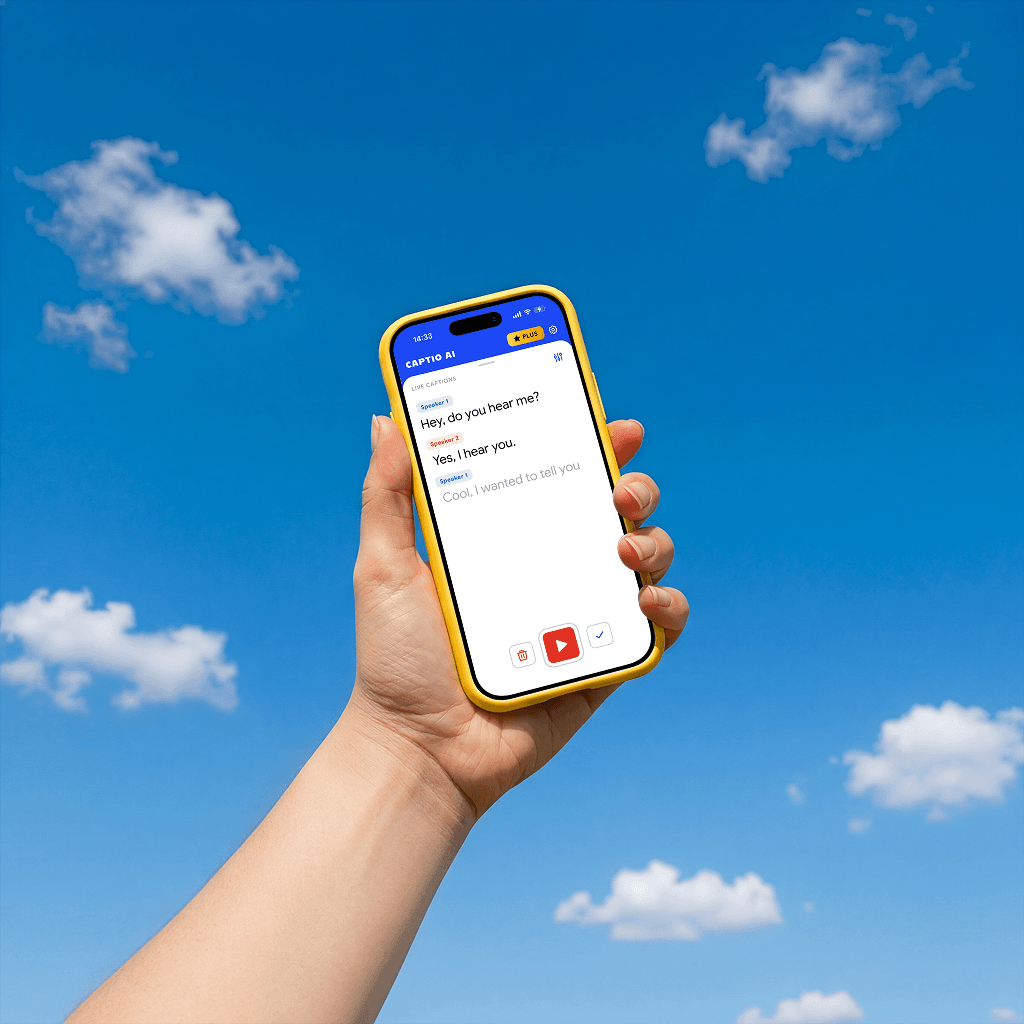
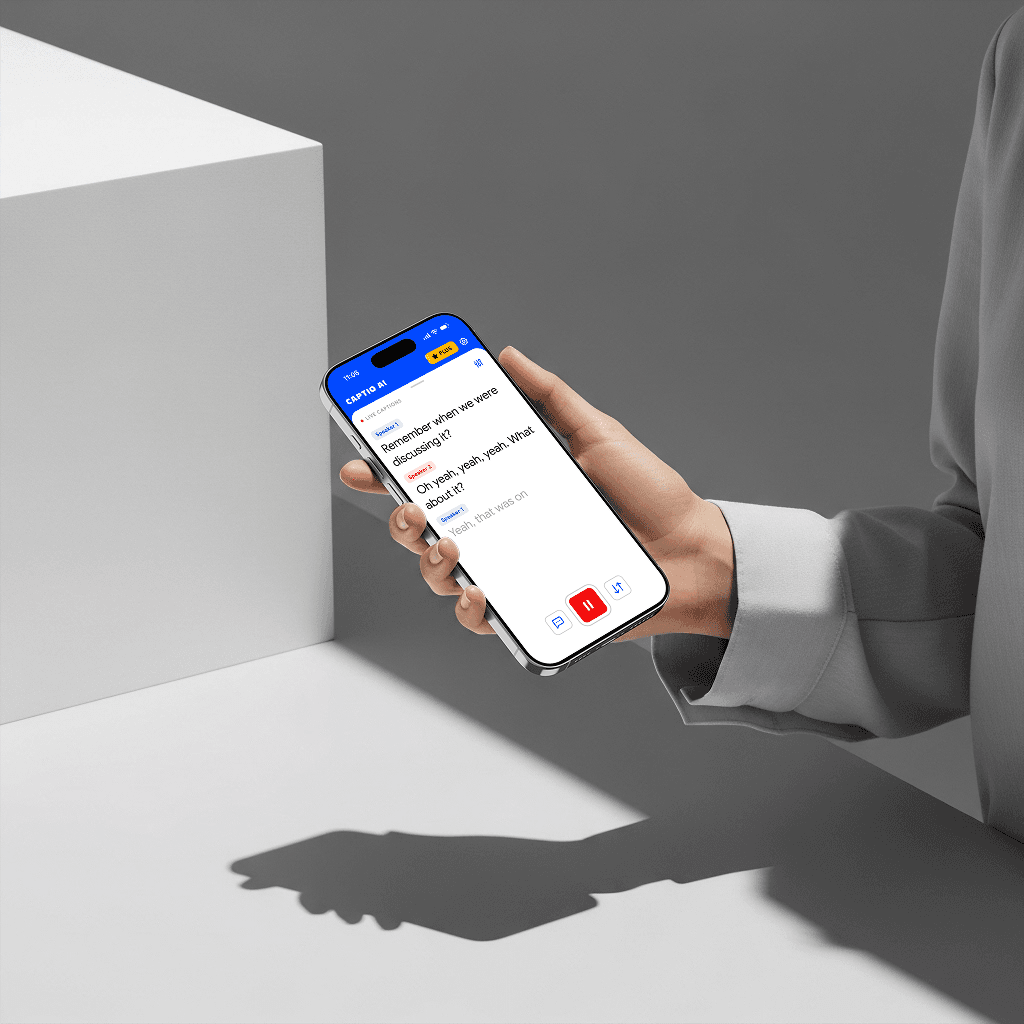
You talk. They follow. No adjustment needed.
You speak naturally
No slowing down, no special phrasing, no training required. Captio AI handles everything — you just talk the way you always do.
They read as you speak
Your words appear on their screen word by word while you are still talking. Not a summary after — the full sentence, in real time.
Works wherever you both are
Living rooms, offices, restaurants, social gatherings. No venue setup, no special conditions. Captio AI works anywhere you have a conversation.
No sign language from either side
You do not need to learn anything new. Neither do they. Captio AI bridges the gap without requiring any change to how either of you communicates.
Works with how you actually speak
Fast, accented, casual. Captio AI handles real speech — not just slow, clear dictation. You do not need to perform clarity for it to work.
Private by default
Your conversations are never recorded, stored, or shared. Audio is processed in real time and discarded immediately — nothing is kept.
Why Welsh is hard to understand
Consonant mutations
- Three types of initial mutation change the first consonant of a word — the lip shape shifts completely
- Welsh has three classes of initial consonant mutation — soft, nasal, and aspirate — that change the first consonant of a word based on grammatical context. 'Pen' (head) becomes 'ben', 'mhen', or 'phen' in different constructions. A lip reader sees an entirely different consonant position for words that are grammatically forms of the same item — the mutation is invisible from grammar but changes the entire visual lip profile.
Voiceless lateral /ɬ/
- Welsh 'll' is produced with lateral airflow and looks identical to /l/ from outside
- Welsh 'll' is the voiceless lateral fricative [ɬ] — produced by placing the tongue tip at the alveolar ridge and releasing air laterally, with no lip movement. From outside the mouth it looks identical to the voiced lateral /l/. Two words distinguished only by voiced vs voiceless lateral articulation appear the same to a lip reader.
Voiceless nasals and resonants
- Welsh has voiceless versions of nasal consonants — sounds rare in European languages, invisible at the lips
- Welsh has voiceless versions of nasal consonants (/m̥/, /n̥/, /ŋ̊/) and a voiceless lateral resonant — sounds rare in European languages that look visually identical to their voiced counterparts. A lip reader encounters additional homophone pairs created by a voicing distinction they cannot see.
North–South dialect split
- Northern Welsh and Southern Welsh differ in vowel length, consonant realizations, and prosody
- Northern Welsh (Cymraeg y Gogledd) and Southern Welsh (Cymraeg y De) differ significantly in vowel inventory, consonant realizations, and prosody. The vowel /ɨ/ in the north has no counterpart in the south. A deaf person calibrated to one variety encounters a different phonological profile from speakers of the other.
Welsh–English switching
- Wenglish — Welsh-English code-switching — creates an unpredictable phonological stream in South Wales
- In South Wales particularly, speakers shift fluidly between Welsh and English, often mid-sentence. A deaf or hard of hearing person faces an unpredictable alternation of two phonological systems — Welsh consonant mutations and voiceless consonants alongside English phonology — in the course of a single family conversation.
Download for free
Wales has 575,000–610,000 deaf and hard of hearing people, no dedicated deaf mental health service, and a proposed BSL Bill still awaiting legislative action.
An estimated 575,500 to 610,000 people in Wales live with hearing loss or tinnitus, according to RNID Cymru data and Welsh Government estimates. Of these, approximately 5,600 to 7,300 people use British Sign Language in Wales, based on projections derived from Scottish Census and England GP Patient Survey figures. Despite Wales having its own devolved government with an active disability policy agenda, Wales remains the only country in the United Kingdom without a dedicated deaf mental health service.
A January 2025 Institute of Welsh Affairs report calling for a BSL (Wales) Bill documented persistent barriers to service access for deaf and hard of hearing people in Wales: ineffective communication systems in the NHS, a lack of flexible booking arrangements, and insufficient deaf awareness training for health professionals. A 2024 peer-reviewed study (PMC11358617) on deaf people's experiences in Welsh health services found that health providers still routinely phoned deaf patients despite knowing they were deaf — a pattern of systemic inaccessibility that extends beyond the clinic into daily life.
The linguistic complexity of Wales — where 29.2% of the population speaks Welsh and everyday speech shifts between Welsh and English — adds a specific dimension to communication access for deaf people. A deaf or hard of hearing person in a Welsh-speaking community may encounter Welsh consonant mutations, voiceless lateral fricatives, and North–South dialect differences alongside English phonology in the course of a single family meal.
Download for free
What you hear stays with you.
Gone the moment it ends
Captio AI processes your audio in real time and discards it immediately. Nothing is recorded. Nothing is kept.
Not a product
Your conversations are not something Captio AI sells, shares, or monetizes — to anyone, for any reason.
Not used to train anything
What you say in a doctor's appointment or a job interview never ends up in a training dataset. Not ours. Not anyone else's.

Private by default
Captio AI supports 60+ languages
Download for free
Frequently asked questions
Make every conversation work — for both sides in Welsh.
Captio AI is free to start
Download for free